Scott's Blog of Doom!
  • Daily Updates
  • Scott's Rants
  • Headlines
  • Daily Updates
  • Scott's Rants
  • Headlines
  • Observer Flashbacks
  • Mailbag
  • Archives
  1. Archives
  2. 5-Star Reviews

5-Star Book Reviews — page 2

Rants

5-Star BOOK Reviews: Jumbo Tsuruta’s Books, Part XIII (FINAL)

By Alex Podgorski on 16th March 2026

This is the final part of my Jumbo Tsuruta books coverage which will cover remaining parts of Tsuruta’s 1999 book Jumbo Tsuruta’s Natural Power Strengthening Bible. I’ve been going over it piecemeal since the start with direct quotes featuring Tsuruta’s summaries of various wrestlers. I think the book also has lessons on how to execute certain wrestling moves, which I think might be useful. I won’t name each one because if I did we’d be here forever.

You can read part 1 here, part 2 here, part 3 here, part 4 here, part 5 here, part 6 here, and part 7 here, part 8 here, part 9 here, part 10 here, and part 11 here, and part 12 here.

Jumbo Tsuruta Books

Continue reading
Rants

5-Star BOOK Reviews: Jumbo Tsuruta’s Books, Part XII

By Alex Podgorski on 13th March 2026

This is the penultimate entry in my coverage of Jumbo Tsuruta’s books. Here we’ll look at Tsuruta’s final years in wrestling, his transition to academia, his retirement, and his passing. We’ll also conclude two of the books I included in this coverage. With Tsuruta moving away from the ring we’ll get the chance to peer more into Tsuruta’s mind. ETERNAL and SECOND GONG have a few notes on Tsuruta’s theories and I think it’ll be interesting to see whether these high-concept philosophies can be applied to the world of professional wrestling.

You can read part 1 here, part 2 here, part 3 here, part 4 here, part 5 here, part 6 here, and part 7 here, part 8 here, part 9 here, part 10 here, and part 11 here.

Jumbo Tsuruta Books

Continue reading
Rants

5-Star BOOK Reviews: Jumbo Tsuruta’s Books, Part XI

By Alex Podgorski on 11th March 2026

Now we enter more familiar territory as Jumbo Tsuruta pivots to facing Mitsuharu Misawa and beginning a years-long intergenerational feud. Section will cover the second half of 1990 and parts of 1991 with lots of attention given to big matches along the way. There will be some overlap here with my Mitsuharu Misawa books coverage, but this time we’ll look at these same events from Jumbo’s perspective. We’re also going to be treated to a few interesting anecdotes and nuggets of wisdom from Tsuruta about how he perceives matches and, after so many chapters devoted to outside criticism, some answers to those same critiques from the man himself.

You can read part 1 here, part 2 here, part 3 here, part 4 here, part 5 here, part 6 here, and part 7 here, part 8 here, part 9 here and part 10 here.

Jumbo Tsuruta Books

Continue reading
Rants

5-Star BOOK Reviews: Jumbo Tsuruta’s Books, Part X

By Alex Podgorski on 10th March 2026

This next section in Jumbo Tsuruta’s books will cover an important and change-filled period. We will go from early 1988 to spring 1990, during which many important things happen. These include: Bruiser Brody’s return, two title unification events, a brief note on how UWF influenced AJPW’s matches, and of course, Tsuruta versus Tenryu and the fallout from the latter’s shocking departure. We’ll see how Tsuruta dealt with so many different factors, but there will also be plenty of focus on Baba and Tenryu as critical figures in Tsuruta’s career.

You can read part 1 here, part 2 here, part 3 here, part 4 here, part 5 here, part 6 here, and part 7 here, part 8 here and part 9 here.

Jumbo Tsuruta Books

Continue reading
Rants

5-Star BOOK Reviews: Jumbo Tsuruta’s Books, Part IX

By Alex Podgorski on 4th March 2026

Last time we look at Jumbo Tsuruta learning from the legendary Lou Thesz and making his transformation into a main-event talent. This next section will look at how Tsuruta channels those changes into major title victory. Winning a big title belt proves fruitful and all, but more importantly Tsuruta finds him dealing with not one but two people challenging him like never before, and the result is Tsuruta finally awakening as more of a complete wrestler.

You can read part 1 here, part 2 here, part 3 here, part 4 here, part 5 here, part 6 here, and part 7 here, and part 8 here.

Jumbo Tsuruta Books

Continue reading
Rants

5-Star BOOK Reviews: Jumbo Tsuruta’s Books, Part VIII

By Alex Podgorski on 2nd March 2026

Last time we looked at Jumbo Tsuruta’s career he was dealing with a torrent of criticism from all sides. This next section covers how he and the powers around him dealt with that, along with some more context to the power plays that he got caught in and the specific lessons he got from one of the greatest wrestlers of all time.

You can read part 1 here, part 2 here, part 3 here, part 4 here, part 5 here, part 6 here, and part 7 here.

Jumbo Tsuruta Books

Continue reading
Rants

5-Star BOOK Reviews: Jumbo Tsuruta’s Books, Part VII

By Alex Podgorski on 3rd February 2026

At the end of the last section we looked at some initial criticism of Jumbo Tsuruta coming from within. Kim Duk was the first to vocally criticize Tsuruta’s career trajectory, using terms like “fabricated, false star” and “running on pre-laid tracks”. At the time those were simply the grumblings of one man. If anyone besides Duk had those same thought they didn’t share them out loud. But Tsuruta’s response to these claims (or lack thereof) would lead to those whispers getting louder. Eventually, Tsuruta would have no choice but to do something, which leads us into his career in the 1980s.

You can read part 1 here, part 2 here, part 3 here, part 4 here, part 5 here, and part 6 here.

Jumbo Tsuruta Books

Continue reading
Rants

5-Star BOOK Reviews: Jumbo Tsuruta’s Books, Part VI

By Alex Podgorski on 27th January 2026

This next section in Jumbo Tsuruta’s books covers another short period of about two years, from 1976 to 1978. There are a few notable milestones during this period, including one dream match that inspires two future legends to become wrestlers and a surprise encounter that is considered one of the earliest examples of MMA in recorded wrestling history. Then we will conclude with an unexpected anecdote about Tsuruta’s boss Giant Baba which, all things considered, actually explains a lot of his booking decisions over the decades.

You can read part 1 here, part 2 here, part 3 here, part 4 here, and part 5 here.
Jumbo Tsuruta Books

After becoming the NWA United National Champion in All Japan, Tsuruta starts planning for his future which seems to be in lockstep with Baba and AJPW. After years of construction and an estimated 60,000,000 yen, AJPW completes its new training camp and dojo in the Setagaya Ward of Tokyo. Tsuruta is named the owner on paper but Baba advises that he and AJPW will pay the loan as rent and once that is paid off it becomes Tsuruta’s in every way. Despite being only 25 years old Tsuruta serves as head honcho in this facility yet he doesn’t lord over anyone. His three juniors – Onita, Fuchi and Sonoda, the “Three Crows” or “The Three Idiots of Kyushu” – recall Tsuruta being friendly with his them. In ETERNAL Osano elaborates on this by describing Tsuruta’s activities outside the ring. When he wasn’t training or attending sponsor events Tsuruta played guitar semi-professionally and even wrote some songs. However his singing skills left a bit to be desired. Still, with his Gibson guitar in hand, his short hair grown out, and dressed in jeans and western-style clothes, Tsuruta changed the image of a professional wrestler…and in the process attracted LOTS of female fans. Osano notes that Tsuruta was arguably the first “idol wrestler” with fan clubs sprouting across the country. On several occasions Tsuruta brought his juniors into this side hustle with Onita singing (since he actually had the voice for it), Haru Sonoda doing comedy impressions, and Fuchi serving as host.

Shifting back to wrestling, Tsuruta’s next big moment takes place on August 25, 1977. On this night Tsuruta faces “Masked Noble” Mil Mascaras in a dream match that was heavily promoted towards the two groups of fans each man cultivated: women for Tsuruta and kids for Mascaras (APOD: as I noted before, both Kenta Kobashi and Toshiaki Kawada wrote about being inspired by this very match in their respective autobiographies). This match was also important for Mascaras since he was trying to capitalize on a sudden career resurgence. Having wrestled in Japan for six years, Mascaras became entrenched in the country’s wrestling scene but with little change fans grew bored with him. Then one day, AJPW director Shin Umegaki managed to get a copy of British pop band Jigsaw’s Sky High and used it as Mascaras’ entrance theme. That small change turned into a huge turnaround for Mascaras, leading to more people being swept up in his presentation. As for Tsuruta, Osano credits him with actually introducing entrance themes to puro in Japan. According to Osano, the first known use of any entrance music in Japanese wrestling was on October 30, 1975 when Tsuruta faced Abdullah the Butcher and entered the venue to the song Chinese Kung Fu by French disco group ‘Banzai’.

Back to the match in question, plenty of effort is put into ensuring it lives up to the hype. Both Mascaras and Tsuruta enter the venue on horseback and professional cheerleaders are brought in to hype up the crowd even further. Additionally, this match is also given something of an Olympic undertone with Tsuruta representing the 1972 Munich games and Mascaras representing Mexico in the 1964 games. Despite the rain putting something of a literal damper on the match (it being an outdoor venue and all), the match ends up an overwhelming success and is voted Match of the Year for 1977 by Tokyo Sports. This match also leads to Tsuruta learning an important lesson about pro-wrestling: knowing how to balance “the world of strength pursuit in pro-wrestling” and “the world of artistry that captivates the audience”.

The next big match in Tsuruta’s career is one that focuses more on that former, the strength pursuit part, as he faces Anton Geesink in what is considered his one-and-only MMA contest. Geesink was known all over Japan, particularly in martial arts circles for his mastery of judo. Geesink to pursue professional wrestling was made possible by promoter Saburo Arashida, the same man who brought The Beatles to Japan. It was also the culmination of a nine-year effort on NTV’s part and they originally intended for him to face Baba in a big New Year’s Eve show, but with AJPW’s TV viewership declining they thought he would make a great opponent for the rising Tsuruta instead. As a matter of technicality, Geesink’s contract for this encounter was with NTV directly and not All Japan. Geesink’s transition to pro-wrestling is overseen by Dory Funk, Jr., who teaches him some wrestling moves and builds on what technical skills he already has rather than teach him from scratch. However, the results are not good. Despite garnering plenty of attention, Geesink doesn’t do well in the ring. Despite a few singles and tag bouts in AJPW throughout 1975 Geesink isn’t given strong evaluations as a wrestler. Upon returning to face Tsuruta for the UN title Geesink fully embraces his judo background. Alas the match is given a poor reception from a wrestling perspective; however, retroactive reviews view this match in a different light since it was a styles clash more befitting of MMA. For his part, Tsuruta spent a lot of the first half on defense grappling out of holds on the mat. Then when Tsuruta tried to bring it back into pro-wrestling territory, Geesink ignored the referee’s orders and slapped on a rear naked choke which forced a disqualification decision.

However, Tsuruta still finds something nice to say about Geesink. Per BIBLE:

Real name: Anton Geesink
Date of Birth: April 6, 1934
Place of Birth: Utrecht, Netherlands
Height: 200 cm
Weight: 120 kg

The Dutch Judo King Anton Geesink, who ran around the mountains carrying logs.
Gold medalist in the judo open category at the 1964 Tokyo Olympics. In October 1973, he suddenly announced his transition to professional wrestling on the All Japan mat, causing a sensation in various circles. After that, he went to the United States with Jumbo Tsuruta and trained in professional wrestling at the Funk dojo in Amarillo, Texas.
His debut match was a tag match held on November 24 of the same year at the Kuramae Kokugikan, teaming with Giant Baba against Bruno Sammartino and Calypso Hurricane. Geesink secured a submission victory over Hurricane, marking a promising start, but afterward, he struggled and only remained active on the All Japan mat for two years.
In February 1978, responding to the interspecies match between fellow Dutchman and double judo champion at the Munich Olympics, Willem Ruska, and Antonio Inoki, he challenged Jumbo Tsuruta for the UN Heavyweight title. However, he could not withstand Tsuruta’s various professional wrestling techniques, went on a rampage, and suffered a disqualification loss. Currently, he is a member of the IOC from the Netherlands and awarded a silver medal to women’s judo athlete Ryoko Tamura at the 1992 Barcelona Olympics.
When I faced him, I felt a pressure of strength that I had never experienced from other wrestlers. His power was so exceptional that during the Tokyo Olympics, judo officials said, “Japanese judo is not lacking in technique and mental strength. We only lost in physical strength.” However, in modern judo, it is common knowledge that physical strength is also a part of technique. Especially in international competitions, one cannot win without having muscle strength equivalent to foreign athletes.
As a result, Japanese athletes now actively engage in weight training using machines, but the source of Geesink’s power, ironically, was the “functional muscle” developed through his childhood living environment and judo competitions.
Running in the mountains and performing activities like chopping wood, which could be considered a form of “ascetic training,” likely strengthened his toughness. If he had understood the “art” of professional wrestling, he would have surely become a top-tier wrestler.

The wrestler whose judo footwork did not disappear in the ring
In fact, the plan to bring Geesink into the ring was initiated by Nippon Television, which was broadcasting “All Japan Pro Wrestling.” As you know, Geesink became the world champion by defeating a Japanese competitor in the open category of judo, which was officially included in the Tokyo Olympics. The strong impression he left likely led the executives at the television station to believe he would be incredibly strong as a professional wrestler.
However, professional wrestling is not that simple. If he had been younger, it might have been different, but Geesink was already past his prime.
When he wore a judo uniform, he was indeed strong. His throwing techniques were sharp. However, the problem arose after the throw. Perhaps due to the remnants of his judo days, he would think, “That’s it, it’s a point.” This would cause his attacks to falter. Even though he understood it mentally, his body could not keep up. No matter how hard the opposing wrestler tried to create a match that felt like pro wrestling, they could not connect.
After much contemplation, Geesink left behind the famous saying, “Professional wrestling is the art of wrestling.” This sentiment is not misguided. Professional wrestling is not just about winning or losing. Of course, the competition is important, but it is also about receiving the opponent’s techniques and elevating the fight itself, showcasing its intensity. In that sense, professional wrestling can be said to be a form of “art” using the body.
Having studied in Japan for a long time and being familiar with the spirit of judo, it seems that Geesink never fully understood the rules of the professional wrestling world.
Geesink’s strength lay in his “functional muscle.”
Regardless of his wrestling techniques, Geesink’s strength was remarkable.

(APOD: You can watch that match here. And yes, it still sucks. Poor Tsuruta).

As 1978 progresses Tsuruta finds himself the subject of criticism from the wrestling media. They look back at his career and note that he became the #2 star in AJPW within six months of debuting. By comparison, Riki Choshu, another Olympian turned pro, was still struggling to complete the transition and found himself mired in midcard purgatory at the same time. Genichiro Tenryu was facing similar struggles as Choshu. Given Tsuruta’s immense and immediate success, why then, had he settled into his current position? Where was his hunger to reach the very top?

Furthermore, comparisons are being made to younger wrestlers who were purportedly catching up to Tsuruta despite their lack of elite pedigrees. First there was Mitsuo Haneda, an AJPW trainee who was gaining popularity in the American Territories to the point he changed his ringname to “Rocky Haneda”. And on the NJPW side there was Tatsumi Fujinami, an Inoki trainee, who was turning heads after winning the WWWF Junior Heavyweight Championship. Fujinami’s success in particular was seen to be stealing Tsuruta’s thunder and the staff who wrote these pieces criticized Tsuruta for being in such a privileged, advantageous position and spending his free time engaging in music as a side gig. On one hand Osano, himself a longtime reporter, contextualizes these criticisms by explaining that people tend to empathize more with those who have struggled and clawed their way up. Tsuruta, with his relaxed demeanor and cream-of-the-crop pedigree, would naturally garner less popular understanding. Furthermore, when it comes to this new wave of anti-Tsuruta sentiment, Osano points the finger at Masanori Toguchi, a.k.a. Kim Duk. Though Toguchi was respectful of Baba as his senior, he was somewhat resentful of Tsuruta and his elitism, calling him a “fabricated star” and criticized him for “running on rails laid out for him”.

With Duk having similar pro-wrestling training as Tsuruta, Baba offered him a spot in AJPW in the hopes of cultivating a rival for Tsuruta from the same generation and from the same background. The result was a series of bloody and violent singles and two-out-of-three falls matches that were often positioned above Baba himself on AJPW cards. Baba valued Duk despite his Tsuruta comments and Tsuruta gained something else from Duk: the arm-trap version of the belly-to-belly suplex. For the audience, who had grown accustomed to Tsuruta throwing opponents in spectacular fashion, the slight of Duk doing the very same to Jumbo was a sight to behold. For his efforts, Baba offers Duk a fulltime position in AJPW; however, Duk prefers to stick with his current arrangement that puts working the American territories first and Japan second. There’s some noise about Duk not wanting to work under Abdullah The Butcher or Kintaro Ohki any further and Duk states he wants to stick with wrestling for The Funks instead.

Another reason this arrangement doesn’t work out is that, according to Osano, once Baba establishes a specific hierarchy between wrestlers he doesn’t change it no matter what. In the case of Toguchi/Kim Duk, that meant that, no matter what he did or how popular he’d get, he’d always be the “eternal third man” behind Baba and Tsuruta. This might’ve been a different situation in New Japan where Inoki’s competitive spirit might’ve allowed for stronger personalities to grow. However, given the bitter nature of the Inoki split from Japan Pro-Wrestling, Baba refuses to pit wrestlers from the same faction against each other.

APOD: That last bit is an important detail that gives some much-needed insight into Baba’s modus operandi. For decades Baba was this mythical figure in wrestling discussion, this never-do-wrong genius booker who’d be on the short list of people legitimately worthy of having a “world’s best boss” coffee mug. However, Baba’s conservatism as a booker has also been the subject of many a debate. Much of that has been centered on the Four Heavenly Kings and how All Japan became a walled garden in the 1990s. But these details reveal that Baba’s more restricted and cautious approach to booking was an older creation. He didn’t lean into interpersonal rivalries and didn’t want to pit two wrestlers of the same group against each other, no matter how much money it would’ve drawn. At the same time the comment here about the entrenched hierarchy is a big one. It might explain why things moved at such a snail’s pace in All Japan and why, for example, Kawada never surpassed Misawa even if he might’ve earned the right to do so, because Baba had it in his mind that Kawada was forever the junior in their relationship. Minor anecdotes like this are why I do these translations: there always some small detail to uncover that helps us understand the reasons why things happened the way they did in the past and, since history tends to repeat itself, from this we can have a better understanding of what could still happen in the future.

As always, thanks for reading.

Rants
Rants

5-Star BOOK Reviews: Jumbo Tsuruta’s Books, Part V

By Alex Podgorski on 19th January 2026

Continuing on our look at Jumbo Tsuruta’s career we look at more matches and carefully crafted booking decisions. This section covers Tsuruta’s gradual shift from title challenger to title holder, along with more big matches against big-name opponents. There’s one person in particular who will have a major impact on Tsuruta’s in-ring career and will shape the way he wrestles going forward.

You can read part 1 here, part 2 here, part 3 here, and part 4 here.

Jumbo Tsuruta Books

Continue reading
Rants

5-Star BOOK Reviews: Jumbo Tsuruta’s Books, Part IV

By Alex Podgorski on 8th January 2026

This next section of Jumbo Tsuruta covers his return to Japan and then a second foreign excursion. Much of the attention here is to Tsuruta’s continued improvement and the changes in the techniques he displays in his matches. Much of this will cover his travels across the NWA and the big names he wrestles, along with some peculiarities about tradition and norms in wrestling that are long gone from today’s world. So anyone looking for a quick little peak at wrestling history will find some interesting little anecdotes here.

You can read part 1 here, part 2 here, and part 3 here.

Jumbo Tsuruta Books

Continue reading
Rants

5-Star BOOK Reviews: Jumbo Tsuruta’s Books, Part III

By Alex Podgorski on 30th December 2025

This next section covers Jumbo Tsuruta’s training in the United States, in particular, what he learned from Americans. Like most wrestlers, Tsuruta went on foreign excursion to gain a broader perspective by experiencing American wrestling firsthand. As luck would have it, Tsuruta would receive training from one of the most revered and respected wrestling families of all time in the Funks. His lessons from that legendary family, along with the wrestlers in their employ, would prove critical to Tsuruta’s understanding of his chosen profession.

You can read part 1 here and part 2 here.

Jumbo Tsuruta Books

Continue reading
Rants

5-Star BOOK Reviews: Jumbo Tsuruta’s Books, Part II

By Alex Podgorski on 22nd December 2025

This next section of Jumbo Tsuruta’s books will cover his time training for, and then participating in, the 1972 Munich Summer Olympics. This was a goal Tsuruta set for himself years earlier as he wanted to both achieve something big and negate some negative perceptions people had developed towards him. However as we will Tsuruta’s time at the Olympics wouldn’t bear that much fruit while a chance conversation would lead him down a new career path once his university life ended.

You can read part 1 here.

Jumbo Tsuruta Books

Continue reading
Rants

5-Star BOOK Reviews: Jumbo Tsuruta’s Books, Part I

By Alex Podgorski on 18th December 2025

AJPW’s Four Heavenly Kings owe much of their success to Jumbo Tsuruta. Without him their careers wouldn’t’ve ever reached the same heights. This isn’t only due to Tsuruta’s in-ring accomplishments; it’s also due to his sudden departure from the ring in 1992 due to illness. This proved to be a double-edged sword: while it put the spotlight squarely on the Four Kings as AJPW’s central quartet, it also changed the course of wrestling history since Tsuruta never well and truly passed the torch to them in the ring. In any case, for a critical period from 1990 to 1992 Tsuruta was the absolute monster that the Four Kings chased. As such most people these days know Tsuruta in relation to them. In truth Tsuruta is much more than that. As we will see from his writings and what people have written about him, Jumbo Tsuruta is one of the biggest wrestling stars of the past fifty years in more ways than one.

Jumbo Tsuruta Books

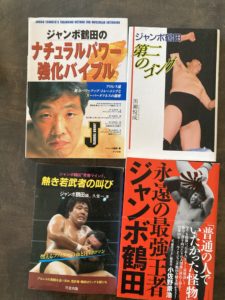
Clockwise from top left:

Jumbo Tsuruta’s Natural Power Strengthening Bible by Tomomi Tsuruta, published April 20, 1999

Jumbo Tsuruta’s Second Gone by Yoshinari Kurose, published March 31, 1999

Eternal Strongest Champion Jumbo Tsuruta by Kagehiro Osano, published May 30, 2020

Jumbo Tsuruta: The Cry of the Passionate Young Warrior by Misao Kasakura, published November 25, 1983

BIBLE is an unusual book; as its name implies it’s less an autobiographical piece and more of a pro-wrestling guide from a practitioner’s perspective with specific instructions on how to train the body, do certain moves, and focus on specific muscles to execute pro-wrestling properly. It also contains some interesting anecdotes from Tsuruta on everyone from trainers and veterans above him, to his contemporaries, to those below him. GONG is something of a career retrospective written by a wrestling journalist going over his biggest accomplishments and a few key anecdotes from his childhood. CRY is something of a mid-career review, looking at Tsuruta’s accomplishments up to 1983. Lastly, ETERNAL is the mammoth volume written by Kagehiro Osano, the same journalist who wrote the five-star book about Mitsuharu Misawa and contributed significantly to Akira Taue’s 2023 autobiography.

Tomomi Tsuruta was born on March 25th, 1951, in what is now Yamanashi, Japan, an area that apparently had about 2,000 people named “Tsuruta”. The name “Tomomi” is more of a feminine name and his parents gave it to him because he had a low birth weight which gave him more of a feminine appearance at first, along with a tendency to easily get colds. However, by the time he entered elementary school he was already far bigger and more robust than most of the kids his age. This growth came from the fact that he had to go up and down the same slope of a street surrounded by rice fields that young Tomomi would take to go to and from school everyday. This continued into his teens: his elementary school was 1.1 kilometers away and his junior high school 1.3, both being at 90 meters of elevation from his home. In BIBLE Tsuruta himself notes that his mother was tiny but his dad was fairly big for a Japanese man, standing at 179cm and weighing 90kg. Tsuruta also notes that his family also had a small ranch on their land which allowed him basically get unlimited milk. He notes that on average he drank 1.8 litres of milk each day.

When Tsuruta wasn’t running home from school, he was helping his farming family with odd tasks, usually involving lifting or carrying things. It’s noted in GONG that these experiences would later serve as the foundation of Tsuruta’s master’s thesis on scientific training methods while attending Tsukuba University Graduate School:

“Rather than training with equipment like barbells or at athletic gyms, I believe that using the natural environment and training in everyday life increases physical strength. I felt this from my past experiences. Muscles built naturally do not fade quickly. Muscles built artificially with barbells may look strong but quickly become stiff, lack flexibility, and cannot keep up with varied movements. Moreover, if one neglects training, they can fade away in just one or two weeks.” – Jumbo Tsuruta’s Master’s Thesis

In terms of someone who embodies this idea, Tsuruta cites Dutch judoka and fellow Olympian Anton Geesink as his inspiration.

In ETERNAL, 17-year-old Tsuruta found himself unintentionally forced into sumo wrestling. While accompanying a sumo-loving relative sightseeing through Tokyo, the two ended up at a sumo dojo and Tomomi, without realizing it, passed the dojo entrance test. However, through some miscommunication Tsuruta wasn’t allowed to leave and thus spent most of a summer at this dojo training in sumo. Further fanning the flames was that one of his uncles had competed in sumo with one stable and Tsuruta was interested in switching to a different one, a big no-no in sumo. He also learned soon into this training that he wouldn’t be able to balance training with academics which went against Tsuruta’s own ambitions. In the end he managed to leave but it cast a shadow over him as someone who “ran away”, which led to some cold stares from those around him and a presumption that although he was big, he didn’t have any guts.

Tsuruta’s salvation came from an Olympic procession that he saw on TV. Wanting to redeem himself, Tsuruta turned towards whatever sports that could get him into the Olympics. First he played basketball at high school and university, along with track and field. His had once expressed interest to become a sumo wrestler, but the incident above changed his mind. In a somewhat ironic twist, in GONG it’s noted that in his critical high school years his grades in English and Japanese weren’t all that good, and yet he’d go on to not only get his master’s thesis published but he’d go on to become a university lecturer in both Japan and the United States. Tsuruta also played baseball for about six months and did decently well but didn’t continue due to his poor eyesight.

Tsuruta played basketball for three years, becoming a standout in the intra-high school system and became the central force in his high school going undefeated for three years in the Yamanashi Prefecture. as he grew into a high school senior he also played as a lock in rugby and placed third in a high school-level sumo tournament after only a week of training. Tsuruta found these experiences in various sports critical to his pro wrestling career, stating in ETERNAL,

“In basketball, I developed body balance, quick movements, endurance, and jumping ability. The ability to structure a game with a momentary flash of inspiration also helped me after becoming a professional wrestler. My experience in rugby was beneficial for wrestling. The way to tackle in rugby and the ability to read the opponent’s movements could be applied to wrestling tackles.” – Jumbo Tsuruta

However, despite his success in all these sports Tsuruta’s school life also had some drawbacks. Tsuruta recalled having a complex for being big because he stood out and thus became the center of attention without wanting to. This manifested in the form of a stutter and a struggle with him making friends. However, once the prospect of competing at the Olympics reappeared in his mind Tsuruta was able to focus solely on that and ignore those other drawbacks wherever he could.

APOD: This seems like a fitting place to stop for now as the next section will cover Tsuruta’s more direct involvement with the Olympic world. I think this section was very interesting because it served as a fantastic starting point on how Tsuruta became such an incredible wrestling athlete. It shattered the preconception that Tsuruta was always an elite and showed how he became physically strong through everyday tasks that built his body naturally. This mindset would follow Tsuruta for most of his life and would explain why he was so good at so many different sports and aspects of pro-wrestling.

As always, thanks for reading.

Rants
Rants

5-Star BOOK Reviews: Masanobu Fuchi’s Book, Part VII (FINAL)

By Alex Podgorski on 18th November 2025

With this entry we will conclude Masanobu Fuchi’s book. This last section goes over the rest of the 1990s and then switches to much more dramatic material. In the span of about a year Fuchi loses his beloved boss, his best friend leaves for America and then dies on the operating table, and then the company he devotes his life to is torn apart from the inside and he’s tasked with deciding its future. It’s a lot for one man to handle but as he has already shown, Masanobu Fuchi isn’t one to shy away from challenging situations.

You can read part 1 here, part 2 here, part 3 here, parts 4 and 5 here, and part 6 here.

Masanobu Fuchi Book

Fuchi opens Chapter 7 with Jumbo Tsuruta (of course) passing on his jumping knee technique to Jun Akiyama. Apparently there’s an entire thing in Japan about people actually passing on techniques from master to pupil, instead of people just stealing from each other in other parts of the wrestling world. One of the most noted examples of this is Tsuruta being taught Lou Thesz’s Greco-Roman Backdrop from Thesz himself and thus adding it to his repertoire. Then the Four Heavenly Kings would fine-tune that same move for their own ends while still tracing it back to Thesz, in some sort of wrestling version of a family tree. In the case of the jumping knee, Fuchi recalls seeing OG Nature Boy Buddy Rogers use it and mentioned it to Tsuruta, which led to Baba giving is blessing for Tsuruta to start using it. Fuchi also mentions that most people mess this move up because they lean forward on execution whereas Tsuruta was able to more or less stay in place when landing his.

Then he goes back to talking about Tsuruta some more, specifically his declining health and how he couldn’t really enjoy himself anymore once he was diagnosed with Hepatitis B. To Tsuruta’ Fuchi’s misfortunes with money and women were paltry compared to his own health issues and Tsuruta was sure to remind him of this when he was still alive. Even Tsuruta’s wife would tell Tomomi (Jumbo’s real first name, which is decidedly feminine hence him becoming “Jumbo” as a pro wrestler), to hang out with Fuchi as a means of forgetting his woes.

While Fuchi was keeping Tsuruta company outside the ring, in the ring he pivoted down the hard as the Fou Heavenly Kings took center stage. At this time he found himself facing Giant Baba many times. He noted that Baba’s moves really hurt because he was strong and bony, which made even easy-looking moves like the Coconut Crash much more painful, especially his knife-edge chop since he had a bony protrusion in his pinky finger. On the same note, Fuchi believes that Baba really wanted to go out to izakayas and hang out with fans like a normal person but couldn’t because of his size and stature.

According to Fuchi Baba tried to be considerate to fans wherever possible. When the Great Hanshin Earthquake occurred in January 1995, Fuchi was one of the voices opposed to holding the scheduled wrestling event given the circumstances. He thought it was better to refund the tickets and have wrestlers volunteer in providing air to the disaster-stricken region. However Baba’s wife Motoko disagreed was strongly in favor of the wrestlers encouraging the victims through their wrestling. Ultimately Baba decided that all the wrestlers scheduled for that event would donate their pay to the disaster victims.

Fuchi skips ahead a bit to keep the discussion on Baba with the next subject being Baba’s final days. Fuchi, like many people, was kept in the dark about Baba’s condition and when he missed a date for the first time in over a decade or two, Fuchi was worried but Baba downplayed it as a cold. When things were reportedly getting more serious he is told it’s things like a bowel obstruction or something like that. Then the day came when he learned of Baba’s passing. He described as being more shocked then sad, only losing his composure and started crying when the media began airing footage of Baba over the decades. Also apparently Antonio Inoki came to visit when the press weren’t around.

1999 gets worse for Fuchi when Tsuruta announces his retirement and his departure for America as he will go teach in Oregon. Tsuruta’s retirement ceremony is held in March of that year and AJPW also hosts two major events within months of each other: a Baba appreciation event in the Nippon Budokan which draws about 28,000 people and their second Tokyo Dome – billed as Baba’s Retirement Show – which draws an estimated 65,000.

Shortly after this, Fuchi began getting a bit more in tune with AJPW’s backstage situation. Now, as per what he noted in his intro, he wouldn’t speak negatively of anyone. He reiterates this point by describing his reticence regarding AJPW’s boardroom meetings as chaotic and him taking any position could be seen as unnecessarily righteous:

“After Baba’s passing, the internal situation of All Japan Pro Wrestling continued to be chaotic. I was also given an executive title and frequently participated in company meetings, but it was true that there were conflicts even in those settings. However, it would be rude to reveal the details of that time, so I will refrain from doing so. It would only make it seem like I had a righteous cause.” – Masanobu Fuchi

However, the next big shock for Fuchi is Tsuruta’s death in 2000 from complications during a liver procedure in the Philippines. Fuchi was expecting there to be some equally big tribute ceremony for Tsuruta. However, the tribute organized by Misawa was, by Fuchi’s standards, underwhelming, with it being limited to Tsuruta’s three children holding his portrait on the entrance. Fuchi confronted Misawa angrily over this but Misawa said nothing. Fuchi understands that Misawa has much more to deal with at the time, including possible issues with NTV.

Fuchi glosses over the NOAH Exodus and his initial decision was that, at 46 years old, he should retire. He was just about to return to his family home in Kitakyushu when he receives a phone call from Toshiaki Kawada saying he stayed with AJPW and that Motoko was “motivated” to keep AJPW alive. This convinced Fuchi to keep going a bit longer. When he met Kawada in person after their initial press conference to discuss AJPW’s continued survival, Fuchi recalls being shocked at Kawada’s continuing with All Japan. Apparently, AJPW meat so much to Kawada that ‘Dangerous K’ was moved to tears by the prospect of the company dying out so quickly and unfortunately:

“I love All Japan. The All Japan Pro Wrestling that Baba-san created. So I don’t want it to end easily. It absolutely cannot end like this…” – Toshiaki Kawada

(APOD: Fuchi undercuts his own importance to AJPW’s survival here. Though Toshiaki Kawada was still a big name in puro in 2000 he couldn’t carry the company alone. Kawada NEEDED someone else to be there with him and Fuchi was the right man for the job. Fuchi’s presence added weight to Kawada staying and helped the promotion survive as more than just one man’s desperate attachment to something with one foot in the grave. It wouldn’t be inaccurate to say that Fuchi changed the course of wrestling history by deciding to stay with Kawada to keep AJPW alive.)

Fuchi, along with Kawada, goes to New Japan to negotiate how the next little bit is to play out. Discussions take place involving Fuchi, Kawada, Riki Choshu, and Katsuji Nagashima of NJPW. Fuchi openly asks why NJPW isn’t trying to book matches with Misawa’s crew to which Nagashima responds, “It’s the All Japan banner. If we wanted to, we could crush it, but we value All Japan.” Fuchi takes this as motivation to work his hardest to not get crushed so easily.

Fuchi’s last memory of this period isn’t about wrestling per se, but about family. Around the end of 2000 All Japan is still alive albeit with a skeleton crew with undercards filled by freelancers from other promotions. Around this time Fuchi returns home to Kitakyushu for a local show and stays at his family home. He drinks with his father and as they prepare to go to bed Masanobu’s father notes how others in his wider family praise him to his father. “The other day, when I returned to Shonai (my father’s hometown), my eldest brother said, ‘Masanobu is something else.”

Fuchi (the wrestler) doesn’t say anything but in his bed he feels his own tears welling up as this marks the first time his father ever praises him for his wrestling career.

The book’s epilogue notes a few other big happenings in 2001-2: another big AJPW Tokyo Dome show headlined by Stan Hansen’s retirement, multiple legends coming out to do another tribute to Giant Baba, and Motoko handing control of AJPW over to Keiji Muto. Then Kawada retires but this time Fuchi chooses to stay close to AJPW a bit longer while others like Jun Akiyama and SUWAMA assume key backstage positions in the company.

By being somewhat close to a management position Fuchi is better able to understand the difficulties of being a wrestling manager/promoter. To this end he recalls how tight a ship Baba ran when he was alive and how, despite sometimes never making a profit himself, Shohei Baba would to his best to ensure wrestlers were taken care of.

“Baba-san often said, “As a president, I take pride in never having delayed payment for wrestlers or employees, not even once. If someone says that’s just a given, then so be it (laughs).”
I had a vague sense that the company had faced several critical situations, but no matter the circumstances, Baba-san always smoked his cigar calmly. A president must be like this. If they are anxious, the employees will become uneasy.
There were times when, after paying the wrestlers, employees, and foreign wrestlers their fees, as well as accommodation and travel expenses, Baba-san ended up with not a single yen for himself.
“What’s this, am I working for free this series?”
He and Motoko-san would look at each other and laugh about it.
During the era of the Four Pillars, when the Nippon Budokan was packed to capacity seven times a year, we wrestlers received bonuses three times a year and would go on a family trip to Hawaii once a year.
Now, I receive welfare pension every two months. Thanks to Baba-san and Motoko-san for continuing to pay into the welfare pension for the wrestlers’ retirement. Those wrestlers and employees who were part of Baba-san’s era and are over 56 years old must be receiving the welfare pension. It’s a grateful situation.
After Baba-san passed away, suddenly people started saying things like, “What was All Japan Pro Wrestling like?” or “Baba-san was like this,” but when I look at the faces of those talking, I am surprised. Do these people really know about that era? Outsiders shouldn’t say whatever they please. Everyone has passed away, and I have become one of the few living witnesses. Therefore, I want to properly preserve the things I have seen, heard, experienced, and remembered in a tangible form, which is why I have put this into a book.” – Masanobu Fuchi

APOD: Fuchi’s book was certainly interesting but in my opinion it wasn’t as groundbreaking as I expected it to be. It came across as bit soft, partially on purpose given Fuchi’s gentlemanly decision to not speak ill of the dead. Granted that’s an honorable thing to do but I still think Fuchi glossed over too many things that would’ve made this into a more complete book. He doesn’t discuss handing the book over to Misawa in any way. He doesn’t talk about many of the undercarders and other veterans he faced in the ring, including luminaries from WWF, WCW, the NWA, and beyond. And from his tone Fuchi seems WAY too caught up in the Jumbo Tsuruta mythos, painting him with as much of a reverent brush as WWE paints its own core crew of legends. But aside from that, Fuchi has a few interesting anecdotes about his life and career that make for a quick and interesting read. Though for those of us who are already as deep into the wrestling bubble as this, Fuchi’s relatively surface-level discussions and analyses fails to go beyond scratching the surface on important subjects.

Final Rating: ***3/4

As always, thank you for reading. Next on the docket, Jumbo Tsuruta’s books.

Rants
Rants

5-Star BOOK Reviews: Masanobu Fuchi’s Books, Part VI

By Alex Podgorski on 11th November 2025

At last, we get to the most noteworthy section of Masanobu Fuchi’s books: the 1990s and the era of the Four Heavenly Kings. This section covers the first half of the decade and sets the scene for Misawa to take over in the wake of the big SWS Exodus (which Fuchi doesn’t discuss because, again, he doesn’t want to be outwardly negative towards anyone). As one of the men pulling the strings behind the scenes during AJPW’s most famous periods, Fuchi’s recollections are quite valuable. But how honest and detailed will he be when it comes to these famous wrestlers and the impact they had?

You can read part 1 here, part 2 here, part 3 here, and parts 4 & 5 here.

Masanobu Fuchi Book

Fuchi begins by noting that AJPW’s dojo had been quiet and empty before he left on excursion but when he returned it was livelier with guys like Mitsuharu Misawa & Toshiaki Kawada having already gone through training and debuted. Fuchi introduces Misawa and immediately sings his praises. From the get-go Misawa checked almost every box: his gymnastics background made helped him stand out so the point that Baba was openly praiseworthy of him from early on. He doesn’t say much about Kawada, only that “he admired Misawa”. However, the subtext here implies that while both men were exceptional trainees, Misawa was simply more exceptional in almost every respect. That said, Fuchi observes an initial challenge ahead for both of them: their small stature would make it difficult for them to handle the many big men who ruled the roost like Baba himself, Stan Hansen, Tsuruta, and at least at the time they were rookies, Bruiser Brody.

Fuchi glosses over Baba’s initial plans and how he wanted to build AJPW around Tsuruta and Tiger Toguro (Kim Duk) but the latter left before those plans could come to fruition. He does note that both Great Kojika and Great Kabuki were filling important roles on the roster, with Kabuki being “immensely popular” upon return from America (APOD: Fuchi kinda undersells this description of Kabuki in a major way. From what I’ve read several times already from comments Kabuki was an enormous draw for All Japan and helped them have one incredibly profitable tour during the 1980s which almost never happened). Because of how successful those guys were during that time, the idea of Misawa becoming the ace of all them seems farfetched at first.

Mitsuharu Misawa

Next Fuchi pivots to the whole Tiger Mask situation and first notes how the OG Tiger Mask – Satoru Sayama – was so popular he might’ve outdrawn Antonio Inoki himself. However, Fuchi credits Sayama’s opponents more than the man himself, especially Dynamite Kid whom Fuchi recalls wrestling and praises him for his sharp movements and being small in stature but still powerful. Fuchi even recalls wrestlers in American confusing him for Sayama and how Tiger Mask defeated Chavo Classic for the junior title.

Fuchi summarizes something I’ve already covered in my Mitsuharu Misawa books review, how Baba had a short conversation with Misawa while Misawa was in Mexico and asked him if he could jump from the top rope. When Misawa answered positively, he was quickly brought back to Japan and rechristened Tiger Mask II. However, Fuchi speculates that one reason AJPW obtained the rights to the masked character was because of a supposed falling out between NJPW and Tiger Mask creator Ikki Kajiwara. At the same time, Fuchi also recalls Baba frequently praising Misawa’s potential as another reason for him being chosen to dawn the mask.

“That guy is amazing. He’s already great as he is.” – Giant Baba on Misawa before he donned the Tiger Mask, circa 1984

However, as Misawa himself and those who chronicled his career noted, Misawa didn’t enjoy portraying Tiger Mask. He struggled with the pressure of living up to such lofty standards and, as such, didn’t enjoy this period. Fuchi also notes the major difference in their physiques: Misawa was five inches taller and 40 pounds heavier, even in his junior heavyweight days. Expecting Misawa to be as fluid and lightning quick as Sayama was nonsensical. Still the audience expected flying techniques from Misawa as they had from Sayama and while Misawa could execute these techniques as well as his predecessor, they put added strain on his heavyweight frame. As such Misawa’s time as Tiger Mask II was mired with injuries and pain to his joints. Even though he added new techniques to his repertoire to further distinguish himself from Sayama’s Tiger Mask like the Tiger Suplex and the Tiger Suplex ’85, Misawa often reached out to Fuchi for advice. For Fuchi this was understandable: Sayama only wrestled as Tiger Mask for about two-and-a-half years while Misawa did so for over twice that. However, Fuchi doesn’t give specific examples of the advice he gave Misawa, only noting “I shared my ideas in my own way”.

From there Fuchi presents Misawa’s unmasking as a direct response to Genichiro Tenryu’s SWS Exodus.  Fuchi recalls May 14, 1990, the day Misawa unmasked, as a major date in AJPW’s chronology. With reports of AJPW on the brink of collapse dominating the coverage of AJPW, Misawa declared that, “If this doesn’t gain popularity, my career as a wrestler is over.” However, a bigger story from that same day emerged: in a main-event tag match between Giant Baba & Jumbo Tsuruta and Terry Gordy & Steve Williams, Williams slammed Baba into a corner exceptionally hard which caused immobilizing back pain.

It was around this time that Fuchi was made booker/matchmaker for AJPW and the thought of Baba himself being unable to wrestle was seen as catastrophic for AJPW. Baba had spent years cultivating a specific image: no matter what challenges he faced Baba always responded with grace and composure. Even when NJPW would shit-talk AJPW publicly Baba would chew on a cigar with an air of serenity. But this time things were different, with Baba describing the pain of that slam as sending an electric shock down his back. In response, Fuchi takes Misawa & Kobashi out to the bars and encourages them to “step up” to solve this crisis by having them target Jumbo Tsuruta. Fuchi also meets with Tsuruta soon after and lays out his plan for the two of them to “crush” their younger challengers.

As part of this grand plan, Fuchi describes a specific match that laid the foundation for what was to follow: the six-man tag that took place on May 26, 1990 that led to Misawa drawing first blood with an elbow smash on Tsuruta. And, as has become pro-wrestling canon,

Misawa’s.

Elbow.

Is.

God.

Fuchi recalls Tsuruta’s initial response to Misawa’s elbow. Though he told Tsuruta to remain calm and Tsuruta replied “I’m calm, I’m calm” he was anything but. Tsuruta, who very much followed the Baba template and showed control and composure at all times, unloaded on Misawa with an uncharacteristically fiery display of violence. Even Baba himself told Tsuruta “Hey! Don’t crush them!”.

Misawa’s push only continued from there. He beat Tsuruta on June 8, 1990 and soon after became the first Japanese wrestler to make Tsuruta submit. In that latter case Misawa used a facelock technique that Fuchi had taught him which Fuchi describes as a sort of chokehold Karl Gotch taught him but in Fuchi’s hands the move was seen as “too plain” so he stopped using it. This facelock, combined with the powerful elbow strike, were Misawa’s tools to deal with bigger heavyweight opponents that would otherwise overwhelm him. But despite these tools Fuchi was convinced that Tsuruta being the wall that Misawa couldn’t easily overcome served as the foundation for the feud’s success.

“Surely, many fans watched with skepticism. The key was whether Misawa had enough skill to exceed those expectations, and his earnest fighting style far surpassed what fans had imagined. That is why All Japan Pro Wrestling became even more exciting than when Tenryu was around.

Even so, the central figure remained Tsuruta. Tsuruta stood as an enormous wall, squarely accepting the challenges of Misawa, Kawada, Kobashi, and Taue, and clashing fiercely with them. He was the greatest contributor to nurturing the later “Four Pillars.”

The “Jumbo Tsuruta is the strongest” theory was substantiated by his crushing of Misawa and others amidst the intensifying Four Heavenly Kings wrestling era.
There was even an instance when Misawa, after defeating Tsuruta in a singles match, was so overwhelmed with emotion that he burst into tears.” – Masanobu Fuchi

Toshiaki Kawada

After more of the same talk about how Tsuruta as the company’s strongest wrestler defined this feud, Fuchi finally talks about Kawada. He notes Kawada lost his first 205 matches (APOD: which makes Kenta Kobashi’s much-discussed losing streak seem paltry in comparison) and notes how Kawada initially had a “cute” face that later became more menacing. He also notes that over time Kawada’s view of Misawa shifted from ‘admiration’ to ‘rivalry’. In terms of advice, Fuchi recalls telling Kawada to master taking breakfalls; however, compared to Misawa, Kawada initially struggled to master this aspect so strongly, likely owing to Misawa’s gymnastic background helping him. In response, Kawada put in double the amount of training hours. Furthermore, Fuchi noted that Kawada had a mischievous or rascal-like personality which Fuchi suggested Kawada introduce to his matches. Kawada showed this immediately with his stepkicks (APOD: now known as the Kawada Kicks, used by guys like Seth Rollins and Will Ospreay, among others) which pissed off Kawada’s opponents to no end. And even though Kawada didn’t have an outward gimmick in the traditional American sense, Kawada’s personality as “the mischievous brat who never listens to others” resonated with fans (APOD: which makes sense given AJPW’s growing popularity with families and children at the time).

Kenta Kobashi & Akira Taue

Fuchi introduces Kobashi and corrects a presumption that he was he who rejected Kobashi when it was in all likelihood Haru Sonoda who did so. He briefly summarizes how Kobashi made a life-changing decision to enter AJPW’s dojo at twenty years old despite having a stable blue-collar job at the time and admiring Kobashi’s dedication to training. He also introduces Taue who joined around the same time but struggled more in training than Kobashi due to his time as a sumo wrestler engraining certain instincts in him. (APOD: I’ve covered both Kobashi’s and Taue’s biographies extensively and you can check those out here and here to get their perspectives). Fuchi presents these two as beneficiaries of the Tenryu Exodus since they were thrust into prominent positions due to AJPW’s roster being so clearly thinned out after the Exodus completed.

After Tsuruta left All Japan in July 1992 due to illness Fuchi’s initial plans fell apart. Without a target for Misawa and the Super Generation Army to aim for, Fuchi decided that it was more important to build a new rivalry for Misawa. He concluded that this quartet would draw money if they fought each other, hence Kawada joined Taue to create The Holy Demon Army and the birth of the Four Heavenly Kings of Professional Wrestling.

“As the booker, my ultimate mission was to “fill the Nippon Budokan seven times a year.”
While I planned the match cards, the matches themselves were entirely dictated by the abilities of the wrestlers. I didn’t give them any advice.

The hallmark of the Four Pillars was the elimination of ring-outs and disqualification finishes, ensuring decisive outcomes within the ring. This idea came from Baba.
‘I may not have big sponsors, but the fans are my sponsors. We must treasure the fans who come to the venue. We must never betray them.’

With this belief, the organization adopted the slogan “Bright, Fun, and Intense.”
“Intensity is necessary because it’s pro wrestling, but if it’s always just intense, fans won’t stick around. Compared to when we were in our 20s and 30s, there are now more women and children coming to the venues. To ensure those fans return, it has to be bright and fun.”

The intensity was carried by the Four Pillars and Hansen, while the “bright and fun” aspect was represented by the Family Army versus the Villainous Society. That was Baba’s vision.” – Masanobu Fuchi

Fuchi compares Misawa to NWA Champions of the past and notes how Baba saw Misawa as resembling them in terms of how he possessed a strong sense of responsibility.

“Those who bore the NWA banner were beings above even the champions. You must fulfill your duty as someone who carries the banner of All Japan Pro Wrestling, just like the NWA champions did.” – Giant Baba to Mitsuharu Misawa

Of course, Fuchi notes that all four of these guys pushed themselves like crazy, trying to surpass one another. He believes they all came together at the right time and place for their legendary matches to be born. At the same time, he recognizes that some of their moves and actions were risky and dangerous with fans raising concerns about their health. He also notes how the Four Heavenly Kings had many copycats who wanted to replicate their matches and style. However, Fuchi strongly thinks that these guys had certain distinct traits that makes it impossible for anyone to copy what they did in the ring:

“Amid intense exchanges, there were moments when the action would stop, and they would glare at each other. They would gauge the opponent’s damage and think, “What should I do next?”
Within the movement, there was always a sense of “timing.” Today’s pro wrestling is non-stop action.
I believe the four of them learned this sense of “timing” from the matches between Tsuruta and Hansen.
After one exchange or a big move, there would be a brief moment of glaring at each other, followed by a split-second transition to the next attack with a “Alright, here we go.”
Tsuruta learned this “timing” from Baba and inherited it. In other words, Four Pillars Pro Wrestling carries the “royal road” bloodline that originated with Baba.” – Masanobu Fuchi

(APOD: This is, in essence, what Fuchi argues is the crux of Four Kings’ wrestling: not just crazy head-drops and escalating risk, but a dedication to balancing motion and stillness to create teases in matches that may or may not come true. The anticipation of something possibly connecting is just as important as the completed execution itself, which seems to be lost on many people who’ve attempted to replicate this specific style over the decades).

Fuchi concludes this section with a brief mention of guys like Jun Akiyama and Stan Hansen. He doesn’t go into Akiyama’s career all that much yet but notes that Akiyama lost consciousness during Four Kings’ matches quite a bit during his early career as he was largely unable to keep up with the Four Kings’ intensity (APOD: This isn’t meant to be a slight against Akiyama but Misawa, Kawada, Kobashi, and Taue were in such a league of their own that even a university-level elite like Akiyama couldn’t match their physicality. But he brought something altogether different in his matches with them that make him, at the very least, an entertaining alternative to Kobashi in Four Kings tag matches).

Fuchi also praises Stan Hansen for going the distance to be the new main threat for the Four Kings despite being over forty which by wrestling standards is “old man territory”. For his efforts Baba would be particularly grateful – and therefore generous – to Hansen for his dedication and notes how Harley Race and The Destroyer received similar treatment from Baba for their loyalty as well.

Fuchi closes with some final remarks about Baba and how he reportedly cried during the Four Heavenly Kings’ matches. Baba flatly denies all of these claims, many of which stem from announcer Ken Wakabayashi making bold proclamations during intense matches and speculating that Baba, not being immediately responsive, was choked up by what he was witnessing. Baba’s response to all of this was, “I am Giant Baba. I wouldn’t lose my composure and cry.” The only time Fuchi recalls seeing Baba cry was during Haru Sonoda’s funeral since he assumed personal responsibility for booking that flight to South Africa. All that being said, Fuchi notes that the era of the Four Heavenly Kings was exceptionally profitable for All Japan. He confirms that the company ran at a loss for many years but during the Shitenno years Baba made enough profit to pay off debts owed to Nippon TV. However, Baba jokes that he shouldn’t’ve paid all of them off since those debts could’ve been used as leverage in later negotiations between AJPW and NTV. Finally, Fuchi notes that this situation between wrestling promotion and broadcaster would have significant impact in just a few short years.

APOD: There is still quite a bit of discussion on the Four Kings in the next chapter, which will also introduce Jun Akiyama to the mix. Fuchi paints an interesting picture about these men and how they rose to become one of the most famous quartets in modern wrestling history. To paint a whole picture Fuchi fully admits that some of the things the Four Heavenly Kings did were indeed risky and dangerous but he understands their perspectives. Fuchi contextualizes the head-spike direction of the Shitenno style by noting that it was borne from a need to both surpass a previous generation and make up for a shrinking roster of interchangeable opponents. Fuchi asked an interesting open-ended question about what would happen if guys like Terry Gordy, Ted DiBiase, most of the SWS Exodus crew, and of course, Jumbo Tsuruta, were all still around either collectively or individually. Would the Four Kings style have evolved in the way it did? Would those four wrestlers reach the top of All Japan? Hell, would Misawa even unmask in the first place? These ideas are merely food for thought, but we’ll know a bit more about Fuchi’s booking in the next section.

As always, thanks for reading.

Rants
Rants

5-Star BOOK Reviews: Masanobu Fuchi’s Books, Parts IV & V

By Alex Podgorski on 9th November 2025

This section of Masanobu Fuchi’s books will cover more ground and will serve more as setup for the much bigger Four Heavenly Kings Era. As such I’ll be going over two chapters here since they go over more or less the same general topic, that being the Giant Baba’s growing focus on heavyweights and the impact of the feud between Jumbo Tsuruta and Genichiro Tenryu. There will be also some personal anecdotes from Fuchi about his experiences in one of the bigger angles of the decade and how he grew more and more trusted by AJPW’s power-brokers. So even though he’s not someone many people reading this are familiar with, hopefully by the end you’ll understand why he was so useful just a little bit more.

You can read part 1 here, part 2 here, and part 3 here.

Masanobu Fuchi Book

Continue reading
Rants

5-Star BOOK Reviews: Masanobu Fuchi’s Books, Part III

By Alex Podgorski on 6th November 2025

After years of toiling away and praying for an opportunity to wrestle abroad, Masanobu Fuchi finally gets his chance. This section will see Fuchi interact with many famous wrestling veterans from the past. For Fuchi this dream was more important than finding a girlfriend. Luckily he’ll soon get his wish.

You can read part 1 here and part 2 here.

Masanobu Fuchi Book

Chapter 3: “Baba’s Boy” Goes to America for Training

Right before Fuchi departs for America, Genichiro Tenryu debuts and begins training while still wearing his sumo topknot. His training is split between being overseen by Tsuruta, someone named Takachiko, and Baba himself, with Fuchi and the other trainees serving as practice partners in between. Around this time Fuchi wins the Tokyo Sports’ Effort Award for puro (APOD: Along with Ryuma Go and Shoji Kai), but Fuchi recalls his parents being happier about winning it than he was. Soon after Billy Robinson comes to All Japan and Fuchi volunteers to be his practice partner. Aside from Robinson, Fuchi also learns trains with and learns techniques from, Horst Hoffman, Pat O’Connor, and Karl “Kami-sama” Gotch. He also describes receiving plenty of instruction and advice from “The Destroyer” Dick Beyer.

As 1979 turns into 1980 the other two trainees depart with Fuchi’s foreign excursion still left undecided. In a surprise turn of events, Fuchi credit Ed Farhat (The Original Sheik) with helping him get a working visa to wrestle in the United States. This allowed Fuchi to accompany Baba to an NWA convention and is, in all likelihood, the only time Fuchi and Vince McMahon would be in the same room together. Sheik’s help didn’t end there, though; he describes how wrestling in the Detroit territory had declined so he encouraged Fuchi to go work in Puerto Rico. Fuchi followed Sheik there and the two of them meet up with Abdullah The Butcher.

Abby is the one who takes care of Fuchi while in Puerto Rico and gives him pointers about making money in that territory. He also warns Fuchi about the fans there being far more aggressive than in Japan and how they’d have to fight against fans if necessary. By watching Abby fight wildly and lose by via disqualification, Fuchi witnesses Abby rile up local crowds enough for them to want to see him next time. This is now Abby as a heel made money which, at times, was more than what the babyfaces made. When not working closely with Abby, Fuchi also recalls being well taken care of by Race and Bruiser Brody, both of whom had worked for Baba in the past. Being “Baba’s boy” comes with certain perks and a certain level of respect, but Fuchi earns his keep as well. He recalls the lessons he learned in AJPW dojo and applies them in the ring which the people around him all respect. Fuchi notes that many American wrestlers lack the same mastery of fundamentals Baba had drilled into him so Fuchi is able to hold his own in athletic and competitive matches.

Much of Fuchi’s initial time in Puerto Rico sees him wrestle as the masked wrestler “El Destructor” which he doesn’t particularly like. One reason is that he has to wash the mask every day and it doesn’t always dry in time so on many nights he wrestles in a damp mask which is worsened by how much sweat pours down his brow. A few weeks later Onita joins him and Fuchi sheds the mask. He and Fuchi form a generic tag team showcasing that they’re from Japan, which he finds refreshing. At this time he’s paid about 10,000 yen per week, which translates into the same monthly salary that university graduates were paid in white collar jobs in Japan. Fuchi is particularly proud about how the promoter of the Puerto Rico territory put so much trust in him and Onita, noting “As expected from Baba’s boys”.

Four months later Fuchi moves to Amarillo, Texas, to wrestle under Dory Funk, Jr. When he arrives, there weren’t any matches scheduled so Fuchi and Onita spent a few days going to cattle & horse actions and going to local Texas bars. Since he and Fuchi were staying with the Funk Family the two Japanese guys return the favor by cooking for their hosts. After that they both go to Memphis where Tojo Yamamoto wrestles. As part of their new gimmick Fuchi receives bamboo swords sent to him from Japan by either his mother or sister. Through some sort of obligation to his host, Fuchi ends up giving one of said swords to Yamamoto. Fuchi has positive memories of wrestling in Memphis since the wrestlers of that time were similar in size and he could wrestle more normally. Fuchi recalls wrestling the team of Jerry Lawler and Bill Dundee and the Rock ‘N’ Roll Express duo of Ricky Morton & Robert Gibson. Over time Fuchi & Onita would learn to evaluate wrestlers among themselves, which they didn’t have the luxury of doing in Japan. Fuchi also concludes that the lessons he learned in AJPW’s training dojo were universally applicable since he could work with anyone in seemingly any territory.

It was also around this time that Fuchi starts zeroing in on what would become his individual style. He wants to focus on ground wrestling and submissions, which wasn’t all that common in the territories he wrestled in. At the time he could only name a small handful of wrestlers who had a similar style: Eddie Graham, Gene Anderson, George Scott, and a few members of the Crockett Family. Beyond them there was only Fuchi.

After Memphis, Fuchi goes to the Florida territory and a guy named Omuka introduces him personally to Karl Gotch. Fuchi essentially jumps for joy at the prospect of learning from Gotch. Despite extremely long drives from one venue to another Fuchi still finds time to train at Gotch’s place. However, a small dilemma presents itself: Gotch regularly offers Fuchi wine during training and Fuchi, not wanting to be rude, accepts. Often more than once. This leads to numerous occasions where Fuchi would show up at the venue stinking of wine but he wouldn’t make excuses that he was only drinking it because Gotch offered. Incidentally, when Fuchi mentions that he had learned some techniques from Billy Robinson Gotch would “make a dissatisfied face”. Of all the things Fuchi learns from Gotch he is especially grateful for improving his bridging technique.

After spending six months in Florida and another four months in Puerto Rico, the last leg of Fuchi’s excursion would be nine months in North Carolina. During this period Fuchi forms closer bonds with several wrestlers, improved his English, getting a girlfriend (which helped with his English) and also starts riding with Bruiser Brody. It was around this time that Brody describes Jumbo Tsuruta as his biggest rival. In fact, Fuchi claims Brody was so engrossed in beating Tsuruta that he started changing his body and style to be able to match Tsuruta in the ring. It was also Brody who helped Fuchi master his English and the two of them would often talk for 3-4 hours on the road and after shows.

APOD: There was plenty of interesting stuff in this section as it pertained to Fuchi’s training. In many ways Fuchi serves as a bridge between the older generations and both his own and his successors. He is one of the rare few to receive training from some of the most renowned grapplers of decades past and as such carries a wealth of knowledge to pass down to later generations. Hell, if I had received training from or wrestled against Giant Baba and his many associates and staff, Bruiser Brody, Abdullah The Butcher, Billy Robinson, Lou Thesz, Karl Gotch, The Destroyer, The Funk Family, Pat O’Connor, and Jerry Lawler then I’d be bursting at the seams with wrestling knowledge. Though there isn’t anything all that revelatory in this section it’s the thought of Fuchi being so well-rounded that needs to be emphasized here. It’s extremely rare to find a single individual who has that much firsthand wrestling knowledge so it’s no wonder that he did such a great job as AJPW’s matchmaker towards the 1990s. But before we get into all that, Fuchi still has some work to do setting the stage for the era of the Four Heavenly Kings and that involves more discussion about Jumbo Tsuruta and Genichiroy Tenryu.

Thanks for reading.

Rants
Rants

5-Star BOOK Reviews: Masanobu Fuchi’s Books, Part II

By Alex Podgorski on 29th October 2025

Masanobu Fuchi might not be the biggest wrestler by any means but he’s a longstanding veteran with over forty years’ experience. He has a lot of interesting knowledge and wisdom to impart, some of it wrestling-related and some of it more universal. While in the last section I introduced him as the guy who helped build the generation that came after him, this next section will largely cover his recollections of the people that came before him.

You can read part 1 here.

Masanobu Fuchi Book

Continue reading
Rants

5-Star BOOK Reviews: Masanobu Fuchi’s Book, Part I

By Alex Podgorski on 27th October 2025

After months of careful and tedious work I’ve translated several books written by or about the fabled Four Heavenly Kings of All Japan: Toshiaki Kawada, Kenta Kobashi, Akira Taue, and Mitsuharu Misawa. So now that we know so much more about these legendary wrestlers’ lives and careers it’s time to turn the clock back even further and look at one of the biggest masterminds behind their success. That brings us to this man:

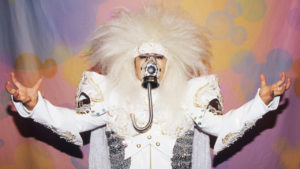
Masanobu Fuchi

This is Masanobu Fuchi. His name might not be as well-known as the Four Kings or any of the other big names to go through All Japan during the 1980s and 1990s. But without him there wouldn’t’ve been that golden era of the 1990s since he played a central role in AJPW as Baba’s primary matchmaker from the late 1980s to about 1998. He was also a fountain of knowledge who bridged between the Four Kings on one side and his and older generations on the other. The closest person I can compare him to would be Dean Malenko: a shorter and technically adept workhorse who had a decent in-ring career on his own but contributed much more significantly to wrestling as a matchmaker/agent. As someone who was tasked with the equally challenging task of booking matches that satisfied multiple at-times competing priorities and as someone who trained in All Japan before the period that drew most of us to it in the first place, Fuchi has a unique perspective that I think is worth sharing with the rest of the world.

Masanobu Fuchi Book

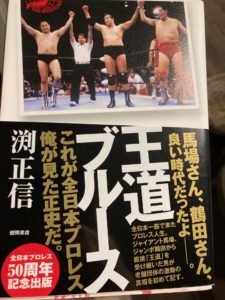
Royal Road Blues
Published March 31, 2022

Continue reading
Rants

5-Star BOOK Reviews: Mitsuharu Misawa’s Books, Part XVIII (Final)

By Alex Podgorski on 20th October 2025

This is the final part of my coverage of the many books written by or about Mitsuharu Misawa. I’ve saved this one for last for two reasons. First, it’s by far my favorite of his books and behind only my copy of Ichinose’s Four Kings Bio, it’s the best and most insightful book about wrestling I’ve ever read. Second, everything up to this point has been tied to a specific point in time in Misawa’s life whereas this last book is, like Misawa’s legacy, timeless.

This last book is called IDEALIST in which Misawa wrote his own personal philosophies about professional wrestling. But not just about the in-ring aspect of it; he also covered being a promoter, a booker/matchmaker, a talent scout, a trainer/mentor, and an observer. I don’t think there has ever been a book that has looked at wrestling from so many different angles with one person assuming a level of authority in each one. Maybe Ric Flair’s or Bret Hart’s book could compare since both of them did booking/matchmaking at certain points but I don’t think either of them were as open about it as Misawa is here. For this reason, I don’t think there’s a single book like this anywhere in wrestling which makes it such a rare piece of guidance and insight into how pro-wrestling works.

I’ve mentioned IDEALIST a few times already but now we’re going to take a look in-depth at what Misawa had to say about certain topics and certain people. I’ll try to include as many direct quotes as I can but not too many because I don’t want this to be too long.

Misawa opens IDEALIST by saying that, at the time, he considered professional wrestling incomplete; that is, that a singular complete form had not yet been shown. He states that wrestling must constantly evolve if it is to survive in an uncertain future (APOD: Keep in mind this was published in 2004, during the height of the MMA boom in Japan which led to a downturn in interest in pro-wrestling; as such Misawa’s words are quite timely given his environment). He also vows to answer some logical and reasonable questions fans might have about the inner workings of wrestling without unveiling the curtain too much.

“Professional wrestling is a sport filled with countless attractions. The impact of trained bodies clashing in a six-meter square ring might be overwhelming for someone visiting the venue for the first time. Moreover, for those who have been familiar with professional wrestling for many years, it is a deep and creative sport that the more you know, the more you understand. There is no bottom to professional wrestling. With the flexible thinking and ambition of the wrestlers and their daily training, they can create a world that endlessly fascinates people. If fans raise their expectations for professional wrestling, the wrestlers will desperately try to meet them.” – Mitsuharu Misawa

You can read part 1 here, part 2 here, part 3 here, part 4 here, part 5 here, part 6 here, part 7 here, part 8 here, part 9 here, part 10 here, part 11 here, part 12 here, part 13 here, part 14 here part 15 here, part 16 here, and part 17 here.

Mitsuharu Misawa Books

Continue reading
Previous Next

Search

Recent Posts

  1. The SmarK Rant for WWF Superstars – 01.03.87 Rants
  2. AAA Review – 07.18.26 Rants
  3. Morning Daily News Update – 19th Jul 2026 Rants
  4. Collision Review – 07.18.26 Rants
  5. Live Feed Mania – WWF Smackdown 04.10.01 Rants
Scott's Blog of Doom!
  • Email Scott
  • Follow Scott on Twitter
© 2026 Scott's Blog of Doom! Read about our privacy policy.