

5-Star BOOK Reviews: Jumbo Tsuruta’s Books, Part X
By Alex Podgorski on 10 March 2026
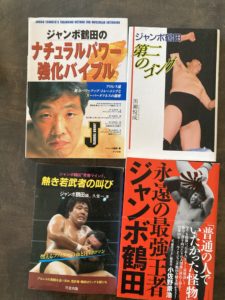
This next section in Jumbo Tsuruta’s books will cover an important and change-filled period. We will go from early 1988 to spring 1990, during which many important things happen. These include: Bruiser Brody’s return, two title unification events, a brief note on how UWF influenced AJPW’s matches, and of course, Tsuruta versus Tenryu and the fallout from the latter’s shocking departure. We’ll see how Tsuruta dealt with so many different factors, but there will also be plenty of focus on Baba and Tenryu as critical figures in Tsuruta’s career.
You can read part 1 here, part 2 here, part 3 here, part 4 here, part 5 here, part 6 here, and part 7 here, part 8 here and part 9 here.
We begin with Baba’s plan to unify AJPW’s three singles titles: Tsuruta’s NWA International Heavyweight title, Tenryu’s United National title, and Stan Hansen’s PWF Heavyweight Champion. Also added to the mix is a returning Bruiser Brody, who had been away from All Japan for several years. On March 9, 1988, Tenryu beats Hansen via roll-up to become dual United Nation & PWF champions. A few days later, Tenryu retains both titles against Hansen via DQ. As for Tsuruta, he loses the NWA International title to Brody on March 27th. Tsuruta gets another shot at Brody in April and makes public statements about how “it’s all about the result.” Despite these statements suggesting he’ll be sacrificing match content for match result, he wins the title back and has a good match in the process. Sadly, Brody’s comments about bringing the best out of Tsuruta and wanting a rematch in the future never come to pass due to Brody’s murder in Puerto Rico that July.
Much has already been written and spoken of Brody’s murder, but now we get some small anecdotes from the All Japan perspective. According to Osano in ETERNAL, Baba had plans for dream matches to be decided through fan voting for upcoming Nippon Budokan events and Brody featured in the results quite heavily. Baba was toying with possible team arrangements between Tsuruta, Tenryu, Hansen, and Brody, most likely under mixed arrangements and not the “Japan vs. Foreigners” default. Osano leaves an open-ended thought wondering how AJPW’s trajectory would’ve changed had Brody never been killed.
(APOD: The more Baba experienced serious challenges with roster management the more his “Walled Garden” isolationism becomes more understandable. I’m not defending it, considering how badly it messed up the company’s booking and roster development down the line, but from Baba’s perspective it seemed like a natural thought in the face of constant roster challenges. Gordy’s overdose, Brody’s murder, and the Tenryu Exodus, all lead Baba down a more conservative attitude towards promotion and wrestler management. He seemed to have big plans for certain foreigners, only for some outside force to screw them up.)
At the same time, Baba decides to focus on building tag team rivalries with the roster he has. Tsuruta joins forces with Yoshiaki Yatsu to create “The Olympics” while Tenryu makes Ashura Hara his main partner as The Ryu-Hara Cannon. The Olympics create a tag team finisher in a sandwich knee bat in response to Ryu-Hara Cannon’s sandwich lariat. Both teams also have to deal with The Road Warriors in the mix for tag team gold. Unfortunately, even with new teams in the mix, the same murky finishes persist in the ring. In one instance, Hawk throws referee Joe Higuchi out of the ring and then covers Tsuruta for a pin. Referee Kyohei Wada runs down to count the three, but then Higuchi gets back up and nullifies the result and disqualifies the Road Warriors. And yet the PWF tag titles, having a different lineage and rule-set, were able to change hands in a DQ. This made Tsuruta & Yatsu dual champions, and so their newly-won PWF tag titles and their existing NWA International tag titles merged and became the AJPW World Tag Team titles.
On the singles side, the rivalry between Tsuruta and Tenryu heats up, but only from one side. Tenryu tries to add more passion and enthusiasm into things but Tsuruta remains detached. He acknowledges this as a personality flaw early on, stating, “I’m not the type to express my earnestness straightforwardly. I know it’s a disadvantage for me, but that’s just how I am.” However, little by little he does start getting more animated. The first obvious sign comes in the form of a linguistic detail as Tsuruta switches to “ore” from “boku” when referring to himself in promos. Eventually the two have a showdown in Yokohama in October 1988 which Tsuruta wins via DQ after almost 35 minutes. What’s notable here is that this match includes some UWF-style elements like a Gotch-style package hold and some stiff kicks that were decidedly not All Japan-like. Aware of UWF’s booming popularity, Tsuruta and Tenryu adopt some aspects of that style without deviating too far from their established philosophies. Tsuruta gets notably angry when Tenryu hits soccer kicks and face stomps and answers with a diving knee strike to Tenryu’s forehead. Tenryu used more UWF-style holds which angered Tsuruta to the point he lands a powerbomb (which Osano claims was “forbidden”). Tsuruta continues pummeling Tenryu until Tenryu snaps and attacks back in kind. Tenryu keeps attacking despite the ref’s protestations, leading to a DQ finish. The decision leaves everyone stunned and referee Wada justifies this decision claiming that letting it go any further will take the contest beyond the bounds of professional wrestling and thus become invalid. However, the silver lining in this match is that Tenryu is able to awaken the monster within Tsuruta.
But Tsuruta refuses to acknowledge this, saying,
“I have a certain amount of pride, so I don’t think that’s true. I’m originally the type who wants to wrestle. It’s probably due to my early experiences fighting people like Dory Funk Jr., Billy Robinson, and Jack Brisco. But matches against Japanese opponents like Tenryu or Hara have a strong nuance of brawling. They’re more of an ‘up style,’ but I’m fundamentally a ‘mat style’ wrestler. When I fight Tenryu or Hara, I get emotional too, and it turns into more of a brawl—just using things like the jumping knee—and that’s probably why people say that. Nowadays, wrestlers are all about warriors and ‘up style,’ which might be what the times demand, but I have no intention of changing my style. Against Tenryu’s ‘up style,’ I’ll use ‘up style,’ and against Dory’s ‘mat style,’ I’ll use ‘mat style’… adapting to the opponent. My style is to deal with things as they come, you know. Attacking Tenryu harshly? He gets back up no matter how hard you hit him, so that’s why I go all out. With Tenryu, there’s a ‘pleasure in his comebacks” – Jumbo Tsuruta
Tsuruta further emphasizes that he is still passionate about pro wrestling just not outwardly so like Tenryu. At times Tsuruta would mock Tenryu for getting so riled up in matches. However, in his own 2016 book, Tenryu explains that he was riling himself up intentionally because that allowed him to get into the right frame of mind to wrestle at his best:
“I was deliberately making myself irritated—keeping myself in a state of dissatisfaction. If you get in the ring not full but hungry and irritated, you can attack your opponent with severity. If you attack severely, the opponent hits back twice as hard, and that naturally makes the match heat up and satisfies the audience—that was my thinking. If you do things half-heartedly, the opponent only comes half-heartedly too. That’s why I went at my opponent with everything I had and instead take everything they can give me. I take their full-force attacks, so my body takes damage, but I thought that was my way of repaying the fans. And that’s what I kept doing from the time I was said to be the top until the day I retired.” – Genichiro Tenryu, 2016
At the same time, referee Wada suspects that the reason these matches got so heated was because Tenryu crossed a line between being snug and belittling. Specifically, while slaps were ok, pulling hair specifically would touch a nerve with Tsuruta and he’d consider it belittling.
As the feud continues, Baba makes his big declaration saying, “Since everyone is turning to martial arts, I will monopolize professional wrestling.” This marks the first steps on the Royal Road. But it isn’t an overnight switch: some of the matches in spring 1989 still feature brawling, count-outs, and disqualifications. An early exception, however, is Tsuruta’s win over Stan Hansen in the unification match on April 18th which ends with Tsuruta ducking a Western Lariat and getting a roll-up to unify his International title with Hansen’s United Nation and PWF titles to create the new Triple Crown.
Tsuruta’s first big match as Triple Crown Champion takes place two days later as he defends against Tenryu. Despite Tenryu showing new moves, Tsuruta’s able to block them. According to Osano that match features another “rule-breaking” powerbomb. But it doesn’t cause a disqualification: in this case the move is botched and causes Tenryu to land on his head and Tsuruta gets a quick three-count after only 15 minutes or so. This marks the first time a Tsuruta/Tenryu matches ends with a pinfall. (APOD: You can watch that match here and see that nasty powerbomb and judge for yourselves). In response to that, Tsuruta explains that he was going to follow-up with a Backdrop but since Tenryu slipped he had no choice but to go down with the action and protected Tenryu as much as he could. Tsuruta likens this incident to a car accident and tries to make the best out of the timing.
Wada is brought in once again to provide another perspective. He suspects that Tenryu deliberately chose to take that powerbomb incorrectly as a sort of middle finger to Tsuruta. In response, Osano asks Tenryu this directly and Tenryu states that since he landed awkwardly he didn’t want to move carelessly and add more risk of injury so he let the three-count happen. However, Osano isn’t convinced.
Speaking of Osano, he includes here an interview he conducted with Tsuruta shortly after this match. Tsuruta rebuffs the notion that he has changed and states that it’s the fans who have changed the way they perceive him. His raised fist and the big “Ooohh” that comes after it is an example: originally fans would laugh at this but come 1989 they’re popping for it. Tsuruta doesn’t mind heckling and appreciates the idea of different flavors of wrestling for fans to savor. He also believes there’s a balance between fans enjoying themselves and wanting them to watch seriously.
Tsuruta notes he can’t wrestle forever and states it’s important to have a life plan for the next phase that follows. Because of this mindset, Tsuruta acknowledges some criticisms of him being a “salaryman wrestler”. Tsuruta brushes these off, saying he’s dedicating this current phase of his life to wrestling hoping to have everything lined up perfectly for him to be secure in his 50s and 60s. He knows this might not be a popular opinion but he’s not going to change due to the pressure. He brushes off accusations of being an elite and emphasizes that he wants to have a separate private life when out of the ring, likening it to professional basketball players who devote a certain number of hours per day on the court and then go back to being ordinary people. Tsuruta also notes he trusts Baba and claims Baba never does anything wrong (APOD: HA!), but states he’ll strive to be Baba’s successor in the ring but won’t dedicate any time to the backstage or management affairs beyond sharing his opinion in a consultant capacity.
On Tenryu, Tsuruta states that the two are simply different people in almost every respect, save their passion for wrestling. But he thinks that since Tenryu has traits he lacks, their in-ring interactions complement each other, kind of like two distinct colors mixing together to create something new in the process.
Things turn to the next big match, the rematch with Tenryu on June 5, 1989. This is widely considered the first major stop on the King’s Road and the spiritual foundation for the Four Heavenly Kings. Tenryu confirms that his neck is fine following their previous match and Tsuruta states that he isn’t going to hold back because doing so would be disrespectful to his opponent. After an initial surprise in the form of a bridging German from Tenryu, the match grows increasingly sophisticated. Tsuruta zeroes in on Tenryu’s neck and got some boos in the process. Tenryu answers with sumo-inspired techniques. Tsuruta hits back with his suplexes and amateur grappling. In the end Tenryu hits an enzuigiri and two powerbombs to secure the pinfall. Osano credits Tenryu’s tenacity as being more meaningful to the match than Tsuruta’s wider array of techniques.
Years later Tenryu is still happy with this match and how people still ask him about it. As for Tsuruta, Osano has a transcript of an interview about it from when Tsuruta was still alive.
“It was a match where I gave it my all, so I have no complaints. More than when I fought Hansen, I was happy regardless of winning or losing. I’m fortunate to have great rivals of the same generation. Of course, since it’s a competition, you have to win, but that’s not everything. Even if you lose, if you can produce something that makes fans say ‘Amazing!’—that’s the real thing.” – Jumbo Tsuruta
A rematch takes place on October 11th with another sophisticated exchange. Tenryu lands a throat chop which infuriates Tsuruta and brings the monster out. This version, Wada notes, is unstoppable. Not even Tenryu’s powerbomb (no longer forbidden) could stop him and Tsuruta reclaims the title after 22 minutes. Also apparently someone throws a raw egg at Tsuruta but Jumbo no-sells it.
Despite losing, Tenryu considers his revolution a success since he’s convinced he has made Tsuruta take wrestling more seriously and he offsets the drop in attendance following Riki Choshu’s departure.
Around the same time the Tenryu-Tsuruta conflict heated up, another conflict was reported to have ended. When Antonio Inoki got elected to the House of Councillors, he handed over presidency of NJPW to Seiji Sakaguchi, whom Baba liked and trusted way more than Inoki. The reporters framed this as a wrestling version of the Fall of the Berlin Wall and an alignment in business interest that would see mutual benefit for both companies.
Such cooperation would not be seen in America as WCW and the NWA disagreed on which talent could be used in Japan. Baba and Sakaguchi had agreed on trading Ric Flair (AJPW) for Steve Williams (NJPW) but WCW told NJPW Flair eould no longer send either Flair or The Great Muta for any joint shows. This is also believed to be the reason WCW backed out of the Wrestle Summit show that also included the WWF. Baba remained conciliatory and loaned Stan Hansen and several other AJPW talents for that Dome show. The biggest note for that show as far as Tsuruta is concerned is his & Yatsu’s victory in a tag match that showcased more of Tsuruta’s calm and composed fighting presence.
Osano gives a bit more backstory on Wrestling Summit and how it was created in response to a perceived WWF invasion of Japan. It was presumed that, had WWF entered Japan alone, AJPW and NJPW would’ve teamed up to undermine their success. WWF, anticipating such a thing, sent letters out to Japanese companies and, allegedly, accidentally sent a letter intended for All Japan to All Japan Women (AJW). In response, Akio Sato served as a representative for Vince McMahon, Jr. in talks with the other promotions to put together this cooperative event (APOD: This might be the most interesting bit of trivia so far with Akio Sato being an unexpected bridge between Vince McMahon and The Four Heavenly Kings of AJPW). Once he conceded that he needed to work with another promotion, McMahon originally proposed a 50/50 partnership with Baba. However, Baba proposed bringing New Japan along, turning it into a three-promotion event. Vince agreed, so long as the main-event would be Hulk Hogan vs. the top foreign wrestler in Japan, which ultimately became Stan Hansen after Terry Gordy refused the job. Baba also got his wish to have a dream match with Andre the Giant and WWF enthusiastically provided 2026 Hall of Fame inductees Demolition Ax & Smash for the event.
As for Tsuruta and Tenryu, they were given complementary opponents. Tenryu was given “Macho Man” Randy Savage since Sato concluded Savage’s style wouldn’t complement Tsuruta while Tsuruta was put in a tag match with King Haku against Rick Martel & “Mr. Perfect” Curt Hennig. Incidentally, Jun Akiyama, who wasn’t much of a fan as a kid but did watch this show with his grandfather, got goosebumps watching Tsuruta Backdrop Martel. Once the show concluded, the consensus was that Tenryu/Savage was match of the night while Tsuruta was left a bit disappointed.
Osano shifts back a bit to an incident a month prior. Tenryu teams with Hansen against the Miracle Violence Connection of Terry Gordy & Steve Williams. Tenryu loses to a submission hold from Doc which leads to Hansen attacking him after the match. In what is framed as an improvised spot, Tsuruta comes down to save Tenryu from Hansen. However, despite a teased cooperation, Tenryu turns Tsuruta down.
Around this time the conversation shifts to Megane Super and Tenryu’s departure. According to Osano, Tenryu’s goal was to raise the pay for Fuyuki, Kawada, and other midcarders who he saw working just as hard as him if not harder. Days later Tenryu meets with Megane Super executives with Kendo Nagasaki serving as go-between. Soon after Tenryu dissolves his Revolution stable and announces that he’ll quit if he loses his next match to Tsuruta. Having interviewed Tenryu several times, Osano concludes that Tenryu has a knack for saying important things in a casual sense, so he notes that comment while many others ignore it.
The final encounter between Tsuruta and Tenryu takes place on April 19, 1990. During entrances Hansen attacks Tenryu and Tsuruta interferes to fend Hansen off. Tenryu channels his anger towards Tsuruta and they clash fiercely once again. This match is all action from the start and basically serves as one single extended finishing stretch that goes about twelve minutes. After 12:32, Tsuruta pins Tenryu to retain his Triple Crown and Tenryu…quits as promised. A few night later, Baba calls Weekly Gong and tells Editor-in-Chief Shimizu the following:
“I think you already know, but Tenryu is going to Megane Super. We’ve had several discussions, including today, and I believe we had a good conversation. In the future, there might be a rivalry between Tenryu’s side and ours. Since it’s a peaceful departure, please don’t write any strange articles.” – Giant Baba
As further context explaining Tenryu’s departure, Osano recalls a conversation with referee Kyohei Wada who, aside from calling matches, communicated between opposing locker rooms. In this case, Tenryu wanted to go all-out which meant, among other things, using weapons. However, Tsuruta refuses to go along with using chairs and all that, which Tenryu claims deflated his fighting spirit. In addition, Baba proposes for Tenryu to return to the regular stable and team with Tsuruta, but Tenryu declines because he presumes it would always be “Tsuruta & Tenryu” and not “Tenryu & Tsuruta”. However, Tsuruta later explains that his refusal to participate in such unchained matches is the risk of blood and how his Hepatitis was too much of a risk factor. Both Wada and Tenryu confirm that neither of them knew Tsuruta carried Hepatitis. Later, after Tsuruta’s passing, Tenryu admits that, had he known Tsuruta had Hepatitis around this time, he would’ve changed his tune. He also puts some blame on Wada for a misinterpretation of facts: Tsuruta told Wada he “can’t participate in a bloody match”, but Wada in broken telephone tells Tenryu Tsuruta “can’t participate in such things”.
After gushing over how Tsuruta vs. Tenryu was the best part of Tsuruta’s career, Osano looks at the fallout of Tenryu’s departure. Tenryu was the person Baba trusted the most in All Japan and his willingness to go along with the harmony-shaking Tenryu Revolution was proof of that. Tenryu states that Baba had an air that would keep some people at bay and in response he pivoted closer to Tenryu. Baba even proposes to make Tenryu president of All Japan, to which Tenryu retorts, “What will become of Tsuruta’s position?” Wada recalls Baba lamenting over how Tsuruta couldn’t leave All Japan to Tsuruta and said it was natural for him to grow fond of Tenryu over the latter’s hard work and thoughtfulness.
Baba holds a public press conference stating that Tenryu’s departure was amicable and doesn’t say a single bad thing about him. Tsuruta, however, had harsher words:
“As a fellow wrestler, it doesn’t feel good. Honestly, I think, ‘He could have at least said something to me.’ From my perspective, no matter what happens from now on, I will never fight Tenryu again. Our views on life and values will never align. Well, as a colleague, I want to watch over him warmly… but right now, I feel more betrayed.” – Jumbo Tsuruta on Tenryu’s departure
The final message on this section is from Baba, who vows to do everything he can to restore fans’ trust and confidence in All Japan amidst a changing landscape while Tsuruta declares himself the ace of All Japan by default.
APOD: This was a lot to get through as we covered a critical period in Tsuruta’s career. He was joined at the hip with Genichiro Tenryu and their matches were hailed as among the best All Japan ever showcased. However, there was just as much significance placed on Tenryu here as there was on Tsuruta since Tsuruta needed a rival to succeed. Tenryu deserves his flowers for being more important behind the scenes when it came to nurturing the next generation and how he brought out the best/the beast in Tsuruta. However, Tsuruta gives an honest and down-to-earth explanation of his personality and it’s refreshing when someone openly admits their limitations as a person. Tsuruta not wanting to become something he’s not and understanding the importance of work/life balance is intriguing, and it contrasts very well with Tenryu’s clear passion and desire for transformation both in the ring and backstage. But most importantly is communication: Osano frames the catalyst in Tenryu’s departure as a misunderstanding between Tsuruta, Tenryu, and Wada, over Tsuruta’s rightful caution over bleeding. It’s one of those curious little stories about something so small snowballing into something destructive and game-changing. As for Osano’s claim that Tsuruta vs. Tenryu is the best feud, we’ll see how that measures up to Tsuruta versus Misawa and company in the sections to come.
As always, thanks for reading.