

5-Star BOOK Reviews: Jun Akiyama’s Books, Part II
By Alex Podgorski on 10 August 2026
Welcome back to my 5-Star Book Reviews series. Today we’ll look at Part Two of my coverage of Jun Akiyama and we’ll focus on his training and debut. The circumstances of Akiyama’s debut are important because he followed an often-seen archetype in wrestling: the super-rookie hyped to the moon and given massive shoes to fill from the start. This wasn’t typical of All Japan given Baba’s slower and more conservative booking philosophy. As such, Akiyama finds himself dealing with added pressure sticking out like a sore thumb while also carrying the weight of his alma mater on his shoulders. We also get Akiyama’s direct thoughts on his debut, along with a critical look at his training and the lessons he got from his seniors. Given that both of his books are written at times when he’s in a more senior position himself and able to impart wisdom onto younger trainees, there’s much more of a critical or retrospective tone in his words. This is refreshing as we can see his experiences from wider perspectives and judge for ourselves whether his career progression really worked out well or not.
You can read part one here.
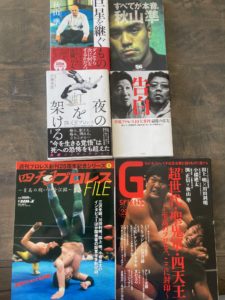
We begin this segment with excerpts from ICHINOSE’s Four Kings bio as he shares some of Akiyama’s documented amateur wrestling achievements. Despite not being seen as big of a name as Jumbo Tsuruta, Genichiro Tenryu, or Hiroshi Wajima, Ichinose concludes Baba had similar expectations of this new signee. Akiyama uses his upcoming press conference with Giant Baba to turn the clock back and explain where how he first got exposed to wrestling. Akiyama cites his grandfather as the one who first introduced him to it and together they’d watch plenty of wrestling back when it aired on primetime TV (APOD: the 50s and 60s in particular were a boom period for puro with Rikidozan becoming a national hero and reigniting national pride in postwar Japan. Since wrestling’s growth coincided with Japan’s postwar reconstruction, millions of people watched Rikidozan’s matches with Japanese and foreign talent). For his part, Akiyama cites the rivalry between The Dynamite Kid and Tiger Mask I as the first feud to really catch his eye and Jumbo Tsuruta hitting Rick Martel with a Backdrop at Wrestling Summit 1990 as his second biggest memory since it “sent chills down his spine”.
The summer before signing with AJPW, Akiyama visits the Capitol Tokyu Hotel, Baba’s favorite resting place. Akiyama was nervous but Baba reassures him that it would be a friendly chat and it was. At the same time, his upper two years at Senshu University aren’t as physical as the first two: he spends his third year wrestling in a limited capacity due to a knee injury which causes his school team to drop divisions. In his fourth he pivots to the captain’s role and split his focus between that and job hunting. He toys with pursuing Olympic wrestling but concludes wouldn’t qualify. In terms of future employment, Baba appears to be very interested in signing him, going so far as to visit Akiyama’s parents’ home to prevent him from following the Senshu-New Japan pipeline. After plenty of soul-searching – and not wanting to end up like the weary 40-year-old salarymen he sees around him on a bus – Akiyama accepts Baba’s offer.
In SINCERE Akiyama describes his first days training. The dojo in this case is a rented house in Aodabai, a sub-district of Meguro in Tokyo, southwest of Shibuya. On his first day he’s introduced to Kenta Kobashi, who oversees his training. Given Kobashi’s documented obsession with training, Akiyama finds himself training in wrestling twice per day with weight training in between and the night session being free training. These combined sessions would go about 5-6 hours per day; by comparison, during NOAH’s early years the daily training time was halved. In INHERIT Akiyama half-jokingly admits that Kobashi’s obsession with training borders on sickness but Kobashi sticks to his inhuman regimen because he feels that if he stops his muscles will atrophy. In hindsight, Akiyama believes Kobashi is truly special because few people, if any, could keep up with him. During his initial training Akiyama struggles keeping up with Kobashi and tears his pectoral muscle in the process since the lack of recovery leaves his muscles too tensed up. Another part of that same training includes 1,000 push-ups per day which is okay for Kobashi but not Akiyama and other “normal” people. There were times when Kobashi would do weight training for seven hours a day and, as his partner, Akiyama was forced to go along (APOD: It still bears repeating but in one of Misawa’s books Toshiaki Kawada tells a joke that sums Kobashi up pretty well: “You don’t need a knife to kill Kobashi, just take away the barbell”).
When it comes to actual wrestling training Akiyama is caught by Kobashi and other unnamed seniors, although in INHERIT he explains that neither Misawa nor Kawada advised him about what to do outside of actual in-progress matches. While he’s taught finer technical details they don’t teach him how to structure a match; that skill he learns from watching and learning from seniors and stealing their techniques. Akiyama notes in SINCERE that the last and final things rookies learn are the techniques for their own offense. In other words, 95-99% of AJPW training centered on building a body that wouldn’t break and taking the opponent’s techniques while going on offense was the remainder. There is an overwhelming focus in AJPW on learning to take moves cleanly but that doesn’t always happen with wrestlers from other promotions. From Akiyama’s perspective outsiders coming into AJPW’s ring would sometimes takes moves sharply or be reluctant to take certain moves, leading to more emotional and chaotic encounters (APOD: This may explain why Baba walled off his garden during the 1990s: not wanting to deal with the usual nonsense of egos and unsportsmanlike arguing, he wanted to cultivate a strong trust in his roster that would lead to harmonious and beautiful matches devoid of the roughness found elsewhere). Akiyama also recalls certain ideas Baba teaches him himself, specifically ideas on how wrestlers are perceived by the audience. Baba emphasizes making yourself look stronger by standing in the center of the ring and having your opponent circle you rather than the opposite or two equal forces circling each other. Such lessons, Akiyama argues, aren’t shared with everyone.
Baba further emphasizes the need for a top wrestler to have class and specifically points out that using kicks doesn’t make one look very strong. Baba cites Kawada’s various kicks as examples and asks Akiyama rhetorically, “He doesn’t look very strong, right?” (APOD: Despite Baba emphasizing during the 1990s that “the fans are our sponsors” there was a disconnect between Baba’s ideals and what his fans wanted. One reason Kawada focused on kicks was to stand out and, to some degree, channel the kick-heavy shoot-style competing with AJPW at the time. But more importantly, Masanobu Fuchi encouraged Kawada to portray a mischievous rascal-like persona and that helped him get over). Despite these gentlemanly undertones, Akiyama finds it hard to lean into Baba’s teaching when surrounded by the Four Heavenly Kings and would continue using kicks since the Kings’ matches were so emotional that being gentlemanly made it harder to keep up with them.
Shifting back, ICHINOSE explains that AJPW’s debutants usually had three possible patterns to follow. The first was for them to immediately start at a high level, as seen with Tsuruta and Tenryu. The second was for them to team with Baba himself, as seen with Wajima and Taue. The third was to start from the bottom and work their way up, as seen with Misawa, Kawada, and Kobashi. Akiyama doesn’t fit into any of these categories; instead, he ends up a special case, debuting on AJPW’s 20th Anniversary show in Korakuen Hall. His match is in the semi-main event opposite Kobashi. Ichinose, who, throughout his book, reveals that he was part of a secret “salon” of reporters and journalists influencing Baba’s booking, confidently argues that Akiyama could handle debuting in such a prominent position. At the same time, Ichinose reveals a secret ambition for this direction: he wanted to emulate something New-Japan-like that had a heavier focus on Young Lions challenging established wrestlers to “stimulate” the hierarchy within the roster. Baba doesn’t agree at first since he worried that a loss in his debut would put a black mark on the golden rookie. But with time he agrees and the match goes on as planned.
In the end Akiyama loses to Kobashi in thirteen minutes and the match gets rave reviews from the press, the fans, and Baba’s inner circle. However, Akiyama believes that his super-rookie hype proved a double-edged sword because he set too high of a bar for himself which caused him to fall into a slump during. Per SINCERE:
“Even though it’s me saying this, my debut match was too good. I feel like I gave not just 100% but 120% of my ability. Looking back now, I realize you shouldn’t reveal everything you have in your debut match. It’s fine to give your all emotionally, but you should hold back on some of your usable moves. Ultimately, the audience sees my 120% as my average performance. That’s why the second year was tough. My first year was good, so the second-year slump came around. I never intended to settle as a mid-carder from the start. I always planned to become a main eventer someday, and Baba-san wanted that too. Maybe because of that, watching the main event matches at the time weighed heavily on me. I wondered if I could ever do something like that.” – Jun Akiyama
APOD: This was an immediately insightful section and I’m glad I chose to cover Akiyama. No disrespect to Jushin Liger but Akiyama’s already far more open and thoughtful with his career trajectory. He’s not being overly humble or diplomatic like some of his peers: while he’s taking the usual approach of criticizing things as they happened to him, he goes deeper with happenings he struggled with and does a better job balancing perspectives to give the reader a wider view of events. Akiyama’s status as the super-rookie is something to be learned from and applied elsewhere: giving someone the monster push from the start rarely works as intended since setting such a high bar from the start leaves far more room for error. Akiyama’s immediate career proves this: despite a strong start in the latter half of 1992 he found himself struggling by 1993 despite constant progress and regular praise from those around him. As we’ll see in the chapters ahead, Akiyama will have a significant mountain to climb if he hopes to reach the same level as the fabled class above him.
As always, thanks for reading.