

5-Star BOOK Reviews: Jun Akiyama’s Books, Part I
By Alex Podgorski on 5 August 2026
Welcome back to my 5-Star Book Reviews series. We’re going back to All Japan and the King’s Road here with a look at none other than Jun Akiyama. Some of you might remember him for his AEW appearances in 2022 and 2024. But more importantly, Akiyama’s best remembered for his work in AJPW, NOAH, and later DDT. He’s one of the most important figures in the King’s Road canon, having been presented as the heir apparent to the Kings’ throne. Yet for one reason or another, his career isn’t seen to have reached those same heights (never mind the fact that he’s still gainfully employed in wrestling and seems to have stability in an otherwise unstable industry). Some people consider him a failed star, one who didn’t grab that brass ring despite such heavy promise during the first ten years of his career. Others have argued that he earned the right to stand alongside the Four Heavenly Kings, with some arguing that he was a better wrestler than Taue and should’ve taken his spot among that legendary pantheon. But as we’ll see, Akiyama has strong opinions about his involvement with that group.
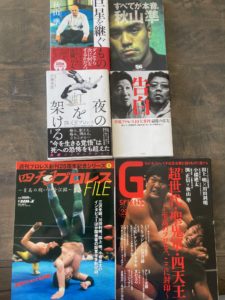
Top Row: Akiyama’s books:
Everything is Sincere, published March 21, 2001; and
Inherit The Giant Stars, published March 31, 2018
Second row: Supplemental Sources:
The Four Heavenly Kings Pro Wrestling: Excessive Innocence Devoted to the Ring by Hidetoshi Ichinose, published February 10, 2019; and
Confession: The Final Truth of the 10 Major Incidents in Heisei Pro-Wrestling by Takarajimasha, published February 10, 2018
Bottom row: Magazines
Weekly Pro Wrestling 25th Anniversary Series 2, Volume 14, Number 5: Four Heavenly Kings FILE Complete Record of Supreme Battles, published August 1, 2008; and
G Spirits Volume 29: Discussion of the Heirs of the King’s Way: Revisiting the Past to Understand the Future, published November 5, 2013
SINCERE is Akiyama’s first book, covering the initial part of his career and his thoughts on NOAH going in a different direction from AJPW’s established canon. INHERIT goes further into his later career and his involvement with All Japan as an authority figure and important bridge between his generation and his successors. ICHINOSE’s book is, of course, the magnum opus of the fabled Four Kings’ wrestling and includes many passages on and from Akiyama not included elsewhere. CONFESSION is more of a tell-all book co-written by various wrestling journalists interviewing different wrestlers. Akiyama’s contributions to that book center on Misawa’s death and how he viewed the 1990s AJPW wrestling style. The Four Kings FILE magazine is, from what I uncovered, Ichinose’s most significant primary source when writing his book and contains some information that might not have made it to the final copy of his work. Lastly, SPIRITS, despite having Akira Taue on his cover, includes a detailed sit-down interview with Akiyama and Masanobu Fuchi in which the two discuss the fabled Shitenno style in yet further detail.
Jun Akiyama was born on October 9, 1969, in Izumi, Osaka Prefecture. There’s was a family of four: Jun, his parents, and a brother six years his junior. At the time Izumi had a rough image with drugs and prostitution readily visible, along with fights between boys from competing schools. Initially only his father worked and made a decent living as a craftsman who made hand-woven carpets. But once automation became the norm his work slowed and soon Akiyama’s mother found work doing some home-based work cutting fabric. Akiyama compares his situation to many of his peers and sees a common theme of wrestlers seeing their parents struggle as children and thus seeking any career path that could repay their parents’ hard work. As a child Akiyama exceled at baseball and continued to well into his wrestling career, which was rare among combat sports athletes.
Middle school was a bit difficult for Akiyama since, on top of the above issues in his hometown, his school was also a bit on the rougher side. Though he wasn’t a full-blown delinquent, he was briefly involved with a crowd that would play a card game at train stations and swindle passersby of money (though not violently or in an organized crime-related way). Akiyama vividly recalls the girls in his school being bigger bullies than the boys, throwing their mandarin peels onto classroom blackboards, openly ignoring and insulting teachers and, in one case, bullying a random girl by stripping her fully nude. This school likewise had some exceptionally strict teachers, including one who’d respond to bad behaviour by slapping students on the butt with his wooden sword.
To avoid falling in with the worst crowds, Akiyama focuses as much as possible on sports and academics. He avoided fights at all costs, with the only exception being group brawls with students, though Akiyama never got caught. He won some of these fights and lost others, though most of these fights started and ended with one punch.
Akiyama starts wrestling in high school and joins the swim club as well, though the latter he only does briefly due to an almost-lifelong fear of water. He recalls visiting a local pool and his uncle threw him without warning in a sort of Spartan-inspired test of fortitude. For some reason this event frightens Akiyama and leaves him having intermittent success with pools, swimming, and water in general (APOD: This will come up again once Akiyama starts wrestling as being in enclosed spaces like showers would cause him problems). While wrestling he notices that his wrestling club and the judo club shared practice space and soon finds himself in both clubs doing both clubs’ training regimens simultaneously. He commits to both, even though this leaves him practicing almost seven days a week but, since his family lacked much money for post-secondary education, he hopes this will improve his chances of enrolling somewhere prestigious or earning a scholarship.
Come his second year of high school, Akiyama has scouts from Senshu University approaching him (APOD: Senshu boasts one of the best wrestling programs in the entire country and included alumni like Hiroshi Hase, Riki Choshu, and Manabu Nakanishi). After attending a training camp in Wakayama, Akiyama’s path to university is all but confirmed. However, he feels bad having to ask his parents to help him pay his tuition. He experiences frustration at first because one of his university seniors tells him he’s “just an extra”. Akiyama reflects on this and compares his experience to then-NOAH rookie Makoto Hashi, who was likewise dismissed as an “extra” since he was in the same generation as standout star Naomichi Marufuji. He concludes that being constantly defeated and relegated to either the sidelines or the bottom of the totem pole gave him the confidence to keep fighting. As proof, six months after joining the university team, Akiyama defeats the same senior who called him an “extra”.
Akiyama sums up his university experience by discussing his championships and accomplishments. He places third in the All-Japan Championships in his first year and in his third year he loses in the finals of the Intercollegiate Championships following knee surgery stemming from training too much. Then he shares an interesting story about sharing a dorm with Nakanishi and on their first night together Nakanishi kept Akiyama up all night watching American porn. Nakanishi isn’t the only NJPW-affiliated wrestler to leave an impact on Akiyama; he also recalls Choshu visiting, doing some coaching, and disciplining Akiyama and the other trainees with his shinai (bamboo kendo sword).
APOD: This seems like a good place to stop for now. This section gave us a brief introduction to Akiyama’s early life and amateur wrestling days. He painted a picture of growing up in an unflattering city at a time when Japan was experiencing a grittier, tougher economic shift. Akiyama, like many wrestlers, sought to overcome a difficult childhood and give his family a better life. Though his childhood wasn’t as tragic or adversity-filled as the Four Kings, he was still ambitious enough to focus on escaping and rising above his surroundings. The most notable detail in this section, in my opinion, concerns Akiyama’s fear of water, which would manifest even whenever he got splashed in the face. This will manifest itself more than once, especially once he starts flirting with the main event scene in AJPW.
As always, thanks for reading.