

5-Star BOOK Reviews: Jumbo Tsuruta’s Books, Part II
By Alex Podgorski on 22 December 2025
This next section of Jumbo Tsuruta’s books will cover his time training for, and then participating in, the 1972 Munich Summer Olympics. This was a goal Tsuruta set for himself years earlier as he wanted to both achieve something big and negate some negative perceptions people had developed towards him. However as we will Tsuruta’s time at the Olympics wouldn’t bear that much fruit while a chance conversation would lead him down a new career path once his university life ended.
You can read part 1 here.
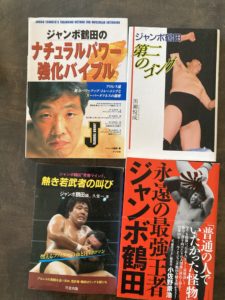
In April 1969 Tomomi Tsuruta was accepted into the highly prestigious Chuo University Faculty of Law, Department of Political Science while still aiming for the upcoming Munich Olympics. His academic path was meant to help build his post-Olympic life as he didn’t want to be pigeonholed by athletics-based careers like many other who attended a school centered on physical education. Because his family wasn’t all that wealthy, Tsuruta chose to stay with nearby relatives who operated a buildings material business. Though he didn’t have to pay room and board, he did contribute by transporting cement and gravel to and from construction sites on days off from classes and basketball practice. In BIBLE Tsuruta describes how each bad weighed 50kg but he was strong enough to stack two on top of each other and carry them at the same time. However, despite a quick progression onto the university’s basketball team, Tsuruta soon found himself outclassed when playing basketball against foreign teams.
As Tsuruta looked to pivot towards an individual sport in order to qualify for the Olympics, he began selecting one sport after another. First was judo but that quickly proved to be the wrong option due to a wide field of opponents and competitors muddying his viability as a top candidate. Then there was boxing but this had the opposite problem: a thin pool of candidates and the fact that the Olympic committees were only looking for middleweights and Tsuruta was too big. This left one option: wrestling. However, the basketball team wouldn’t let Tsuruta join the wrestling team out of fear of potential damage to their reputation. This was confirmed by Makoto Kamada, one of Tsuruta’s classmates at university, a multi-time serving councilman in Iwamisawa City, and one of Tsuruta’s teammates at the Munich Olympics. Kamada explained in ETERNAL that the previous story that had gone out was that Tsuruta was rejected by the wrestling team for allegedly not being too weak-willed (if he couldn’t handle basketball, how could he handle wrestling?). But since Tsuruta was so big, the wrestling team was very enthusiastic about having such a heavyweight on their team, so of course the basketball team didn’t want him leaving them either. Also, in BIBLE Tsuruta notes that, like Kobashi later on, it was in his personality that if someone told him ‘no’, he’d get more fired up and want to do that same thing even more.
Undeterred, Tsuruta began wrestling training at the Self-Defense Forces Physical Training School in Asaka, Saitama Prefecture. he also trained at a YMCA in Kanda, Tokyo, and by chance got to witness Antonio Inoki reveal the cobra twist (abdominal stretch) for the first time. These daily six-hour training sessions were overseen by Tatsuo Sasaki, himself an accomplished amateur wrestler in Japan and having competed in the 1964 Olympics in Japan and the 1968 Mexico Olympics. He was also active for the Munich Olympics and ended up competing alongside Tsuruta, Masa Saito, Thunder Sugiyama and Riki Choshu (who ended up representing South Korea). In BIBLE Tsuruta describes receiving his Olympic confirmation letter as a mix of “of course” and “is this really true?”, trying to show as much public confidence as possible.
Though Tsuruta’s life in the Olympic village was initially satisfying the rest of it was marred by the terrorist incident of the Munich Olympic attacks. Because some of the victims of that attack were wrestlers Tsuruta’s competition bracket changed. In the end Tsuruta ended up facing Polish competitor Edward Wojda and Czech competitor Petr Kment and lost to both due to lost points from the official. The rest of his experience is described in ETERNAL: he also lost to Hungarian wrestler József Csatári and Yugoslav wrestler Ištvan Semeredi, leaving his Olympic debut without any wins. Though Tsuruta admits he had the physical bulk needed to perform at this level he noted his own lack of technique and an inability to compete in international tournaments as reasons for his lack of refinement and understanding of the rules. One of Tsuruta’s fellow competitors, Yoshihide Isogai, a highly accomplished Japanese amateur wrestler, also noted that on the Olympic stage the distinction between freestyle and Greco-Roman wrestling blurred with the techniques used borrowing more from Greco. Although Tsuruta had trained in both styles, in the lead-up to his Olympic debut he focused more on Greco-Roman since freestyle focused on lower back takedowns while Greco focused un underhooks. His coach also recommended he focus on Greco since the 100kg division had few contenders his size and no upper weight limit, which allowed Tsuruta to continue eating and bulk up until he surpassed 120kg in weight. Still, his lack of exposure to international ranks proved his undoing; that said, Tsuruta does promise himself that he’ll win a medal in four years’ time when the Olympics take place in Montreal.
(APOD: This might not seem like much since most of us have come to understand “pro-wrestlers at the Olympics” through the prism of Kurt Angle but the truth is that Angle is a one-in-a-billion exception. Though Tsuruta’s lack of accomplishment might seem insignificant, Angle achieving what he did is extremely rare. Additionally Tsuruta was more of a multidisciplinary athlete who was splitting his time between different sports and other activities while Angle devoted himself to wrestling almost exclusively. The fact that Tsuruta even made it to the Olympics in the first place despite his noted lack of international placement speaks volumes to his raw talents).
On the flight back to Japan Tsuruta found himself sitting next to a member of the Gold Medal-winning Japanese Olympic volleyball team and eventually the two became close enough to chat casually. Tsuruta, being big, tall, and springy, thought he’d join a volleyball team once he returned home but this player, Seiji Oko, suggested Tsuruta try pro-wrestling instead. Unfortunately, Tsuruta suffered a tragic loss as his father, who was fighting pancreatic cancer while his son was competing in Munich, passed away the day after Tsuruta returned. From what his family told him, Tsuruta’s father clung to a handheld radio as much as possible listening to matches and cheering him on as much as possible.
After mourning his father, Tsuruta found himself weighing his options. Aiming for participating in the 1976 Montreal Summer Olympics would require him to enter the Self-Defense Forces Physical Education School and stay there after the Games as a wrestling coach. He couldn’t really get into his family business since he was the second son and thus ineligible for inheriting and since his older brother was already in that position. This left him to pursue professional wrestling. And while his mother was strongly against it – largely stemming from the public’s negative perception towards it at the time – Tsuruta made up his mind and decided to meet Giant Baba to begin the next chapter of his life.
APOD: Given how much attention many people have given Tsuruta’s status as an Olympian I wanted to see how those experiences shaped his pro-wrestling career. On one hand it’s a bit disappointing that Tsuruta, this legend of a man touted as an exceptional human specimen, didn’t actually achieve all that much on the Olympic stage. On the other hand, there’s plenty of context to understand why he couldn’t meet through-and-through dedicated amateur wrestlers who trained day and night. There wasn’t all that much surprising here save for the fact that Tsuruta’s foray into professional wrestling seems to have been initiated by a chance meeting with a fellow Olympian. So in a way Jumbo Tsuruta going to the Olympics didn’t serve as a direct path into pro-wrestling it still set him down that road in a different way than expected.
As always thanks for reading.