

5-Star BOOK Reviews: Jumbo Tsuruta’s Books, Part I
By Alex Podgorski on 18 December 2025
AJPW’s Four Heavenly Kings owe much of their success to Jumbo Tsuruta. Without him their careers wouldn’t’ve ever reached the same heights. This isn’t only due to Tsuruta’s in-ring accomplishments; it’s also due to his sudden departure from the ring in 1992 due to illness. This proved to be a double-edged sword: while it put the spotlight squarely on the Four Kings as AJPW’s central quartet, it also changed the course of wrestling history since Tsuruta never well and truly passed the torch to them in the ring. In any case, for a critical period from 1990 to 1992 Tsuruta was the absolute monster that the Four Kings chased. As such most people these days know Tsuruta in relation to them. In truth Tsuruta is much more than that. As we will see from his writings and what people have written about him, Jumbo Tsuruta is one of the biggest wrestling stars of the past fifty years in more ways than one.
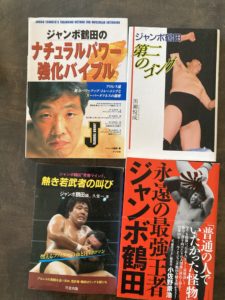
Clockwise from top left:
Jumbo Tsuruta’s Natural Power Strengthening Bible by Tomomi Tsuruta, published April 20, 1999
Jumbo Tsuruta’s Second Gone by Yoshinari Kurose, published March 31, 1999
Eternal Strongest Champion Jumbo Tsuruta by Kagehiro Osano, published May 30, 2020
Jumbo Tsuruta: The Cry of the Passionate Young Warrior by Misao Kasakura, published November 25, 1983
BIBLE is an unusual book; as its name implies it’s less an autobiographical piece and more of a pro-wrestling guide from a practitioner’s perspective with specific instructions on how to train the body, do certain moves, and focus on specific muscles to execute pro-wrestling properly. It also contains some interesting anecdotes from Tsuruta on everyone from trainers and veterans above him, to his contemporaries, to those below him. GONG is something of a career retrospective written by a wrestling journalist going over his biggest accomplishments and a few key anecdotes from his childhood. CRY is something of a mid-career review, looking at Tsuruta’s accomplishments up to 1983. Lastly, ETERNAL is the mammoth volume written by Kagehiro Osano, the same journalist who wrote the five-star book about Mitsuharu Misawa and contributed significantly to Akira Taue’s 2023 autobiography.
Tomomi Tsuruta was born on March 25th, 1951, in what is now Yamanashi, Japan, an area that apparently had about 2,000 people named “Tsuruta”. The name “Tomomi” is more of a feminine name and his parents gave it to him because he had a low birth weight which gave him more of a feminine appearance at first, along with a tendency to easily get colds. However, by the time he entered elementary school he was already far bigger and more robust than most of the kids his age. This growth came from the fact that he had to go up and down the same slope of a street surrounded by rice fields that young Tomomi would take to go to and from school everyday. This continued into his teens: his elementary school was 1.1 kilometers away and his junior high school 1.3, both being at 90 meters of elevation from his home. In BIBLE Tsuruta himself notes that his mother was tiny but his dad was fairly big for a Japanese man, standing at 179cm and weighing 90kg. Tsuruta also notes that his family also had a small ranch on their land which allowed him basically get unlimited milk. He notes that on average he drank 1.8 litres of milk each day.
When Tsuruta wasn’t running home from school, he was helping his farming family with odd tasks, usually involving lifting or carrying things. It’s noted in GONG that these experiences would later serve as the foundation of Tsuruta’s master’s thesis on scientific training methods while attending Tsukuba University Graduate School:
“Rather than training with equipment like barbells or at athletic gyms, I believe that using the natural environment and training in everyday life increases physical strength. I felt this from my past experiences. Muscles built naturally do not fade quickly. Muscles built artificially with barbells may look strong but quickly become stiff, lack flexibility, and cannot keep up with varied movements. Moreover, if one neglects training, they can fade away in just one or two weeks.” – Jumbo Tsuruta’s Master’s Thesis
In terms of someone who embodies this idea, Tsuruta cites Dutch judoka and fellow Olympian Anton Geesink as his inspiration.
In ETERNAL, 17-year-old Tsuruta found himself unintentionally forced into sumo wrestling. While accompanying a sumo-loving relative sightseeing through Tokyo, the two ended up at a sumo dojo and Tomomi, without realizing it, passed the dojo entrance test. However, through some miscommunication Tsuruta wasn’t allowed to leave and thus spent most of a summer at this dojo training in sumo. Further fanning the flames was that one of his uncles had competed in sumo with one stable and Tsuruta was interested in switching to a different one, a big no-no in sumo. He also learned soon into this training that he wouldn’t be able to balance training with academics which went against Tsuruta’s own ambitions. In the end he managed to leave but it cast a shadow over him as someone who “ran away”, which led to some cold stares from those around him and a presumption that although he was big, he didn’t have any guts.
Tsuruta’s salvation came from an Olympic procession that he saw on TV. Wanting to redeem himself, Tsuruta turned towards whatever sports that could get him into the Olympics. First he played basketball at high school and university, along with track and field. His had once expressed interest to become a sumo wrestler, but the incident above changed his mind. In a somewhat ironic twist, in GONG it’s noted that in his critical high school years his grades in English and Japanese weren’t all that good, and yet he’d go on to not only get his master’s thesis published but he’d go on to become a university lecturer in both Japan and the United States. Tsuruta also played baseball for about six months and did decently well but didn’t continue due to his poor eyesight.
Tsuruta played basketball for three years, becoming a standout in the intra-high school system and became the central force in his high school going undefeated for three years in the Yamanashi Prefecture. as he grew into a high school senior he also played as a lock in rugby and placed third in a high school-level sumo tournament after only a week of training. Tsuruta found these experiences in various sports critical to his pro wrestling career, stating in ETERNAL,
“In basketball, I developed body balance, quick movements, endurance, and jumping ability. The ability to structure a game with a momentary flash of inspiration also helped me after becoming a professional wrestler. My experience in rugby was beneficial for wrestling. The way to tackle in rugby and the ability to read the opponent’s movements could be applied to wrestling tackles.” – Jumbo Tsuruta
However, despite his success in all these sports Tsuruta’s school life also had some drawbacks. Tsuruta recalled having a complex for being big because he stood out and thus became the center of attention without wanting to. This manifested in the form of a stutter and a struggle with him making friends. However, once the prospect of competing at the Olympics reappeared in his mind Tsuruta was able to focus solely on that and ignore those other drawbacks wherever he could.
APOD: This seems like a fitting place to stop for now as the next section will cover Tsuruta’s more direct involvement with the Olympic world. I think this section was very interesting because it served as a fantastic starting point on how Tsuruta became such an incredible wrestling athlete. It shattered the preconception that Tsuruta was always an elite and showed how he became physically strong through everyday tasks that built his body naturally. This mindset would follow Tsuruta for most of his life and would explain why he was so good at so many different sports and aspects of pro-wrestling.
As always, thanks for reading.