

5-Star BOOK Reviews: Jumbo Tsuruta’s Books, Part VIII
By Alex Podgorski on 2 March 2026
Last time we looked at Jumbo Tsuruta’s career he was dealing with a torrent of criticism from all sides. This next section covers how he and the powers around him dealt with that, along with some more context to the power plays that he got caught in and the specific lessons he got from one of the greatest wrestlers of all time.
You can read part 1 here, part 2 here, part 3 here, part 4 here, part 5 here, part 6 here, and part 7 here.
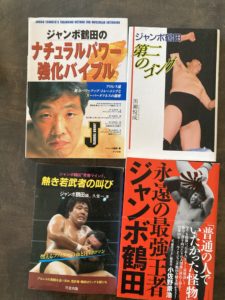
We open with Osano talking about an incident in 1977 that was buried and not revealed to the public until the 2000s. Osano learned from Kabuki that one of Baba’s younger assistants named Tomotsugu “Samson” Kutsuwada wanted to start a new organization by rallying behind someone named Ryoichi Sasakawa who was a political and financial power broker with ties to Japanese right-wing parties. Osano alleges that Tsuruta was involved in this plot but Baba found out. Yet Baba only fired Kutsuwada and told Tsuruta he’s wouldn’t be fired because “he’s special”. As a result, Baba removed Tsuruta from any players’ association roles (APOD: the closest thing to a wrestlers’ union) and Tsuruta never went against Baba’s wishes ever again. According to Kabuki, whenever the AJPW went on regional tours and meet with local promoters or businesspeople, Tsuruta would stay behind at hotels.
However, Masanobu Fuchi has a different perspective. Since he was closer to Tsuruta than anyone else, Fuchi suspects the whole thing wasn’t serious from the start but just talk from the various affiliated parties involved with Baba like a gym owner, a printer of pamphlets and, allegedly, NipponTV. According to Osano in ETERNAL, by piecing everything together, the grand plan, had it gone through as alleged, would’ve seen Sasakawa provide billions of yen to force both Baba and Inoki into retirement and established a new era of professional wrestling with Tsuruta as the (sole) ace.
This situation leaves Tsuruta isolated, especially with Kabuki going to the States to train and Thunder Sugiyama quitting AJPW after being demoted to non-wrestling activities (APOD: reading between the lines here it becomes clear that Baba’s public statement were often half-truths at best and outright lies at worst when it came to talent management or anything that risked tarnishing his image). As for the big question, why Baba forgave Tsuruta, Osano suspects that Baba’s pride and his determination to maintain a public image opposite that of scandal-ridden Inoki convinced Baba to let this slide. In another odd twist, Baba also forgave Tsuruta to such a degree that he began treating Tsuruta favorably by appointing him president of an AJPW-affiliated company called B&J (Baba & Jumbo). B&J’s primary focus was transporting and setting up rings, which had previously been outsourced to a third-party transport company.
Talk of this affiliated organization opens the door to an issue discussed at length in my Misawa book reviews: about how AJPW was divided up into lesser entities under one parent company. A major reason for Misawa’s NOAH Exodus was his lack of control over finances and how the Babas’ confusing command structure made it hard for him to properly budget for the future. It turns out Tsuruta experienced these same problems as well. Even though he was appointed president of this B&J enterprise he had no authority. Motoko Baba’s stance on the whole thing was, allegedly, “We’ll handle it until he understands.” Tsuruta understood this to mean he was merely a figurehead and when the employees of B&J expressed real concerns to him he answered earnestly telling them he had no legitimate decision-making authority. Kyohei Wada appears again here and recalls Motoko once telling Misawa something similar, in that typical Japanese ambiguity, “Just wait a little longer, and once you understand everything, I’ll hand it all over to you”. (APOD: In other words, it seems like Motoko was testing Misawa to see if he had the chops to actually manage an organization. That might seem like a good idea on paper but in doing so she was playing with wrestlers’ lives and livelihoods. Add to that the overwhelming stress of being a wrestler in general and the continued fallout from Giant Baba’s death and you have an obvious recipe for disaster that Motoko herself should’ve seen coming).
The discussion shifts to a change in AJPW management with Baba stepping down as the company’s representative director and Mitsuo Matsune, the former head of NTV’s sports department, taking the role instead. Baba remains chairman while a few more TV executives becoming involved as well. And much to his disappointment, Tsuruta is brought into this management circle as well. At one point the suits ask Tsuruta if he can be “on top”, which in this case means not only the in-ring ace but also responsible for things like recruiting foreign wrestlers and matchmaking. Tsuruta quickly and decisively passed those responsibilities onto his senior Akio Sato. Tsuruta purportedly acted all gloomy and melancholic during this period, which the suits took as a lack of ambition. Had Tsuruta been more ambitious, they argue, “All Japan might have changed”.
There’s a brief note on wrestling booking and how Sato learned the management and structural sides of pro wrestling from George Scott, the booker for Mid-Atlantic. Under Sato’s booking, the seniority system is removed from All Japan and priority is placed on developing younger talents while Tsuruta and Tenryu are built as the promotion’s two main pillars. Osano also notes that Sato had a spell booking CWA for Jerry Jarrett and had been scouted by Vince McMahon Sr. to become WWF’s expansion coordinator. Osano credits Sato for putting together the WWF/AJPW/NJPW Wrestling Summit in Tokyo Dome show. These factors serve to explain why Tsuruta chose Sato to book: he had more experience in the role and had a better understanding of American talent.
Tsuruta’s experiences with that 1977 coup and his powerlessness as a figurehead for B&J formed his bias against anything not directly related to wrestling in the ring, all of which he combined under the umbrella of “troublesome matters”. But trouble continued to follow him as he also kept receiving offers from other organizations. NJPW tried to recruit him in 1983 through Hisashi Shinma along with Tiger Toguchi and later Abdullah the Butcher, using newspapers and journalists as de-facto intermediaries. While Toguchi and Butcher went to NJPW for at least one tour, Tsuruta refused and told Baba of the incident. Another offer came from UWF and Tsuruta’s senior from Chuo University Nobuo Urata. However, once again Tsuruta stayed with All Japan despite the various internal conflicts therein.
With Tsuruta choosing to focus on in-ring excellence exclusively, plans are put in place to turn him into a true ace. Thus he changes his attire to black trunks and boots, feeling that the brighter color scheme made him look too youthful and less serious (APOD: A similar piece of advice would later be taught to Toshiaki Kawada and lead to his adoption of his trademark black & yellow tights). Additionally, the image of black trunks was, at the time, specifically associated with Rikidozan and so NTV were looking to channel that image with this new Tsuruta. Although he loses to Ric Flair in the typical two-out-of-three falls match, his performance was seen as an improvement from before.
Following this match Tsuruta would have one of the most important lessons of his life by sparring with Lou Thesz himself. These lessons took place between late 1982 and early 1983, during which time Thesz taught Tsuruta how to do his Greco-Roman Backdrop and his Flying Body Scissor, a.k.a. the Thesz Press (APOD: This was an enormous deal since, in Japan, there was still this mindset of moves being inherited or passed down from master to student). These moves, along with the original powerbomb, were known as “Thesz’s Three Sacred Treasures”. Between April 30th and May 5th of that year, Tsuruta fine-tunes his Backdrop so that it is as close to identical to Thesz’s as possible. Additionally, Thesz explains the origins and lineage of his Backdrop and how the move became so important over time:
“The foundation of my wrestling is Greco-Roman style, taught by my father, Martin Thesz. I learned the Greco-Roman backdrop from George Tragos in the U.S. I was also taught a style of backdrop by Dick Schikat, where you forcefully lift the opponent by inserting your left hand into their groin and throw them backward, while I was circuiting New York in 1935 after turning pro. Furthermore, during an expedition to San Francisco in 1938, I learned the judo back throw from Ad Santel. The back throw shares commonalities with the Greco-Roman backdrop in terms of timing and the throwing point. I learned the timing of the throw from Santel. Therefore, I believe that the backdrop I completed in my own style combines the Greco-Roman backdrop, the backdrop taught by Schikat, and the timing of the back throw.” – Lou Thesz
The combination of Rikidozan’s trademark black trunks and Thesz’s Backdrop cemented Tsuruta as the new ace of All Japan. Incidentally, here is Tsuruta’s professional analysis of Lou Thesz, per BIBLE:
Lou Thesz
Real Name: Aloysius Martin Thesz
Date of Birth: April 24, 1916
Special Move: Back Drop
Hometown: Missouri, USA
Height: 191 cm
Weight: 110 kg
At the age of 8, he began learning amateur wrestling under the influence of his father, a Hungarian amateur wrestler. He entered professional wrestling upon graduating high school. He developed the back drop by mixing the suplex from amateur wrestling with the rear throw from judo.
In 1937, at the age of 21, he became the world heavyweight champion, going on to hold the NWA World Heavyweight Championship six times, maintaining the belt for a total of 12 years and 9 months. He also achieved the remarkable feat of 936 consecutive wins from January 1948 to March 1955.He first came to Japan in October 1957 and faced Rikidozan for the world heavyweight championship. After receiving the baptism of the backdrop for the first time in Japan, Rikidozan reportedly said after the match, “I didn’t know what was happening. Everything went dark in front of me. Then it was a bright red fire. I just looked into hell today.”
He is one of the strongest wrestlers in history, possessing steel-like muscles and intricate technique.Lou Thesz left an immortal record of 936 consecutive wins. Although I have never actually participated in an official match, I witnessed his true power during practice. He could be called the strongest champion in professional wrestling history.
I have wondered where the secret of Thesz’s unfathomable strength lay. He was not particularly large for a wrestler, nor was he muscular. Rather, he even gave a slender impression.
However, his actual muscle strength was remarkable compared to his appearance. When I grappled with Thesz, I felt a tenacity that was extraordinary.
It was as if there was thick piano wire inside his body. When he came to Japan, Thesz performed a feat where he grabbed a pillar with both hands, lifted both legs up, and astonishingly matched a peak wrestler for a duration.
At that time, Thesz must have been well over 60 years old, but the sharpness of his small arc backdrop remained intact. Even after aging and no longer headlining matches, he must have diligently trained his abdominal and back muscles to maintain the power of his signature move. Thinking about that, my astonishment turned into admiration.
When I fought against him, he was young, and his physical strength was remarkable. He was a wrestler weighing over 100 kg, not just a light gymnast. There was no other way to describe it than as fearsome muscle strength.
During Thesz’s heyday, modern strength training methods had not yet been established, but from Thesz’s attitude, one could sense a philosophy that there is a way for wrestlers to train their bodies in their own manner. However, Thesz hardly did any strength training using equipment like barbells. His training mainly consisted of orthodox push-ups and squats.
Speaking of Thesz, here is another direct copy/paste from BIBLE, this being Tsuruta’s detailed description of how to do a Thesz-style Backdrop, complete with descriptions of which muscles need the most work:
It is a move where you lift the opponent’s body, arch your own body backward, and slam the opponent down. It is famous that “Iron Man” Lou Thesz developed this move, inspired by the amateur wrestling “arching throw.”
Dory’s style of backdrop is to lift and then “throw slowly, big, and beautifully.” It was a backdrop with high artistic value. I always thought that was the correct way, but when I saw Lou Thesz’s backdrop during his visit to Japan, I was deeply impressed. The secret Thesz taught me was “throw with your navel.” In other words, rotate your body compactly, as if your navel draws a small arc.
With this way of throwing, the opponent has no time to break their fall, so the damage inflicted is great. Since I am tall, sometimes the backdrop gets too steep depending on the opponent, so I adjust the way I throw.Arm Muscles
The biceps and brachialis are used to firmly hold the opponent’s body.Abdominal Muscles
The rectus abdominis and internal/external oblique muscles make the movement from holding the opponent to arching your back powerful, giving impact to the backdrop.Back Muscles
The latissimus dorsi and teres major are used when pulling the upper arms holding the opponent backward. The erector spinae muscles are used when forcefully arching the back.
APOD: This was a shorter section to emphasize Tsuruta’s commitment to wrestling and how he would focus on being the ace everyone wanted him to be. But to do that he had to undergo major changes, both physical and mental. He had to change his attire, adopt new moves, and turn away from having his attention split between wrestling and other matters. With Tsuruta as ace the idea of a wrestler also being a manager/behind-the-scenes figure was over, at least for the moment. And throughout all of this, it’s clear that Lou Thesz was a major force behind Tsuruta’s transformation from lovable loser to true wrestling master, so much so that I had to include as many direct references to Thesz and his techniques as possible.
As always, thanks for reading.