

5-Star BOOK Reviews: Jumbo Tsuruta’s Books, Part III
By Alex Podgorski on 30 December 2025
This next section covers Jumbo Tsuruta’s training in the United States, in particular, what he learned from Americans. Like most wrestlers, Tsuruta went on foreign excursion to gain a broader perspective by experiencing American wrestling firsthand. As luck would have it, Tsuruta would receive training from one of the most revered and respected wrestling families of all time in the Funks. His lessons from that legendary family, along with the wrestlers in their employ, would prove critical to Tsuruta’s understanding of his chosen profession.
You can read part 1 here and part 2 here.
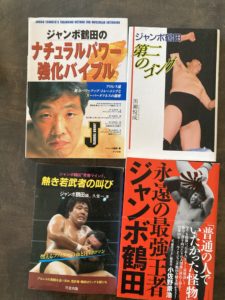
In ETERNAL we get a brief explanation of the state of wrestling around 1972/3 when Tsuruta was contemplating becoming a wrestler. At the time there were not two but four promotions: Japan Pro-Wrestling/Japanese Wrestling Association (JWA), International Pro Wrestling/International Wrestling Enterprise, New Japan Pro-Wrestling, and All Japan Pro-Wrestling. Central to the Baba/Inoki rivalry were the TV stations backing them, with Nippon TV backing Baba and NET (now Asahi TV) backing Inoki. In addition, of these four promotions, AJPW was seen to be the most stable since it had the backing of then-NTV president Kozo Kobayashi, who had a direct line to Baba and influenced some of his decisions.
After finishing with the Olympics, completing his university studies, and talking with his older brother about how wearing trunks is better than wearing a mawashi, Tsuruta announces his plan to become a professional wrestler under Giant Baba. However, his wrestling coach and colleagues oppose this, save Ichiro Hatta, the president of the Japan Amateur Wrestling Association who supports him and says, per BIBLE, “Why not, Tsuruta? If you become a professional wrestler, you’ll be a pro.” Tsuruta gives significant credit to Hatta since he had a “progressive” way of thinking as he saw amateur and pro wrestling as one big sport. This would later blend into Tsuruta’s career-long mantra of amateur wrestling thriving so long as pro-wrestling thrived and vice-versa in sort of longstanding symbiotic relationship.
When he actually makes the public announcement, the way he presents his decision is given significance: with Japanese being a very complex language with dual meaning or various underpinnings in word choice, Tsuruta doesn’t refer to his decision as “joining an organization” but “employment at a company”. He wants to frame his decision as being a mix of athlete and salaryman, suggesting that he will be with Baba for a very long time.
At the time AJPW only had eight wrestlers: Baba, Thunder Sugiyama, Masahiro Komatsu, Genichiro Tenryu, Samson Kutsuwada, Akio Sato, Mitsuo Momota, and Seiji Sakaguchi. This, coupled with its status as a new organization, gave Tsuruta the impression that there was no typical Japanese hierarchical structure and more opportunities for advancement and this less strict structure appealed to Tsuruta’s individual personality. Tsuruta was also reassured because Thunder Sugiyama was there since he competed alongside Tsuruta in the 1972 Munich Olympics. Once on the roster Tsuruta found himself comfortable doing things that the others could not. In particular Tsuruta was able to execute the Lou Thesz Greco-Roman Backdrop and other suplex variations that the others couldn’t do. Tsuruta also notes that, at the time, AJPW broke away from old traditions (APOD: which would end up being rather ironic given its 1990s shift to one of the most conservative wrestling products in the world).
At the time AJPW didn’t have a training facility so some of the initial training took place at a local kickboxing gym called Yamada Gym and the promotion’s “office” was located at Baba’s rented apartment in Mejiro. While here Tsuruta was given foundational training on pro-wrestling which was built on the concept of “receiving”, i.e. taking all the opponent’s moves which, as described in these Tsuruta books and in many other Japanese language wrestling books, is a concept unique to pro-wrestling and not seen in other sports. Baba’s motto on this was: “Anyone can attack, but a professional wrestler must be able to take any move from the opponent cleanly, and to protect one’s own body, one must acquire the skills to handle being taken down from any position.”
In addition Baba also placed emphasized rope work so that the wrestlers could move freely in the ring and have a better understanding if their own space inside the ring. As it turns out rope work is a lot more intricate than it looks: it takes extensive training to learn how to hit the ropes, the takeoff with the feet, the number of steps to make it look clean, and the direction to run after the tackle. Tsuruta learned these concepts from Masio Koma who also trained Masanobu Fuchi. When Tsuruta wasn’t being trained in the ring by Koma Baba was teaching the young kid from a rural background about table manners, etiquette, and how to dress in formal attire. Baba wanted Tsuruta to come across as a star and conduct himself accordingly so that he would have more of a distinguished presence when in public.
After getting his foundation set in AJPW, Tsuruta went to train under Dory Funk, Sr. at the Western States Sports Promotion in the Amarillo territory. There is a small factual contradiction here as in BIBLE Tsuruta notes his first opponent is Canadian wrestler Moose Morowski, in ETERNAL it’s described as prelim wrestler El Tapia, and on Cagematch it’s described as Stan Hansen. Tsuruta would ride to venues with referee Ken Farber and since the ref had to arrive before everyone else and leave after everyone else, Tsuruta would watch all the other matches after his was done. Tsuruta gives lots of credit to the Funks for teaching him important lessons on how to think while performing in the ring:
“A professional wrestler is not only fighting against their opponent but also fighting against the fans watching. The entertainment aspect of entertaining the fans is also important. It’s essential to watch other wrestlers’ matches and hear the cheers of the audience.” – Dory Funk, Jr. in ETERNAL
“Terry taught me to “read the audience’s psychology.” He told me to observe what kind of attacks the audience responds to, and build my own style based on that. My selling points were my youth and energy. I was also advised to acquire fast and brilliant techniques to attract younger fans.” – Jumbo Tsuruta in BIBLE
In addition, Dory Funk, Jr. describes his father praising Tsuruta after such a short time since he seemed to take to pro-wrestling like a fish to water:
“After watching Jumbo’s moves, my father (Senior) would pat Jumbo on the shoulder, shake his hand… and then he started giving him numerous opportunities. Jumbo was one of the few natural talents who could do it from the start. His background as an Olympic representative in Greco-Roman wrestling was significant.” – Dory Funk, Jr. in ETERNAL
In ETERNAL Dory Jr. is credited with teaching Tsuruta other basic wrestling techniques that were outside of Tsuruta’s amateur-inspired repertoire. Dory references how, like he did with Kurt Angle once he signed with WWE, he encouraged Tsuruta to use what he learned in the amateur world and would then fill in any gaps with his own knowledge of wrestling techniques. Dory ended up teaching Tsuruta the front suplex, side suplex, and double-arm suplex, along with the arm drag (called the Cyclone Whip at the time), the latter being a very important technique to AJPW and later NOAH cannon as Baba emphasized the importance of being able to perform a “beautiful” arm drag. In addition, Dory suggested that Tsuruta steal good techniques from various wrestlers so that he could pass those on to other wrestlers once back in All Japan.
Once he completed training Tsuruta began wrestling in front of live crowds in Amarillo as ‘Tommy Tsuruta” since Americans struggled to pronounce “Tomomi”. But what was unique to Tsuruta was that he wasn’t booked as either a babyface or a heel, bucking the typical trend of making Japanese foreigners as token heels. Dory credits this to Tsuruta’s Olympic experience as, to him, it would be hard to boo a known Olympian. For the first little bit Tsuruta’s wrestling schedule was as follows: Monday = El Paso, Texas, Tuesday = Odessa, Texas, Wednesday = Lubbock, Texas, Thursday = Amarillo, Texas for daytime TV studio recording & night matches at the Amarillo Sports Arena, Friday = Abilene, Texas, Saturday = every other week in Hereford, Texas, Colorado Springs, Colorado, Sunday = Albuquerque, New Mexico or Clovis, New Mexico. At some point Tsuruta “graduated” from riding with the referee to riding with Terry. It was during those long rides that Terry shared his knowledge and experiences with Tsuruta, regardless of whether or not Tsuruta fully understood what Terry was saying. This led Tsuruta to conclude that,
“The American dojo is the backseat of the car during the circuit. When traveling for hours, senior wrestlers share the history of the industry and details about matches. This way, the new boy gains respect for the industry and for his seniors.” – Jumbo Tsuruta
Tsuruta improved so quickly that, after only three months, Dory Sr. concluded that there was nothing left to teach him. This would be later told to Genichiro Tenryu when he went on excursion to the same territory. The Funk patriarch was so impressed with Tsuruta that he called him “fantastic” which was the highest compliment he could possibly give. Sadly, Tsuruta was present for Dory Sr.’s sudden passing when Dory died of a heart attack on June 3, 1973. According to Tsuruta, Dory Sr. was hosting a party and as part of the entertainment he started doing some friendly shoot wrestling with his guests. At some point he put someone named Sonton in a front face lock and was in high spirits. But just 15 minutes later he went outside told his wife “I think I might have a heart attack so please tell Terry. But I don’t want anyone else to know so don’t tell anyone else.” Unfortunately Dory passed away on the car ride to the hospital.
After Dory’s passing Dory Jr. took over the Amarillo territory and continued to have Tsuruta work for him. Tsuruta scored victories over the likes of Mac Quory, British wrestler Black Angus Campbell, and a pre-WWF Greg Valentine. He drew against Dory in an NWA World title match and against Nick Kozak for the NWA TV Title. He also suffered losses against both Dory and Terry as well as Karl Von Steiger, Cyclone Negro, Killer Karl Cox, Killer Karl Krapp, Dick Murdoch, and the masked wrestler The Patriot (not Del Wilkes but an older wrestler known as Bobby Hart). Another important figure in Tsuruta’s early years was Gordon Nelson, a renowned shooter who represented Canada in freestyle wrestling at the 1952 Helsinki Olympics, a longtime opponent of famous British shooter Billy Robinson and, at the time of Tsuruta’s Amarillo excursion, the territory’s “policeman”. Tsuruta also received lessons from Moose Morowski who served as both Tsuruta’s opponent and partner in different settings. Stan Hansen, who ended up in the same territory around this time, recalls what some of those lessons looked like:
“It was lucky for me to learn from great professionals like Karl Von Steiger, Moose Morowski, Cyclone Negro, and Gordon Nelson. They taught me various things while pushing me during matches in front of the audience. They gave me lots of advice like ‘do this, do that’ during the matches, but more importantly, they taught me the crucial lesson of ‘whatever you do, absolutely do not do this!’ That was extremely helpful. It was an unspoken rule… that is, I learned through my body that you must not injure your opponent. You can hit and kick the places you train, but you must not attack the vulnerable spots. When I mistakenly attacked a forbidden area, I was mercilessly crushed. Because of that, I learned, ‘Ah, I must not do that.'” – Stan Hansen in ETERNAL
Tsuruta and Hansen grew close as friends and eventually became tag partners. Like Tsuruta, Hansen was also positioned as neither a babyface nor heel so that he could grow and mature by facing various different opponents. As all of this was going on, there were various plans and methods in Japan to keep tabs on Tsuruta, so to speak. In particular, NTV would dedicate time to conduct “reports” on Tsuruta’s progress in the United States by obtaining photos and showing them on broadcasts while describing Tsuruta as “the future star of All Japan”.
With Tsuruta’s time in the United States done I figured this would be a fitting spot to share what Tsuruta thought of the Funks. Though he didn’t say much of anything about Dory Senior, he had plenty to say about both Dory Jr. and Terry. Here are those “profiles”, per BIBLE:
On Dory:
Dory Funk Jr.
Real Name: Dorlens Funk Jr.
Date of Birth: February 19, 1942
Hometown: Indiana, USA
Height: 190 cm
Weight: 115 kg
His father, Dory Funk Sr., was also a professional wrestler. He excelled as an American football player at Texas Western College. He entered professional wrestling in May 1963 and won his debut match by submission.In February 1969, he challenged Gene Kiniski, who had defeated Lou Thesz to become the NWA Heavyweight Champion. Contrary to most predictions, he won and became the 46th NWA Champion at the young age of 26. He defended the title for four years but lost it to Harley Race.
His first visit to Japan was in November of the year he won the NWA title, on the mats of Japan Pro Wrestling. In 1971, he teamed up with his brother Terry to capture the International Tag Team Championship from the Baba-Inoki team.
Afterward, he was active on the All Japan mats, shining as the 10th, 12th, and 14th International Heavyweight Champion. For Jumbo Tsuruta, he was both a mentor during his training in Texas and a great rival with whom he had many memorable matches, both in singles and tag team bouts.
“Steal from watching the matches” is the Funk’s teaching method.
With naturally developed, flexible, and enduring muscles, the young champion Dory has been coming to Japan since he was young, so he knows Japan well. He loved sashimi and natto, which foreign wrestlers often struggle with. Once, while dining in Hokkaido, he casually ate sashimi from a man who looked like a gang leader nearby, saying, “I’m hungry,” which caused panic among those around him. Normally cheerful and not particular about small things, he was called “Mr. Cool” because he rarely changed his expression during matches.
In March, the year after I joined All Japan Pro Wrestling, I went to the United States to begin training at the Funk’s dojo in Amarillo, Texas. At that time, Dory and Terry Funk were at the peak of their popularity, traveling all over the United States, and they had no time to coach us young wrestlers in detail.
Perhaps because his father was also a professional wrestler, Dory had a craftsman’s approach to wrestling. He believed that techniques should not be taught but rather learned by observation. Therefore, his catchphrase was “Watch a lot of matches.” He would say, “Tommy (my nickname), if you see a technique from my or Terry’s matches that you think you can use, go ahead and use it.”
I learned basic things like how to tackle and how to be thrown from a headlock, but most of it was practical training. In front of Dory and the others, I would mimic and wrestle with other young wrestlers. Occasionally, Dory would say things like, “That’s not good,” or “The promoter won’t pay you for that move,” teaching me the professional way of fighting.
Dory’s wrestling style, full of speed, was also a precursor to modern professional wrestling. This was made possible by his flexible and springy muscles. For example, when an opponent attempted a rolling cradle, he would rotate his body once in response and counter with a cradle himself. This was a quick reversal technique that Dory excelled at, demonstrating just how flexible his muscles were.
Of course, his endurance was also exceptional. During his time as NWA Champion, it was common to have 60-minute full-time matches, and he had an incredible match that ended in a 90-minute draw with Jack Brisco. Where did he hide that much power in his not-so-large body? In my view, it was because he helped with farm work using a shovel since childhood and built his strength by grappling with his wrestler father. In other words, my mentor was also a person of “natural power.”
On Terry:
Real name: Terry Funk
Date of Birth: June 30, 1944
Place of Birth: Indiana, USA
Height: 188 cm
Weight: 110 kg
Younger brother of Dory Funk Jr. Like his brother, he was a football player at Texas Western University. He entered professional wrestling in April 1965, following in his brother’s footsteps. His first visit to Japan was in 1970 with Japan Pro Wrestling. In 1975, he defeated Jack Brisco to become the 51st NWA Heavyweight Champion. In the 1977 World Open Tag Team Championship in All Japan Pro Wrestling, he teamed up with his brother Dory. The scene where Butcher stabbed Terry’s right arm with a fork in the final match against the Butcher & Sheik team even caused some fans to faint.Signature move: Rolling cradle hold
Despite being injured, he never lost his fighting spirit, earning him the nickname “Texas Bronco.” However, this ultimately led to the overuse of his body, resulting in an early retirement match in 1983 on All Japan’s mat. After overcoming his injuries, Terry made his comeback a year later. Currently, he is once again showcasing intense fights in Japan.
The heart and stamina of the Texas Bronco, Terry Funk, never lost to anyone. He appreciated my boldness in challenging the champion with my youth. He likely saw the potential for the future in my appearance. I am also grateful to Terry, who embraced that with his whole being. Terry has an old injury on his knee from football, and he has undergone multiple surgeries due to his extreme fighting style. By the end of his time in All Japan, he was using painkillers meant for thoroughbreds before matches. He must have been in such bad shape that human medication no longer worked for him.
To compensate for his lower body weakness, he had strong upper body strength. He excelled in punch attacks from the southpaw stance, and unlike many wrestlers of his time, he trained with a sandbag hung in the gym. Terry’s greatest strength was undoubtedly his “toughness.” He possessed not only physical toughness but also mental resilience. Perhaps the “toughness” that people often mention about me is something I inherited from Terry.
“Listen to the crowd and wrestle” – Terry Funk
I have stayed at Terry’s house a few times, and I was surprised to see him lying on his back in bed with his boots on, snoring. That was still the better part; after matches, he would shower while still in his tights, dry them in front of the fireplace, and then go to sleep like that. He said, “If I take them off, I have to put them on again tomorrow,” which I thought was a bit careless.
On one hand, he was laid-back, and on the other, he was a “great person.” Internally, he was very naive and had a strong sense of duty and compassion, which was one reason why he was liked by Japanese fans. In contrast to his brother Junior, who was the “Mr. Cool” and did not show emotions in the ring, Terry was the “Mr. Hot.” He was the type to fight with his feelings.
During my time in Amarillo, I remember the advice Terry gave me: “Listen to the crowd and wrestle.” True to those words, his fiery fights, backed by the cheers of the fans after being pushed to the limit by his opponents, were the essence of Terry.
A tough man both physically and mentally
One memorable match against Terry was the third match in the “Jumbo Tsuruta: The Trial of Ten Matches” in ’76. Terry was my mentor during my time in America, and it was also my first challenge for his NWA World Heavyweight Championship, so I remember feeling mentally unprepared. The difference in experience showed; I managed to win the first fall with a rolling cradle pin, but Terry took the second and third falls in quick succession. Although I lost the match, the fans regarded it as a match that would lead to tomorrow.
APOD: This section was interesting as it gave a glimpse into what wrestling was like in the Territories system of old. That was a successful and beloved era for many wrestling fans so it’s refreshing to read about Tsuruta’s experiences there, especially in relation to the Funk Family. Though there wasn’t all that much revelatory here it was great reading about the lessons the Funks imparted on Tsuruta and what he’d bring back to Japan with him. But best of all there’s still plenty more to talk about when it comes to Tsuruta’s ongoing training in the next section as that will cover Tsuruta’s continued improvements back home in Japan with people brought into AJPW from elsewhere.
As always, thanks for reading.