

5-Star BOOK Reviews: Jumbo Tsuruta’s Books, Part VII
By Alex Podgorski on 3 February 2026
At the end of the last section we looked at some initial criticism of Jumbo Tsuruta coming from within. Kim Duk was the first to vocally criticize Tsuruta’s career trajectory, using terms like “fabricated, false star” and “running on pre-laid tracks”. At the time those were simply the grumblings of one man. If anyone besides Duk had those same thought they didn’t share them out loud. But Tsuruta’s response to these claims (or lack thereof) would lead to those whispers getting louder. Eventually, Tsuruta would have no choice but to do something, which leads us into his career in the 1980s.
You can read part 1 here, part 2 here, part 3 here, part 4 here, part 5 here, and part 6 here.
Another wrestler to criticize Tsuruta was Mutsu Hirai, a technician from the same generation as Baba who booked for Japan Pro-Wrestling before the Inoki and Baba splits. Hirai had witnessed Tsuruta’s wrestling during the 70s and once told Akio Sato, “Jumbo’s pro wrestling feels so light.” Baba also trusted and respected Hirai, who made sure Sato and other wrestlers leaving JPW to join Baba’s all Japan wouldn’t have any trouble. And yet even though Hirai wanted to share his knowledge with Tsuruta, it is said that Baba used Masio Koma to shield Hirai from interfering in Tsuruta’s development. Sato confirms this, saying that Koma would tell Tsuruta nine out of ten things on his mind and would omit the tenth. The reason for this, according to Osano, is so that Koma and other veterans could protect their own positions. After all, if they shared everything they knew, what other purpose would they serve?
Another critic was The Great Kabuki, who was skeptical of Tsuruta’s rapid growth after a mere six-month stay with The Funks. According to Kabuki, Tsuruta had no original ideas of his own, wasn’t quick-witted in matches, and lacked the adaptability needed to make his matches exciting. He simply executed matches steadily without variation. And since he was thrust into a prominent position so quickly, Kabuki concluded that Tsuruta was playing it safe. Further proof came from observation: Tsuruta’s matches stateside saw him wrestle more experienced and higher status wrestlers almost exclusively which meant they led his matches for him. At the same time Tsuruta acknowledged that he was in no position to change matches laid out by those veterans and seniors:
“I can put on matches above a certain standard with anyone. My opponents aren’t going to adjust to my style, so I have to adapt to theirs while still delivering matches that satisfy the audience. Showing that level of skill is tough.”- Jumbo Tsuruta
Akio Sato further noted that Tsuruta was never given the opportunity to actually shape the Jumbo Tsuruta character since none of the matches he had matches that let him do so.
As the 80s begin a clear hierarchy is established in All Japan: Baba as the #1, the rotating crew of top-rate foreigners coming to face him in the #2 spot, and Tsuruta as #3. Tsuruta was seen as something of a stepping stone to Baba and in tag matches he’d play setup man and absorb the opponents’ attacks before tagging in Baba for the babyface comeback. In these situations, no matter what Tsuruta did, once Baba entered the match, the crowd completely forgot about Tsuruta.
Eventually fans, too, grew dissatisfied with Tsuruta since he created a strong impression that he didn’t have the drive to stand shoulder-to-shoulder with Baba, much less take him down. By contrast, both Tatsumi Fujinami and Riki Choshu openly declared their goals of surpassing Inoki in New Japan which got plenty of buzz among fans and attention from the wrestling media. Since no one challenged Baba’s hierarchy, All Japan soon became less exciting (APOD: Ichinose’s metaphor of Baba driving the All Japan bus down the same route while keeping the speed limit rings ever true here).
From here we look at the Champion Carnival, a.k.a. The Spring Festival, AJPW’s premier singles tournament. In ETERNAL Osano explains it as the spiritual successor to The World League which was a means for Japan Pro-Wrestling to gather the biggest names from all over and fight in one place. It’s further noted that initially Baba wasn’t fond of Japanese-on-Japanese matchups since he believed they would harm relationships within the promotion. However as time passed he became persuaded to book such matches owing to fans’ growing desire to see such “dream matches”. In the 1980 edition of the tournament Tsuruta finally reaches the top and beats Dick Slater to win; however, along the way he only manages to draw with Baba once again. That said, this CC victory is framed as Tsuruta “surpassing Baba for the first time”.
With this CC victory there is talk of “seizing the era”, specific terminology that I saw plenty of when I covered Kenta Kobashi’s books. Basically there is a heavy emphasis here and with other Japanese wrestlers on passing the torch and creating a new “era” one generation after another. This is where the who and how behind a victory mean just as much as the victory itself. In Tsuruta’s case, even though he beat Slater, who was presented as Terry Funk’s protégé, Tsuruta couldn’t rightfully claim to usher in his own era because he hadn’t really beaten either Funk himself or, more importantly, Baba. Akio Sato once again highlights this point, noting that it was him, not Baba, who elevated younger wrestlers since Baba wasn’t proving to be particularly good at this.
“To be honest, Baba-san, Giant Baba, could create himself as a star, but he couldn’t create stars as a booker. During that Carnival, I was in America, so I didn’t actually see it, but the moment the championship match became Jumbo vs. Slater, it was already a failure. If they really intended to usher in the Tsuruta era, the opponent should have been Baba-san, Terry, or perhaps Butcher. It’s only when you decisively defeat the top wrestlers of the previous era that fans truly feel the dawn of a new era. Frankly speaking, both Baba and Terry ran away from it.” – Akio Sato
(APOD: This is an interesting note because it shatters the mythos of Giant Baba being this genius booker. Much of that mythology stems from the deification of the Four Heavenly Kings later on, but the Four Kings owe much of their initial success to having Tsuruta as the monster for them to slay. And as Kawada noted, the main reason he split from Misawa was because Tsuruta’s departure left him with nothing to pursue as Misawa’s partner. Ironically, the same problem of Baba not passing the torch to Tsuruta would come to pass for the Four Kings as Tsuruta’s departure from AJPW in 1992 due to illness would leave the Kings, particularly Misawa, without a decisive win over the previous generation’s ace.)
As further proof of growing criticism towards Tsuruta, Osano looks at the awards he is bestowed over the years. Tsuruta doesn’t win the MVP award until 1983 but he wins the Best Bout/Match of the Year in four of the first seven years of the awards: 1976 (against Rusher Kimura), 1977 (against Mil Mascaras in that “dream idol match), 1978 (against Harley Race), and 1980 (teaming with Baba against Terry Funk & Dory Funk, Jr.). However, despite these accolades, Tsuruta’s lack of upwards progress leads to Tsuruta being called the “Gallant Loser” around the end of 1980, defined as “a wrestler who puts on excellent matches, overpowering champions in terms of content, but ultimately falls short of victory and fails to capture the belt—a term laced with irony.”
Part of this reputation stems from how matches are booked, which is another reflection of Baba’s booking philosophies of the time. Tsuruta faces many credible opponents including some of the most venerated American wrestlers of the era. And yet even though he has good showing, Tsuruta goes to a time-limit draw, wins only one fall in two-out-of-three falls matches, wins via count-out or disqualification, or ends up in a double count-out scenario with his opponent. In other words, everything but a decisive three-count.
The match that cements Tsuruta as “The Gallant Loser” is, according to Osano, a two-out-of-three-falls match between Tsuruta and Ric Flair on October 9, 1981. Despite being arguably the single greatest wrestler in the world at the time, in Japan Tsuruta is considered far superior to Flair in terms of skill and technique. In his first visit to Japan years earlier, Flair was merely six months into his wrestling career. As such, he was the lowest-ranked wrestler among the foreigners and served as errand boy for Dusty Rhodes and Dick Murdoch. In April 1978, Tsuruta defeated the rechristened Nature Boy to retain his United National Championship (APOD: Osano notes that this Tsuruta/Flair match is awarded Match of the Year honors, though it doesn’t say from which publication).
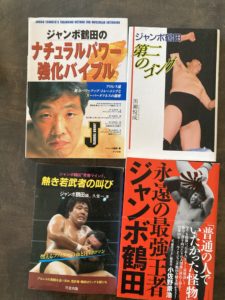
When this NWA World Title match came about, Tsuruta’s fans were hopeful that he could become NWA Champion. However, they were disappointed with the result. Tsuruta won the first fall clean and then Flair tied it up with a vertical suplex/Figure-4 Leglock combination. The third fall featured typical 80s chicanery with a slow-counting referee and some mistimed placement from the official. In the end Tsuruta hit his groin on a turnbuckle which Flair took advantage of to secure the pin. As an aside, here is Jumbo Tsuruta’s evaluation of Ric Flair, per BIBLE:
Rick Flair
Signature Move: Figure Four Leglock
Real Name: Richard Morgan Fliehr
Date of Birth: February 25, 1950
Place of Birth: Minnesota, USA
Height: 185 cm
Weight: 110 kgDuring high school, he was active as an American football player. He entered professional wrestling in 1972. In 1981, he defeated Dusty Rhodes to become the 62nd NWA Heavyweight Champion.
He was skilled in transitioning from rough attacks like toe kicks to his finishing move, the Figure Four Leglock, bringing a degree of stability to the NWA, which had seen rapid changes in champions. He would go on to capture the NWA Heavyweight Championship a total of 10 times.
In 1991, he clashed with the NWA leadership, which had changed its name to WCW, and left to join WWF. The following year, he won the WWF Heavyweight Championship by defeating The Undertaker in a Battle Royal. He became the second person, after the original “wildman” Buddy Rogers, to hold both NWA and WWF titles.
He had his first encounter with Jumbo Tsuruta in 1978, before becoming the NWA World Champion, challenging for Tsuruta’s UN Heavyweight Championship. He managed to win the second fall with the Figure Four but ultimately lost 2-1.
Flair, who became the NWA champion, is well-known, but he actually visited Japan during his unknown days. In 1973, he was in International Wrestling’s Matsudo. At that time, Flair had a clearly overweight physique. He was marketed as a “power wrestler” like Bruno Sammartino, but he didn’t make much of an impact, and even Mighty Inoue, who was in International Wrestling, said, “He hardly left an impression.” Perhaps because of his weight, he lacked stamina and was described as “a wrestler I would never want to call again.”
However, after that, Flair underwent a significant image change. Those who knew him from his earlier days would have been shocked. I was one of them. He likely incorporated bodybuilding training, losing excess fat while building muscle. There was no trace of his previously chubby self. He had a beautifully shaped physique and long hair dyed blonde, imitating the original “wildman” Buddy Rogers.
It wasn’t just his appearance that changed. His wrestling style also underwent a major transformation. He adopted the Figure Four Leglock as his finishing move, transitioning from a power wrestler to a technician.
The condition to remain a champion is to have a body that can endure long matches. Initially, Flair often found himself on the receiving end, only to turn the tables at the last moment, with the familiar pose of kneeling and pleading for forgiveness with his hands together in front of his chest. In Japan, this might have been seen as “pathetic for a champion” and disliked. However, it was a big hit with Americans. When Flair was champion, there was a balance of “grace” and “strength” in equal measure.
The idea that “as long as you’re strong, that’s all that matters” likely emerged after the appearances of Hansen and Brody. Perhaps due to the overall busyness of the world, professional wrestling began to demand speed like a business. Matches that focused on slowly attacking with a headlock like in the past could no longer be held. The traditional 60-minute three-match format changed to a single match. Match durations that used to be 30 or 40 minutes became shorter, with 10 or 15 minutes becoming the norm. There were also extreme cases like the Road Warriors, who could finish a match in 2 or 3 minutes.
Until Flair’s era, when three-match formats were common, stamina to fight for a full 60 minutes and techniques to keep the audience engaged for long periods were the conditions for a champion. The reason he could reign as champion for so long was likely because he met these two conditions.
When he was sweating alone in the gym, diligently working on his physical transformation, Flair might have already had his sights set on the NWA belt.
Tsuruta would go on to challenge for the NWA Championship five more times, failing each time. And just to prove that Flair was the only person with whom Tsuruta found himself stuck in inconclusive matches, his NWA World title match against Kerry Von Erich in May 1984 likewise ended with a double count-out and the champion retaining. These finishes weren’t limited to the NWA title, either; Tsuruta would suffer the similar fates when challenging for the AWA Heavyweight Title as well. He challenged Nick Bockwinkel several times throughout the 1980s but he only ever won via DQ and suffered many double count-outs as well, leaving the belt out of reach. Osano makes a very explicit comparison between this period of unsatisfying conclusions and the far more conclusive era of the Four Heavenly Kings during the 1990s. On this “reform period” Baba is quoted as saying,
“Fans come to see who wins, and if the match ends in a count-out or disqualification, they think, ‘I paid good money to see this, and this is what I get?’ This has been a source of frustration for fans since the beginning of pro wrestling. So, let’s eliminate that. And first, pro wrestling, like any other sport, must have referees who are sacred and untouchable. Therefore, let’s give referees full authority… That would be the quickest way for pro wrestling to be recognized as a legitimate sport by society,” – Giant Baba
(APOD: Ironic for Baba to say this when he was the one allowing foreigners to have such indecisive finishes when wrestling for him…or maybe that was the price he paid for continuing his relationship with the NWA and being at the mercy of the political complexity that came with membership).
Despite this later change, Tsuruta is still noted to bear some responsibility for his limited success. He was perceived to exude a sense of resignation about him and lacked the same ambition and fighting spirit as others around him. In his matches he would respond to an opponent’s movements and techniques flawlessly but would never push beyond that. This left fans with a sense of security in Tsuruta’s performances, leaving them with a sense that they were always guaranteed a certain standard from Tsuruta. However, despite that standard being consistently high, it would never rise beyond a certain point. Tsuruta’s matches were said to lack tension, suspense, and unpredictability. The conclusion many fans drew was that Tsuruta was a guy who could skillfully execute techniques but lacked the emotion behind him. Though he tried to counter this by scratching his head in frustration and shouting here and there to express his anger, fans didn’t buy what he was selling.
Two more people provide more critical insight into Tsuruta’s shortcomings. The first is his longtime friend Masanobu Fuchi who, if you recall my recent covering of his book, was largely awestruck and complimentary of Jumbo Tsuruta:
“I remember Baba-san once mentioning in front of everyone, ‘Tsuruta lacks the sense of desperation or urgency that Inoki has. Even though he possesses incredible technical skills, his lack of expressiveness is a problem. In amateur wrestling, if you execute a move properly, your opponent can’t move—that’s clear. But his facial expressions are completely absent. Even with the Cobra Twist, with your long arms and legs, if you execute it sharply, it should be convincing, but your face fails to convey it. Unless you tighten it with desperation like Inoki, you can’t convey strength or intensity.’ I remember Baba-san saying that to Tsuruta.” – Fuchi
The other is Nippon TV producer Hara Akira, who analyzed Tsuruta from a TV professional’s perspective and concluded that Tsuruta was far too emotionally detached from his craft:
“Without a doubt, he was a genius, and when it came to wrestling, he was at the top of the world. However, what he lacked was something that could touch the hearts of the audience. As a professional wrestler, he was too polished. He lacked that something which could resonate with the Japanese spirit, something that could appeal to the soul. That was perhaps the one thing he didn’t inherit from Baba-san. There were plenty of good role models around. Baba-san, for instance, was an excellent example of wrestling that captured the audience’s hearts. And the best role model in that regard would have been Antonio Inoki. Hypothetically speaking, if he had been influenced by Inoki, he might have turned out completely different.” – Hara Akira, Nippon TV
APOD: This was a very insightful section that revealed many of the drawbacks of both Jumbo Tsuruta as an athlete and the failures of the power-brokers around him. There’s no such thing as a 100% perfect wrestler and Jumbo Tsuruta’s lack of success during the late 1970s and early-to-mid 1980s proves that. He was skilled in his craft but in an era defined by results he proved to be far less of a star than what was being sold. Baba was clearly above him and appeared reluctant to job for his star pupil. The various champions of the NWA gave him hollow victories left and right that left him on a treadmill, moving without actually progressing. The criticism he received – that he was a guy who knew a lot of moves but lacked the ability to connect with audiences’ hearts – is really interesting and also timely since that has been an ongoing criticism for MANY wrestlers active now as well. It just goes to show you that the more things change in wrestling the more they stay the same.
As always, thanks for reading.