

5-Star BOOK Reviews: Jumbo Tsuruta’s Books, Part VI
By Alex Podgorski on 27 January 2026
This next section in Jumbo Tsuruta’s books covers another short period of about two years, from 1976 to 1978. There are a few notable milestones during this period, including one dream match that inspires two future legends to become wrestlers and a surprise encounter that is considered one of the earliest examples of MMA in recorded wrestling history. Then we will conclude with an unexpected anecdote about Tsuruta’s boss Giant Baba which, all things considered, actually explains a lot of his booking decisions over the decades.
You can read part 1 here, part 2 here, part 3 here, part 4 here, and part 5 here.
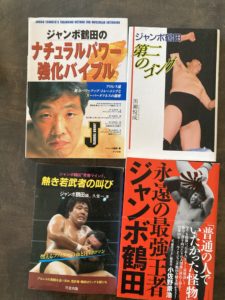
After becoming the NWA United National Champion in All Japan, Tsuruta starts planning for his future which seems to be in lockstep with Baba and AJPW. After years of construction and an estimated 60,000,000 yen, AJPW completes its new training camp and dojo in the Setagaya Ward of Tokyo. Tsuruta is named the owner on paper but Baba advises that he and AJPW will pay the loan as rent and once that is paid off it becomes Tsuruta’s in every way. Despite being only 25 years old Tsuruta serves as head honcho in this facility yet he doesn’t lord over anyone. His three juniors – Onita, Fuchi and Sonoda, the “Three Crows” or “The Three Idiots of Kyushu” – recall Tsuruta being friendly with his them. In ETERNAL Osano elaborates on this by describing Tsuruta’s activities outside the ring. When he wasn’t training or attending sponsor events Tsuruta played guitar semi-professionally and even wrote some songs. However his singing skills left a bit to be desired. Still, with his Gibson guitar in hand, his short hair grown out, and dressed in jeans and western-style clothes, Tsuruta changed the image of a professional wrestler…and in the process attracted LOTS of female fans. Osano notes that Tsuruta was arguably the first “idol wrestler” with fan clubs sprouting across the country. On several occasions Tsuruta brought his juniors into this side hustle with Onita singing (since he actually had the voice for it), Haru Sonoda doing comedy impressions, and Fuchi serving as host.
Shifting back to wrestling, Tsuruta’s next big moment takes place on August 25, 1977. On this night Tsuruta faces “Masked Noble” Mil Mascaras in a dream match that was heavily promoted towards the two groups of fans each man cultivated: women for Tsuruta and kids for Mascaras (APOD: as I noted before, both Kenta Kobashi and Toshiaki Kawada wrote about being inspired by this very match in their respective autobiographies). This match was also important for Mascaras since he was trying to capitalize on a sudden career resurgence. Having wrestled in Japan for six years, Mascaras became entrenched in the country’s wrestling scene but with little change fans grew bored with him. Then one day, AJPW director Shin Umegaki managed to get a copy of British pop band Jigsaw’s Sky High and used it as Mascaras’ entrance theme. That small change turned into a huge turnaround for Mascaras, leading to more people being swept up in his presentation. As for Tsuruta, Osano credits him with actually introducing entrance themes to puro in Japan. According to Osano, the first known use of any entrance music in Japanese wrestling was on October 30, 1975 when Tsuruta faced Abdullah the Butcher and entered the venue to the song Chinese Kung Fu by French disco group ‘Banzai’.
Back to the match in question, plenty of effort is put into ensuring it lives up to the hype. Both Mascaras and Tsuruta enter the venue on horseback and professional cheerleaders are brought in to hype up the crowd even further. Additionally, this match is also given something of an Olympic undertone with Tsuruta representing the 1972 Munich games and Mascaras representing Mexico in the 1964 games. Despite the rain putting something of a literal damper on the match (it being an outdoor venue and all), the match ends up an overwhelming success and is voted Match of the Year for 1977 by Tokyo Sports. This match also leads to Tsuruta learning an important lesson about pro-wrestling: knowing how to balance “the world of strength pursuit in pro-wrestling” and “the world of artistry that captivates the audience”.
The next big match in Tsuruta’s career is one that focuses more on that former, the strength pursuit part, as he faces Anton Geesink in what is considered his one-and-only MMA contest. Geesink was known all over Japan, particularly in martial arts circles for his mastery of judo. Geesink to pursue professional wrestling was made possible by promoter Saburo Arashida, the same man who brought The Beatles to Japan. It was also the culmination of a nine-year effort on NTV’s part and they originally intended for him to face Baba in a big New Year’s Eve show, but with AJPW’s TV viewership declining they thought he would make a great opponent for the rising Tsuruta instead. As a matter of technicality, Geesink’s contract for this encounter was with NTV directly and not All Japan. Geesink’s transition to pro-wrestling is overseen by Dory Funk, Jr., who teaches him some wrestling moves and builds on what technical skills he already has rather than teach him from scratch. However, the results are not good. Despite garnering plenty of attention, Geesink doesn’t do well in the ring. Despite a few singles and tag bouts in AJPW throughout 1975 Geesink isn’t given strong evaluations as a wrestler. Upon returning to face Tsuruta for the UN title Geesink fully embraces his judo background. Alas the match is given a poor reception from a wrestling perspective; however, retroactive reviews view this match in a different light since it was a styles clash more befitting of MMA. For his part, Tsuruta spent a lot of the first half on defense grappling out of holds on the mat. Then when Tsuruta tried to bring it back into pro-wrestling territory, Geesink ignored the referee’s orders and slapped on a rear naked choke which forced a disqualification decision.
However, Tsuruta still finds something nice to say about Geesink. Per BIBLE:
Real name: Anton Geesink
Date of Birth: April 6, 1934
Place of Birth: Utrecht, Netherlands
Height: 200 cm
Weight: 120 kgThe Dutch Judo King Anton Geesink, who ran around the mountains carrying logs.
Gold medalist in the judo open category at the 1964 Tokyo Olympics. In October 1973, he suddenly announced his transition to professional wrestling on the All Japan mat, causing a sensation in various circles. After that, he went to the United States with Jumbo Tsuruta and trained in professional wrestling at the Funk dojo in Amarillo, Texas.
His debut match was a tag match held on November 24 of the same year at the Kuramae Kokugikan, teaming with Giant Baba against Bruno Sammartino and Calypso Hurricane. Geesink secured a submission victory over Hurricane, marking a promising start, but afterward, he struggled and only remained active on the All Japan mat for two years.
In February 1978, responding to the interspecies match between fellow Dutchman and double judo champion at the Munich Olympics, Willem Ruska, and Antonio Inoki, he challenged Jumbo Tsuruta for the UN Heavyweight title. However, he could not withstand Tsuruta’s various professional wrestling techniques, went on a rampage, and suffered a disqualification loss. Currently, he is a member of the IOC from the Netherlands and awarded a silver medal to women’s judo athlete Ryoko Tamura at the 1992 Barcelona Olympics.
When I faced him, I felt a pressure of strength that I had never experienced from other wrestlers. His power was so exceptional that during the Tokyo Olympics, judo officials said, “Japanese judo is not lacking in technique and mental strength. We only lost in physical strength.” However, in modern judo, it is common knowledge that physical strength is also a part of technique. Especially in international competitions, one cannot win without having muscle strength equivalent to foreign athletes.
As a result, Japanese athletes now actively engage in weight training using machines, but the source of Geesink’s power, ironically, was the “functional muscle” developed through his childhood living environment and judo competitions.
Running in the mountains and performing activities like chopping wood, which could be considered a form of “ascetic training,” likely strengthened his toughness. If he had understood the “art” of professional wrestling, he would have surely become a top-tier wrestler.The wrestler whose judo footwork did not disappear in the ring
In fact, the plan to bring Geesink into the ring was initiated by Nippon Television, which was broadcasting “All Japan Pro Wrestling.” As you know, Geesink became the world champion by defeating a Japanese competitor in the open category of judo, which was officially included in the Tokyo Olympics. The strong impression he left likely led the executives at the television station to believe he would be incredibly strong as a professional wrestler.
However, professional wrestling is not that simple. If he had been younger, it might have been different, but Geesink was already past his prime.
When he wore a judo uniform, he was indeed strong. His throwing techniques were sharp. However, the problem arose after the throw. Perhaps due to the remnants of his judo days, he would think, “That’s it, it’s a point.” This would cause his attacks to falter. Even though he understood it mentally, his body could not keep up. No matter how hard the opposing wrestler tried to create a match that felt like pro wrestling, they could not connect.
After much contemplation, Geesink left behind the famous saying, “Professional wrestling is the art of wrestling.” This sentiment is not misguided. Professional wrestling is not just about winning or losing. Of course, the competition is important, but it is also about receiving the opponent’s techniques and elevating the fight itself, showcasing its intensity. In that sense, professional wrestling can be said to be a form of “art” using the body.
Having studied in Japan for a long time and being familiar with the spirit of judo, it seems that Geesink never fully understood the rules of the professional wrestling world.
Geesink’s strength lay in his “functional muscle.”
Regardless of his wrestling techniques, Geesink’s strength was remarkable.
(APOD: You can watch that match here. And yes, it still sucks. Poor Tsuruta).
As 1978 progresses Tsuruta finds himself the subject of criticism from the wrestling media. They look back at his career and note that he became the #2 star in AJPW within six months of debuting. By comparison, Riki Choshu, another Olympian turned pro, was still struggling to complete the transition and found himself mired in midcard purgatory at the same time. Genichiro Tenryu was facing similar struggles as Choshu. Given Tsuruta’s immense and immediate success, why then, had he settled into his current position? Where was his hunger to reach the very top?
Furthermore, comparisons are being made to younger wrestlers who were purportedly catching up to Tsuruta despite their lack of elite pedigrees. First there was Mitsuo Haneda, an AJPW trainee who was gaining popularity in the American Territories to the point he changed his ringname to “Rocky Haneda”. And on the NJPW side there was Tatsumi Fujinami, an Inoki trainee, who was turning heads after winning the WWWF Junior Heavyweight Championship. Fujinami’s success in particular was seen to be stealing Tsuruta’s thunder and the staff who wrote these pieces criticized Tsuruta for being in such a privileged, advantageous position and spending his free time engaging in music as a side gig. On one hand Osano, himself a longtime reporter, contextualizes these criticisms by explaining that people tend to empathize more with those who have struggled and clawed their way up. Tsuruta, with his relaxed demeanor and cream-of-the-crop pedigree, would naturally garner less popular understanding. Furthermore, when it comes to this new wave of anti-Tsuruta sentiment, Osano points the finger at Masanori Toguchi, a.k.a. Kim Duk. Though Toguchi was respectful of Baba as his senior, he was somewhat resentful of Tsuruta and his elitism, calling him a “fabricated star” and criticized him for “running on rails laid out for him”.
With Duk having similar pro-wrestling training as Tsuruta, Baba offered him a spot in AJPW in the hopes of cultivating a rival for Tsuruta from the same generation and from the same background. The result was a series of bloody and violent singles and two-out-of-three falls matches that were often positioned above Baba himself on AJPW cards. Baba valued Duk despite his Tsuruta comments and Tsuruta gained something else from Duk: the arm-trap version of the belly-to-belly suplex. For the audience, who had grown accustomed to Tsuruta throwing opponents in spectacular fashion, the slight of Duk doing the very same to Jumbo was a sight to behold. For his efforts, Baba offers Duk a fulltime position in AJPW; however, Duk prefers to stick with his current arrangement that puts working the American territories first and Japan second. There’s some noise about Duk not wanting to work under Abdullah The Butcher or Kintaro Ohki any further and Duk states he wants to stick with wrestling for The Funks instead.
Another reason this arrangement doesn’t work out is that, according to Osano, once Baba establishes a specific hierarchy between wrestlers he doesn’t change it no matter what. In the case of Toguchi/Kim Duk, that meant that, no matter what he did or how popular he’d get, he’d always be the “eternal third man” behind Baba and Tsuruta. This might’ve been a different situation in New Japan where Inoki’s competitive spirit might’ve allowed for stronger personalities to grow. However, given the bitter nature of the Inoki split from Japan Pro-Wrestling, Baba refuses to pit wrestlers from the same faction against each other.
APOD: That last bit is an important detail that gives some much-needed insight into Baba’s modus operandi. For decades Baba was this mythical figure in wrestling discussion, this never-do-wrong genius booker who’d be on the short list of people legitimately worthy of having a “world’s best boss” coffee mug. However, Baba’s conservatism as a booker has also been the subject of many a debate. Much of that has been centered on the Four Heavenly Kings and how All Japan became a walled garden in the 1990s. But these details reveal that Baba’s more restricted and cautious approach to booking was an older creation. He didn’t lean into interpersonal rivalries and didn’t want to pit two wrestlers of the same group against each other, no matter how much money it would’ve drawn. At the same time the comment here about the entrenched hierarchy is a big one. It might explain why things moved at such a snail’s pace in All Japan and why, for example, Kawada never surpassed Misawa even if he might’ve earned the right to do so, because Baba had it in his mind that Kawada was forever the junior in their relationship. Minor anecdotes like this are why I do these translations: there always some small detail to uncover that helps us understand the reasons why things happened the way they did in the past and, since history tends to repeat itself, from this we can have a better understanding of what could still happen in the future.
As always, thanks for reading.