
5-Star BOOK Reviews: Toshiaki Kawada’s Autobiography, Parts I and II
By Alex Podgorski on 23 January 2025
Some wrestling fans collect figurines. Others collect replica title belts. Others still have tape libraries of events and matches long lost to time. Myself? I like to read, especially about my favorite wrestlers, which is why, following my first trip to Japan last year, I bought something that few people have: a Japanese wrestler’s autobiography.
But not just any wrestler’s: Toshiaki Kawada’s.
And instead of just letting it sit on my bookshelf collecting dust, I figured that maybe there’s something in here worth sharing with the rest of the fandom.
Now you’re probably asking yourself a few questions. Firstly, why go through all of this effort? Well there are a few reasons. First, as advanced as we are in 2025 we’re still at a time when plenty of knowledge remains locked behind language barriers. So much of modern wrestling history has been influenced by happenings in other countries yet much what is available has been written by English speakers. With the Four Pillars of All Japan being so romanticized by the wrestling fandom and straight-up copied by more or less every major name to go through American wrestling since 2000, it would be interesting to see what these wrestling legends wrote about their own experiences. So if I’m going to say that I know a lot about a specific subset of pro-wrestling, it only makes sense for me to be able to use an actual Japanese wrestler’s autobiography as a source.
Secondly, why Kawada? Well if I’m being honest I actually appreciate him as a wrestler more than Misawa. Though Misawa is clearly the bigger name and is remembered more even in his own country, I think Kawada deserves more credit for putting together so many of the best matches in 1990s AJPW cannon and beyond. To compare 90s AJPW to, say, the film The Dark Knight, Misawa would be Batman while Kawada would be Heath Ledger’s Joker. And we all know whose performance meant more in the grand scheme of things.
Thirdly, I figured it would be entertaining to see wrestling from Kawada’s perspective directly rather than use secondary sources all the time. Though I didn’t buy his book expecting some kind of salacious exposé or shoot promo style burial of his enemies, I was hoping he would go over what he thinks of the business that brought him so much fame. Since much has been written about him and his peers by Westerners (myself included) I figured sharing his story here would serve to help correct the record on any narratives that might’ve come out over the decades. For this review series I’ll be using Jabroniville’s format and putting my thoughts in boldface at various points, because if the system works why change it…
Before we go any further, though, a quick note on translation. I don’t speak Japanese beyond the odd conversational phrase and can’t read their text for shit. But when I decided to try and have this book (and the others in my collection) translated, I wanted to exhaust every possible opportunity to get professional help.
I reached out to a few people in Japan like wrestling journalist Fumi Saito and wrestling historian Koji Miyamoto. Both of them, naturally, were too busy.
I reached out to the University of Toronto’s School of East Asian Studies to see if either a faculty member or a student would be able to help, even for a fee. I was refused.
I reached out to the Japanese Canadian Cultural Centre. No translators were available.
I reached out to three companies that do translation services. One flat out refused because they only handle technical documents and not personal documents. The other two would’ve charged me between $0.15 and $0.40 PER CHARACTER to translate this book. So to translate a single $20 book cover-to-cover would’ve cost me around $27,000.00. And I have several.
So hopefully you can understand why I went with an AI tool to translate these books for me. I use OpenL to translate one page at a time. I take a photo of each page with my phone and upload it into the translator so that I avoid damaging the book by forcing it into a traditional scanner. This is a tedious process but I figure it’s all worth it in the end…somehow…and with that,
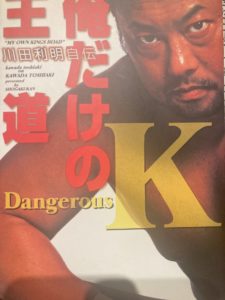
My Own Royal Road: The Autobiography of Toshiaki Kawada, Published on April 20, 2003
Chapter 1: Childhood
Kawada opens this chapter on a dramatic note, revealing that he was almost stillborn. He was born in his family’s home on December 8, 1963 in Tochigi Prefecture north of Tokyo. Since Tochigi was rural at the time his mother had to rely on a midwife to assist with his delivery. But because his umbilical cord had wrapped around his neck, he came out blue and not crying. He would’ve been declared dead right then and there had the midwife not took some water in her mouth, sprayed it on his face, and slapped his face repeatedly. Kawada then jokes that he’s glad it wasn’t poison mist she was spraying.
Kawada ruminates about his childhood, noting that he was something of a troublemaker when playing outside. He did things like set fire to bales of hay or diving into barbed wire, joking that he was doing deathmatches before Atsushi Onita made them popular.
He describes himself as a sportsman at school and, being active, he disliked studying. However, he does recall an early of memory of parents’ visit day and his teacher reading an essay that he wrote. The teacher was apparently impressed with how well it was written but Kawada was too shy to raise his hand in front of everyone and take credit. Or maybe, as Kawada again jokes, it was because his handwriting might’ve been good for an elementary schooler’s.
Kawada’s first encounter with pro-wrestling isn’t a good one. He’s introduced it by his grandfather who watches wrestling on the family’s only TV. Most family homes build in the post-war period had only one family room and one TV set. Since there were six people in Kawada’s household (Toshiaki, his younger sister, both parents*, and paternal grandparents) and only one TV, choices had to be made. While young Toshiaki wanted to watch some popular program with his friends, his grandfather got to watch what he wanted instead which was wrestling (APOD: Kawada doesn’t directly mention it here but the wrestling he did see at the time he described elsewhere as “like sludge” and thus had a negative impression of it, even if his friends watched it and play wrestled amongst each other).
*not for long, though
Then tragedy strikes when nine-year-old Toshiaki loses his father in an accident. His dad was removing an air conditioner from a building when “lightning struck”. It’s ambiguous whether it was the house that got struck or Kawada’s father that got struck but either way the man fell off the building and died right then and there. Kawada doesn’t go into much further detail about his relationship with his father, other than he has good memories of spending time with his dad and that he would visit his father’s grave and ask for guidance.
Kawada then talks about having to move due to his father’s death and watching his mother “work all day and night, hardly having time to sleep” to support the family. He believes that he inherited her competitive spirit (and also her stubbornness).
Years go by and Kawada’s in middle school getting decent grades when he is reintroduced to professional wrestling. This time he gets the opposite impression. He describes this match as having a “sports-like, refreshing image, unlike the usual messy ones”. The match in question is Mil Máscaras versus Jumbo Tsuruta from August 25, 1977.
Though this doesn’t make him a fan it does change his overall perception. Interestingly, another match he sees soon afterwards is Terry Funk and Dory Funk, Jr. vs. The Sheik and Abdullah The Butcher from the 1979 World’s Strongest Tag League.
“I thought I wouldn’t feel anything from that match either, but embarrassingly, I was moved. That was my real encounter with professional wrestling.” – Kawada
Shortly after this he begins to really follow professional wrestling regularly and starts toying with actually becoming one. Standing 178cm (just under 6 feet tall) in in junior high, Kawada had a solid sports background by the time he was in his mid-teens, having played baseball and enrolled in his school’s sumo club. He also talks about spending 70,000 yen to buy a 145-kg set of barbells with a bench to help him bulk up. And another part of that bulking up involved eating like crazy, at times to the point of throwing up.
By the time he’s in his senior year of junior high and contemplating career paths, Kawada has this exchange with a guidance counselor.
GC: “So which high school do you want to go to?”
Kawada: “Actually, I want to become a professional wrestler.”
GC: “…so, which high school?”
Though Kawada’s guidance counselor responds incredulously over his chosen future, Kawada remains steadfast. He describes “taking preventative measures” in case this career path doesn’t work out so he applies to a high school that has a good amateur wrestling program as a sort of failsafe. He also starts sending postcards to both New Japan and All Japan, though only NJPW sends him a response.
Chapter 2: The Youth Of The Wrestling Club
NJPW sends Kawada a note saying they want to an “entrance exam” which would consist of some “basic” physical tests to determine his suitability for the company. He reaches their dojo in the Setagaya district of Tokyo (APOD: which, coincidentally, is also where his restaurant, Menjarasu K, is now located). He goes through the typical exercises: 500 squats, multiple sets of push-ups, and amateur wrestling sparring, and in each segment Kawada watches as the trainees drop like flies. Next Kawada describes getting noticed by Akira Maeda, who tells him to write his name and height on a piece of paper and take it to Kotetsu Yamamoto at NJPW’s head office, which he found thanks to Hiro Saito. The people in the NJPW office seemed pleased with him and they tell him to contact them right after he graduates (junior high school).
A small conflict emerges as Kawada begins thinking that, since he has already been accepted to New Japan, there’s no need for him to attend high school (APOD: high school is not mandatory in Japan, especially if you’re going into certain types of careers that don’t require further technical or book knowledge). Still, Kawada’s mother and his teachers try to convince him to still pursue a high school education and enter pro-wrestling after that, only three years later. Ultimately, he decides against going to NJPW directly and goes to high school, which ends up playing a huge role in his future.
Shortly after starting high school at Ashikaga Institute of Technology High School, Kawada is introduced to two of his seniors, Yoshiaki Yatsu and Mitsuharu Misawa. Misawa is introduced as Kawada’s first sparring partner and as someone who wants to become a professional wrestler as much as Kawada does, so instantly there’s some camaraderie there. And yet Kawada notes that Misawa is a bit quiet at the time and doesn’t talk all that much which is unfortunate for Kawada since he loves to chat (APOD: this tends to run counter to the persona Kawada has cultivated both in wrestling afterwards. Jonathon Foye, an Australian academic who has written two books about puro [to which I contributed], noted that Kawada has cultivated a persona akin to The Soup Nazi from Seinfeld and is noted for his purported grumpiness and lack of smiling in public).
Not long after that Kawada is sold a false bill of goods by being called a “special scholarship student”. It was some kind of encouragement mechanism to move into the wrestling club’s dorm. Thinking it would lower his tuition, Kawada agrees but soon finds himself doing menial chores for all of his seniors, as expected of the youngest and newest member of the club, all on top of a brutal training schedule:
“To briefly explain the daily routine, I would wake up at 5 AM, wash my face, and immediately start preparing for the seniors. Since I was the only first-year student in the dorm, I had to do everything myself. Morning practice would start at 5:30 AM. The seniors didn’t necessarily want to practice diligently, but they couldn’t slack off because they never knew when the teacher might show up. Well, the teacher came almost every day.
The content of the morning practice wasn’t always the same, but it involved running around the school (about 1500 meters) five times in under five minutes; if we didn’t finish in under five minutes, the number of laps would keep increasing. Then we would do various types of basic training.
After practice, I prepared breakfast for the seniors with the supplies I had bought the day before. Then I had a meal with the seniors, and after that, I had to clean up. Of course, I had to do it alone, so it took a long time. After all, there were eight seniors and just me, so I felt like a housekeeper.
Once the cleaning was done, it was straight to school. School started around 9 o’clock, but I had to complete all the previous tasks within that time, which now seems impossible even for a god. Naturally, once I got to school, I would end up sleeping on my desk until noon. I’m not bragging, but I don’t remember studying even once during high school.”
(APOD: AND THIS DOESN’T EVEN GET HIM TO NOON!)
Sometimes he’d have to go grocery shopping for everyone, on other days he’d have to clean the dojo, which meant that he wouldn’t be able to clean his home classroom.
“And at 3:30, the tough afternoon practice begins. After basic exercises, sparring starts, and it goes on for more than two hours. The end of practice varies depending on the day, but it’s usually around 7:30 PM. After that, it’s my second round of housekeeper time. Even though I’m completely exhausted, I go grocery shopping again. I prepare dinner without resting, eat with everyone, and then clean up alone. While I’m cleaning up, the seniors are taking a bath and starting to relax in their rooms. When I get back, I’m asked to go again.”
What’s worse is that Kawada is also cursed with bad timing since, without another class of underclassmen beneath him to take over menial duties, he’s stuck in this role for TWO YEARS. Being stuck in this role makes it hard for him to attend wrestling camps or keep up good grades, and he even makes a comment about contemplating suicide at least once.
(APOD: Kawada doesn’t delve into his relationship with Misawa at much at this point, only noting that Misawa was unusually self-reliant at the time and, compared to the other “eccentric” seniors in the club, Misawa “seemed normal”. But there are other publications that go a bit deeper into this period in Kawada’s life, like Hidetoshi Ichinose’s 2019 Four Pillars bio, which I found on the ProWrestlingOnly forums. Kawada is said to have described Misawa as being a “small oasis in hell” due to this two-year nightmare, but Kawada does not directly describe any of that here.)
The last few pages of this chapter describe Kawada being falsely accused of extortion (all due a stupid miscommunication over a newbie at the school being on scholarship and not attending practice), and really having his potential blossom after completing high school. He briefly goes over some of his various wins at district, regional, and finally the national level, and how he also crosses paths with Kodo “Samson” Fuyuki and Tamon Honda, before beating Yamada/Liger at the National Sports Festival.
APOD: So overall these two chapters serve to set the stage for Kawada’s foray into professional wrestling. He didn’t like it at first but over time grew to love it enough to pursue a career in it. He would’ve gone as early as right after junior high (which would’ve put him at around 14-15 when graduating) but ultimately chose to attend high school for more training and preparation (He wouldn’t’ve been the youngest pro wrestler anyway; in Japan possibly but not the world since Rey Mysterio debuted when he was fourteen and some sources note that André the Giant started wrestling at age twelve!) Though he’s not one to focus on the personal relationships during these chapters he describes in detail how painful it was for him to endure two years as the gofer for an entire wrestling club without quitting. Though he doesn’t really describe any extreme events (save one club foray up a mountain that sees them eat frogs and larvae to survive), he paints enough of a picture to make readers understand just how physically and emotionally demanding his high school life was.
That’ll do it for this entry. Next Time: Chapter 3: Introduction to All Japan Pro Wrestling!