

5-Star BOOK Reviews: Jumbo Tsuruta’s Books, Part V
By Alex Podgorski on 19 January 2026
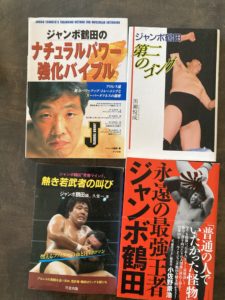
Continuing on our look at Jumbo Tsuruta’s career we look at more matches and carefully crafted booking decisions. This section covers Tsuruta’s gradual shift from title challenger to title holder, along with more big matches against big-name opponents. There’s one person in particular who will have a major impact on Tsuruta’s in-ring career and will shape the way he wrestles going forward.
You can read part 1 here, part 2 here, part 3 here, and part 4 here.
Tsuruta returns to Japan and participates in the Champion Carnival, this time changed to a single-elimination format instead of its usual round-robin league format. In his block, Tsuruta beats Jerry Soto in the first round and gets a bye to the semi-final since The Destroyer and Abdullah The Butcher fight to a double-DQ. The opposite block has Giant Baba rack up wins with the goal of creating a Baba-Tsuruta showdown in the finals. However this doesn’t happen because Tsuruta wrestles “Mr. Wrestling” Tim Woods to a draw and in their rematch he sprains his ankle which forces a loss for him via referee stoppage.
After a few months of recovery Tsuruta continues his big matches in the summer, facing mentor Dory Funk in a two-out-of-three falls match. Despite losing, the press showers Tsuruta with praise for his performance here as he shows a knack for main-event wrestling despite his relative inexperience. Next, Tsuruta challenges for the NWA World Junior Championship against Ken Mantell. Since the NWA had a weight limit of 105kg, Tsuruta sheds 8kg of weight to qualify for the title bout. Once again, this is contested under two-out-of-three falls and each man gets one fall apiece. The match ends with Mantell escaping out of a cobra twist and both men falling out of the ring causing a double count-out and the champion retaining. Though the reasoning behind this decision might be obvious for fans who recall watching older NWA Wrestling, Osano explains the decision for potential younger readers by noting the “traveling champion” aspect of the territories:
“Skillfully drawing a match to a draw when the challenger seemed likely to win and leaving the audience thinking “so close!” to defend the belt is a common tactic of world champions who travel to various territories to face the top local talent, and in that sense, it can be said that Mantell controlled this match.”
However, after the match Tsuruta got a hold of Mantell and executed a double-arm suplex on him to send the fans home happy, especially since it avoided a potentially unsatisfactory conclusion to the title bout.
A few days later Tsuruta faces NWA World Champion Jack Brisco in another title bout but loses clean in a similar two-out-of-three falls match that also gets praise from fans and reporters. Tsuruta concludes 1974 with an astonishing 90.5% win percentage, a big deal in Japan considering its still sports-like presentation at the time. It’s also a stunning rebuke of something called the “sophomore jinx” in which rookies excel in their first year but often struggle in their second. Incidentally, in early 1974 Tokyo Sports establishes its annual Professional Wrestling Awards and Tsuruta is bestowed with the Technique Award.
In February 1975 plans are put in place for Baba and Tsuruta to win tag team gold as a master/student duo. After failing to win gold twice in Japan, Baba & Tsuruta head to Texas to challenge for the NWA International Tag Team Championships. In ETERNAL, Osano gives us a brief history lesson about how things were in Texas during the Territories Era with the state being split in three: “Western States Sports Promotion” led by the Funks based in Amarillo, “Big Time Wrestling” led by Fritz Von Erich based in Dallas, and “Houston Wrestling” led by Paul Boesch based in Houston. Osano notes that had Baba & Tsuruta wrestled the Funks in Amarillo they’d be booed, even if all four guys wrestled clean. Since NTV refused to broadcast a match in which Baba was booed, and since fans of individual territories didn’t always follow happenings in other ones, it was okay for the Funks to wrestle the babyface Japanese duo in Dallas under von Erich. After one fall to each team, it’s Tsuruta who scores the deciding fall by countering a suplex on Dory. The fact that then-NWA President Sam Muchnick congratulates the victorious Baba & Tsuruta adds more weight to Tsuruta’s growing list of accomplishments.
ETERNAL skips ahead to late 1975 with an ambitious event called the All Japan Pro Wrestling Open Championship, a tribute to Rikidozan’s 13th anniversary and the 200th anniversary of the founding of the United States of America. Baba promotes this as an open-door event intended to invite key representatives from various organizations, including Inoki, who had been prodding Baba for a match since at least 1974. However despite all the concessions, Inoki declines to participate, stating that he wanted to face Baba for a Japanese championship and not in a round-robin festival. That said, the event does end up featuring a who’s who of wrestling at the time: Rusher Kimura, Great Kusatsu, Mighty Inoue, Kintaro Ohki, Hiro Matsuda, The Destroyer, Anton Geesink, Dory Funk, Jr., Abdullag The Butcher, Dick Murdoch, Horst Hoffman, Don Leo Jonathan, Pat O’Connor, Harley Race, Dusty Rhodes, Baron von Raschke, Mr. Wrestling, and Ken Mantell. At one point Fritz Von Erich jokes, “Is Baba trying to empty the American wrestling scene!?” Beneath the glamour of all these big names is another plan to showcase Tsuruta against another cavalcade of credible opponents. Tsuruta goes to a 30-minute broadway with Murdoch, beats Hoffman, then Inoue, and then goes to a double count-out with then-ace of International Wrestling (IWE) Rusher Kimura. Then on December 15th Tsuruta faces Baba one-on-one for the first time. Despite showing everything he had – including managing to gutwrench suplex the massive Baba in a moment that conjured images of the Russian wrestling monster Aleksandr Karelin – Tsuruta lost to Baba’s fabled 16-mun kick/running neckbreaker combo. Tsuruta concluded this tournament with a DQ loss to Butcher and a time-limit draw with Dory, leaving him in 4th place in the tournament standing. Osano writes that Tsuruta received the Tokyo Sports MVP award for 1975, but records show that award went to Baba, not Tsuruta.
Around the same time Tsuruta experiences a personal tragedy with the death of his senior Masio Koma. As noted in my Fuchi translations, Koma was an important trainer and one of Baba’s close confidants. Akio Sato, another higher-up in Baba’s inner circle, notes that Koma would unify everyone and oversee the development of Baba’s plans. He was said to speak with Baba’s voice and was responsible for executing Baba’s will to have Jumbo Tsuruta protected as he was brought up. Koma also served as an older brother figure for Tsuruta and took a lot of internal criticism from people who had doubts in Tsuruta’s skills and push. Kyohei Wada speculates that Tsuruta was given something of a golden boy level of treatment especially when it came to travel, which was said to fuel resentment from others in the company at the time. Fuchi speaks a bit more about this, noting that Tsuruta was keenly aware of these feelings and would sometimes feel awkward about his treatment. However Baba persisted and reminded everyone that Tsuruta’s star power was essential in them being able to feed their families. Still, some seniors would still leave a parting shot at Tsuruta, glaring at him without saying anything out loud. But despite this one-sided iciness Tsuruta isn’t noted to have been boastful or arrogant; Kendo Nagasaki notes that Tsuruta was always considerate and used respectful language no matter who he talked to (APOD: This is a very important detail given the ambiguities, passiveness, and interpretative nature of the Japanese language. It’s easy for a slight shift or misstep in language use to fundamentally change the meaning of a word or phrase, so Tsuruta maintaining this considerate attitude helped ease tensions in a jealousy-driven business).
After this Tsuruta undergoes his Ten Match Trial Series, with AJPW’s fans voting on his opponents. 80,000 votes are tallied with over 500 different wrestlers’ names included. Some names are completely idealistic and carry a “dream match” overtone, including then-WWWF Champion Bruno Sammartino, André the Giant, Lou Thesz, and Antonio Inoki. However, Tsuruta’s first opponent is none other than Verne Gagne. This was a big deal given the complicated situation with Gagne’s AWA and Baba still being a member of the NWA. This match came through thanks to cooperation with IWE in Japan and because Gagne respected Tsuruta for his Olympic participation. In typical wrestling of that time, they wrestled under two-out-of-three falls rules with each man scoring one fall and in the end going to a double count-out. Though he didn’t win in the end, Tsuruta would adopt Gagne’s “screw-style” dropkick and shifted away from the Brisco-style one he used up to that point.
This trend of Tsuruta wrestling to no decision continued with inconclusive matches against Kimura and Billy Robinson, the latter going 70 minutes. He also lost one fall to two against Terry Funk which, coincidentally was watched by Genichiro Tenryu and inspired Tenryu to switch from sumo to puro. Once again Osano takes the opportunity to give a brief history lesson on wrestling from another country, this time focusing on Robinson, his training, and the origins of British “Catch-As-Catch-Can Wrestling”:
“Robinson was born on September 18, 1938, in Manchester, England. He dedicated himself to wrestling from a young age and joined the Billy Riley Gym, known as the ‘Snake Pit,’ at the age of 15. There, he learned Catch-as-Catch-Can wrestling. The ‘Snake Pit’ is located in Wigan, a coal mining town in Greater Manchester, and Catch-as-Catch-Can originally developed from the wrestling of coal miners. This style, which the working class in Northern England enjoyed as a form of gambling wrestling, was practical and involved painful techniques, making it a dangerous style that the upper class in Southern England despised as ‘barbaric and hazardous.’ Only those recognized by Riley as ‘shooters’ could turn professional under the “Snake Pit” after overcoming the harsh sparring.”
Osano explains that Robinson had previously been exclusive to New Japan (especially following his famous singles match with Inoki in 1975) so his switch to All Japan shocked wrestling fans and journalists. This switch, according to Osano, stemmed from Robinson refusing a pay cut from New Japan and when he contacted Dory, who was booking foreign talent for Baba, he was offered the same conditions Inoki had offered him originally.
The match between Tsuruta and Robinson took place in a sweltering hot gymnasium that lacked air conditioning in the middle of July which added to both wrestlers’ fatigue. Still they went over an hour and ended up with an inconclusive finish. Still this match ends up being highly influential on Tsuruta since Tsuruta starts adopting new stylistic elements from Robinson. Up to that point Tsuruta’s style had been inspired by Dory Funk and adopted a “big and slow” style done in a way that allowed the audience to see well. Robinson, meanwhile, had a “fast and strong” approach inspired by his training and Tsuruta gradually shifted towards what Robinson did. After their matches and some sparring sessions, Tsuruta remarks, “Of all the opponents I’ve faced, Robinson had the most techniques from big moves to small moves. He had the muscle memory that was suited to actual wrestling movements.”
Here’s Tsuruta’s detailed evaluation of Billy Robinson, per BIBLE:
Billy Robinson
Real Name: Same
Date of Birth: September 18, 1938
Specialty: Double-arm suplex
Hometown: Manchester, England
Height: 191 cm
Weight: 118 kg
He is from the British wrestling training facility that raised Karl Gotch, Billy Riley’s gym (commonly known as the “Snake Pit”). He reportedly attended for four years without a single day off from the age of 14 to 18 to master his techniques. He made his professional debut in 1956. After that, he moved to America as “the strongest man in Europe” and became a top star in AWA.
His first visit to Japan was in 1968 for International Pro Wrestling. He showcased the double-arm suplex for the first time on Japanese mats and earned the nickname “human windmill.” (For reference, his opponent was Masao Kimura, currently known as Rusher Kimura.)
In 1975, he appeared on the mats of New Japan Pro Wrestling. He fought Antonio Inoki to a draw. In All Japan, he was active for about five years starting in 1976. During that time, he also won both the PWF Heavyweight and UN Heavyweight titles. He had his first match against Jumbo Tsuruta in the fourth match of the “Trial of Ten Matches” in 1976. The result was a 1-1 time-limit draw. After that, Robinson and Tsuruta engaged in fierce battles over the UN Heavyweight title held by Tsuruta.Robinson’s “functional muscles” were well-equipped for the sport. The strength of the back muscles that supported Bill Robinson’s artistic suplex, the “human windmill.”
It was my first match against him. It was a hot day, and I think the temperature in the ring was close to 40 degrees. I remember my body slipping from the sweat, making it difficult to execute my moves as I wanted.
In the first fall, Robinson won with a shrimp hold, and I managed to take the second fall with the same shrimp hold. At this point, I had exhausted my stamina. However, since he was someone I had wanted to fight for a long time, I stood only with my willpower. Robinson’s expression remained unchanged. He possessed not only power but also muscular endurance. Even if he was tired, he probably didn’t want to show that to a young guy like me. It was a clash of “youth” and “face.”
After 60 minutes, there was no decision, and after a 5-minute extension, the match ended in a time-limit draw. In subsequent matches against him, I also faced tough opponents that ended in full-time draws.
He was a cheerful person who was often mistaken for a comedian, but during this era, Bill Robinson was a representative of true wrestlers alongside Karl Gotch, and he was one of the athletes I aspired to be like.
Among all the opponents I faced, Bill Robinson had the most techniques, from big moves to small ones. His finishing move was the double-arm suplex, but the techniques leading up to it were diverse. Robinson was a British wrestler. The way techniques are executed and applied differs subtly between England and America. My wrestling was rooted in American style, for example, with the suplex. When I learned from Dory Funk Jr., I would throw it “gracefully and slowly” so that the audience could see it well, whereas European wrestlers like Robinson and Gotch emphasized “speed and strength.”
Of course, to give speed to a move, a certain amount of power is necessary. Robinson had a thick chest, strong arms, and legs, and his entire body was muscularly developed. I believe his back muscles were particularly strong. A powerful back is essential for delivering a speedy suplex.
Generally, European wrestlers often have extensive amateur wrestling experience, which contributes to their well-developed back muscles. Robinson was thoroughly trained at the famous “Snake Pit.” At that gym, it is said that the only weight training equipment available was minimal barbells and dumbbells. More than 90% of the training was practical wrestling practice on the mat. Thanks to that, I think he had muscles suited for actual wrestling movements.
Around the same time AJPW revives the NWA United National Championship, a quasi-international title almost akin to the WWF’s Intercontinental Championship when that title was at its peak of prestige. The UN Title was sealed away in 1973 following the murky dissolution of the Japan Wrestling Alliance, but Baba returned it to further signify that Tsuruta’s star was still rising. This also ensured that Baba, then reigning PWF Heavyweight Champion, wouldn’t have to worry about losing his own title in a potential premature showdown with Tsuruta. The match to crown the new UN champion takes place on August 28, 1976 with Tsuruta defeating Jack Brisco two falls to one. With this title secured it’s clear that Tsuruta is being pegged for a future reign as world champion and, to most if not all observers, Tsuruta was AJPW’s de-facto ace behind only Baba himself.
APOD: Once again there wasn’t all that much groundbreaking here with this section serving to add more history to Tsuruta’s gradual climb to the top. The best parts of this section were the historical tidbits about the Territories and the origins of British wrestling, both of which took place decades ago. Osano did an excellent job explaining these details for anyone unfamiliar with them and they helped contextualize Tsuruta’s growth as a performer. There’s also this refreshing undertone of wins mattering and being treated like a big deal, which gives the whole thing a real sports presentation. Though the only thing I can think of that might’ve been disappointing for fans at the time was the overrepresentation of inconclusive matches in Tsuruta’s career. Maybe that was par for the course at the time but for someone watching wrestling now who might be accustomed to clean and decisive finishes, having so many inconclusive matches, especially ones that go over an hour, might be more irritating than satisfying.
As always thanks for reading.