

5-Star BOOK Reviews: Jumbo Tsuruta’s Books, Part IV
By Alex Podgorski on 8 January 2026
This next section of Jumbo Tsuruta covers his return to Japan and then a second foreign excursion. Much of the attention here is to Tsuruta’s continued improvement and the changes in the techniques he displays in his matches. Much of this will cover his travels across the NWA and the big names he wrestles, along with some peculiarities about tradition and norms in wrestling that are long gone from today’s world. So anyone looking for a quick little peak at wrestling history will find some interesting little anecdotes here.
You can read part 1 here, part 2 here, and part 3 here.
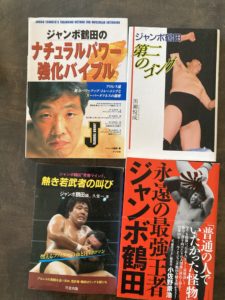
Tsuruta returns to Japan in October 1973 and faces Moose Morowski in a 30-minute singles match in his Japanese debut. Baba specifically selects Morowski for this role since he sees Morowski as a reliable opponent for this momentous occasion. However Tsuruta couldn’t hide his nervousness and spends most of the match hitting horizontal chops and jumping brain chops early on. He would later stop using these moves since they were associated with Baba and Rikidozan and would later switch to the elbow smashes taught to him by Dory Funk. But as the match wore on he got more confident and eventually beat Morowski shortly after hitting a standing dropkick.
Shortly afterwards there is a public call to determine Tsuruta’s name since “Tomomi” doesn’t work for a man this size. Earlier that year Antonio Inoki came up with a new move known as the Manji Gatame which led to his popularity surpassing Baba’s. In response, Baba reaches out to his fans and through postcards AJPW collects a series of suggestions. It is through these fan suggestions that the name “Jumbo Tsuruta” comes up, in reference to the Boeing 747 becoming the premier airplane for international routes and to professional golfer Jumbo Ozaki becoming the first Asian to place 8th in the 2nd Masters tournament in 1973.
As Tsuruta’s career back home in Japan takes off, All Japan experiences some internal strife. The roster balloons with the closure of Japan Pro Wrestling and its merger with All Japan. Seiji Sakaguchi leaves All Japan for New Japan and AJPW’s broadcast on NET Television (a different broadcaster from NTV) is canceled. In addition, Osano also introduces several of the stakeholders who become part of AJPW’s structure going forward: Wataru Takahashi, the president of Tanoshiri; Masao Yamamoto, the guardian of the Rikidozan family and president of Shochiku Rent-a-Car; Wataru Narahashi, a former director of Japanese pro wrestling and a member of the House of Representatives; and Okuzumi Kobayashi, president of Nippon Television; and Chairman Okubo of Mitsubishi Electric. Under their combined influence/pressure, Baba takes on all the wrestlers from Japan Pro, despite his initial insistence on only taking in young wrestlers. Nine wrestlers from Japan Pro join All Japan’s eight: Kintaro Oki, Ueda Banosuke, Great Kojika, Matsuoka Gantetsu, Takachiho Akihisa (The Great Kabuki), Miji Hirai, Sakurada Kazuo (Kendo Nagasaki), Haneda Mitsuo (Rocky Haneda), and Ito Masao.
Faced with a growing roster and having to balance both his existing wrestlers and these new arrivals – many of whom were champions and top draws – Baba makes the bold decision to make Tsuruta his new main partner. This is done because Baba strongly believes that Tsuruta is the future and his lack of existing wrestling history in Japan makes him something of a neutral pick between the established All Japan side and the Japan Pro side. One of the first big matches under this dynamic is a tag match between Baba & Tsuruta on one side and Dory Jr. and Terry on the other. That match showed how much Baba had faith in him and saw him as something of a successor.
In ETERNAL, Osano includes some background on the norms of the wrestling world. At the time there was allegedly an unspoken rule in Japanese wrestling that wrestlers didn’t use other wrestlers’ finishing moves, or at least those operating in the same country or territory. Osano also notes that certain techniques had a major influence on the perception of pro-wrestling. The biggest of these was the German suplex which was said to have “elevated pro wrestling to the realm of art”. That move was created by Karl “Kami-sama” Gotch, the God of Pro Wrestling, and only had two disciples: Hiro Matsuda and Antonio Inoki. A close second was Billy Robinson’s double-arm suplex, labeled “the best technique” the sight of Billy Robinson showing this technique allegedly took reporters’ breaths away. Another was the side suplex (a.k.a. the gutwrench suplex), another of Robinson’s original techniques which became the finishing move of “European Emperor” Horst Hoffman. Up until 1973 Japan only understood the existence of three suplex variations: German, double-arm, and side.
Tsuruta, upon his return and during his rise, showcases all three of these along with a fourth: the front suplex, a.k.a. the overhead belly-to-belly suplex, which would soon become known as the Jumbo Suplex. Tsuruta would use these different suplexes in accordance with Dory’s training which had him emphasize his size and throw his opponents in wide but controlled arcs that showcased his immense power as opposed to the smaller Robinson using it as a display of speed. As an aside, Tsuruta was never taught the German suplex by Gotch but instead taught himself how to do it. Even though it didn’t have the same impact as the other three, he still adopted ostensibly as a means of taking advantage of its then association with Inoki. Even though guys like Fujinami, Tiger Mask, and Akira Maeda each returned from foreign excursion with their own suplex variations, since Tsuruta had four to his name he becomes known as the “Original Suplex Machine”.
In the next AJPW Giant Series Tsuruta found himself headlining more than anyone else as he tagged with Baba in most of the main events. This was important because another big name on that tour was Dutch Olympic judoka Anthonius Geesink who would go on to wrestle in AJPW for two years. At the same time Tsuruta finds himself being positively compared to the top NWA wrestlers of the time and had his first match against Jack Brisco in a #1 Contender’s match for the NWA World Championship. This situation also leads to one of Tsuruta’s earliest English promos, telling the audience in a pre-recorded promo ahead of the match, “Nobody knows who will win. I will just fight with all my might.” Tsuruta loses this match two falls to one but it receives rave reviews with Tsuruta being praised for his suplex game.
Immediately after this, Tsuruta embarks on his first international tour of the NWA’s territories in the US and Canada. First is Portland, home of Northwest Pacific Wrestling and former AJPW wrestlers Matsui Suzuki and Dutch Savage, both of whom had told promoter Don Owen of Tsuruta’s reputation. Then he goes to Vancouver, BC, to Gene Kiniski’s NWA All-Star Wrestling to team with Al Madril to face masked man Mr. X (actually Guy Mitchell, a.k.a. The Stomper) and Buck Ramstead. From there he goes to familiar territory Lubbock, Texas to face The Great Koji, who was wrestling under the gimmick of Chinese wrestler Kung Fu Lee and teamed with Dick Murdoch. After that Tsuruta goes to Georgia Championship Wrestling and scored victories over wrestlers like Ronny Garvin and Bobby Duncum, However, the book is a bit inaccurate on this as Cagematch lists Tsuruta’s match with Duncum as a draw.
After that Tsuruta makes his Madison Square Garden debut which is considered a dream stage for American wrestlers alongside the Kiel Auditorium, the latter considered the headquarters of the NWA. At that time the only Japanese wrestlers to have competed at MSG were Baba and Mammoth Suzuki. Tsuruta scores a victory over Johnny Rodz and the Japanese press makes a big deal out of this appearance as neither Rikodozan nor Inoki had made it to MSG by that point.
From there Tsuruta goes to Championship Wrestling from Florida which Osano notes was an important territory since promoter Eddie Graham required that any wrestler, even heels, needed to at least be competent in wrestling. Here Tsuruta faces legendary hardman Danny Dodge and they go to a 20-minute draw. This is promoted as a clash between Olympians as Hodge won a silver medal at the 1956 Melbourne Olympics, placed fifth at the 1952 Helsinki Olympics, and had also placed at the top of the NCAA Division I tournament three years in a row. Two days later Tsuruta goes to another 20-minute draw against Nelson Royal. The next day Tsuruta finds himself in a double-shot at the Kiel Auditorium for the NWA St. Louis territory, first in a singles match against Billy Howard and then in a 12-man Battle Royal. In that latter match Tsuruta encounters Andre the Giant for the first time, on whom he landed brain chops and attempted a sleeper. On this Tsuruta notes in ETERNAL, “In those days, if you had a match in St. Louis, you were recognized as a top wrestler.” Tsuruta also describes interacting with André as a “valuable experience”.
Next in ETERNAL Osano notes two matches that aren’t recorded elsewhere: first a singles victory over Bob Backlund in a match at the Amarillo TV studio, and on the following night a victory over Killer Carl Cox, whom he couldn’t defeat during his initial training excursion. The former match leads to a rematch in El Paso for NWA Western States, with Tsuruta’s initial win being used to build this bigger rematch. Tsuruta has a lot of nice things to say about Backlund. Per BIBLE:
Bob Backlund
Real Name: Robert Backlund
Date of Birth: 1950
Hometown: North Dakota, USA
Height: 193 cm
Weight: 115 kg
A graduate of the North Dakota University wrestling team. A serious wrestler hailed as the “reincarnation of Lou Thesz” and a wrestling genius. In 1978, he defeated Billy Graham to become the 8th WWWF Heavyweight Champion (the name was changed to WWF in 1979).
His first visit to Japan was in July 1974 for All Japan Pro Wrestling. In 1978, he entered the ring for New Japan Pro Wrestling as the WWWF Heavyweight Champion, engaging in a famous match with Antonio Inoki (he won all three matches).
Signature Move: Piledriver
After lifting his opponent, Backlund would jump and slam their head down, and the impact of his unique piledriver left fans in awe. His speedy and powerful wrestling style, supported by a physique developed through thorough weight training, can be said to have brought a new era to professional wrestling.He trained alongside Jumbo Tsuruta at the Amarillo Funk dojo. When he came to Japan in 1975, he faced Tsuruta in seven matches, all of which Tsuruta won.
Backlund and I are同期の桜 (synchronized cherry blossoms) from Funk’s dojo. In terms of physical qualities and technical diversity, I believe I am not inferior to Backlund. However, I can only admire his practice-first philosophy and the speed and power that arise from it. Having experienced a serious illness, I feel that I need to become a training demon like the old Backlund without caring about appearances. My principle was to fight elegantly and captivate the audience by fully utilizing space, but as an amateur wrestler, I might have originally aimed for a more powerful and robust style of wrestling.
I now see the former Backlund as a “virtual enemy” and want to establish a style like “Iron Man” Lou Thesz, combining elegance and strength.
The young WWWF champion was a training demon.
Though Backlund may give a somewhat plain impression, he thoroughly engaged in weight training with barbells, and his physique is simply “incredible” from my perspective. He was originally diligent in practice, but especially after becoming the WWF champion, training seemed to be a hobby for him. Like Karl Gotch, he is the type who pursues his own strength rather than entertaining the audience.He was a perfectionist who refrained from eating any meat other than chicken because “it adds fat.” He rarely went out to play, spending his time either training, eating, or sleeping. In my younger days, I wanted to have fun outside the ring, going out for drinks and eating what I liked, but after turning 30, I became more conscious of my diet. Wrestlers often travel for local events, making it difficult to maintain a balanced diet. While it’s a common impression that professional wrestlers eat a lot of meat, I try to focus on a Japanese diet centered around natto, tofu, miso soup, and rice as much as possible.”
There is a reason for this. The ingredients for natto and tofu are soybeans. Bodybuilders often drink protein supplements to help increase muscle mass, and the main component is the same as what is found in soybeans. Additionally, the carbohydrates abundant in rice are converted into glycogen, an energy source in the body. Marathon runners consume a lot of carbohydrate-rich foods like pasta before a race. This is known as carb-loading, and it is also effective in professional wrestling, which requires endurance similar to that of a marathon.
After one more tag match, Tsuruta returns to Japan. Osano concludes this section by explaining how Baba uses his NWA connections to make sure Tsuruta competes on local untelevised shows to gain more seasoning while also traveling across many different territories. The idea here being that he wants to create this ‘worldly’ image of Tsuruta as someone who can compete globally.
APOD: this was a very factual and statistical section of Tsuruta’s books aimed at showing who he wrestled and what he learned from them. Tsuruta comes across as a sponge, absorbing experience, skills, and techniques from one opponent after another to improve himself. The history of suplexes and the emphasis on Tsuruta for all intents and purposes going against the grain by adopting other wrestlers’ signature techniques as his own marks a major turning point as this improves his perception as a world-class athlete. We will see more of this as Tsuruta’s as a performer continues well into the 70s.
As always, thanks for reading.