

5-Star BOOK Reviews: Kenta Kobashi’s Books, Part I
By Alex Podgorski on 17 February 2025
I’ve got something special lined up for all of you this time around: you’re not getting one Kenta Kobashi review; you’re getting TWO.
Kenta Kobashi is quite possibly the internet’s favorite wrestler. He has consistently ranked among the top Japanese wrestlers across many different fansites and forums. He has been featured prominently by various Youtubers like Kim Justice’s Wrestling Road and WrestlingColin, the latter doing such a tremendous job on a recent Kobashi bio piece that Kobashi himself praised it. He’s also my personal favorite wrestler and, judging from the comments I’ve read on my reviews, he’s the favorite of some of yours as well. Much has already been said about the man by outside observers, but what has the man himself had to say about his career and the industry to which he has devoted his life? That’s where these reviews come in.
As it turns out the first Japanese wrestling book that I bought was Kobashi’s second book, published in 2016. Then I got my hands on the first one thinking that it would cover something different entirely. As it turns out the books are concurrent, meaning they cover more or less the same timeline but with different degrees of detail. In other words, Kobashi split the first 30 or so years of his life and the first twelve years of his wrestling career into two books, rather than continue chronologically after the first one. So instead of separating them I decided to review them both at the same time, combining the details from both into one single story. And with that, let’s dive in.
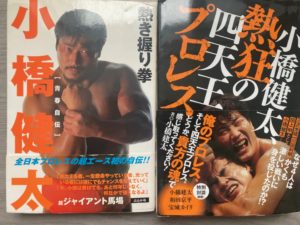
Left: Kenta Kobashi [Youth Autobiography] Passionate Fist, Published May 20, 1999 AND
Right: Kenta Kobashi, The Enthralling Four Heavenly Kings Pro Wrestling, Published February 14, 2016
(APOD: For clarity’s sake I’ll be jumping back and forth between books as we go through them. I’ll refer to the first one as FIST and the second one as PILLARS.
Both books have prefaces filled with optimistic and motivational language since Kobashi is, by nature, an extremely determined person who can’t take no for an answer and who doesn’t believe that something is impossible. These include, from FIST:
“Dreams are not meant to be admired, they are meant to be fulfilled.”
“If you are afraid, nothing will start; if you don’t take action, nothing will change.”
PILLARS opens with an optimistic outlook on pro-wrestling while also acknowledging that the industry had entered a winter period in the 2010s but many companies were working hard to improve.
In FIST, Kobashi also acknowledges that some people out there might have serious dislike for professional wrestling, whether that’s because they think it’s fake, because it’s barbaric, or because they simply dislike one company or another. To which he responds,
“I can proudly say this: the “professional wrestling” we are doing is something we can engage in without shame and is worth dedicating our lives to! If I were to give a reason why I can say this so confidently, it’s because a great power is born from the unity of feelings between us wrestlers and the audience who pays to come and watch us.”
He notes that he has received many letters from fans who watched him wrestle and display his courage which in turn inspired them to do the same. And since Kobashi found the same inspiration from wrestlers when he was a child he wants to do the same for others. He then goes on to explain why the connection between wrestlers and their fans is so important:
“Are you familiar with the phrase “desperate strength”? It means that when placed in a predicament, people can unleash dormant potential power. For us wrestlers, your support is the source that generates this incredible power.
When I am about to lose consciousness during a match or when I feel like giving up due to the opponent’s attacks, hearing your cheers turns into great strength and gives me even more power. I believe that in life, there are always unpleasant and tough times or moments when you feel like giving up. At such times, if watching our matches can turn into courage for you, there is nothing more gratifying for us wrestlers.
We transform your cheers into strength. You gain courage by watching our matches. It is because this is a place where we can build such a relationship of trust that I am truly glad I bet my life on “professional wrestling.””
And with that we enter the first chapter.
Boyhood
PILLARS has a second intro of sorts, one tied to Kobashi’s childhood. Once in elementary school he was asked who he admired. His initial answer was two people: Sadaharu Oh and Shigeo Nagashima of the Yomiuri Giants baseball team. He describes Oh’s accomplishments and how in 1977 he broke Hank Aaron’s home run record and then retired in 1980 with a record of 868 home runs while Nagashima was such a compelling player that even the Emperor of Japan would attend his games. There was also a baseball player named Shige Takada whom Kobashi notes maintained a “calm professionalism” and constantly delivered results even if his individual achievements never reached those of Oh or Nagashima. Kobashi also notes that the owner of the Giants at the time, Matsutaro Shoriki, had a personal motto that all of his players had to adhere to: “The Giants must always be gentlemen”. They followed this motto without deviation: Kobashi never saw them complain, make excuses, provoke opponents, or play unfairly. They always came across as dignified and upstanding athletes and Kobashi notes that he was drawn to this aura they exuded.
Now for the actual biographical details…
Kenta Kobashi was born on March 27, 1967 in Fukuchiyama City, a green and quiet place that, at the time, had no highways or even a convenience store. Initially his was a family of four: himself, his older brother, and their two parents. However, by the time he was in elementary school his family was already falling apart. His parents divorced when he was ten or eleven. Kobashi has few memories of his father, noting that he remembers his parents arguing many times and that his father hit him a few times after drinking. Interestingly, Kobashi doesn’t express outright hatred or anger towards his father and instead expresses indifference towards him and states, “I strongly feel that my mother is the only parent who raised me.” He also notes that Kobashi is his father’s name and both he and his older brother stubbornly refused to adopt his mother’s maiden name after the divorce was finalized (APOD: which makes complete sense in a culture that addresses you by your last name most of the time). Had he done so his name would’ve been “Kenta Kondo” and he notes that this just wouldn’t sound right when called by a wrestling ring announcer. (APOD: he’s absolutely right, there’s no way that would come out the same way as “KOBASHIIIII KENTAAAAAA!”)
With his parents’ divorce Kobashi found himself in a single-mother household which made life much more difficult for him (APOD: This is a common thread for three of the Four Pillars: Kobashi, Kawada, and Misawa). As he has stated before in many interviews over the decades, “I had almost nothing.” Still, neither he nor his brother recalls ever feeling shame, misery, or disgust over being poor. If anything the sight of his mother working so hard night and day to provide for them instilled a deep pride in him and they both concluded “we must never do anything to make her sad.”
Kobashi was introduced to pro-wrestling by his older brother who was a fan at the time. Kobashi was simply following his brother, liking what he liked and doing what he did because he wanted to mimic his older brother and keep up with the topics he was interested in. His most memorable match was the one between Jumbo Tsuruta and Mil Máscaras from 1977 (the same match that inspired Toshiaki Kawada). The two brothers would play wrestle as most kids do but at the time Kobashi didn’t really think of wrestling as a possible career; he was simply a fan.
As a fan Kobashi would watch as often as he could and also began reading pro-wrestling magazines wherever he could. And yet while he notes in PILLARS that he fell in love with wrestling around this time in FIST he notes that his primary goal was still to become a professional baseball player. Since he had relatives in Himeji he wanted to go to Toyo University Himeji High School hoping to get scouted for the Yomiuri Giants. Incidentally Kobashi also notes that Giant Baba used to play for the Giants as well and when he watched Baba wrestle he exuded that same dignity and gentlemanly atmosphere mentioned above. From PILLARS:
“Looking back now, I think I must have projected my ideal father image onto Mr. Baba. Due to the loneliness of not having my real father by my side, I increasingly immersed myself in pro wrestling, overlaying my ideal father image onto the “strongest, biggest, and kindest man” on TV, Giant Baba. That admiration for Mr. Baba eventually transformed into a longing to become a professional wrestler.”
In FIST, Kobashi notes how he loved playing baseball as a kid but poverty made the simple things difficult. He didn’t have a bicycle, a phone for emergencies, radio, or camera at home. His baseball coach was kind enough to lend him things like an old bike and a catcher’s mitt but this led to jealousy and some harsh treatment from other kids (though not outright bullying). Kobashi notes that immersing himself in sports allowed him to avoid thinking about the challenges of being in the rare instance of a single-mother household at the time. He would go to an after school care facility for kids of working parents and once at home he notes there were times when they didn’t have enough to eat so his mom would give her kids her portion of whatever they had.
Kobashi is more earnest about his childhood in FIST and notes one instance of throwing a temper tantrum due to being hungry in the middle of the night. In response his mom went out on her bicycle to get them something but there were hardly any streetlights at the time and her bicycle’s light was broken so she rode blindly in the dark. She ended up catching some kind of ditch and returned with the food…and some blood in her mouth from losing four of her front teeth. From there he vowed to be much less selfish as a child.
Kobashi gets a small dose of karma shortly afterwards as his family is forced to move to another district of Fukuchiyama, forcing him to leave behind both his circle of friends and the girl he liked. Their new house was relatively dilapidated with some pillars being eaten by termites yet since the rent was cheaper it was all they could afford. Further complicating things was that he entered middle school at the same time his older brother entered high school, the latter adding more expenses to the family’s stretched finances and causing their already overworked mother to work even harder. He notes that she’d work two jobs on top of preparing meals and other housework, at times literally working all day and night.
Once in middle school Kobashi loses interest in baseball due to the cost of the equipment and some stress from his treatment in little league and tries joining a different sports team. To make the most out of his height (and because he read an interview from Jumbo Tsuruta in which Tsuruta states that playing one of those sports helped him grow taller) he considers volleyball or basketball but then the guy sitting next to him in class recommends judo which Kobashi takes a liking to since he was still a wrestling fan. Incidentally in PILLARS he notes that, up to that point, he had only ever been to one live wrestling event and it was not All Japan but New Japan since AJPW didn’t run shows in Fukuchiyama at the time. His brother had also gotten him tickets to International Pro Wrestling as well but the promotion closed before that event would take place. In terms of his experience with those wrestlers his two books seem to give two different accounts. In PILLARS he describes getting an autograph from Dynamite Kid while in FIST he describes Kid pretending to write an autograph before throwing the board at him. He also notes in FIST that some of his friends were spat on. He also recalls being chased by Stan Hansen during Hansen’s entrance.
In FIST he notes the judo club was a meeting place for delinquents and only one other person was taking it seriously. Around the same time his older brother expressed interest in becoming a professional wrestler and thus so too did young Kenta. Kobashi centered his life in getting stronger so getting physically bigger and stronger came at the expense of studying. Kobashi in PILLARS:
“Every morning, before going to school, I ran continuously at Sandanike Park near my home, and I relentlessly did squats and push-ups every day. Rain or shine, I dedicated myself wholeheartedly, and as a result, I became much harder to throw in judo matches. Thanks to that effort, by the time I was in the third year of middle school, I had grown taller than 180 centimeters, and my body had become larger.”
Kobashi, like Kawada and Misawa, wanted to join a wrestling promotion straight out of junior high but this was impossible because AJPW had a minimum requirement of high school or above for all applicants. And because of his family’s situation Kobashi didn’t want his family to be spoken of in a negative light, that “oh, they can’t even afford to send their kids to high school”. Because he was improving his physical condition he received offers from private high schools but not full tuition waivers because his academic record was unremarkable. So he set his sights on a public high school with a good judo program…except there was one problem: his academic record was so bad that getting there was deemed impossible. Out of about 800 junior high students Kobashi initially placed 640th or 650th. To get into his desired high school he needed to get into the top 100. His teachers told him this was impossible, but Kobashi was basically the living embodiment of the Adidas slogan and refused to give up:
“I dislike being told by others that something is “impossible.” Even if I’m labeled as “impossible” without having made any effort, I wonder how they can know that. If the result of my efforts turns out to be impossible, then that’s just how it is. But to be deemed impossible by others without even trying is not acceptable to me.”
And so Kobashi crammed and crammed, sometimes so hard that his eyesight diminished. He studied hard and over time got his score up into the top 300s, then the 200s, and then finally high enough to be accepted to his high school of choice. At the same time he also continued to build his strength for local and intercity judo tournaments. He would do things like tie barbells to his back with a belt and run 5kms with it or create makeshift weights to lift and build up his arms. At times these crude weights would drop or cut him and his chest would bleed. But this was worth it if it made him stronger. He devoted each and every free moment he could to becoming stronger, even if it came at the expense of dating or other interpersonal relationships. Eventually he graduated high school and, while his mother was proud, she confided in him that she too was experience trouble with her peers at work, partially stemming from purported preferential treatment and her exceptional work ethic as a part-timer compared to the other full-timers. Kobashi vowed to become strong not just for his mother but he wanted to be successful enough for her to be comfortable in her later years. Kobashi also has a positive message for those experiencing similar struggles in their own lives:
“I hope that those being bullied will have a strong heart that won’t be defeated. If you don’t want to be bullied, the only option is to become strong. If you say that it’s impossible and do nothing, the situation will not change at all. If you continue to make efforts to become strong both mentally and physically, you will surely change as a person.”
Despite his constant growth and improvement, though, Kobashi was not dead-set on choosing wrestling as a career path as of yet. Instead, he wanted to bring stability to his life and especially wanted to help his mother out. That meant living independently and supporting himself. In response to this one of his coaches, one Mr. Takahashi – who had given him many pointers in judo and encourages him to struggle so that he could find answers on his own when improving his techniques – recommended he join a company called Kyocera, which was a high-end ceramics company.
That’s where chapter 1 of FIST ends while the first chapter in PILLARS goes on a bit but the subject of these last few pages ties into Kobashi’s first few years as a working adult so I’ll save that part for later.
APOD: These first chapters in Kobashi’s books really help us understand more about the man and what’s in his head than anything else. He’s humble and honest about his childhood and acknowledges the difficulties he experienced growing up not having all that much. Though he doesn’t describe his home life as unstable or unsupportive there were financial and economic challenges that made it harder for him to experience what his peers had. This, coupled with how much his mother struggled to raise two sons on her own, convinced him to adopt an unwavering “impossible is nothing” mentality which followed him all through his life. Understanding how the man thinks is important because it lays the foundation for everything that follows. Much has already been written about the ups and downs of Kobashi’s wrestling career, including the immediate brick wall he encountered trying to enter it in the first place. But we’ll check that out next time.
Thanks for reading.