

5-Star BOOK Reviews: Jumbo Tsuruta’s Books, Part IX
By Alex Podgorski on 4 March 2026
Last time we look at Jumbo Tsuruta learning from the legendary Lou Thesz and making his transformation into a main-event talent. This next section will look at how Tsuruta channels those changes into major title victory. Winning a big title belt proves fruitful and all, but more importantly Tsuruta finds him dealing with not one but two people challenging him like never before, and the result is Tsuruta finally awakening as more of a complete wrestler.
You can read part 1 here, part 2 here, part 3 here, part 4 here, part 5 here, part 6 here, and part 7 here, and part 8 here.
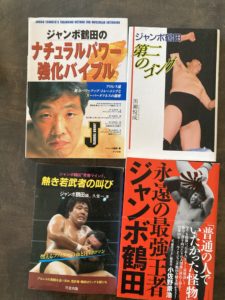
Tsuruta channels all of his training and transformation into a match with Bruiser Brody in August 1983 that ultimately ends with him scoring a fall with the Lou Thesz Press. On that same night, Terry Funk announces his retirement. Then in February 1984 Tsuruta beats Nick Bockwinkel to become the first Japanese AWA World Heavyweight Champion. This is seen as a crucial step in Tsuruta surpassing Baba, but it takes some time because Akio Sato is sent by the NTV executives to persuade Baba to allow it to happen. As an aside, this book contains an insightful quote from Bockwinkel who summarized his willingness to match his opponents’ strengths by saying, “If my opponent dances the waltz, I’ll dance the waltz; if they dance the rumba, I’ll dance the rumba.” Also around the same time Tenryu wins the vacant NWA United National Championship, defeating Ricky Steamboat in a tournament final.
Tsuruta’s AWA World title win is seen as a major personal accomplishment and also breaks a long chain of world title matches ending with indecisive finishes. But his tour of the States as defending champion wasn’t the babyface success it was hoped to be: in several matches, including defenses against Blackjack Lanza and Jim Brunzell, Tsuruta gets booed vociferously and pelted with garbage as a heel, even though none of his actions in the ring are heelish in any way,
Tsuruta’s title reign sees him defend the belt against luminaries like Lanza & Brunzell, Bruiser Brody, Billy Robinson, Greg Gagne, David Sammartino, and Blackjack Mulligan. He wins some matches by pinfall but also has a few count-out and disqualifications as well, making a reversal from being on the opposite end of that equation during the previous decade. Incidentally, through all of this Tsuruta remains the reigning and defending NWA International Heavyweight Champion which he goes on to hold until mid-1986. In another defense Tsuruta faces Baron Von Raschke, who receives what is described as an “ultra babyface” reception. Raschke’s gimmick, at the time, was that of a literal Nazi, FWIW. Tsuruta’s reign goes on for sixteen successful defenses plus one no-contest against Brody, and ends when Tsuruta loses the title to Rick Martel in a two-out-of-three falls match refereed by Leo Nomellini, the man who, thematically, ended Lou Thesz’s undefeated streak decades earlier.
After dropping the title, Tsuruta returns to Japan to announce his engagement and get married to his longtime girlfriend Yasuko. According to Tsuruta it was love at first sight, though there’s was a long-distance relationship since he was wrestling mainly out of Tokyo and she was a college student in Kobe. It started as a casual relationship, but after she graduated he asked her to marry him. But she turned him down because she had dreams of being a flight attendant. Tsuruta responded to this rejection by crying while burning love letters; however, over time he would still send her season’s greeting and New Year’s cards. Then, in an unexpected twist, Yasuko ends up being on a flight with Giant Baba and other wrestlers and she is impressed at their gentlemanly behavior. Soon afterwards Yasuko realizes her dream was achieved and she decided to pursue marriage. Their marriage takes place on September 23, 1984 and has about 1,500 attendees.
Around the same time as Tsuruta finds a partner in his personal life he also finds a new partner in his professional life in the form of Genichiro Tenryu. This pairing gets praise from Baba who decides to keep them together for at least another year. However, there’s still an issue with negative conclusions, to the point that Tsuruta publicly laments, “What more could we have done to win?!?!!” On the management side of things Baba experiences frustration with foreign wrestlers being relied on in main event matches and them refusing to take clean finishes. Further constraining him was the growing threat from WWF’s nationwide expansion: though he still had strong ties to both the NWA and AWA come 1983/4, he began worrying that disgruntled foreign stars dissatisfied with booking that didn’t go their way would simply sign with WWF. Baba’s solution was a gradual one: shift focus onto native talent while still respecting the hierarchy of wrestlers, even though those at the top were almost always foreigners.
Jumbo Tsuruta vs. Riki Choshu
There is also another force muddying these waters further: Riki Choshu and his invading force from Japan Pro-Wrestling. Baba did not want the press presenting Choshu as being on equal level with Tsuruta & Tenryu. When those two guys responded to Choshu’s comments, Tsuruta gave a cool & passive remark while Tenryu answered fire with fire which made Tenryu the first star to take Choshu on. Chushu ends up facing both guys but finds Tenryu more exciting and engaged in battle than Tsuruta. In these Japan vs. Japan battles Baba observed a problem with many native-born wrestlers in that their styles were too deviant from form and lacking in dedication for fundamentals:
“What I thoroughly felt from them was an interesting disregard for logic, lack of adherence to basics, and deviation from standard theory. The theories we were taught by Rikidozan and learned in America, they completely ignored, doing pro wrestling as they pleased. But that ironically resonated with the fans. However, while it may have gained popularity in Japan, it wouldn’t hold up globally. Top-tier wrestlers never deviate from the fundamentals” – Giant Baba
Baba’s comments seemed to ignore the draw of this AJPW vs. JPW feud, that being the contrasting styles. The awkwardness exchanges and lack of smoothness was the appeal in this case; however, the comments from the wrestlers from both sides reflected frustration. The AJPW wrestlers would tell the outsiders they didn’t know how to wrestle while Choshu’s forces would complain that AJPW’s style was “sluggish”. This led to increasing stiffness, less rhythm, and both sides refusing to take each other’s moves or sell for each other. Still, according to Fuchi, the fans went wild for these encounters.
Misawa, who was wrestling as Tiger Mask II and feuding with Kuniaki “Tiger Hunter” Kobayashi, summarized the situation thusly:
“Simply put, it’s the difference between ‘offense’ and ‘defense.’ On their side, it felt like ‘whoever strikes first wins!’ But what I noticed was that they ran out of steam quickly. Even if they came at us aggressively at first, or attacked us, if we could endure it, there were surprisingly many opportunities to win.” – Mitsuharu Misawa
However, Tsuruta benefitted from these arrangements because they allowed him to make use of his height advantage, showcase his ability to recover quickly, and maintain a calm composure in a field defined by chaos and heated passion. Per Fuchi in ETERNAL,
“In matches against foreign wrestlers, even if you stayed down after being knocked down, they wouldn’t attack immediately. But with Japan’s wrestlers, if you went down, they’d attack you right away. If you didn’t get up and counter immediately, the match wouldn’t work. Tsuruta, being taller than the Japan wrestlers, could take hit after hit and then counterattack with such impact and presence that it surpassed their offense. When Tsuruta moved like that with his large frame, his recovery was incredible!” Additionally, when a taller wrestler attacked from above, the shorter opponent had no choice but to lower their head, which must have looked impressive to the fans.” – Masanobu Fuchi
Throughout this time, the only “balanced” match that everyone appeared to like was Tsuruta vs Animal Hamaguchi, which had a lot more of that push-and-pull than the rest of the field.
Another beneficiary of this period was Yoshiaki Yatsu who started as part of Chushu’s group but soon grew closer to the AJPW side. Like Tsuruta, Yatsu was an Olympic-level wrestler but from a lower weight class. He also had an unusual training trajectory: rather than start in NJPW and train with Karl Gotch in Florida afterwards, Yatsu instead went straight to the US to start his training, according to Osano, and worked directly under Pat Patterson and later Hiro Matsuda. Over time Yatsu would grow comfortable with AJPW and appreciate their style more than New Japan’s. This was important because many commentators considered NJPW’s the better style and AJPW’s a slower and almost infantilizing subset. But not Yatsu:
“After all, New Japan’s pro wrestling doesn’t resonate. You could say it’s because the styles are different, but All Japan’s pro wrestling isn’t as simple as New Japan’s. All Japan has multiple ways of structuring matches, right? I thought it was a hassle, but I also felt that All Japan’s matches were real pro wrestling. New Japan ends things quickly, so there’s nothing to think about, but All Japan’s pro wrestling is about carefully showing the match while considering every corner of the audience. Also, the All Japan guys were bigger than the New Japan guys. Being big is definitely the biggest weapon. Their movements may look slow and deliberate, but each move is heavy, so in reality, the smaller, more active wrestlers end up using more stamina.” – Yoshiaki Yatsu
Yatsu would wrestle Tsuruta as part of the wider feud with Choshi and Tsuruta put Yatsu over big time, comparing him to a fine wine that improves if you let it mature. As for Yatsu’s opinion of Tsuruta, he notes that Tsuruta never got rattled when others criticized him. Against New Japan guys, Tsuruta would even go so far as mock them and hold back, never showing his maximum strength. Yatsu describes Tsuruta’s unmatched stamina and his overwhelming sense of control led to him overwhelming opponents and dominating matches. Yatsu compares Tsuruta to Tenryu and notes Tenryu was easier to work with because he was more expressive. The only exception to that rule is a press conference between Tsuruta and Choshu in which Tsuruta makes uncharacteristically heated remarks.
However, plans for a Tsuruta/Choshu singles fall apart due to Tsuruta suffering an injury. Plans pivot to a match between Choshu and Yatsu with Choshu winning and using this as an opportunity to declare a new era for him and his crew.
As for Tsuruta, this is where his unfortunate downfall begins because during a routine blood test he learns he has Hepatitis B, which was likely transmitted to him from his mother during pregnancy. Though Tsuruta learns of this diagnosis in the mid-1980s, Osano states that Tsuruta doesn’t experience any major flare-ups or symptoms of the disease until around July 1990.
Going back to the Choshu situation, Tsuruta does end up facing him in a big match on November 4, 1985 that goes to a 60-minute draw. Despite that inconclusive finish, the match is framed as a display of Tsuruta’s overwhelming victory because he adhered to a “champion’s wrestling style” and made Choshu wrestle around him. Specifically, Tsuruta made sure that the last move being executed before time ran out was a Boston Crab because it had Tsuruta in a dominant position. In other words, an example of the techniques displayed mattering as much as or more than the recorded result.
“If I stand in the center of the ring and make my opponent move around me, I appear superior. If I immediately counter their strikes, it looks like we’re equals, so I leave a slight pause. This was a strategy I learned from the incredible wrestlers during my early days as a ‘valiant loser.'” – Jumbo Tsuruta
Different people reacted differently to this match. According to Akio Sato this match exposed Choshu’s shortcomings as a wrestler along with the limitations of the New Japan style. Choshu reportedly ran out of gas 20 minutes into a one-hour broadway and his aggressive style didn’t resonate with AJPW’s audience, who referred more of a see-saw rhythm. Fuchi also notes that Choshu’s techniques were better suited to an opponent of equal size like Tenryu but since Tsuruta was taller the angle at which Choshu struck made for a less thrilling visual. The referee for the contest, Tiger Hattori, noted that Tsuruta had a tendency to engulf or “swallow” his smaller opponents which made it harder for them to showcase their strengths. It’s easier for someone bigger to exert strength from above but MUCH harder to showcase strength from below. Because of this, Choshu struggled to look good and thus wasn’t able to “share” in the match as much as he wanted. Tenryu felt similarly to Hattori, noting that Tsuruta was making Choshu look small and wasn’t clashing head-on. As for Choshu himself, he would state in 2012 that he thought Tsuruta was amazing but he couldn’t get into his own rhythm and going at Tsuruta’s didn’t work for his character.
Soon afterwards Choshu beats Stan Hansen to win the PWF Heavyweight title from Stan Hansen. This changes AJPW’s landscape somewhat to a company defined by now two but three pillars: Tsuruta with the International title, Tenryu with the United National title, and Choshu with the Pacific title. However, this doesn’t last as Choshu returns to New Japan in early 1987, claiming that he didn’t want to be placed within the framework of All Japan. in the immediate aftermath of his departure there is a sense of gloom in AJPW’s locker room and suddenly things felt like they were lacking intensity. Tsuruta remarks that Choshu had blown threw All Japan like a whirlwind and now he was gone just like that.
Osano would meet Choshu decades later in 2019 and talk about Tsuruta for the ETERNAL book. Unlike in their active wrestling days, when Choshu would speak to and of Tsuruta in harsh tones and without honorifics, here he would be respectful, admirable, and would always make sure to add a “-san” or “-sempai” when addressing his senior. However, Choshu’s words all seem to be talking about Tsuruta in broad strokes or from distant observation; he never discusses their in-ring activities or their feud during the invasion. Osano suspects that, if Tsuruta were still alive, he’d be reminiscing about those days with Choshu like a bunch of old war buddies.
Jumbo Tsuruta vs. Genichiro Tenryu (the beginning)
Genichiro Tenryu, on the other hand, has a more complex relationship with Tsuruta. In ETERNAL Tenryu recalls receiving a warm reception from Tsuruta when they first met from their shared experiences in sumo. Tsuruta’s friendlier aura leaves Tsuruta with the impression that “pro wrestling isn’t so bad” and he might have an easier time making the jump from sumo to puro than he first thought. However, over time this relationship grew complicated, with Tenryu getting very particular about his word choice. His initial introduction in ETERNAL has him refer to Tsuruta as a “comrade” with shared experiences but once Tenryu leaves for SWS that turns to a sort of a one-sided rivalry with Tenryu not wanting to feel inferior to Tsuruta in any way.
An important part of this framing begins in Tenryu’s foreign excursion to Amarillo. Since he goes after Tsuruta, the Funks and the rest of the territory view Tenryu through a Tsuruta lens. Though Tenryu learned something called the ring cradle, a technique Tsuruta never could, within three months Tenryu began losing his shine. Tenryu’s struggles to adapt lead to two more foreign excursions during the 1980s. Tenryu eventually makes it back and scores a big win in a tag match against Baba & Tsuruta. Around the same time, though, they began drifting apart personally since their hobbies and preferences changed. So while they were friendly, they never became best friends.
In 1985 when Choshu arrives, Tsuruta and Tenryu are paired together as the Crane-Dragon duo or The Tsuru-Ryu Combination. However, from Tenryu’s perspective, that arrangement was all about Tsuruta while Tenryu served an accessory to Tsuruta’s greatness. This was reflected in fan interest as well, with Tsuruta’s lines for autographs being much longer than Tenryu’s. It affected the press as well: after matches Tsuruta would go one way and Tenryu another which caused the journalists to split off to get their scoops and photos. In these small actions, many journalists observe a slow-boiling tension. According to Osano, the starting point for this tension goes back to when Tsuruta delegated matchmaking authority to Akio Sato around the time of the regime change mentioned in the previous section. It seemed like Tenryu was one of the many observers who concluded that Tsuruta lacked ambition and his unwillingness to handle more responsibilities as the new chosen ace reflected a lack of interest in steering AJPW going forward. In other words, when Tsuruta proclaimed that he’d be ace solely in the ring, Tenryu saw this as a failure of leadership.
This tension reaches its peak on June 7, 1986 during a tag match between the Tsuru-Ryu Combination and The Road Warriors. After the Road Warriors win the match Tsuruta and Tenryu getting into a series of heated backstage arguments and at least one public one in which Tenryu proclaims that he was tired he was tired of seeing Jumbo’s back and babysitting Wajima. Baba, despite his dislike for such disruptive occurrences, listened to and went with Tenryu’s plan to shake up the roster’s alignments. This leads to Tenryu’s Revolution stable and the pushes of younger guys like Ashura Hara and, later, Toshiaki Kawada.
In retrospect, however, Tenryu acknowledges that some of his statements were likely too hot-headed and unfair to Tsuruta. Tenryu knew the real Tsuruta as a person and admires Tsuruta’s unseen qualities. However, in the context of AJPW at the time Tenryu still thinks that his need to keep the company’s product exciting put him at odds with Tsuruta’s more relaxed personality.
Baba ultimately respects Tenryu’s plans and starts booking Tenryu and Tsuruta as opponents. It’s noted from the start that Tsuruta displays significantly more passion and fighting spirit than before. Tenryu, it seems, is able to goad Tsuruta into being fiercer and more aggressive. In other words, more relatable to the audience. Even Baba agrees, saying on commentary that this expressiveness was the very thing Jumbo had lacked up to that point and Tenryu is a better motivator than a push from behind by Baba ever could’ve been. To really hammer home how special this is, Tsuruta goes so far as to grab the house mic and calls Tenryu out.
Eventually a singles showdown takes place between Tsuruta and Tenryu on August 31, 1987. This is their third-ever encounter, the prior two taking place under more “neutral” circumstances and ending in 30-minute draws. This, however, was something else: a match that would allow emotions to be unleashed. They fought much more physically than before. Eight minutes in Tenryu busts Tsuruta’s head open. Minutes later Tsuruta removes his kneepad and lands the jumping knee with his knee fully exposed. They battle on the apron, reverse spots on the mat, and escalate higher and higher. The match concludes with a double lariat spot that leads to Tenryu winning by count-out as he’s hanging upside down with a leg caught on one of the ropes. This match reflects the strengths and weaknesses both men have. Though Tsuruta is more technically proficient, Tenryu has more tenacity and passion.
In the end the match gets praised by Baba and both wrestlers acknowledge each other. It also proves a ratings success, getting a 12.4% Nielsen rating. (APOD: You can watch that match here). A rematch takes place two months later in October that shares many features, including the intensity and popular appeal, but it’s rating dips slightly to a 9.5% Nielsen rating. The August 31 match is also voted Best Bout/Match of the Year by Tokyo Sports for 1987.
As for why it’s successful, Tenryu attributes it to breaking Tsuruta’s rhythm and never letting him settle into a formula.
“In that first chapter of the showdown, I used moves I don’t usually perform—like a German suplex or executing a jumping knee before Jumbo did. I probably thought, ‘If I fight the same way as always, I won’t be able to overcome Jumbo Tsuruta.’ I needed to break through with unpredictability. Jumbo tends to settle into a rhythm and calmly execute his style of wrestling, so I couldn’t let him do that. I had to keep changing my approach and tactics against Jumbo. When I did the jumping knee, he got angry, removed his knee pad, and drove his knee directly into my face with full force.” – Genichiro Tenryu
And of course, this wouldn’t be a Tsuruta review without his professional evaluations. Here’s his opinion of Tenryu, per BIBLE:
Tenryu Genichiro
Real Name: Genichiro Shimada
Date of Birth: February 2, 1950
Hometown: Fukui Prefecture
Height: 189 cm
Weight: 125 kgFormer sumo wrestler from the Nishonoseki stable. He entered the ring in December 1963 and won the makushita division in September 1970. He retired from active competition after the autumn tournament in 1976 and joined All Japan Pro Wrestling in October of the same year. Shortly after, he went to America to begin his pro wrestling training under the Funks. In November of the same year, he debuted in Texas against Ted DiBiase.
In February 1984, he became the UN Heavyweight Champion. In October of the same year, he won the inter-tag title with Jumbo Tsuruta as the “Tsururyu” team. The following year, he engaged in intense battles with Riki Choshu, who transferred to All Japan, and formed an alliance with Ashura Hara in 1987. In June 1989, he captured the Triple Crown Heavyweight title from Jumbo Tsuruta and left All Japan Pro Wrestling after the April 1990 event. That same year, he formed a new organization called SWS. When SWS collapsed in June 1992, he launched WAR the following month. He participated in New Japan Pro Wrestling, defeating Choshu, Hashimoto, and Fujinami, and in May 1994, he achieved a pinfall victory over Antonio Inoki in their first match. He is the only Japanese wrestler to have pinned both Baba and Inoki.Why has Tenryu, who originally should excel in short-term battles due to his sumo background, acquired such stamina? It may sound abstract, but it boils down to “spirit.”
He endures and endures until he can unleash his finishing move, the powerbomb. One reason he can take so many of his opponent’s moves is that there is a limited variety of techniques. He cannot create the match himself by executing his own moves.
So he receives. He continues to take hits. For Tenryu, who has few techniques, bouncing back with spirit was the way to become a top wrestler. And when the opponent has exhausted all their moves and stamina, Tenryu’s inherent explosiveness comes into play.The secret of stamina that allows him to conserve his finishing moves until the end. Tenryu’s wrestling style is to absorb the opponent’s moves to the limit and then bounce back at the end. As you know, Tenryu was a former sumo wrestler. In sumo, explosiveness is more important than endurance. The way to fight in sumo is to unleash all your power in a single moment of engagement. Facing Tenryu always meant a clash of stamina against stamina.
I began to feel the difficulty of having two ace-level wrestlers in one organization. It seemed Tenryu felt the same, as after the match, he avoided meeting my gaze. Two heroes cannot stand side by side. I thought he might leave All Japan. A year later, my premonition came true.
APOD: This was a long section as we covered lots of ground during a volatile period in Tsuruta’s career. He found himself affected by two imposing outside forces in Choshu and then Tenryu, both of whom disrupted his ho-hum attitude and sense of calmness about wrestling. Choshu was more of an outside observer but Tenryu was and still is much more vocal about Tsuruta and willing to explain things in vivid detail. Having also translated three books by Tenryu, I can confirm that he still recalls his feelings for Tsuruta and their matches in great detail and with entertaining language. But for now it’s good to see Tsuruta finally showing personality because, as I noted in an earlier section, being good at executing techniques is only part of the equation. Tsuruta’s calmness made him come across as detached, elitist, and disconnected from the very action he was involved in. Thankfully Tenryu was the perfect force to prod Tsuruta right spots to make him emote and express himself with genuine animation. And thankfully the next section will cover one of Tsuruta’s peaks as a performer.
As always thanks for reading.