

5-Star BOOK Reviews: Kenta Kobashi’s Books, Part X
By Alex Podgorski on 25 March 2025
And now we conclude Kenta Kobashi’s long and winding road with the final part of his career. This is a sad period marked by a series of unfortunate illnesses and more injuries that, ultimately, force Kobashi into retirement. Before 2006 he had half-jokingly stated he wanted to keep wrestling until age 70. But unfortunately a routine check-up revealed a bombshell of a shock that risked ending not just his career but his life as well. And while he’d end up overcoming that illness (which is still remarkably on-brand for him as a wrestler and as a person), it was clear that his days of being the pro-wrestling version of Superman were over.
You can read part 1 here, part 2 here, part 3 here, part 4 here, part 5 here, part 6 here, part 7 here, part 8 here and part 9 here.
Although he has done interviews here and there over the years regarding his career and life post-2006, only one of his books touches on this period, that being his 2013 book NO REGRETS.
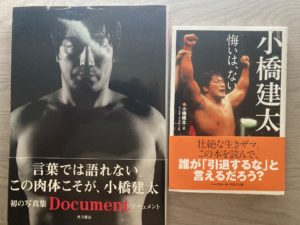
Kobashi opens this final section with the question, “Am I going to die?”. Lovely. What started as a routine annual health check-up ordered by the company (something Misawa was sure to mandate and follow through with when forming NOAH) turned into kidney cancer. Kobashi isn’t sure where and how it came about; when it comes to health he only mentions consistently having a cold since 1996 but blew it off because, well, medically speaking a cold is nothing serious. But Kobashi also notes the saying “a cold is the root of all diseases” and he should’ve sought an earlier diagnosis rather than trying to beat it on sheer willpower alone.
Of course, the first question Kobashi asks after hearing the news is “will I be able to wrestle?” because he wanted to participate in Yoshihiro Takayama’s return match from a cerebral infarction/stroke. But moments later a darker thought creeps in: “am I going to die?”. Kobashi attributes this to a generational attitude as, in his time, the general mentality was that “cancer = death” (APOD: thankfully this isn’t always the case anymore but medical science still has a long way to go).
After coming to terms with his diagnosis Kobashi returns home where his girlfriend Mayuko is waiting for him. Their conversation basically goes something like this:
Mayuko (worried): “How was it?”
Kobashi: “…I have cancer.”
Mayuko: “…”
Kobashi: “Babe?”
Mayuko (after bursting into tears): “…Please marry me!”
Kobashi acknowledges that they’d been dating for a long time but ultimately turns her down in that moment. Not because he doesn’t love her, but because he wasn’t sure he’d be able to manage his own life going forward, much less hers as well. For a moment he thought she’d be happier without him, but apparently love is much stronger than that, as shown by the fact that she stayed by his side and, as of this writing, the two of them to still be happily married and have a daughter together.
Back to wrestling Kobashi is concerned that wrestling could still have a dramatic effect on his body. If the membrane surrounding his kidney were to break then the cancer would spread throughout his body. However upon arriving to Yokohama City Universal Hospital his scans show both a mixture of cancerous images plus some benign tumors. So in early June 2006 he announces his cancer diagnoses and a month later he’s admitted to hospital.
Kobashi opts for laparoscopic surgery based on his intent to return to wrestling, which later becomes a full nephrectomy to remove his right kidney. The night before, however, he is told by the head surgeon, “Mr. Kobashi, your muscles are about three times that of an average person, so even if we cut, we might not be able to approach it well. In that case, we would have to make a large incision from the side; would that be okay?” to which Kobashi says yes, do what you must. Because this wouldn’t be a Kobashi story without a stupid amount of muscles.
Jokes aside, the doctor also strictly reminds him that this procedure is to save his life, not his career, and tells him to stop talking about returning to wrestling. In the moment Kobashi goes along because, well, few things are more important than beating cancer. But after waking up from the procedure and once the anesthesia wears off he has the following thought:
“No athlete has returned to sports after having one kidney removed. Losing a kidney, which filters waste in the body, is not as simple as one might think. Even if I said, “I will definitely make a comeback,” it would probably sound like a joke to most people. Nevertheless, until I heard the doctor’s words, I had only been thinking about returning.”
(APOD: I’m not aware of any full-time athlete making a complete comeback after having a kidney removed so if someone else out there knows of one then please share). Once he wakes up he describes various values that indicate body stress (which usually peak at 150 for an ordinary person) reaching 10,000 for him. This causes him to be intubated for an unknown amount of time until his body’s stress management mechanisms returned to whatever counts for “normal” in his case (APOD: the more I read about Kobashi the more it becomes apparent that he became far more of a genetic freak than Scott Steiner).
After about two weeks he starts taking baby steps on the path to recovery, which usually involves walking in a pool and getting some basic exercise. Then he encounters an early challenge: because protein was bad for his kidneys he couldn’t consume all that much which caused his body to lose its peak form. He also notes that, at the time, there weren’t any muscle-building supplements that contained less protein. As a result, when he looked in the mirror one day he saw a completely different person.
After months of uncertainty and a general trend of weight loss, Kobashi vows to return to the ring, if not just for one occasion. So on December 10, 2006, he announces his intent to come back. But although his kidney numbers were very good during his regular check-ups, each time he asked if this was enough to return to the ring he was met with, “what are you talking about?”
His “main” doctor, who had been overseeing his knee surgeries, notes that his initial procedures in 2000 were done to give him another 5-6 years. Sure enough, six years have passed and he has another knee surgery. He finds himself in medically uncharted waters as there were no precedents at the time for whether his body could recover enough for him to return to the demanding world of pro-wrestling. He tries different diets and mixtures in his diet so that he can be in passable condition to wrestle and, sure enough…
Even if it’s for only one match Kobashi wants to come back. And he does. For one night he turns the clock back as best he can. You can watch the full match here. (APOD: There aren’t many matches that really make me emotional but this is one of them. The man returns from cancer to the sound of 19,000 people chanting his name. To say he’s given a hero’s welcome would be massive understatement. As most comments online have noted, Kobashi gave cancer his eighth-ever Burning Hammer and it, like the others, never kicked out. Even if he’s slower and moving gingerly, the sheer emotion of the match and how much he defied the odds to come back really make this into something truly special. ***** for sure).
Although he lost, IIRC the final ring announcement came out as “KOBASHI HAS BEATEN CANCER!” Fans, commentators, and his fellow wrestlers could be seen and heard crying or sobbing. Jun Akiyama, who endured over 100 machine gun chops in the corner, started smiling at one point during the match because he had his friend back. And the next day when he went for another check-up, his kidney numbers were alright. He also notes that he should check back ten years hence to see if the cancer returns (APOD: and here we are almost twenty years later and, sure enough, no cancer. I told you no one kicks out of the Burning Hammer!) Kobashi also takes this opportunity to share a story about encountering a young boy who had pediatric cancer who had been given six months to live. Although this isn’t one of those fairytales where he overcomes his diagnosis, he ends up living three times that prognosis, which really moves Kobashi while he was in the hospital.
So ends one battle…but more conflict is right on the horizon.
After the 20th anniversary of his wrestling debut comes and goes Kobashi notes he’s having a hard time feeling heat or cold on one hand. He has emergency surgery to repair serious ulnar nerve damage in his right arm, which is a problem for him being someone who relies on chops and lariats in the ring (APOD: I’m a bit less sympathetic here because Kobashi’s almost comical obsession with training got him to this point. He had been documented practicing chops on metal ringposts and lariats on concrete barriers so him having self-inflicted ulnar nerve damage is unfortunate but not unexpected). His doctor warns him to cut down some of his heavier offense including the machine gun chops but Kobashi says “I can’t do that” (In DOCUMENT, his 2006 photo book, he describes being seen in a restaurant and someone mimics his chopping action as a means of recognizing him so it’s justifiable that he doesn’t want to part ways with that signature move). As part of his stubbornness surrounding these techniques his condition worsens to the point that he starts dropping things and struggles to hold chopsticks. At one point he even struggles to write neatly, which forces him to undergo yet another surgery. He comes back in 2009, but then he is rocked by another shocking event involving someone very close to him.
On June 13, 2009, Kobashi describes feeling unwell after a match and goes onto the NOAH tour bus to rest up. Then he sees an ambulance rush to the venue and then wrestler Shuhei Taniguchi wakes him up on the bus warning him of something serious.
“It’s serious! The president has collapsed in the ring.”
The next time Kobashi sees Mitsuharu Misawa it’s in a hospital, and by that time Misawa’s body had gone cold.
“To me, Misawa-san was still the same person I met at the Otsu gym when I went for an interview to become a professional wrestler. Even after 20 years, I have never forgotten the gentle eyes I saw through Tiger Mask’s mask.
In the ring, he was sometimes an opponent and sometimes a partner, but once we stepped off the ring, he was a dear friend. I learned about the mindset towards pro wrestling by observing Misawa-san’s attitude, which he never spoke about. I desperately chased after Misawa-san’s back and absolutely did not want to lose.
When Misawa-san was still Tiger Mask, he often took me in a taxi to matches at Korakuen Hall. When he was riding in his unmasked face, he would suddenly pull out the mask from his bag and put it on as we approached Korakuen, surprising the driver. The driver’s astonished face was amusing, and whenever it was time for Misawa-san to put on the mask, I would always watch the driver’s reaction in the rearview mirror.”
Things continue in a somewhat gloomy tone. NOAH continues shows after Misawa’s death since that’s how they had been trained. As he enters 2010 he has yet another arm surgery and his in-ring career slows down. Little of note happens during this period, save for his marriage to Mayuko becoming public knowledge. In a strange coincidence, Kobashi notes that there are some unusual similarities between his wife’s mannerisms and his mother’s. At the same time, because his health had deteriorated he became a bit more negative around this period but he thanks his support system for helping him through this dark time, and so he wants to make extra sure to thank his wife and mother for their support.
Kobashi returns to the ring after a very long time away and it’s clear by this point that he only has a few matches left in him. One of those happens to be at the AJPW/NJPW/NOAH ALL TOGETHER charity event in the wake of the 2011 earthquake and tsunami, where Kobashi teams with Keiji Muto to take on Toru Yano and Takashi Iizuka. This match is clearly a feel-good fanservice match and is only really remembered for the end which involves Muto and Kobashi hitting dueling moonsaults, despite neither of them having a functioning knee between them.
A second ALL TOGETHER show takes place on the following night but this time things don’t go well as Kobashi suffers a hairline fracture in his left tibia and more ligament injuries in his right knee. Things get so bad for him that he has to sit in a corner during group photo sessions. Then they get even worse. The moment he returns home from a tour he collapses and is hospitalized…where the doctors reveal to him his neck is in worse condition than Misawa’s.
Kobashi’s neck…is in worse condition…than Mitsuharu fucking Misawa’s!
At this point he is given two choices: immediate surgery or immediate retirement. Kobashi, naturally, chooses neither. At first he is prescribed some sort of medication and for a while he resumes weight training. But when his overall condition doesn’t improve to where it should he is given no further choice but to go under the knife once again. He is warned this surgery is to prevent further deterioration, not to restore things to the way they were before. But since the doctors also tell him that this surgery is to ensure he can still function normally, he doesn’t have much choice anymore.
This procedure involves taking bone from his pelvis to his neck and having a ceramic placed where the bone was removed. But then the pelvis cracks where the ceramic was inserted, which Kobashi attributes to maybe one or two sessions of much less intense rehabilitation. Still for a time he finds himself unable to walk due to the situation, which causes him to struggle internally between two halves: one side telling him his situation is hopeless and the other telling him to still keep going. His wife tries to tell him to be more proud of himself for all that he has done yet he still finds himself swimming in doubt.
Then, after many times when he realizes “I can no longer do this”, coupled with a general decrease in the number of kids who say they like pro-wrestling, Kobashi decides to retire.
And that’s the end. “No Regrets” isn’t about his career, it’s about not having any regrets about making the decision to retire. Kobashi doesn’t go into his actual retirement show ‘Final Burning in Budokan’ and instead focuses ahead on his life after wrestling. He leaves the wrestling world without regrets and the book concludes with another long timeline of events great and small in his life.
APOD: The first four chapters of this book, which covered his early life to the death of Giant Baba, didn’t include anything not covered in FIST, PILLARS, or other interviews elsewhere, and is only truly interesting for the NOAH leg of his career and onwards. Sadly these sections are just begging for more content and details, with most of them featuring details and subjects that look like they’re starting to go somewhere but never go into really granular detail. This is an unfortunate conclusion because, judging from Kobashi statements and excerpts recorded elsewhere, the man is unusually open and talkative about wrestling, especially compared to his more tight-lipped Japanese brethren. I don’t know if he ever plans on writing about his NOAH career more specifically, but if he ever publishes a book on this period you bet I’m going to get my hands on it.
Final Rating: ****1/4
And with that the review of Kenta Kobashi’s books has come to an end. As a happy aside, Kim Justice’s Wrestling Road just released a Kobashi vs. Stan Hansen video today and yours truly is name dropped in it courtesy of these book reviews. I really appreciate the plug, as does Scott himself for getting more attention to this blog, surely.
As for next steps, this is where I leave it to you all to decide. Ever since I started reviewing these books, my collection of Japanese wrestling books has, to put it lightly, ballooned. I plan on getting to Mitsuharu Misawa eventually but that’s on the backburner since I’m trying to combine eight books written either by Misawa himself or those with close personal knowledge of him and between several contradictory statements that’s taking some time to organize. In the meantime, here’s a collection of what I have and I’d be happy to know what you’d be interested in:
- Akira Taue’s 2023 autobiography
- Jun Akiyama’s two books
- Hirokazu Hasegawa’s 1997 Four Pillars interviews
- Two books about Jumbo Tsuruta
- Yoshihiro Takayama’s 2003 autobiography and his 2025 NO FEAR follow-up book
- An 800-page book on 1993 in joshi/women’s pro-wrestling
- KENTA/Hideo Itami’s 2022 autobiography
- Confession: The Final Truth of the 10 Major Incidents in Heisei Pro-Wrestling
- Masanobu Fuchi’s book
- Kyohei Wada’s 2010 book
- Hidetoshi Ichinose’s Four Pillars biography (since KinchStalker has actually done the real work and gone over it with a fine-toothed comb I wouldn’t mind going over this one in broad strokes or if someone wants to know something specific about its contents)
- Naomichi Marufuji’s 2018 autobiography “The Ark’s Heir”
- Stan Hansen’s two Japanese books
- Two books about Keiji Muto’s career
Thanks for reading.