

5-Star BOOK Reviews: Kenta Kobashi’s Books, Part IV
By Alex Podgorski on 26 February 2025
So after experiencing a challenging childhood, a conflict-ridden early adulthood, and a taxing training regimen that had caused him more mental anguish than physical, Kenta Kobashi finally makes his debut as a pro-wrestler, and boy do things get interesting.
We left off with Kobashi already having debuted and his undercard losing streak already underway. He also suffers an early setback in the form of a knee injury and Baba wants him to rest now since he won’t have that luxury when he’s on top. Note that Baba says ‘WHEN’ he’s on top, though this kinda goes over Kobashi’s head at first, but it’s clear that Baba has big plans for Kobashi in the future.
You can read part 1 here and part 2 here and part 3 here.
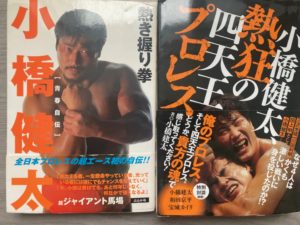
And as a reminder, since this a review of two books at once, I’ll be referring to Kobashi’s first book as FIST and his second one as PILLARS. Since FIST is slightly more neatly organized that’s the one that’ll make up the basis of this review.
As Kobashi prelim career begins, in PILLARS he takes note of where Misawa, Kawada, and Taue are in relation to him and, no surprise, all of them are much higher on the card. Misawa is flying high as Tiger Mask II and in some cases is being showcased along Tsuruta and Tenryu as AJPW’s “3Ts”. Speaking of Tenryu, Kawada joins his “Revolution” Stable alongside Koko Fuyuki and, as “Footloose”, they win the All Asia Tag Team Championships. Even Taue, who debuted only a month before him, is already getting more of a strong position: his first match has him team with Baba himself in as strong of a show of support as you can possibly get. Meanwhile Kobashi is losing left and right to veterans and foreigners, and at one point he questions how, based on these circumstances, he would ever come to be grouped in with the other three as the ‘Four Heavenly Kings’.
(APOD: Kenta Kobashi’s rookie losing streak has been hailed as a masterstroke of wrestling booking on Baba’s part many times over the decades as it ingeniously got Kobashi over as this gutsy, never-say-die babyface who just didn’t have it in him to consciously give up. Though Kobashi deserves credit for applying this concept to his matches, since he was singularly focused on the in-ring aspect of this he wasn’t aware of the other half of the operation, that being the business end. In Ichinose’s Four Pillars bio Baba is noted to have worked very closely with the wrestling press to try and ensure consistent and positive coverage of Kobashi’s in-ring exploits. Even if Kobashi lost Baba wanted the press to zero in on his sense of guts. This positive media coverage combined with Kobashi’s execution of Baba’s booking plan, is what made it a success. After all, lots of rookies underwent long losing streaks when they first started (Kawada, for example) only to finally win in the end, but none got as much of a response from the media as Kobashi. It also helped Kobashi’s case that, perhaps more so than the other Pillars and even more than Tsuruta, he was specifically marketed towards girls with almost idol-like photo shoots and interviews that attempted to make him more “endearing”.)
In FIST Kobashi notes that after this losing streak ends he finds himself being placed higher up on the card than expected and on a few occasions finds himself teaming with Baba in what is promoted as a father-son tag team. For a rookie to challenge for the All Asia tag titles alongside Giant Baba himself after being active for less than a full year was truly exceptional. This drives Kobashi to perform at the highest level possible since so many eyes are on him. Though Kobashi is grateful for this opportunity this period – 1989 and into 1990 – is one marked by lots of shifts, problems, and challenges.
In FIST Kobashi notes that Baba was starting to toy with new ideas with Kobashi being given a more overt push, which his seniors saw as untraditional and began saying aloud in locker rooms “why is this ROOKIE challenging for the title?” (APOD: this is akin to the initial few weeks after John Cena’s main roster debut: calling him “The Rookie” relentlessly was a secondhand lowering effect on him rather than a positive reinforcement of his promising debut). Some of Kobashi’s seniors come to resent him for what is perceived to be favoritism and so he finds himself being shunned in the locker room. As a result Kobashi continues to train during every waking hour he can, even by himself and on top of his mountain of daily chores to do. Kobashi’s hard work pays off, at least in small doses: he is involved in a six-man tag opposite Baba and despite losing manages to land a missile dropkick and his trademark rolling cradle on Baba. (APOD: Side note: in this match Baba teams with Masanobu Fuchi and, having just finished Fuchi’s book, Fuchi strongly suspects it was Haru Sonoda who actually rejected Kobashi’s initial application. Kobashi only got accepted because Baba himself interviewed Kobashi after Kobashi’s subsequent persistence). After the match Baba praises Kobashi to the wrestling press which gives Kobashi more hope. Shortly afterwards Kobashi finds himself in a tag match alongside Tsuruta against Tenryu and Stan Hansen. Despite being far lower on the card Kobashi unleashes everything he has in that match and in the process gets respect from Tsuruta for his efforts.
In PILLARS Kobashi takes a moment to discuss his foreign excursion that never happens. This foreign excursion had been a customary practice since the days of Rikidozan and basically every ordinary trainee would have one (this is still in place now). But Kobashi is one of the rare few who never goes on a training excursion. Some unnamed seniors tell him “there’s nothing [technical] left to learn” from going abroad, with the only real learning experience being how the American promotions didn’t take care of transportation and lodging and all of that and having to survive on one’s own is a useful life experience but not one immediately necessary for AJPW wrestlers’ careers. Ultimately Baba declines Kobashi’s noisy and repeated demands to go abroad telling him that “I will train you in Japan”. Kobashi suspects the reason for this is a triple whammy of circumstances: his aforementioned seniors not learning anything substantial, Baba’s relationship with whatever was left of the NWA falling apart, and Bruiser Brody’s murder in Puerto Rico being an alarming scandal that even reached Japan.
In FIST, at the start of 1990 Kobashi learns that he will undergo his Seven-Match Trial Series and starts thinking about a new regular finisher. Thinking about his match experience he recalls one match where he had been doing a spinning crossbody attack but one day he sort of botches the rotation and turns it into a moonsault body block (sort of like a quebrada). Expanding on this he brings a big safety mat into a ring and starts practicing this new move from the top rope. This would become Kobashi’s moonsault finisher.
In terms of chronology and ‘who did it first’, there has been much debate on who is credited with this spectacular and popular maneuver. Some sources site Mando Guerrero as innovating it and Chavo Guerrero Sr., popularizing it while others cite Keiji Muto/The Great Muta as the man who brought it to a wider audience. For Kobashi, in a 2013 magazine interview he cites seeing Silver King/Dr. Wagner Jr. as the one to bring that move to Japan and so he took from him and not Muto. Kobashi also recognizes that, come 1990, there are already comparisons being made between Muto himself, beyond them just being two wrestlers that competed in fluorescent orange trunks. Comparing and contrasting their respective takes on the moonsault, Kobashi notes,
“I thought about how to effectively utilize my body and concluded that if I could throw my whole body onto my opponent, it would cause significant damage. Additionally, I figured that adding centrifugal force would increase the impact.
As a side note, while Mutoh’s moonsault press lands with a quick, sharp rotation at a steep angle onto his opponent’s body, I aimed to maximize my body weight by jumping higher and utilizing gravity to its fullest, creating a heavy impact when landing.”
APOD: Kobashi’s moonsault is a thing of beauty. Motherfucker even seems to defy gravity when he does it).
Around this time Kobashi was also seeking advice from everyone around him on how to improve and received conflicting suggestions. Baba tells him “Try everything and find the techniques that suit you” while at least one other senior tells him that it’s unwise to showcase everything at all times (APOD: This ends up being Kawada and, once we reach 1993, this ends up being a major bone of contention, at least from Kobashi’s side). In any case Kobashi goes all out in his matches and starts getting big reactions all the time for his effort. He notes that he wants to have matches that resonate with the audience enough to make them grow in greater numbers so he continues wrestling in this highly demanding style. It’s also around this time that Kobashi starts getting closer with Misawa as both of them share a similar vision of ideal pro-wrestling and a sense of creativity (it was also Misawa who, noting Kobashi’s big body, first suggested he use some kind of diving attack). Following a discussion in a wrestling magazine where Misawa is asked “what comes after the Tiger Suplex ’85, Misawa and Kobashi ‘collaborate’ on creating Misawa’s next big finisher, which becomes the Tiger Driver.
Kobashi continues to wrestle at this high level by putting pressure on himself, thinking that his next mistake or failure could lead to a serious demotion and him no longer getting any positive treatment from the fans or the press (he is, by this point, accustomed to his peers being less-than-thrilled with both his style and his reactions). Even Stan Hansen, who will end up being an important presence in Kobashi’s future, gives him some early praise, noting “Kobashi is a wonderful wrestler. His potential is incredible” before clobbering Kobashi with his Western Lariat in a tag match.
Excited and optimistic, Kobashi demands a singles match with Hansen, only to then realize this puts him in a kill-or-be-killed situation. Compared to Tsuruta, who was powerful yet composed in the ring, Hansen was like a wild unchained animal. Hansen hit him hard with punches and kicks but Kobashi vowed to only poke the bear further to get more out of Hansen until he fought The Lariat at his best.
In PILLARS Kobashi notes another shift in Baba’s booking which sees him abandon traditional and hierarchical ways of thinking and give more focus on rising stars. “Rankings and hierarchy no longer matter. Those who work hard, those who give their all, and those who shine will be given opportunities, says Baba. This more or less coincides with Tenryu’s departure and Baba’s business need to focus on who elected to stay loyal, leading to a new group of wrestlers stepping up to face the last ace standing, Jumbo Tsuruta.
As part of his continued training Kobashi accompanies Baba to Hawaii where he gets more lessons from various Americans. The Road Warriors (and Paul Ellering) give him bodybuilding and weight training advice, The Malenko Brothers help him with matwork and joint techniques, and the recently-transferred ‘Dr. Death’ Steve Williams asks to spar with him. So while it’s not an American excursion through-and-through Kobashi still gets samples of American-style wrestling and ideas to add to his way of thinking. Ultimately Kobashi’s Seven Match Trial Series takes place and he finishes with two wins and five losses. He manages to beat Rip Rogers and Randy Rose but loses to Yoshiaki Yatsu, Great Kabuki, Davey Boy Smith, Jumbo Tsuruta, and Abdullah The Butcher. Kobashi also shares a small anecdote of having a pose-off with Davey and then having a tense exchange after their singles match, though this was clearly professional taunting and not personal provocation.
In March 1990 Kobashi faces Misawa for the first time and is blown away by Misawa’s mental toughness far more than his physical skill:
“In pro wrestling, being strong alone isn’t enough; you also have to be skilled.” It was during my first singles match with Misawa that I truly felt this. In terms of strength, I sensed it more in the mental aspect rather than the technical aspect. No matter the situation, he could calmly assess the match, and if there was even a one-chance moment to counterattack, he would surely seize it. This is something that requires extraordinary mental strength.”
Once Misawa throws off the Tiger Mask he and Kobashi win the All Asia Tag Titles in short order. Having failed in multiple prior challenges, Kobashi credits Misawa as being the main reason they won together on this occasion. Kobashi is elated but before the joy can really sink in he is shocked by the sudden departure of Genichiro Tenryu and many others. Kobashi doesn’t feel resentment towards the departing wrestlers; instead he feels anxiety over his own position and what he can do going forward. In FIST he recalls thinking that if AJPW were to go bankrupt or if there were no other wrestlers left then “I would decisively wash my hands of the wrestling world and start over from zero in Kyoto. If All Japan Pro Wrestling disappears, my wrestling life will also come to an end.” (APOD: This should tell you how persuasive Misawa was in convincing Kobashi to join him in NOAH a decade later).
Then another shocking development takes place that further inspires Kobashi to work even harder. In May 1990 Giant Baba wrestles in a tag match opposite Steve Williams and Terry Gordy and Gordy hits Baba so hard that Baba couldn’t even get back up. For Kobashi, who not only admired Baba as a father figure but also respected him for giving him this opportunity to wrestle, such a sight was unforgivable. He HAD to work even harder going forward. It also put an end to any future talks of him going overseas since the company no longer had the option to let any wrestler go on an optional excursion. As an aside, in PILLARS Kobashi puts over Terry Gordy in particular, despite causing that traumatic scene with Baba:
“Terry Gordy, known as the “Human Torpedo,” was not only large but also one of the top wrestlers with agility, recognized as the rightful successor of the powerbomb technique inherited from the original “Iron Man,” former NWA heavyweight champion Lou Thesz. It may be surprising, but the first foreigner to shine as a Triple Crown champion was not Stan Hansen but Gordy. Unfortunately, Gordy passed away in 2001 at the young age of 40.”
(APOD: For someone like me who has been going back in time to discover great wrestlers who peaked in the past this is much-needed insight. I never watched Terry Gordy before so hearing Kobashi, who is called THE GOAT in certain circles, speak positively of him is enough to revisit the best that Gordy was capable of, both in All Japan and elsewhere).
This section concludes with Misawa & Kobashi relinquishing the All Asia Tag titles as Misawa removed his mask and moves up to heavyweight with Kawada as his new partner. Kobashi is left feeling conflicted: on one hand he understands that the turmoil of Tenryu’s Exodus thinning the roster there is a more pressing need for new opponents for Tsuruta to be cultivated much faster. On the other hand he feels personally disappointed that his first title win of any sort didn’t lead to any title defenses. Additionally, though it’s never really explained why, instead of forming a “lower card” tag team with fellow Super Generation Army member Tsuyoshi Kikuchi, Kobashi finds himself teaming more often with Johnny Ace going forward. In the meantime, Kobashi starts pondering who would become his rival going forward as the Era of the Four Heavenly Kings starts to develop much faster than originally intended.
APOD: Once again this section of Kobashi’s books was light on physical surprises and more about personal drama and mental challenges. Kobashi career trajectory was, by basically every metric, unconventional so his peers and some outside observers were suspicious of what was perceived to be preferential treatment. Though Kobashi reminded the reader that he had come from nothing and got in due to his looks and his work ethic – which, as a reminder, is a huge accomplishment on its own in statistics and ranking-driven Japan – he still experiences trials and tribulations due being a rising star in a complicated environment. Hierarchy and traditions aside, Tenryu’s Exodus, combined with a changing wrestling landscape both nationally and internationally, made it impossible for Baba to adhere to old habits. But at least going forward Kobashi will get to focus more on the in-ring stuff, which is what he’s most famous for anyway.
Thanks for reading.