

5-Star BOOK Reviews: Kenta Kobashi’s Books, Part III
By Alex Podgorski on 24 February 2025
“I had almost nothing” – Kenta Kobashi.
This line set the tone for Kobashi’s entire wrestling journey. Unlike 99% of AJPW’s roster, Kobashi had no remarkable achievements or pedigree to back up his claims of being a hard worker and a positive contribution to All Japan. He was, for all intents and purposes, all talk as far as the notoriously selective AJPW front office was concerned. But fate had other plans. Despite initially being rejected Kobashi kept working harder than everyone around him to get noticed by someone, anyone, within the pro wrestling industry. Sure enough Giant Baba himself gave Kobashi a positive evaluation which opened the door for him to enter AJPW. But just because he got his foot in the door doesn’t mean he wouldn’t have to deal with the ever-present threat of being thrown back out.
You can read part 1 here and part 2 here.
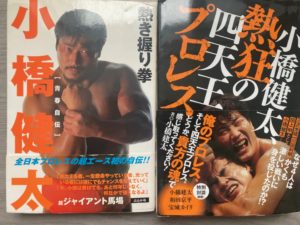
And as a reminder, since this a review of two books at once, I’ll be referring to Kobashi’s first book as FIST and his second one as PILLARS. Since FIST is slightly more neatly organized that’s the one that’ll make up the basis of this review.
Kobashi arrives at AJPW’s training dojo in Tokyo with his head shaved and wearing baggy clothes and is immediately greeted by a swarm of reporters. This turns out to be a case of mistaken identity as he later learns that these reporters were there not to see him, a physically strong yet statistically unremarkable rookie, but Tamakirin Yasumasa, a.k.a. Akira Taue, who joined ALL Japan Pro-Wrestling after another wrestling entity called Japan Pro-Wrestling was collapsing. Taue’s shift from sumo wrestling to pro-wrestling was a big deal, so once the reporters learn “this guy isn’t Taue” they lose interest in Kobashi almost right away. He gets disappointing after getting his hopes up, presuming that even trainees in AJPW were treated like a big deal. Kobashi also notes that when Taue did arrive to train he commuted in a car from elsewhere because Taue already had a wife and kid by the time he started wrestling in 1988.
Upon entry into the dojo he is greeted by a few notable people: the dormitory head Yoshinari Ogawa (who would go on to train virtually everyone in matwork), John “Earthquake” Tenta, and Isao Takagi (a.k.a. Arashi). Tsuyoshi Kikuchi isn’t there that day as he was hospitalized due to nervous gastritis. Kobashi is given a place to sleep, which in FIST he describes as “a decades-old, hole-riddled mattress that looked like it could attract mice, which the senior had used for years.”
Then when it came to training, as described in PILLARS,
“The first serious training involved sit-ups, leg-raise sit-ups, back exercises, and back exercises with the upper body hanging from the apron. Push-ups, various types of push-ups with a wheelbarrow, bridges, bridge returns (kicking up from a bridge position using the neck as a pivot, then turning in the opposite direction without moving the head, drawing a parabola with the feet to return to the bridge position, repeating this rhythmically several times), and sparring are the main menu. I thought I had been doing hard training in my own way until then, but the level is completely different when training with professionals compared to self-training. When training alone, you can go at your own pace, but when training with seniors in a group, it’s not the same. The nervousness of doing it for the first time added to the difficulty, and it was no joke.”
From all of this brutal and difficult training there’s a small contradiction between books. From training alone he describes losing 15kg in PILLARs and up to 30kg in FIST, all from sweating and training his body. And this is coming from a guy who started off at 105ks (231lbs). Then in PILLARS he expands on his list of chores which, as we’ve seen from Kawada’s book, can be just as mentally draining as the physical training.
“New trainees are not only subjected to hard training. In addition to their own training, they are constantly chased by miscellaneous tasks, leaving them with hardly any time to rest. Starting with cleaning the dojo and dormitory in the morning, they participate in joint practice from 11 o’clock. After that, they go shopping for groceries at the station, return to cook, serve food while the seniors eat, and clean up dishes, then finally have their own meal… the chores continue without end. Even after finishing all the chores and returning to their room, there is a rule that they must answer the dormitory phone within three rings, so when they were at the bottom, they couldn’t easily go out. My room was on the second floor, but I often got yelled at by seniors relaxing on the first floor, saying “It’s noisy, answer it quickly!”
If someone visited the dormitory, it was the rookie’s job to rush down the stairs and attend to them immediately, whether it was midnight or dawn. Additionally, the bath and washing machine could not be used until the seniors had finished using them. If a senior didn’t take a bath that day, the juniors couldn’t even take a shower for the entire day. Of course, if a senior said, “I’m fine, you guys go ahead and bathe first,” it would be okay to use the bath, but I don’t remember that happening often.
Even though the training was already hard and left our bodies in shambles, we couldn’t even relax in the bath to relieve our fatigue or calm our minds to sleep peacefully.”
While Kobashi admits that there were times when he really didn’t want to practice not once did he ever entertain the idea of escaping the dojo or quitting outright. If anything this brutal and regimented schedule only pushed his resolve further as it basically took away his freedom to focus on anything other than training and chores. When he did have some little free time he looked for someone to bond with and the only person he could really talk to was Kikuchi (APOD: in case someone doesn’t know who Kikuchi is, he’s one of AJPW’s most noted junior heavyweights, partially famous for being Kobashi’s tag partner in THAT match in Sendai in 1992). Kobashi even notes that there were times when Kikuchi would take punishments or scolding from seniors when Kobashi fell behind in group exercises and took it upon himself to reprimand Kobashi for making mistakes so that stricter seniors wouldn’t scold him as well.
When it came to actual wrestling training Kobashi’s first instructor was Haru Sonoda, who taught Kobashi the importance of breakfalls/learning how to fall properly to protect oneself (APOD: Kobashi, Misawa, Kawada, Fuchi, and Marufuji ALL emphasize this lesson to the extreme. It’s such an important foundational aspect of professional wrestling especially since it allowed the Four Pillars to push the envelope so much throughout the 1990s). As Kobashi summarizes,
“Therefore, no matter how many of the opponent’s moves you take, you must build a foundation and body that can minimize the damage and continue the match. That was the All Japan way of teaching. All the hard training and thorough learning of how to fall are connected to that.
To introduce specific defensive practice menus: defensive techniques from handstands, backward falls, forward rolls, being thrown and taking a defensive stance (when pushed into a corner and thrown with an arm under the armpit), shoulder throws, tackles, and so on. By practicing to take a flat defensive stance on the mat from any position, we thoroughly practice hundreds of times daily to minimize damage to our bodies.”
Kobashi then shifts to Taue’s debut and notes that, given that case of mistaken identity at the start, Kobashi decides to cultivate a rivalry in Taue and puts him over far, stating:
“Taue had an incredible level of physical strength that I could not compare to at all, and his natural power was astonishing. That is an undeniable fact.”
(APOD: Everyone Taue has wrestled/worked with has said similar things about Akira Taue. It isn’t too far off the mark to compare him to Randy Orton in WWE, someone who might not be the most outwardly spectacular or excellent in any one aspect of being a pro-wrestler but is so well-rounded and reliable that his peers all sing his praises. This goes counter to so much of the online discourse about the Four Heavenly Kings, much of which singles Taue out as the lowest and least impressive of the four. So reading what his peers have said/written about him is refreshing and much-needed additional insight.)
Because of his size Kobashi becomes a living crash test dummy that the other wrestlers use to perfect techniques. And by “other wrestlers” he means everyone else: he notes that for several months he basically learns how to take different attacks and absorb impact while not being taught a single offensive attack. Still he remains optimistic and takes his licks without complaint. Once again Kobashi uses this experience to spread an optimistic message to his readers, per FIST:
“I believe that attitude has become a significant asset for me now. Many of you may have numerous complaints about your current situation or treatment. However, if you let that get you down, nothing will change. The issue is what you can grasp from such situations and how you can utilize that moving forward. To change that situation, you must first make an effort to change yourself; otherwise, nothing will change. There may be instances where others can change the situation for you, but even then, there will inevitably be other complaints that arise. Instead of relying on others, you must strive yourself.”
Kobashi spends a long time in this role as no new applicants make it past the initial physical tests for several months. Those that make it past the first day are noted to have quit en masse overnight. He suspects that Sonoda, who to some degree oversaw rookies’ training, expected Kobashi to do the same and give up halfway through his training but Kobashi didn’t. Speaking of Sonoda, Kobashi notes that Sonoda’s sudden passing in a plane crash has a big impact on AJPW’s roster (APOD: it seems like sudden deaths, illnesses, and departures would become a central theme to Baba’s company for the rest of his life).
Baba became stressed and irritated over the press hounding him over Sonoda’s death, to the point that, when his then-attendant Isao Takagi makes a small mistake Takagi is removed from his role as attendant/assistant, though not by Baba himself. Then Kabuki tells Kobashi that, going forward, he will be Baba’s assistant. However, the text in both books implies that this change was ordered by the office and not by Baba himself which further confuses and frustrates and already-upset Baba, who dresses Kobashi down and orders him to get out.
As Baba’s attendant/gofer, Kobashi is assigned to Baba whether Baba likes it or not but Baba initially rejects Kobashi and barely so much as talks to him. When Baba presses him to know who gave him the order, Kobashi doesn’t want to stooge Kabuki out so he just replies “everyone told me”. This one-sided relationship goes on for an undetermined amount of time with Kobashi silently doing an attentant’s chores without any sort of positive recognition. At some point Baba tells him, “I want you to go back to Fukuchiyama! Hurry up and quit and go home!” and since Baba says these with a serious look on his face Kobashi can’t tell if he’s joking or not. Furthermore, Kobashi observes that no other high-profile person in the company was talking to his attendant in the same manner so over time Kobashi starts to wonder if this is all one big shit test for Baba himself to test Kobashi’s mettle.
Nevertheless, Kobashi’s spirit doesn’t break and he does his duties diligently, even going so far as to start carrying other wrestler’s bags as well. However when Baba notices him carrying Wajima’s bags Baba orders him to return them since Baba wanted Wajima to carry his own bags to humble him. Things get confusing as Kobashi is torn between listening to Wajima (his senior), the other seniors who have authority over him, and Baba, as these different sources at times give him conflicting and contradictory orders, all of which leads to scolding/reprimand for the same mistakes. And yet Kobashi, who still held those strong feelings towards Baba as his, for lack of a better term, replacement father figure, still perseveres.
After months of training and hardship as an assistant, Kobashi has his first match, a “pre-debut” appearance in a battle royal on December 16, 1987, on a memorial show dedicated to Haru Sonoda, wearing hand-me-down trunks from Masanobu Fuchi. Then a few months later on February 26, 1988 he has his official debut in a small gymnasium, losing to veteran Genji Okuma in about 4:48 to a Boston crab. Kobashi describes being completely overwhelmed by Okuma’s veteran experience and being out of breath so quickly, which some readers might find remarkable given the stamina he would show less than a decade later in his many 30-, 40-, 50-, and 60-minute matches. Also within those first three months he has his first match with Toshiaki Kawada and notes that he was a quiet man who trained diligently and had an intense way of competing inside the ring.
Weeks and months go by with Kobashi losing each and every match but with each one he develops what he describes as a weed-like mentality (as in the plant in the ground, not the one you smoke), stating in FIST: “If I wanted to win, I believed that I had to turn today’s losses into tomorrow’s victories by giving my all in both matches and practice, which allowed me to stay positive and keep moving forward.” Over time he impresses Baba enough to be recognized as his attendant and starts going out to dinner with Baba, who makes him eat more and more (APOD: in something I believe is called “ebisu” which involves eating to bulk up)
Incidentally, in PILLARS Kobashi notes that as he starts to bulk up Baba takes note of Kobashi’s particular training focus and how he’s building muscles more like American wrestlers. Initially Baba tells him to stop training with barbells, stating “Don’t do such effeminate things.” According to Kobashi, during one of Baba’s first excursions to America he observed two overly muscular men hugging and kissing each other in a gym’s back alley and Baba believed that overt musculature was associated with being effeminate. But more importantly Baba wanted him to stop building muscle for a much more practical reason: “bulging muscles are unnecessary for professional wrestling. Don’t do weight training to add unnecessary muscles.” In Baba’s mind these extra muscles restricted movement and limited in-ring capability, which is why he encouraged his wrestlers to be flexible and have enough padding to take harsh landings.
(APOD: Baba’s practical viewpoint on muscles is very interesting. If you take a look at his roster then Kobashi is the closest anyone comes to resembling the old 1980s bodybuilder archetype while everyone else is burlier and lacking in obvious muscles. The same applies to the gaijins he brings in: Stan Hansen, Steve Williams, Terry Gordy, Dory Funk, Jr., Richard Slinger, and later Vader, are all beefier and more menacing looking than they are cut or chiseled. All of them were more noted for their movements than their looks, which is what enabled them to succeed and get those hefty Baba paychecks. And just to hammer the point home, look at what happened stateside in WWF/E and WCW with all those musclebound bodies: many of them suffered muscle tears, got injured frequently, or got so restricted by their own bodies they couldn’t move or do all that much in the ring. It’s no wonder that, over the decades, the big musclebound wrestlers got injured more often than the smaller or less-chiseled wrestlers stateside.)
However, Kobashi sticks with his training routine because, to him, it’s the only way he can grow. Since he can’t grow taller to match guys like Baba or Tsuruta, the only way he can stand out and have the same credibility as those bigger guys is by looking more physically impressive. It turns out that he even manages to convince Baba of this philosophy and over time Baba starts doing some weight training as well, though obviously not to the same degree as Kobashi (APOD: In a 1997 interview Kobashi also explains that he believes that wrestlers should be admired for their bodies as much as for their techniques because he wants people to believe that wrestlers are exceptional individuals. Over time he becomes so obsessed with training for his wrestling career that he becomes known for training anywhere and everywhere possible, to the point that Toshiaki Kawada half-jokingly says about him, “you don’t need a knife to kill Kobashi; just take away the barbell”. These results pay off huge: in a 2013 interview Kobashi notes that, without ever using steroids per Baba’s strict instructions, at his peak Kobashi manages to achieve an arm circumference of 55 centimeters. So just to hammer this point home: Hulk Hogan, with the help of steroids, managed to get twenty-FOUR inch pythons; Kenta Kobashi managed to get twenty-ONE inch pythons without ever taking them. And they say hard work never pays off…).
Just as it looks like things are going his way Kobashi suffers his first knee injury (of many) but tries to tough it out and keep wrestling. But Baba shuts him down and orders him to take him off. Although Kobashi wants to take after Baba’s own philosophy of never taking time away, Baba gives him another crucial piece of advice:
“Who did the audience come to see today? Jumbo, right? Tenryu, right? Tiger Mask, right? They’re not here to see you. That’s why you can rest now. But when you become the top, you won’t be able to rest anymore. Even if you’re injured, no matter what happens, you can’t take a break. But for now, you can rest. So take a break today!”
(APOD: This will definitely come to pass for Kobashi and it will hit him harder than he ever expected).
While injured Kobashi vows to be more of a well-rounded athlete, one who learns from others and soaks up as many different perspectives and pieces of advice as he can. In FIST he gives us a better picture of his mindset while still at the bottom of the totem pole and nowhere near the same level of importance as the other three (still not-as-yet called so) Four Pillars:
“I believe that my desire to become stronger was perhaps stronger than that of other wrestlers. For example, when the Road Warriors came to Japan, I took the initiative to learn the basics of physical conditioning from them, and I sought out the Malenko brothers for ground techniques, taking advantage of the privileges of being a young wrestler to ask various wrestlers for guidance. By actively incorporating these lessons into my own training, I began to see results that set me apart from others.”
(APOD: for what it’s worth, Kobashi expands upon this quote in a 1997 interview, noting that Paul Ellering was also crucial to teaching him endless step exercises so that he could train whenever he could.)
So that’ll do it for this entry. There’s still a ton of material to cover in this chapter with Kobashi going over his fabled losing streak (which, as we will see next time, had more to it than just losses), and how Kobashi became part of the massive pivot to Super Generation Army and Tsuruta-gun.
Thanks for reading.