

5-Star BOOK Reviews: Kenta Kobashi’s Books, Part II
By Alex Podgorski on 19 February 2025
When we last left Kenta Kobashi he had to make the hardest decision of his life thus far: choosing between achieving his dream and helping his family. The two paths were mutually exclusive: following his dream to become a wrestler had no guarantee of success and his beloved mother, who had been working night and day to take care of him and his brother, was struggling with interpersonal issues at her job and the job itself. And all through his later childhood and into his teens Kobashi made choices that would put as little of a financial burden on his mother as possible. Ultimately Kobashi chose to enter the workforce as a legal adult since giving back to his mom was more important at the time.
Had he stuck with that decision that is probably the last any one of us would’ve heard the name Kenta Kobashi…but fate had other plans, in the form of another athlete thousands of kilometers away who would later become famous for, among other things, biting ears off.
You can read part 1 here.
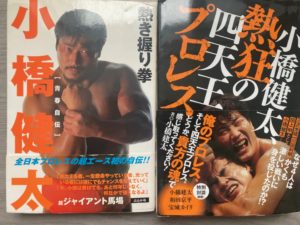
And as a reminder, since this a review of two books at once, I’ll be referring to Kobashi’s first book as FIST and his second one as PILLARS. Since FIST is slightly more neatly organized that’s the one that’ll make up the basis of this review.
Chapter 2: Working Adult Era
One of his high school coaches, Mr. Takahashi, was the one to help Kobashi get his foot in the door at a ceramics company called Kyocera. He doesn’t exactly describe what his job entails but it’s implied to be something menial, repetitive, and difficult, as per his description of it as a “3K” job (“dangerous,” “dirty and difficult”). He also describes finishing his shifts with his clothes “completely blackened” and involving handling explosives. This tends to cause frustration with others in the dormitory as Kobashi and those he works with end up blackening the communal washing machines and leaving the public bath areas extremely dirty. It’s as if he has been through something like this before…
It was believed that this large firm boasted athletic opportunities for employees since, as they lived in on-site dormitories, they would have extracurricular or corporate teams for their employees to immerse themselves in on days off. Kobashi thought he’d have options like track and field and shot put which would compensate for their lack of a judo team. Kobashi was assigned to a facility in Yokkaichi a (relatively) small town more or less in the middle between Kyoto and Nagoya. Upon arrival he’s quick to learn he was sold a false bill of goods: the sports teams he wanted to be a part of were in Kagoshima, literally on the other side of the country. His work schedule has him working two day weekend with rotating shifts, leaving each week different. With no sports clubs, Kobashi quickly finds himself wasting his free time in pachinko parlors and doing nothing else of note.
With the company not providing anything from top-down several of the employees from a nearby high school in Shiga decide to form their own rugby team and invite Kobashi to play since he has a good physique. Despite having never played before he quickly learns the basics and before long starts enjoying it. And yet he’s not happy, especially when his boss does the usual corporate spiel “you can openly talk about your work and discuss changes here. This is open forum”, only to swiftly reject Kobashi’s modest proposal with a single word. This angers Kobashi who forgets the seniority structure for a moment and explodes before calming himself down. Not even training in karate as a distraction helped him. It wasn’t long before Kobashi finds himself questioning his life and his choices. From FIST,
“Am I really going to grow old and die like this?! Is this really my life?! Then what do I want to do? What does my ideal life look like?” I couldn’t immediately come up with any answers, but the regret of “this isn’t how it was supposed to be” began to swirl in my mind.
And then, as Kobashi heard the struggles and voices from within his heart a message from God appeared to him…in the form of a magazine article about Mike Tyson.
Kobashi is shocked to learn some of the trials and tribulations of Tyson’s life and how they parallel his. Tyson’s father left his family when he was young, as did Kobashi’s. Tyson experienced bullying as a child while Kobashi describes the emotions he experienced from poverty and the little league situation as roughly the same. They were both pretty much the exact same age. But then there’s the distinction: Tyson enters boxing at age eighteen and wins his first two fights. A year into his career, in his second fight, he wins the WBC World Heavyweight title, becoming the younger world heavyweight champion in history at 20 years and 5 months. Kobashi is downright mesmerized that Tyson could lift himself up from such a poor environment to such success. As an aside, in PILLARS he mentions a supposed meeting between Tyson and Baba:
“Incidentally, in March 1988, there was a program plan where Baba-san visited Tyson, who was training for a defense match against Tony Tubbs at the Tokyo Dome, to cheer him on, and I once went along as an attendant. Although his body wasn’t that big, his figure quietly hitting the sandbag was truly impressive, and I felt an overwhelming energy from him.”
And with that Kobashi makes his final decision. He can’t spend the rest of his life doing a simple factory job. He decides right then and there to become a professional wrestler. (APOD: So there we have it. Mike Tyson inspired Kenta Kobashi to pursue his dream of becoming a professional wrestler). But then Kobashi takes his ambition a step further: he concludes that he doesn’t want to become a wrestler; he HAS to. Surveying his situation he realizes that he can’t back out once he embarks on this path.
So Kobashi starts taking on bold and difficult decisions. He decides to take a six-month transfer to the remote Kagoshima location where the hours are worse and the work is much harder but apparently the pay is somewhat better. He starts saving up enough money to pay off his expenses from getting his driver’s license and buying a used car. He works as many nights and overtime shifts as he can, paying off all his debts and saving around one million yen (approx., $10,000.00). Upon returning to Shiga he tenders his resignation one month in advance (as is expected over there) and at one point finds himself discussing his departure for six hours (APOD: in a third source of mine, a book containing interviews with all Four Pillars in 1997 by Hirokazu Hasegawa, Kobashi describes this as eight hours). Though he never tells anyone of his ambitions, some higher-ups deduce that he intends on becoming a wrestler based on his fandom. Though he denies it with one of the worst on-the-spot lies of his life (“I want to be a sports instructor”) they ultimately accept his resignation and tell him he can never work there again. (APOD: For anyone unfamiliar with Japanese work culture it is, by Western standards, fucked. An entire industry has popped up over there called taishoku daiko (“job-leaving proxies”) where people hire others to quit jobs on their behalf because this process of trying to guilt/shame you into reconsidering quitting is so deeply engrained over there).
So Kobashi returns home and his mother is…not pleased. In FIST she is openly shocked of his decision and wonders aloud why he made that choice even though she already knows the answer. Kobashi has an internal monologue here recalling feeling pain in this decision causing her such anguish. Meanwhile in PILLARS this exchange is reduced: She, like any good doting mother supports his dream in her own way, saying “Just do what you can” (APOD: anyone else played early Pokémon games and remember your player character’s mother saying the EXACT same line every time you visited her?) By this point Kobashi’s older brother has given up on his dream of becoming a wrestler but fully support his little brother as well. And so Kobashi begins training. He sacrifices going to parties, driving around, and dating, all to train.
So for four months Kobashi lives with his mom in a tiny house that can barely fit the both of them and trains from dawn to dusk until he weighs 100kg. Feeling confident he submits a formal application to the All Japan Pro-Wrestling dojo…
…and is promptly rejected.
And with that Kobashi story comes to a sudden and unfortunate end and – nah, just kidding. This is Kobashi we’re talking about. A man who doesn’t know the meaning of the word “impossible”. Kobashi demands an answer for exactly why he was rejected so he calls AJPW directly and speaks to (who is revealed elsewhere to have been) a member of AJPW’s PR team.
Kobashi gives his name.
PR guy: “Aren’t you already 20 years old? You’re getting a bit old for this, you know. Normally, people come right after graduating from high school.”
Kobashi is prepared for this response and fires back about how both Tsuyoshi Kikuchi and Koki Kitahara, both recent successful AJPW applicants, were older than him (22 and 25, respectively).
PR guy: “Kikuchi is a student champion in amateur wrestling, and Kitahara has a background as an instructor at a martial arts gym, so they have accomplishments. If someone has a track record like that, it’s okay if they’re a bit older. But you have nothing, right?!?!!”
Kobashi’s caught there, not having a proper retort so he just blurts out, “I’ll work really hard too, so could you please let me in somehow?”
PR guy: (pause)… “Well, I guess it’s still impossible. What about your job?”
Kobashi: “”I quit my job and I’m not doing anything right now…”
PR guy: “”Hmm, I see… Then, well, find a new job and work hard there.”” And with that the conversation ended.
(APOD: Kobashi is obviously crushed but he should’ve seen it coming. Just look at All Japan’s track record of previous signings and applicants. Jumbo Tsuruta: Olympic-level amateur wrestler. Mitsuharu Misawa: national amateur wrestling champion. Toshiaki Kawada: national amateur wrestling champion. Masanobu Fuchi: amateur wrestling standout prior to turning pro. Akira Taue: accomplished sumo wrestler. Hiroshi Wajima: accomplished sumo wrestler. And those were the men who entered All Japan before Kobashi. The same trend would continue with Jun Akiyama [university-level amateur wrestling standout scouted for the specific purpose of becoming the next Jumbo Tsuruta] and Tamon Honda [Olympic-level freestyle wrestler]. While this certainly painted All Japan as an elitist promotion from a certain viewpoint, from the company’s perspective Kobashi had no measurable accomplishments to speak of. To them having a hard work ethic was, on its own, meaningless, especially with the usual trend of promising applicants giving up after initial acceptance. So while Kobashi trying to sell himself to this PR guy based on his work ethic is definitely on-brand, it not resonating with the company at first makes at least some sense).
More desperate than ever Kobashi decides to go to a local gym. In PILLARS he reveals the owner of this gym is friends with Mitsuo Endo a referee for International Pro Wrestling (APOD: I’m not sure if this is a typo and meant to be International Wrestling Enterprise, which was another entity outside of the AJPW/NJPW duo or something else, the lineage is not quite clear). After talking it over with Endo Kobashi is approached and told there MIGHT be an offer for him, but it might be New Japan not All Japan (APOD: can you imagine Kobashi in New Japan?!). After some tense waiting Kobashi learns that, in fact, he will be given an interview with All Japan after all.
In May 1987 Kobashi arrives in Otsu City in Shiga where, in FIST, he describes receiving a cold reception from the wrestlers there. A few of them gather around and he can hear them saying amongst each other “that guy looks so confident, but he won’t last more than a few days and will go home soon.” However, Kobashi’s concerns are put to rest when Giant Baba himself – Kobashi’s idol and father figure – is the one who tells him he passed and welcomes him to AJPW. As he makes his way into the locker room and tells them he’s the new trainee, only two people show him any warmth: Jumbo Tsuruta and Mitsuharu Misawa. Baba sends him home to wait for next instructions and he does…for three weeks. One last speedbump in Kobashi’s road to becoming a wrestler. He calls the office one more time explaining the situation and then heads to their training facility to begin his career.
(APOD: It isn’t mentioned here or anywhere else but rumors surrounding Kobashi’s initial rejection and the tribulations he underwent to become a trainee implied that it was Baba’s wife Motoko who initially saw photos of Kobashi on his application and rejected him. This has never been proven (and will never be) but when I first began reading about Kobashi what little info out there on him in English came from Dave Meltzer and a select few other sources. Meltzer implied in early Observers and in some in the 2010s closer to Kobashi’s 2013 retirement that she was the one that didn’t see much in him and passed him over. Little did anyone else in All Japan know that he would go on to be one of their biggest moneymakers…though first he’d have to endure the incredible rigors of training and being an attendant.)
Thanks for reading. Next time: Kobashi’s training.