

5-Star BOOK Reviews: Kenta Kobashi’s Books, Part V
By Alex Podgorski on 1 March 2025
This review will cover a shorter timespan than the previous parts because a lot happens at this juncture in Kenta Kobashi’s career. This will only cover key happenings in 1992 and 1993 since Kobashi has a lot to say about what happens during this time and what was going through his mind at the time. One reason I started translating these books is to understand what these wrestlers themselves considered important, as opposed to what the fandom has written and said about them over the decades. And since Kobashi is such a prominent figure in online wrestling discourse, what better way to understand his point of view than extracting the very thought he put to paper as the things he wanted his fans to remember the most?
You can read part 1 here, part 2 here, part 3 here and part 4 here.
And as a reminder, since this a review of two books at once, I’ll be referring to Kobashi’s first book as FIST and his second one as PILLARS. Since FIST is slightly more neatly organized that’s the one that’ll make up the basis of this review.
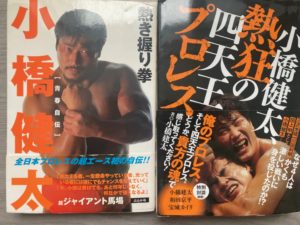
With AJPW’s roster thinned due to the Tenryu Exodus, Kobashi starts thinking about what he can do to make his matches even more exciting. In FIST he concludes that he needs to cultivate in himself a rival so that the fans can have something they can sink their teeth into (APOD: See? Having cold matches on their own, even if they’re technically great, isn’t enough according to the in-ring GOAT himself). He notes,
“Having rivals draws attention, and more importantly, the competitive spirit with those opponents allows one to fight beyond their own capabilities. For a professional wrestler, encountering such opponents is more challenging than finding diamonds. It would not be an exaggeration to say that this can significantly change one’s future.”
Surveying the landscape Kobashi concludes that there are no Japanese heavyweights with whom he could have a deep, extensive rivalry. And so he decides he wants to take down the quartet known as the “Four Kings of Foreigners”: Stan Hansen, Terry Gordy, Steve Williams, and Danny Spivey. He did everything he could to get their attention as, to them, he was just a young punk punching above his weight. He describes using chairs at untelevised events to provoke them. Well he got his wish: on September 4, 1991, he had another singles match with Hansen which ends with, to put it mildly, Hansen being the tar out of him with one of his sickest Western Lariats ever.
“Japanese wrestlers usually try to bring out the best in their opponents and structure the match in a way that pleases the audience as much as possible. However, most foreign wrestlers tend to continue attacking unilaterally to finish the match as quickly as possible, looking for any opportunity to hit their finishing move and wrap things up swiftly. Hansen was a typical example of this, which is why I made a serious effort to provoke him. Rather than simply losing to him, my goal was to make Hansen feel that I would inflict a lot of pain on him. If Hansen approached the match with that mindset, then it would depend on my abilities to turn it into any kind of match. If I got easily crushed, it would end quickly; if I desperately fought back, it would lead to a more intense back-and-forth, resulting in a good match. The harder I worked, the higher the evaluation of the match would be, and that was the form I had hoped for. In fact, in this match, Hansen unleashed merciless and harsh attacks to crush me.”
After losing to Hansen but achieving some mild recognition from the big Texan, Kobashi had to relinquish the All Asia title again, this time because Johnny Ace suffered an arm injury. A replacement partner is found in him in Tsuyoshi Kikuchi, who is still considered a member of Super Generation Army (SGA). There seems to be some conflict in how all of this is presented: if Kikuchi was part of SGA from the start, why was Kobashi paired with Johnny Ace in the first place? In FIST Kobashi describes feeling a conflict over winning tag team title gold with Kikuchi only to relinquish it again when Ace returned from injury. And in PILLARS Kobashi describes enjoying teaming with Ace because, a) it allows both of them to have casual conversation in “half-baked Japanese and English”, and b) there are no rigid seniority issues in the foreigners’ locker room. When teaming with Kikuchi, Kobashi describes feeling a strange “jealousy” of sorts and wanting to out-do him in fiery and competitive matches. But it’s one of those “positive jealousies” that helps spur one forward rather than hold one’s self back.
So Kobashi gives it all in teaming with Kikuchi, culminating in their big tag match in Sendai that sees Kobashi & Kikuchi beat the Can-Am Express to win the All Asia tag titles in front one of the wildest crowds ever seen.
“The atmosphere in the venue was extraordinary; everyone was cheering for us, and it goes without saying that both Mr. Kikuchi and I were supported by those voices. This victory, the triumph of capturing the belt, made me truly realize how wonderful and joyful it felt, and it might have been the first time I experienced that in such a way.”
With this Kobashi can cross off another goal from his bucket list: return home. Before entering wrestling he vowed not to return home until he had either won a championship or been on TV. Since he had now done both he visits his mother to show her a match, only to be disappointed when their family TV distorts the VCR rip of his big TV singles match with Jumbo Tsuruta. In response, Kobashi buys his mom a new TV and VCR player which were new at the time.
Kobashi’s schedule becomes much tighter from there. Two weeks after winning in Sendai Kobashi teams with Misawa to challenge Tsuruta and Taue for the World Tag Titles but fails to become a double tag champion (though not for a lack of trying, this is a terrific match as well). Then about a week later he and Kikuchi defend the All Asia tag titles against Masanobu Fuchi and Yoshinari Ogawa and win after a 30-minute struggle.
Then towards the end of 1992 Kobashi has two notable career developments: Teaming with Giant Baba in that year’s Tag League tournament in a “parent-child team” and participating in Jun Akiyama’s exceptional debut match.
After a brief aside on how his knees started to wear down due to BOTH a combination of excessive moonsault use and regular attacks to his knees by Tsuruta and Fuchi, Kobashi moves into 1993. On the singles front he recalls the night the Four Heavenly Kings are officially born: May 21, 1993 is the night that each of the four Japanese Pillars defeats one of the four Foreign Pillars: Akira Taue defeats Danny Spivey, Toshiaki Kawada beats “Dr. Death” Steve Williams, Kobashi beats Terry Gordy, and Misawa retains the Triple Crown against Stan Hansen. Kobashi takes one more opportunity to put Gordy over as a big deal and how beating him gave Kobashi a ton of momentum and confidence. It’s also around this time that the term “Shitenno” starts being used to describe the Misawa/Kobashi/Kawada/Taue quartet, but Kobashi is still skeptical of being bunched in with them because, by his own admission, he hasn’t won anything with/from them and thus think he’s not yet worthy.
Well he gets his chance to prove himself. Due to Terry Gordy “suffering a sudden illness” ahead of a Triple Crown Heavyweight challenge, Baba hastily books a #1 contender’s match between Kobashi and Steve Williams. Kobashi describes this as a big opportunity for both of them since Doc, too, hadn’t had many big world title opportunities before due to Gordy being the bigger star in the Miracle Violence Connection. And Kobashi, who had gotten praise as a “valiant fighter” needed something to push him from “underdog fighter” to “worthy of fighting for the Triple Crown”. And it seems like his way of conveying that message was to…GET DROPPED ON HIS FUCKING HEAD THREE TIMES IN A ROW!
(APOD: You can watch that full match here. Maddeningly violent finish aside, this match solidified me as a 1990s AJPW fan because it encompassed everything I think is great about the style: it looks and feels rough and competitive, there’s a tense atmosphere, the commentary sells the severity of things by tone and energy without understanding the actual language, it feels like Kobashi and Doc actually want to kill each other (which has been hard to sell stateside for decades), and Kobashi’s auto-pilot selling at the end is out of this world. For all of Meltzer’s hyperbolic statements over the decades, him comparing Kobashi here to Terry Funk is incredibly accurate.)
Here’s what Kobashi had to say about it, from PILLARS:
“The result was unfortunate, but I believe I fought with all my might. For Williams as well, this match made the “Dangerous Backdrop” his trademark, and he proclaimed himself at the top of the singles division. It’s a strange thing to say that I accepted my defeat, but I do take pride in having given my all at that moment. A loss is a loss, but I definitely climbed another step. I think it was a match that I can honestly say that, regardless of the result, I can say it was a fight that could be considered my ideal.”
And from FIST:
“Somehow I crawled to Williams’ dressing room. Of course, I had no intention of starting a brawl. I felt a deep satisfaction from having had the best match, and I desperately wanted to cheer for Williams, who was heading into the Triple Crown match as the winner of this match.
When Williams spotted me, he pushed through the pain and walked over. I believe this feeling was something only the two of us could understand.
“Kobashi, Number 1!”
That one phrase from Williams became the only medal for me, who had lost. I think the wonderful thing about professional wrestling is that winning and losing is not everything.
Life is the same. Is becoming a millionaire a victory in life, or is becoming a celebrity a victory? I don’t think so at all.
Having been poor in my childhood, I have always maintained a hungry spirit, wanting to become rich and famous. However, I never want to choose any means to achieve that; I absolutely do not want to compromise my beliefs just to reach that goal.”
However, Kobashi’s positive spirit is broken somewhat when, around the same time as this match, he finds himself at the center of what can be described as “professional criticism”.
On July 2nd, after a survival tag match between Super Generation Army and the Holy Demon Army, Toshiaki Kawada is quoted as saying to the wrestling media something along the lines of, “That guy (Kobashi) fights the same way against everyone. I can’t tell if he’s strong or weak. He uses big moves too much. I’ll show him that I’m different.” At first Kobashi finds himself perplexed, wondering if Kawada was just hyping the match or if there was something else there. Some publications turned these comments into critical reviews of Kobashi as a wrestler, while others just reported the words as they were. Then apparently Kawada’s words became sharper with time.
“That guy’s style is to throw out big moves left and right, but at least I have no intention of wrestling that way. You can use big moves when the time is right, and you can do pro wrestling with just chops and kicks. But he has to do that; otherwise, he can’t win. I acknowledge that Kobashi is getting stronger, but I will teach him that it’s not enough to win.” – Toshiaki Kawada
(APOD: In a roundabout sort of way Kawada was admonishing Kobashi as a MOVEZ guy who always did the same thing in every match, not adapting to the particular circumstances of his opponents or matches. However, Kobashi didn’t relent or waver in his style: he held his own approach to wrestling so strongly and with such unyielding convictions that he wasn’t going to let Kawada, who may or may not have been coming from a position of veteran experience, dictate to him how he should wrestle. Personally this situation reminds me of the blowback Kenny Omega got after his Forbidden Door match with Will Ospreay which, a propos, included a sickening Tiger Driver ’91 and Kenny’s subsequent comments carrying the tone of “don’t tell me how to wrestle”. Whether one agrees with one viewpoint here or another is a matter of discussion).
Kobashi goes further into explaining why he wrestles differently from people like Kawada without saying whose philosophy is correct, from PILLARS:
“I do not deny matches like the ones Kawada-san has, where he achieves one-sided victories over opponents with lesser accomplishments in a short time, but I certainly do not wish to do that myself, nor do I want to compete with performances outside the ring. Even against opponents with lesser careers, if we clash passionately, a true professional wrestler responds with even greater intensity. I believe that the greatness of pro wrestling lies in both parties fully showcasing their abilities and igniting the audience’s excitement, so I will simply continue on the path I believe in.Wrestling that merely shows a one-sided display of power or only boasts about one’s own strength does not exist in my dictionary.”
Kobashi describes being taught given different advice from different seniors and mentors. Baba was one who encouraged him to find a style that fits him and another unnamed senior told him he can do more when he’s younger. Meanwhile, Kawada, who himself was taught by Kabuki not do overload himself in every match, came by as this messenger of restraint, perhaps so passively encourage Kobashi to save his biggest techniques for when they mattered most.
And just to stay on this topic, here’s another quote from FIST which sums up Kobashi’s mentality surrounding his matches:
“One thing I always keep in mind is to give my best effort in matches, regardless of how small the venue may be. This mindset comes largely from my experience as someone from a rural area, where financial constraints prevented me from attending events in major cities. There are people in rural areas who might only get the chance to see professional wrestling live once every few years. There are also those who manage to buy tickets with their meager savings, finally able to attend. If we, as wrestlers, ignore the feelings of such people and put in a lackluster performance just because it’s a local event or the venue is small, we would completely betray their passionate feelings toward professional wrestling. Having been in the position of a fan myself, I absolutely do not want to cut corners in any venue.”
(APOD: This might be the most respectable and admirable quality of Kobashi’s and is the one that people like Meltzer tended to focus on more than anything else throughout Kobashi’s career. That he would put himself through such agony in every match no matter how big or small the crowd speaks volumes of his respect for the fan, their time, and their hard-earned money. He wanted everyone to remember seeing him at his best so that they’d be convinced to come back for more. But this approach has a dark side as well: not everyone can keep up with this philosophy. Reading elsewhere in various translations of books and magazines, there were few people who could keep with Kobashi’s pace and work ethic. Misawa seems like the only one who could, which is why both Kobashi and Misawa admitted that their 1990s epics came from them sharing similar visions, a similar sense of creativity and “nothing-is-off-limits” attitude towards their matches. Meanwhile Kawada admitted in 2018 that he was one guy who believed in “taking it easy” on rural shows out of the practical need to conserve his body for bigger events. This isn’t a question of right versus wrong but it’s important to understand the mindset behind Kobashi, who is still revered by the wrestling fandom online and within the wrestling business itself as this mythical, almost godlike figure who’d happily destroy his own body for the fans and for the business.)
In the end Kobashi does lose to Kawada on October 23rd after just under 30 minutes of intense wrestling. Interestingly, this match might, chronologically, be the last time that a 1990s All Japan match ends via submission as Kawada locks Kobashi in the stretch plum until he goes limp and then covers him for an easy three-count. Though Kawada admits that Kobashi is growing as a performer he’s still not quote at the same level as the other Pillars…but that only lasts for about a month. On December 3, 1993, Misawa & Kobashi face Kawada & Taue in what is considered “the final form of Shitteno pro-wrestling”. After 24 minutes of hard-hitting action (and a masterful and study-worthy piece of leg selling by Kawada), Misawa & Kobashi capture the AJPW World Tag Team titles and win the 1993 Tag League Tournament. Kobashi is elated. At long last, he considers himself worthy of being called one of the Four Heavenly Kings.
APOD: This is a short segment in terms of timeframe but A LOT happens to Kobashi in 1993 that gives us a look into his mind. He breaks away from the undercard tag scene and moves up to heavyweight. He achieves a dream by teaming with his father figure Giant Baba. He has his “ideal” match against Dr. Death and is one that, ultimately, would be the starting point of the head spike era and mark an even more pronounced shift in how AJPW matches are structured. He overcomes regular criticism from both his peers and professional observers and backs up his claims with actions. We get a glimpse into his mind and come to understand that Kobashi performs at such an elite level because he has such a close connection to the audience and wants them to leave each match thinking they’ve seen him at his best. And finally he achieves a career milestone by winning a top title alongside his closest friend. And this is only 1993; there’s plenty more waiting for him in 1994.
Thanks for reading.