

5-Star BOOK Reviews: Kenta Kobashi’s Books, Part VIII
By Alex Podgorski on 13 March 2025
Kenta Kobashi has spent the entirety of his career in someone else’s shadow. For the longest time he was considered less important than the wrestlers above him and he felt this way as well. Throughout the prior sections of this book Kobashi seems to have struggled with this sense of inferiority. He has tried to prove the company that he’s someone around whom the company can be built around, that he’s worthy of being an ace based on his unwavering commitment to the fans to always deliver his best, regardless of crowd size. And at long last, he’s going to get his chance.
You can read part 1 here, part 2 here, part 3 here, part 4 here, part 5 here, part 6 here, and part 7 here.
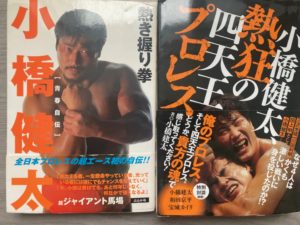
And as a reminder, since this a review of two books at once, I’ll be referring to Kobashi’s first book as FIST and his second one as PILLARS. Since FIST is slightly more neatly organized that’s the one that’ll make up the basis of this review.
We begin this section with the aftermath of AJPW’s first Tokyo Dome show. Kawada has finally pinned Misawa clean for the title which allows Misawa some MUCH-needed time to let his body recover from his multitude of muscle and ligament tears, bone cracks, and joint problems. For the time being AJPW is left without its de facto ace so Kobashi has to step up more than ever, especially since he notices lower attendances on cards without Misawa there. As the self-appointed leader of a new era, Kobashi vows to lead AJPW forward, starting with his victory over Kawada for the Triple Crown on June 12th (in another absolute classic of a match).
Kobashi presents his title win as a sign of things changing in All Japan. He uses the analogy of not wanting to “run on the tracks set by the company”, which has also been used by both Misawa and Jun Akiyama to be somewhat critical of the company’s top-down rigidity. Speaking of Misawa, while he’s away from the ring he becomes more involved in AJPW’s undercard booking around this time and, as a result, he finds himself clashing with both Babas, unaware that Shohei has, in private, started suffering more of the ill effects of his colon cancer. And speaking of Akiyama, he is booked to be Kobashi’s first challenger for the Triple Crown.
Kobashi went onto this match with another leg injury which Akiyama attacked throughout the match because he knows what wrestling is. Akiyama came closer than ever to winning the title but still came up short because Kobashi is basically Son Goku and cannot be defeated no matter how hard he gets pummeled. Per PILLARS,
“While some may think of the Four Heavenly Kings of pro wrestling as merely a showcase of big moves, it is by no means limited to that. This fight, which was a battle that carved out uncompromising souls, became a new battle that symbolizes the new era for both Jun and me, and I was able to convey my own image of an “ace” to Jun.”
Shortly after this match AJPW’s roster rearranges once again. GET is dissolved as Kobashi forms Burning with Akiyama. With Akiyama changing sides the last remnant of the Super Generation Army disappears and Misawa books himself to form The Untouchables with Yoshinari Ogawa upon his return while Takao Omori teams with Yoshihiro Takayama to form NO FEAR and Johnny Ace forms “Movement” with Wolf Hawkfield. Stables start popping up everywhere, leading to new and exciting match ups. Rookies and recent debutants like Naomichi Marufuji and Yoshinobu Kanemaru are included in these stables as well to show that the old hierarchy system is dissolving away.
But despite these interesting changes, business doesn’t turn around for All Japan. Depending on whom you ask their financial success had plateaued in ~1994 and began experiencing a downturn towards 1996, which was accelerated by Misawa’s absence. With no other option to stop the short-term bleeding, Misawa returns in the fall of 1998 and reclaims his position atop the company by defeating Kobashi in another 30-plus-minute epic at the Nippon Budokan. Once again the Misawa/Kobashi brand of match leads to widespread acclaim and in this case it’s voted Match of the Decade by Nikkan Sports.
Kobashi’s fortunes continue to be mixed from there. Though he and Akiyama win the 1998 Tag League, beating the duo of Stan Hansen & Vader in the finals, Kobashi loses his first singles match to Vader in mid-January 1999. But before any further progress can be made, Kobashi’s world is rocked by the sudden and shocking announcement of Baba’s death.
In both books Kobashi reminisces about Baba, who was both a boss and a father figure to him. Though their relationship was, at times, rocky, Kobashi has more good memories than bad, and always tries to include some of the lessons Baba had given him. Per FIST,
“I was also taught by Baba-san that, “As long as there are even a few fans waiting for you, as a wrestler, you should not take a break from a match unless it’s something really serious.” Because of that, I try to follow the president’s teachings and do my best not to take time off, even if I get injured.”
With Baba’s passing FIST comes to an end. It includes an afterword with Kobashi’s typical uplifting and motivational tone, plus a general summary of what has happened in his life up to this point. The book then concludes with a timeline of Kobashi’s life and career up to that point.
APOD: This is a great book. Kobashi is open and honest about basically everything from his early life to his career to his various relationships with other people. Unlike Kawada who kept most things close to his chest and didn’t really “rock the boat” in any way, Kobashi was more than willing to tackle events and occurrences head-on and give his honest feelings/opinions. He spoke from the heart and came across as genuine when describing various conflicts. Of the two books covered thus far, FIST is more grounded and fact-based while PILLARS has, thus far, gone more into the journal-style and emotional aspect of his various conflicts and challenges. Some might like that more dramatic style, but for me I think that FIST is an excellent book that’s really worth reading much more, even if it ends rather abruptly and doesn’t capture MAJOR parts of both Kobashi’s career and personal life.
Final Rating: *****
And while going through this book, it turns out that FIST and PILLARS aren’t his only ones: FIST is his first book PILLARS is his fourth. He released two more, which I managed to get my hands on.
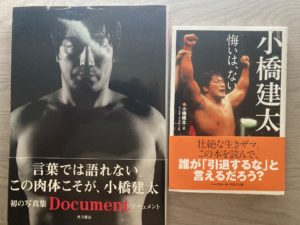
Left: Kenta Kobashi “Document”, Published April 25, 2006,
AND
Right: Kenta Kobashi, “No Regrets”, Published May 31, 2013
DOCUMENT is more of a photo book containing rare photos of Kobashi in and out of the ring but it does have one interview that talks more about Kobashi’s mindset, which I’ll bring up when we get to his matches in America. Meanwhile, REGRETS is more of a “this is proof that I lived” kind of book. It summarizes much of what has already been mentioned in FIST and PILLARS without adding much newer content but it goes go further into Kobashi’s life post-Exodus. So we’ll get to that once we get to the end of PILLARS.
Shifting back to 1999, Kobashi tries to beat Vader in singles competition but fails to do so on two occasions. Frustrated he declares “I will not shave my hair until I take revenge on Vader in a singles match”, which gives us bearded Kobashi as seen on the cover of FIST.
Kobashi participates in the 1999 Champion Carnival tournament and this time he makes it to the finals before losing to Vader once again. He puts Vader over huge, including noting how he was the first person to ever win the CC in his first appearance. He also says nice things about “The Gladiator” Mike Awesome, with whom he describes having a great match later that year in September. It is here that Kobashi goes a bit further into his reaction to Baba’s passing. He, like most people, was completely blindsided by the announcement. When he saw Baba in his casket tears overflowed from his eyelids. He says goodbye forever to his father figure and wonders what’s going to happen next.
The pace picks up again as Kobashi shifts into 2000, completely glossing over another great Misawa/Kobashi singles match from June 1999 and barely mentioning AJPW’s second Dome show in May that year that served as Baba’s “retirement ceremony”. Around the same time Misawa is named company president and he appoints Kobashi to a director’s role but Kobashi describes his position as being more or less the same as what it was before: overseeing the training of other wrestlers. In the ring Kobashi wins the 2000 Champion Carnival as the defending Triple Crown Champion, having dethroned Vader in February. He successfully defends his Triple Crown against Takao Omori in April 2000 and then against Yoshihiro Takayama in May, the latter being the last great match Kobashi would ever have in All Japan.
There is another epilogue of sorts here with Kobashi noting Tsuruta’s death in 2000 and the announcement of the formation of NOAH. Kobashi states his intention on writing about NOAH in greater detail but as of this writing he hasn’t released another book on the subject. He then skips far ahead through the NOAH years since, without Kawada, there were no more Four Heavenly Kings wrestling each other anymore. He then describes their different fates: Misawa tragically dies in the ring in 2009, Kawada quietly retires from wrestling in 2010, and Taue spends a few more years doing lower-card stuff while focusing on NOAH’s management until he, too, retires from wrestling at the end of 2013. He also notes it’s interesting that both he and Taue retired in the same year given how their careers were more or less intertwined from the very beginning.
Then Kobashi gets into another discussion about what Four Heavenly Kings-style wrestling really is while acknowledging some of the comments people have made over the decades.
“What is the essence of “Four Heavenly Kings Pro Wrestling”?
“Doing dangerous moves”
“All four had short careers as wrestlers”
I’ve heard that such criticisms of the Four Heavenly Kings Pro Wrestling are coming up now. However, our wrestling was always about pursuing improvement with a strong desire to excel.
“If you take a big move, then next time, you should avoid getting hit by that move.”
“Even if you take a big move, you should minimize the damage.”
By honing this attitude together, we became more advanced and more intense; it wasn’t just for show that we did dangerous things.
Is there such a thing as “safe pro wrestling”? Since we throw, kick, and hit people, every attack is always accompanied by danger.
And it was this sense of crisis that fostered mutual growth, and this repetition is what defined “Four Heavenly Kings Pro Wrestling.”
Therefore, none of the four thought it was too dangerous, and it was a match that could only happen because all four had the skill to engage in that back-and-forth. We saw each other accumulating rigorous training, and because there was a trust that “he will definitely be able to take it!” even when executing dangerous moves, we were able to engage in exchanges that might seem extreme.”
This epilogue concludes with Kobashi noting that whenever he travels to wrestling venues or even on the streets he’s greeted by people who’ve become fans by watching videos of his matches, to which he says he’s thankful and grateful for the continued support, stating,
“I believe they will surely feel how wonderful pro wrestling is. I am truly grateful to have aimed to become a pro wrestler and to have become one. Even after retirement, the spirit of a pro wrestler is still deeply rooted within me. No, if you love pro wrestling, even if you are not a pro wrestler, that spirit of pro wrestling surely resides in your heart.
A heart that never gives up, no matter the circumstances. A strong fighting spirit that overcomes any difficulties. Pro wrestling that embodies such feelings was undoubtedly “Shitenno Pro Wrestling.””
That is the epilogue of this book’s narrative but it’s not the end of the book itself. The next section is a “Talk Battle”, an interview/discussion that Kobashi conducts regularly during his self-promoted Fortune Dream wrestling events. This one, however, doesn’t take place at a wrestling event but is a more casual sit-down interview between Kobashi, referee Kyohei Wada, and Kairi Hojo (a.k.a. Kairi Sane). I’ll get into the contents of this discussion next time.
Thanks for reading.