

5-Star BOOK Reviews: Kenta Kobashi’s Books, Part VI
By Alex Podgorski on 4 March 2025
Last time on Kenta Kobashi’s wrestling journey he was riding high. He won AJPW’s top tag tournament, won the World Tag Team titles, and overcame an ideological battle with one of seniors that put more of a critical eye on his performances, for better or worse. It seems like Kobashi was riding high, but it wouldn’t be long before things took a turn given that Kobashi wasn’t the only person AJPW’s bookers and matchmakers had to consider in their decision-making.
You can read part 1 here, part 2 here, part 3 here, part 4 here and part 5 here.
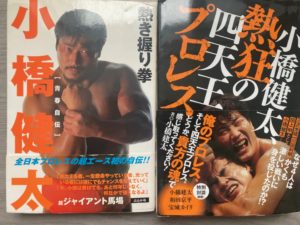
And as a reminder, since this a review of two books at once, I’ll be referring to Kobashi’s first book as FIST and his second one as PILLARS. Since FIST is slightly more neatly organized that’s the one that’ll make up the basis of this review.
Kobashi begins his 1994 on a high note as he has several tag team matches against his father figure Giant Baba, including a two-on-two tag in March in which Misawa pins Baba with a diving neckbreaker. With each passing day he becomes more comfortable being lumped in with the other Four Heavenly Kings but notes that, thus far, his biggest successes have only been in tag matches. Then we get to the 1994 Champion Carnival where Kobashi’s initial hopes of proving himself against Misawa are dashed as Misawa forfeits all of his matches due to a neck injury (APOD: This was actually a rare angle from Baba; he didn’t want Misawa taking any losses so he booked it so that Doug Furnas would “injure” him. Furnas was instructed not to tell anyone that it wasn’t real, which got him heat from, among others, Stan Hansen, which must’ve had him shitting his trunks. The goal, allegedly, was for both Kawada and “Dr. Death” Steve Williams to get more attention and not be overshadowed by ace Misawa. Whether this was the smart choice or having Misawa actually lose for once is up to debate). As for Kobashi, he ends up tied with Akira Taue for 3rd place, having scored wins over everyone except Misawa (forfeit), Kawada, Doc, and a 30-minute draw with Taue. What’s notable here is that Kobashi gets his first pinfall victory over Stan Hansen, which to Kobashi is a very big deal given their history and Hansen’s star power. Hansen congratulates Kobashi to the press and Kobashi basks in this moment of glory before skipping ahead to his next big challenge: Dr. Death.
Kobashi describes Doc as being someone with “unconventional theories” when it comes to wrestling and how his doing things with brute force makes the two of them oddly compatible as opponents. Together they fought for over 41 minutes which was, at the time, the longest Triple Crown title match ever. But unlike their first match which had this sense of murderous intent, this match was like a respectful but no less intense tough guy exchange that gave it its own charm. According to Kobashi, Doc would go on to describe this match as the best of his life. We also get a rare mistake on Kobashi’s part as he falsely claims that this match won Tokyo Sports’ Match of the Year for 1994, which it didn’t; that went to a WAR match involving Tenryu & Ashura Hara taking on Tarzan Goto & Atsushi Onita. (APOD: FWIW the Tokyo Sports awards are taken a bit more seriously as they’ve been described as “legit to a degree” given that panels of wrestling industry veterans determine winners. In other words, it’s not random readers deciding the best of anything but industry experts with, in some cases, firsthand knowledge of wrestling).
Kobashi gets a modicum of revenge later in the year by winning the 1994 Tag League with Misawa for a second time, this time defeating Dr. Death & Johnny Ace. However, Kobashi doesn’t remember all that much of it since he was in a daze due to multiple painkiller injections for serious pain in his left leg.
After a short break Kobashi experiences the aftermath of the Great Hanshin Earthquake which hits Kobe in January 1995. As noted in Kawada’s book, this match ended up being, for all intents and purposes, a charity display to give the victims of the quake something to uplift them following such a devastating loss. Kobashi believes that the match should go on, even if only one person comes to the venue, thinking his match with Kawada would inspire those afflicted by loss could persevere. From FIST:
“Being able to have a match where we both gave our all until the end in front of such people was truly wonderful. Although I didn’t win the Triple Crown again, for this match, I feel like that was okay. As long as a person gives their all until the very end, they won’t end up as a loser.”
Kobashi is ultimately happy with match and is also amazed that, in some cases, fans took alternate train routes to get to Kobe and some slept at the train station or took night buses back home due to the chaos following the earthquake.
In PILLARS Kobashi also described where the term “King’s Road” came from: it was the name given to AJPW’s official fan club, those who sent in postcards, voted on small things here and there, and in some cases got to get special autographs or photos with the AJPW wrestlers. It was completely detached from the wrestling style or the Four Kings themselves but overtime it looks like the terms all melded together so that now, King’s Road is synonymous with the wrestling style of the Four Heavenly Kings, their other partners, and other opponents in their immediate orbit during the mid-to-late 1990s.
Then in both books Kobashi goes on this long tangent about the “power” of professional wrestling and what it means to fight for himself and for the fans. He well and truly believes that he, through his efforts and struggles, can inspire people going through challenges in their own lives, to overcome them. This is why his style is better suited for live viewing than video: his energy comes directly from a live audience, no matter how big or small he just needs their energy and he will fight on. He also insists that having live spectators is required; without them it’s nothing more than sparring in a dojo (APOD: WALTER and Ilja Dragunov would VERY MUCH disagree). Still, Kobashi lays is ideals bare:
“The ideal match I envision—where I burn with passion, my opponent burns, and the spectators are also heated—contains that meaning. I truly think it is wonderful to create a space where everyone gains strength through wrestling and can use that as nourishment to live strongly from tomorrow onward.”
(APOD: This is why the concept of a squash match doesn’t exist in Kobashi’s vocabulary. Each time he wrestles he wants his opponent to bring their A-Game so that he can beat them at their best without shenanigans or false claims of not giving if their all. It’s an admirable quality, but it’s also one that risks leading to staleness and a lack of legitimate intrigue).
“Beyond Despair”
In PILLARS Kobashi assigns an unusually dramatic title for the chapter covering this next section: “Beyond Despair”. When I first started translating PILLARS page by page I presumed that we were getting some kind of time skip to 2001-2 since THAT was a major period of despair given that his knees were in such bad shape that he might not ever return. Or maybe it would be an aside to tackle questions about his battle with kidney cancer. Nope, it turns out that Kobashi gets into such a rut in 1995-96 that he feels more despair than anything else, to the point that the fringe idea of leaving All Japan, a thought that he vowed never to do only a few short years ago, starts coming up time and again.
Kobashi notes that his record against the other Kings remains lopsided going into the 1995 Champion Carnival. This position is reinforced once the tournament is decided: Kobashi ends up in third once again but this time the gap is much more noticeable: he finishes with 13 points due to drawing with Ace, Hansen, and Kawada, and losing to both Misawa and Taue. The Taue loss is particularly impactful, both literally and metaphorically. Not only is he frustrated over not being able to make any progress over Taue, but he also recalls “spitting up blood” after taking Taue’s Cliff Nodowa (apron chokeslam to the floor) during their match (APOD: the 1995 CC is sometimes called the Taue Miracle Run because Akira Taue had arguably the best run of his career. His turnaround was so dramatic and he basically ended up closing the quality gap between himself and the other Kings quite fast and noticeably. And as I had noted before, the 1995 CC Final match between Taue and Misawa is absolutely tremendous and you should go watch it as soon as you possibly can).
Things start to get more complicated from there. Kobashi learns from reading the wrestling mags that Misawa was starting to consider dissolving Super Generation Army, or at least recommending Kobashi branch off on his own, stating, “From now on, in order to develop the younger wrestlers, we may need to dissolve our tag team with Kobashi and team up with younger wrestlers…”. Kobashi is shocked since his own goal was to win the Tag League tournament with Misawa five years in a row. Although Misawa’s comments, uncharacteristic as they are, made sense on some level (APOD: outside of Kobashi’s point of view, AJPW was running on highly repetitive match-ups and Baba’s slowness and conservatism as a booker were putting ever increasing strain in the Kings and established stars. It also didn’t help that Dr. Death was no longer around after being kicked out of Japan for a year), Kobashi is still in doubt about where things will go. In FIST Kobashi describes a comment by Misawa stating “if we lose we disband” ahead of the 6-9-95 tag match, which puts more pressure and anxiety on Kobashi. Come that match, Kobashi notes going into it with a muscle strain, which is why it was taped up for the match. However, in post-match comments Misawa acknowledges that, at least for the moment, he can’t beat the Holy Demon Army without Kobashi and continues to team with him.
(APOD: While all of this might have some kayfabe subtext, Kobashi’s misgivings about splitting off from Misawa have some merit because, quite simply, there is no one else for him to team with on a regular basis. Kawada and Taue are still together and would be until the NOAH Exodus. Misawa is tasked with elevating Akiyama further and does so until 1998 when Akiyama breaks off on his own and is replaced with Yoshinari Ogawa. But in the interim, during this immediate post-Four Pillars era, Kobashi doesn’t have a regular tag partner…in a promotion that is largely tag match focused for much of their touring schedule and had trained their audience to follow this “stable warfare” dynamic since 1990 when Tsuruta-gun and Chosedai-gun were going at it. So this period sees Kobashi trade regular tag partners without much thought put into it. He teams with Kikuchi at times but Kikuchi is firmly entrenched in the junior heavyweight division and will almost always play the fall guy as a result. On other occasions he teams with Johnny Ace, with whom he’s had an on-again-off-again partner relationship going back to the secondary All Asia tag division, but that arrangement appears to be temporary since Ace is needed in main-event tags with Dr. Death and may or may not be needed as a heavyweight support player in other contexts. There are few, if any, native Japanese options: Tamon Honda is an ally of the Holy Demon Army and Yoshihiro Takayama doesn’t sign with AJPW until 1997. The only other Japanese wrestler Kobashi considers is Takao Omori but Baba, for some reason, isn’t willing to push Omori just yet. So if there is no clear plan for Kobashi and he himself thinks that his booking is all over the place, he worries that the fans would think the same and presume that there’s less institutional faith in Kobashi as a future star. And on the singles side the main-event scene is growing ever thinner: Tsuruta sidelined indefinitely, Doc deported, Gordy badly damaged and nowhere near his pre-coma condition, and everyone else either a midcarder or lower. The consequences of Baba’s walled garden isolationism were starting to come up, especially given Kawada wanting so desperately and vocally to mix things up for the fans’ sake and those comments reaching Baba’s ear.)
From there Kobashi finds himself involved in a dubious booking direction that he himself can’t understand. He, Taue, Johnny Ace, and Del “Patriot” Wilkes would compete in a short tournament to determine the next #1 Contender for the Triple Crown. Kobashi is puzzled by this sudden booking decision, assuming that the 1995 CC had a disappointing result. Nevertheless he finishes second to Taue, which solidifies Taue’s challenge Misawa for the Triple Crown (APOD: in case anyone might’ve lost track, the Triple Crown had changed hands a few times between the summer of 1994 and the summer of 1995: Misawa to Doc to Kawada to Stan Hansen to Misawa). What perplexes Kobashi further is that, despite coming in second, Kobashi is booked to face the champion on October 25th at AJPW’s big Nippon Budokan show. It’s somewhat difficult to tell if Kobashi is kayfabing here for the sake of maintaining the prestige of the Triple Crown or if he’s genuinely concerned with what he perceives to be questionable and desperate booking decisions. Per PILLARS:
“Whether it was that match against Williams or this challenger determination league, the fact that I, who couldn’t win, am now smoothly challenging for the Triple Crown title, which should be the pinnacle, just doesn’t sit right with me. I couldn’t accept that challengers were being decided based on vague criteria.”
Things only get tenser from there as, on August 23, 1995, Kobashi experiences what he calls “The Bloody Tragedy in Akita”.
On that date Kobashi teamed with Masao Inoue to take on Stan Hansen and Richard Slinger. For some unknown reason Hansen was unusually irritated, even by his typical ornery standards. He beat the shit out of Inoue as was his gimmick but Kobashi tried to help by grabbing Hansen’s bullrope and using it on him. Hansen retaliated by grabbing a chair and swinging it at Kobashi at ringside but the contact was off and a sharp connecting part of the chair ended up cutting Kobashi’s left arm down to the bone (APOD: as this was a house show there is no video of this but WrestlingColin’s amazing recap of Kobashi’s career includes some photos with the white of Kobashi’s bone sticking out blurred out. You can find this at the 21-minute mark in his video).
Kobashi further describes getting into a backstage tussle with Hansen over the incident which caused many people to break them up. An ambulance was called to take him to the hospital but he refused at first. It took lots of convincing but he eventually agreed and got eleven stitches in his arm. It was also the first time he had ever been in an ambulance. The next day he finds Baba drinking coffee and, without saying a word, gives Kobashi a look that basically says, “you’re not in a position to take time off.” Naturally Kobashi doesn’t, and states that he was more concerned about his name not appearing on the match card than he was about his stiches reopening. Two weeks later they face off again in a tag match and Hansen shows no remorse and attacks the arm (APOD: it doesn’t appear to be out of malice or sheer recklessness but that’s the style Hansen was paid to showcase).
In FIST Kobashi describes feeling legitimate frustration and anger towards Hansen but he can’t let these issues come up in front of the fans because he’s a professional and as a professional you can’t being personal feelings into your matches (APOD: I can’t help but laugh at this statement). Instead, Kobashi puts his feelings aside for professionalism’s sake and has two more career defining performances: his October 25 Triple Crown title challenge against Misawa and his third consecutive successful Tag League Final with the same partner, this time against Kawada and Taue, achieving something that no one else has been able to do. On the matter of the singles match in the Budokan, from PILLARS:
“This match turned into a heated battle lasting over 35 minutes, but I succumbed to the “Tiger Driver” into a pinfall and was unable to overcome the significant wall that is Misawa-san once again. However, this match received high praise from both inside and outside the ring, and I received many words from fans saying, “This is the best bout!” Winning or losing is not everything in pro wrestling; by fighting, we can improve each other, and my battles with Misawa-san always elevate my aspirations.”
APOD: This section reads more like a diary/personal journal with more collections of Kobashi’s thought than actual facts. On one hand he passionately documents the positive things that happened to him and reinforces his positive can-do attitude when faced with professional challenges. On the other hand he isn’t shy about describing how he feels regarding certain decisions outside of his control. By describing his feelings about certain things he’s able to dance around the usual evasiveness associated with both the Japanese language and cultural norms of not being blunt or direct. Through his eyes we’re able to get a glimpse at how things weren’t all rosy for him as a performer. And yet from a wider perspective there are more factors to consider. Kobashi presumes to have smooth and linear career progression, not realizing everyone goes through slumps. While he appeared to plateau in terms of push in 1995, part of that came from a more concerted effort from the AJPW office to push Taue who, by some analyses, needed more direct creative involvement to get over with the audience whereas Kobashi, Misawa, and Kawada were all seen by Baba to be talented enough to get over on their own. And aside from the situation with Hansen, Kobashi’s criticisms with the four-man tournament seems more like a clash with his own idealistic vision of AJPW’s style than a legitimate criticism of a business decision. Then again being an idealist is what Kobashi’s all about, after all, his whole career has been about showcasing both his best and his opponents’ best every night, even to his own physical and mental detriment. So it’s only natural that his worldview would clash with others’ in AJPW, especially as things continue into the latter half of the decade.
Thanks for reading.