

5-Star BOOK Reviews: Kenta Kobashi’s Books, Part VII
By Alex Podgorski on 7 March 2025
The last part of Kenta Kobashi’s books was filled with both inner and external turmoil as the guy struggled with what he perceived to be inconsistent booking and an uncertain future. As we go into his 1996 and beyond, it seems like some of those trends will continue and the poor guy is forced to make chicken salad out of chicken shit while still trying to deliver on ever-rising fan expectations. Things get pretty tumultuous for him, so let’s see how he overcomes these various challenges.
You can read part 1 here, part 2 here, part 3 here, part 4 here, part 5 here, and part 6 here.
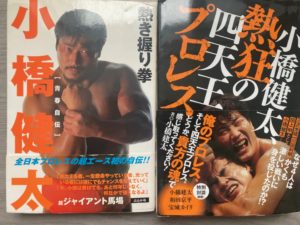
And as a reminder, since this a review of two books at once, I’ll be referring to Kobashi’s first book as FIST and his second one as PILLARS. Since FIST is slightly more neatly organized that’s the one that’ll make up the basis of this review.
Both books mention little to nothing of the first three months of 1996 and skip ahead to the 1996 Champion Carnival where, once again, Kobashi hopes to finally win. He achieves some progress compared to the last two years but, again, he falls short of winning, this time coming in tied for 2nd place with Stan Hansen while Taue and a returning “Dr. Death” Steve Williams tie for first and go to the finals. The only other developments from this point is that Kobashi finally beat Doc one-on-one and that he no longer harbors bad feelings for Hansen for slicing his arm open at that house show.
Then Kobashi talks about coming up with a new finisher and chooses the diving guillotine leg drop. Though he had technically won with it before a year earlier when he and Misawa beat Doc and Johnny Ace in a tag title match, he decides to use that move more regularly hereafter. He explains that his decision comes not from the growing damage to his knees but because moonsault has become predictable and at times takes way too much setup (APOD: FWIW I believe John Cena got his diving leg drop from Kobashi as well).
However, it isn’t long before Kobashi’s having negative thought again. In FIST he notes reading articles about how he is purportedly impatient and becoming obsessed with his in-ring results while in PILLARS he starts asking himself “Am I being kept on a leash?” He observes Akiyama’s elevation to Misawa’s new right hand man and doesn’t speak badly of Akiyama at all, instead stating that he was forced to dissolve his team with Misawa, though he doesn’t say by whose decision. So while Misawa has a new partner in Akiyama Kobashi has to settle with Johnny Ace, The Patriot, and Giant Kimala II. He feels confused about the company’s intentions with him, especially given this presumption that he’s supposed to lead the next generation as he is, after all, much younger than the other three Kings.
Determined to find a new and reliable partner Kobashi approaches Baba who, for some reason, is uncharacteristically blunt and unhelpful, telling Kobashi to “find someone yourself”. He begins to think that the company isn’t investing as much time and energy into his push, which makes him believe he’s turning into an afterthought or is indeed being kept on a leash. And so in PILLARS he describes responding to these developments by “drowning my sorrows in alcohol” (APOD: It isn’t touched on in any of his own books but apparently Kobashi is a TERRIFYING drunk. In a collection of 1997 Four Heavenly Kings interviews, Misawa states that when Kobashi starts drunkenly calling Misawa ‘Aniki’ [Big Brother], that a sign that everyone else is going to have to drink like crazy, to the point that rookies started regularly approaching him and saying “Mr. Kobashi, please don’t drink today”. In that same book Kobashi himself states “If I’m told to drink, I’ll drink as much as I can. My personal record is finishing three bottles of shochu in under an hour. I did it in one go, one after another.” I’m still looking for a source on an old story I read a few years ago about Kobashi getting wasted at a wedding and destroying a toilet).
It is also around this time that Kobashi first meets his girlfriend Mayuko and thanks Baba for being “cupid for his marriage”. (APOD: In a semi-related aside from that same 1997 interview Kobashi addresses rumors circulating in some tabloid magazines that he’s gay based on the fact that he’s approaching 30 and still unmarried. The tabloid allegedly wrote a salacious story that Baba fired Jun Izumida from being his assistant because “Izumida wasn’t his type” and Kobashi spent some three years being Baba’s assistant instead. Kobashi’s quick to quash these rumors, not because of any prejudice but because he doesn’t want people to get the impression that Kobashi’s getting ahead by having that kind of relationship with his boss. In other words, he’s trying to avoid something that could’ve been dismissed as a joking Vince McMahon/Shawn Michaels ‘relationship’ turning into a “Pat Patterson/Mel Phillips/Ring Boy” kind of situation).
Kobashi’s doubts continue as he describes being in a slump through the spring and summer of 1996 until he is announced as Taue’s next challenger for the Triple Crown after Taue defended successfully against Kawada. His initial response is, “What the hell is this!!” He explains that he had never beaten any of the other Kings one-on-one before and wonders if it’s ok for him to be granted a title challenge so easily. He sees this as a further example of the Triple Crown being devalued because, in his mind, he hadn’t properly earned the right to challenge for it. Worsening his doubts is the fact that, fifteen days prior, Kobashi goes to a 30-minute draw with Akiyama, his junior. How can he win the Triple Crown if he can’t put his underclassman down? While in PILLARS he does recognize the booking angle for this match (Taue is trying to beat all three Kings in a row to capitalize on his momentum), Kobashi still feels unworthy because he was losing so many other matches as well which didn’t give him the credibility of a worthy challenger. These doubts and worries get so serious that he even starts thinking that if he loses there will not be a place for him in All Japan anymore. Per PILLARS,
“What will happen to me if I lose? Am I just a decorative existence, a mere figurehead of the Four Heavenly Kings? Am I just a pawn for the company’s convenience? That’s ridiculous! I didn’t become a professional wrestler to be that kind of existence! In my daily life filled with literal suffering, my frustration, which had nowhere to go, led me to an unacceptable conclusion. “If I lose again, there will be no place for me in All Japan!” This was the conclusion I reached. I pushed myself into a situation from which there was no turning back and resolved to give it my all”
(APOD: Either this is incredibly elaborate kayfabe writing or Kobashi’s writing here really does make him jump to conclusions a bit too easily).
After LOTS more motivational I-climbed-out-of-a-bottomless-pit talk we get to Kobashi’s title match with Taue. Midway through Taue kicks Kobashi and hits his eye directly causing swelling and vision loss. Undeterred, Kobashi overcomes all of that and executed his diving guillotine leg drop finisher. But something goes slightly wrong: he lands ass-first on the mat so hard he loses consciousness, which is why, in the match video, referee Kyohei Wada can be seen “guiding” Kobashi to the cover.
There are several pages dedicated to a “full circle” story about how Kobashi was first mistaken for Taue eight years earlier and now he’s world champion. He again talks about overcoming everything to now be on top of the world…well, not quite at the tippy top but close enough. Because although he’s champion he’s not the ace, as the next few months will show.
His first Triple Crown defense takes place in September and that match is the semi-main while Misawa and Akiyama take on Doc and Ace for the tag titles in the main event. Kobashi reads deeply into everything and concludes that the fans must presume that although Kobashi’s carrying gold he’s not a top star. To do that he’s got to make some changes, one of those being his new finisher, and in this case it’s you guessed it, the lariat. Up to that point he had been using it as a transitional move, but a few months earlier Hansen actually had a conversation with Kobashi about this, with referee Joe Higuchi serving as interpreter. Per PILLARS,
“One day, after I started using the lariat as my finishing move, referee Joe Higuchi called me before a match at Korakuen Hall, saying, “Stan wants you to come to the locker room.” What could it be? As I was puzzled, Hansen opened his mouth in the private locker room. “I don’t mind Kobashi using the lariat. But please don’t overuse it. If you’re going to use it, make it count in one shot.”
Like an anime character suddenly being allowed to use a new technique, Kobashi hones his craft until he’s able to deliver a vicious lariat of his own that even the mighty Stan Hansen would approve of. Then things start to improve. Kobashi retains against Hansen, The Patriot returns to being his regular partner (he’s happy since, in his mind, Patriot understands his wrestling style better than most), and he retains again against Kawada via a 60-minute draw, despite having an injured ligament in his lariat arm. However, he suffers a minor roadblock when Patriot suffers an arm injury during the 1996 Tag League that ends their winning ways.
(APOD: As an aside, this part of Kobashi’s book really does change how we might look at things from the past. I don’t know how many of you take Dave’s Wrestling Observer Awards at face value but who his readers have voted for in the past is interesting to note. Anyways the WON readers voted Kenta Kobashi as the Wrestler of the Year for 1996, beating Shawn Michaels by a thin margin. The thing is, Wrestler of the Year is meant for the best all-round wrestler on top, meaning champion, headliner, etc., and Kobashi, despite being very good in the ring, wasn’t recognized as a top guy. Though he had good matches throughout the year he was only champion for the second half and wasn’t even positioned as ace. His matches in ’96 weren’t as good as in ’95. And now we know his own thoughts about being more or less lost in the shuffle throughout the year. In other words, it seems more and more likely that the 1996 WON WOTY award for Kobashi was less a deserving honor for him and more of a protest vote against Shawn Michaels who, by most metrics, should’ve won. Besides, Kobashi would win the award three years in a row from 2003-5, in a time when wrestling was losing out to MMA and when more players were vying for fewer pieces of a shrinking pie.)
And then, we get to arguably the biggest match of Kobashi’s life. January 20, 1997. Kobashi defending the Triple Crown against Misawa. “There probably won’t be a match greater than this”, notes the champ. This is Kobashi’s career defining moment, a match he must win. To do that he’s willing to do whatever it takes and he knows Misawa will do the same since both of them share the same philosophy on wrestling. In fact, Kobashi calls his mother ahead of the match and basically tells her “if something happens in this match please don’t hold anything against Misawa”. Although Kobashi loses in the end, he still makes a tremendous name for himself with what most fans consider the best singles match of his life (APOD: It’s been said that Meltzer only ever saw the cut TV version of that match and only rated based on what he saw so he gave this match ****3/4. However most fans think that the match was MUCH better than that and is better than the other ***** performances these two put on in 1998, 1999, and 2003).
We skip ahead to the 1997 Champion Carnival which is memorable for its three-way playoff at the end since Kobashi, Misawa, and Kawada were all tied for first. Kobashi ends up drawing with Misawa and losing to Kawada, and then he finds out that the returning-from-injury Patriot will be teaming with Johnny Ace. This was stemming from rumors that Patriot would be leaving for WWF/E which Patriot initially denied but later came true. Around this time Kobashi decided to form a stable with both of them and the group would be called…GET (Global, Energetic, Tough). (APOD: I’m sure this might’ve sounded better in Kobashi’s head but that has to be the WORST example of Engrish ever used in a pro-wrestling setting. For all the creativity these guys had when it came to techniques and style, how could they come up with something so bad as a team name? How did we go from Stan Hansen being “The Unsinkable Battleship” and Terry Gordy being “The Human Torpedo”, to Satsujin Gyorai [The Miracle Violence Connection], to Chosedai-gun [The Super Generation Army], to Seikigun [The Holy Demon Army], to…fucking GET?! Hell, even the thrown-together trio of Steve Williams, Gary Albright, and Yoshihiro Takayama, has a better name in Triangle of Power [TOP], even though it would later expand beyond three wrestlers and no longer be a ‘triangle’).
As Kobashi turns 30 he finds himself rethinking his priorities and decides on trying to somehow beat Misawa one-on-one. Midway through the year Patriot does depart for WWF since he has to take care of his children in the US and again Kobashi finds himself in thrown-together team arrangements. Then suddenly another surprise development: Kobashi is challenged to a match by FMW’s Hayabusa, which AJPW accepts. First they wrestle in an AJPW ring which Hayabusa wins, then a rematch is booked for an FMW show. Kobashi is greeted warmly by the FMW side, even though he makes it clear as day that he’s not interested in doing anything other than an AJPW-style match:
“If Hayabusa had been a wrestler who prioritized deathmatches and disregarded the clash of souls, I probably wouldn’t have had any interest in him. I’m not saying deathmatches are bad. However, the pro wrestling I believe in is a battle where you train your body to become a weapon. A fight relying on objects is not the pro wrestling I believe in. Even if the contract at that time had been for an electric explosion match, I would probably have engaged in a physical battle at the center of the ring. Those who need such match formats can have those matches. I don’t deny it. But I don’t need it.”
Furthermore, in PILLARS Kobashi notes that he initially wanted to team with Takao Omori in these crosspromotional matches since Omori was a rookie who joined around the same time as Akiyama but was completely overshadowed by Akiyama’s super-rookie accomplishments and elevation. However, Baba completely shut him down and demanded his partner be Maunakea Mossman/Taiyo Kea instead (APOD: presumably because he didn’t want Omori eating a pin from an outsider). Ultimately Kobashi accepts Baba’s terms and has this second match which ends with Kobashi pinning Hayabusa with a lariat (APOD: ~15 years later Hayabusa, on crutches, would come out on Kobashi’s retirement show Final Burning in Budokan and talk about this match as one of his favorite memories). As an aside, Kobashi also has his first encounter with Vader and approaches him respectfully and they hit it off as future rivals.
It’s also around this time that Kobashi provides his definition of the AJPW style of wrestling as “defensive or receiving wrestling”. In other words, it’s all about taking everything your opponent has and still pushing forward (APOD: To use a video game comparison, it’s like putting most of your points into HP and Defense to tank your opponent’s biggest hits and chip away at them slowly, as opposed to putting everything into offense to create glass cannons, which is how most people at the time would’ve described 1990s NJPW). Kobashi demonstrates this with his August 1997 match with Hiroshi Hase:
“Those who have watched my matches until now would understand that my style of pro wrestling involves bringing out the opponent’s strengths, absorbing all their attacks, and then winning with an even greater offensive. It is often said that ‘New Japan learns from attacking, while All Japan learns from defending,’ and I believe that match was a typical example of this.”
In PILLARS Kobashi describes suffering a severe right thigh muscle tear in September 1997 but can’t take time off anymore, per Baba’s explanation from years earlier. He continued forward until he has another title shot against Misawa in October and this one, like the first one in January, is lauded by the pundits. This one gets voted MOTY by Tokyo Sports and he notices that “Misawa vs. Kobashi” is starting to turn into its own distinct brand.
Kobashi skips ahead past the 1998 Champion Carnival, effectively repeating his thoughts and feelings from the past few years, and moves onto the bigger deal in AJPW’s first ever show in the Tokyo Dome. However this is not Kobashi’s first time in the Dome as he recalls being there for the AJPW/NJPW/WWF Wrestle Summit in 1990 and the 13-company Bridge of Dreams show in 1995. He takes a moment to tell a story about another 1990 Dome show that February that had apparently involved a handful of AJPW wrestlers on a NJPW Dome show. He was assigned as a second to Tenryu and Tiger Mask (Misawa) and noted that Kabuki told him to be ready in case a fight were to break out between both sides since tensions were high over recent Tokyo Sports award winners.
Back to the present, Kobashi learns that his initially booked match for AJPW’s big Dome show was him teaming with Kea against FMW’s Gladiator (Mike Awesome) and Hideki Hosaka. Kobashi seems confused why Baba would book such a card (APOD: presumably because he’s completely unaware of the politics taking place among the companies wanting to work with Baba at this time). However, according to Kobashi enough fans wrote in to AJPW to demand a card change, and so Kobashi found himself teaming with Johnny Ace to take on Vader and Stan Hansen. In PILLARS he also takes a moment to describe the Dome as an unsuitable venue for wrestling due to its shape and acoustics. As a wrestler whose style becomes more entertaining the more energy the fans have, being in a quieter venue with delayed responses and thousands of fans looking up at a screen and not down at the ring, Kobashi much prefers the Nippon Budokan.
APOD: I decided to omit a few repetitive details because it wouldn’t make sense to write it again. Beyond his in-ring exploits Kobashi keeps bringing up these negative feelings related to AJPW’s booking, how he’s being misused and put in weird match arrangements that don’t give off the impression that there’s any consistency to his direction. And when it comes to winning and losing big matches Kobashi finds himself in slumps time and again, to the point that he starts getting very frustrated with his future. But as we’ve seen before he keeps bringing up that “don’t give up” mentality that makes me wonder whether this book was secretly written by a pre-Elimination Chamber John Cena since they both shared the same on-screen personality. Anyways this is a good spot to leave for next time since Kobashi takes on a much more important role going forward: carrying All Japan while Misawa takes much-needed time off.
Thanks for reading.