

5-Star BOOK Reviews: Masanobu Fuchi’s Book, Part I
By Alex Podgorski on 27 October 2025
After months of careful and tedious work I’ve translated several books written by or about the fabled Four Heavenly Kings of All Japan: Toshiaki Kawada, Kenta Kobashi, Akira Taue, and Mitsuharu Misawa. So now that we know so much more about these legendary wrestlers’ lives and careers it’s time to turn the clock back even further and look at one of the biggest masterminds behind their success. That brings us to this man:
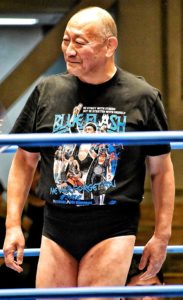
This is Masanobu Fuchi. His name might not be as well-known as the Four Kings or any of the other big names to go through All Japan during the 1980s and 1990s. But without him there wouldn’t’ve been that golden era of the 1990s since he played a central role in AJPW as Baba’s primary matchmaker from the late 1980s to about 1998. He was also a fountain of knowledge who bridged between the Four Kings on one side and his and older generations on the other. The closest person I can compare him to would be Dean Malenko: a shorter and technically adept workhorse who had a decent in-ring career on his own but contributed much more significantly to wrestling as a matchmaker/agent. As someone who was tasked with the equally challenging task of booking matches that satisfied multiple at-times competing priorities and as someone who trained in All Japan before the period that drew most of us to it in the first place, Fuchi has a unique perspective that I think is worth sharing with the rest of the world.
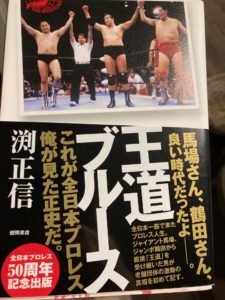
Royal Road Blues
Published March 31, 2022
Fuchi opens with an important statement by stating that he doesn’t speak ill of others and doesn’t want to make a deceased person into a villain. As such he expects that anyone seeking drama or gossip will find this a completely uninteresting book. But if it was then I wouldn’t be sharing my translations with you.
He briefly skips ahead to his training and provides a brief glimpse of what he was going through at the time. He recalls training in a creaky, dilapidated gym that reeked of sweat and mold when Khosrow Vaziri (The Iron Sheik) briefly served as a practice coach for young wrestlers, Fuchi included. The veterans watching included The Great Kabuki, Haru Sonoda, Atsushi Onita, Mototsugu Okuma, and the Great Kojika. Then Baba walked in along with Tokyo Sports reporter Tadao Monma and All Japan Judo Champion Kaneo Iwa. Baba motioned for Iwa to spar with Fuchi, who was significantly smaller than Iwa. But despite Iwa being way bigger and heavier, Fuchi took him down and outgrappled him effortlessly since, under Baba’s orders, Fuchi had previous experience sparring with Dutch judo master Anton Geesink. This grappling contest showcased one of Baba’s mantras, that stamina is everything for a pro wrestler.
After running out of breath against Fuchi Iwa gave up after only five minutes. Baba egged him on and wanted him to go again but for ten minutes yet Iwa protested. Iwa didn’t seem to read the room because next thing he knows Vaziri/Sheikie had Iwa on the mat tapping him out (APOD: No word if Sheikie “made him humble”). Iwa left soon afterwards and Tsuruta explained to him how they had to go all out against this outsider to protect the integrity of the All Japan dojo. Which brings us to Chapter 1 and the actual autobiography.
Chapter 1: Re-Entry Ordeal
Masanobu Fuchi was born January 14, 1954 in Kitakyushu City in the Fukuoka Prefecture. His was a family of four: himself, his mother and father, and a younger sister. Per his recollections Kitakyushu was an “unrefined” city with fights during local festivals being a commonplace occurrence. Despite being big as a kid he disliked conflict with his first and only fight taking place during the sixth grade, which he won with a single blow to the head that knocked his challenger out cold. Even later when he worked in wrestling he never got into conflicts backstage.
Speaking of wrestling, Fuchi recalls that during his childhood (the 1950s and 1960s) he notes that “everyone” was watching wrestling broadcasts, including his whole family. One day he found a photo book which included a photo of Lou Thesz posing and looking muscular and Fuchi’s mother told him that if he trained hard he could look like Thesz. Fuchi took this benign statement as a subtle hint that he should become a professional wrestler.
As he got older – and taller – Fuchi was invited to multiple high school and then university sports clubs but still chose pro wrestling above involving himself in them. He was a huge fan of Baba’s and after learning of Baba’s shocking resignation from the Japan Wrestling Alliance he made the decision to drop out of a local university and move to Tokyo. In a somewhat unusual twist on things, it was his father, not his mother, who opposed his entry into wrestling. But his mother, realizing that having a stable job at the local steel mill wasn’t what her son wanted, secretly gave him 100,000 yen and encouraged him to make a name for himself.
“People have one lifetime, and a name lasts for generations. Go.” – Mama Fuchi to her young son encouraging him to pursue his passion
After renting a cheap apartment in Tokyo and getting some rudimentary training equipment, Fuchi enters AJPW’s dojo dressed in a suit carrying his resume and some training equipment. The secretary, someone named Haraguni, noted that Fuchi was pretty slim but offered him an opportunity anyway. The next day Fuchi entered the dojo and found a young Tsuruta sweeping the floors. Then the two of them sparred for 30 minutes in what served as an on-the-spot evaluation. Fuchi’s accomplishments were somewhat notable, with him participating in the National Sports Festival for Amateur Wrestling and making it to the second round. However, this was nothing compared to Tsuruta the Olympian whose strength overwhelmed Fuchi in short order.
After those 30 minutes ended Fuchi went through another round of physical hell in the form of the typical entrance test. In front of Masio Koma and Mitsuo Momota, Fuchi underwent the usual routine of 500 Hindu squats and 5 sets of 30 push-ups. Though he was accustomed to the squats from previous training, he was dead tired following the sparring with Tsuruta. Still Fuchi made it and was allowed to come back and continue training.
Said training included doing more push-ups and practicing break-falls which Fuchi found excruciating. According to Koma a wrestler needs to become accustomed to the pain. Then he attended a fancy shindig at the Tokyu Capital Hotel ahead of the inaugural Champion Carnival Tournament where he was introduced to his idol Giant Baba for the first time. All of Fuchi’s early interactions with Baba and the other wrestlers were positive with everyone encouraging him and giving him fairly warm treatment (APOD: This contrasts quite sharply with guys like Kawada and Kobashi who endured extremely difficult entries into the dojo).
As the role rookie during the CC, Fuchi found himself taking on random tasks on top of his wrestling work as well. But before he could get comfortable or settle into any routine, Tsuruta, the person he was closest to, was being sent on overseas excursion to train with Dory Funk, Sr. In response Fuchi muttered under his breath that he wanted to go too but it was loud enough for Tsuruta to hear but and Tsuruta gave him more words of encouragement.
However things took a sudden turn for the worse when, around the time of his in-ring debut, he received an urgent call from his mother saying his father had collapsed. Though his seniors were a bit cold about this – interpreting this as him leaving after struggling through the training and highly disciplined life of a rookie – Baba understood and offered him a place back upon his return. Fuchi notes that if it weren’t for those words he might’ve joined another organization.
It turns out his father had suffered a mild heart attack and he used this illness as a pretext to have his son return to university. But this sudden return home turned into an extended six-month stay at home. It wasn’t until Fuchi read a news report of Tsuruta’s triumphant return that he went back to the All Japan dojo. Eventually his father gave in to his son’s desires but noted that he wouldn’t provide any support whatsoever. Surprisingly, Fuchi was able to return to his same room and part-time job in Tokyo without any trouble, as if those things were just waiting for him.
Fuchi was desperate and frantic to make his return to AJPW. Though Baba told him he could return, he had to go to a gym in Ebisu to train and his journey there was marred by congestion on the roads and sickness in his stomach. He made it fifteen minutes late and the seniors who were training there were skeptical of him this time around since they saw his initial departure as a betrayal of trust. So when he entered the dojo he was met with two stiff slaps which, when combined with his carsickness, caused him to collapse on the spot. When he awoke they made him to 500 leg exercises and being slammed 100 times which was overseen by then-16-year-old Onita. Fuchi endured physical hell taking those 100 slams and then his senior asked him, “Fuchi, are you done? If you’re done, you can quit and go home!” to which Fuchi responded by asking for another 100 more. Fuchi found himself being passed around like a ragdoll, thrown over and over by his massive seniors, some with the frames and strength of sumo wrestlers. Fuchi didn’t care if he died right then and there, he chose the path of a wrestler and was going to see it through.
“Once you betray and lose trust, it’s incredibly hard to regain it.” – Masio Koma
Fuchi concludes this section by noting that he survived way more bumps than his seniors thought he would and ultimately he earned enough respect to continue wrestling. He also describes seeing the now-rechristened Jumbo Tsuruta exuding a much more star-like gravitas and promises not to quit ever again.
APOD: There’s not much in this early section as this simply serves to underscore Fuchi’s dueling priorities between wrestling and his family. Like so many people Fuchi spent many years trying to decide between pursuing his childhood dream and finding career stability. He ultimately chose the former, much to his father’s chagrin, but his mother was unlike many wrestlers’ mothers and seemed far more openly supportive compared to the many who initially expressed shock only to warm up to the idea later. Fuchi doesn’t go into much detail on his sports background or his amateur credentials and instead focuses on the physical training he put himself through once accepted into the dojo. What’s perhaps most surprising about this is how easily Fuchi’s initial acceptance goes and how warmly he’s treated as a trainee. I guess this is due to this taking place in the early/mid 70s and not the 80s when AJPW has admittedly experienced a significantly larger number of runaways or failed trainees. Fuchi makes it seem like he was let back in relatively easily, only for his seniors to push him to the brink of death to make sure he actually was committed this second time around. And as we’ll see in the next section, he was far from over with physical punishment.
Thanks for reading.