

5-Star BOOK Reviews: Akira Taue’s Autobiography, Part VII (Final)
By Alex Podgorski on 15 April 2025
And now we come to the end of Akira Taue’s long and winding road in professional wrestling. This will cover some of the most challenging and difficult situations of his life, far more difficult than anything he has endured in either sumo or pro-wrestling. His professional and personal lives will both take serious downward turns, to the point that he ends up at one point fighting for his life. After reading his book in its entirety, I can honestly say that he might actually have overcome more adversity than Kobashi but since Taue’s more quiet and humble in his writings and public comments you have to really look at things from his perspective to truly understand that.
You can read parts one and two here, parts three and four here, part 5 here and part 6 here.
This section opens with a shocking tragedy with Misawa dying from an in-ring accident. Taue describes the cause of death as a cervical spinal cord dislocation. Taue was already backstage when a breathless Taiji Ishimori rushes in and tells him that Misawa’s in trouble. But by the time Taue comes out Misawa’s already turning blue and someone’s doing chest compressions on him. After seeing his body in hospital Taue, who had thus far been very stoic and emotionally detached from the wrestling business, surrenders to his emotions as he confronts this reality (APOD: Taue describes Misawa as someone who would not complain no matter what, even when he was in immense pain from his in-ring style. That lack of complaining lasted years, but when he started vocally complaining even in small under-his-breath exclamations it should’ve been a sign that something was wrong. We’ll probably see more of this when I go over Jun Akiyama’s books).
Then he talks about honoring Misawa’s wishes by continuing the current tour, and once it concludes an emergency board meeting took place and Taue was named the company’s new president. Other changes include Kobashi & Marufuji being appointed as Vice Presidents and Takeshi Morishima taking Taue’s old role of players’ association chairman while Joe Higuchi remained the company’s chief auditor. Meanwhile the previous VPs Mitsuo Momota, Haruka Eigen, Ryu Nakata, and Yoshinari Ogawa step down and become advisors. Taue isn’t sure why these resignations occurred.
In a dark and almost hilariously ironic twist, when Taue is appointed company president Misawa’s wife/widow is the majority shareholder of NOAH. I’m just gonna leave that there.
Anyways, both Mayumi and Misawa’s right hand man Ryu Nakata ask Taue if he can assume the role of president. Apparently Nakata didn’t get along too well with everyone (Momota and Kobashi are said to be two people that didn’t like him). Still Taue asks for a few days to think about it as he doesn’t want to make a rash momentary decision. Momota had also pushed for Kobashi to be president but Kobashi declined as well so Marufuji, Morishima, and Sugiura all pushed Taue to do it even though he, too, wasn’t all that enthusiastic about it. Ultimately he concludes “well there’s no choice, I have to do it”.
Around the time NOAH was 200,000,000 Yen in debt and they no longer had terrestrial broadcasting. Still, in the immediate aftermath of Misawa’s death there are some memorial shows announced. On one of them Taue teams with Keiji Muto and Taue half-jokingly criticizes Muto as a guy who does whatever he wants in the ring, which can be kind of irritating in tag settings. Then in another memorial match Taue teams with a mellowed out Kawada in a Holy Demon Army reunion that was as symbolic a farewell to Misawa as it could’ve been.
As a company president Taue notes having to do a lot of internal structuring which he found unpleasant. There looked to be some degree of contractual and financial stability under for everyone else under Misawa but Taue, aware of NOAH’s bad financial situation, couldn’t continue previous guarantees so some wrestlers were moved to freelance positions and others had to be released. Taue makes a baseball analogy and says that he’d rather let someone go than lower their salary. Further worsening the situation was that NOAH was no longer able to book the Nippon Budokan on a regular basis since they needed money well in advance and it was growing ever harder to predict ticket sales.
Taue describes his initial “promotion” to president as a “decorative” position since he, like Misawa, had little to no experience in management. Taue’s honesty shines through once again as he confirms some people were embezzling funds through loans; though he doesn’t name names he confirms that no wrestlers were involved and it was exclusively composed of higher-ups in the office and accounting staff who were involved. Taue was furious that in some cases several million yen worth of ticket sales were not deposited right away so when he threatened to deduct these amounts from staff salaries he suddenly found the money in the company coffers again. He further concludes that Ryu Nakata didn’t get along with Kobashi or even Keiji Muto, and concludes that Misawa did a balancing act in maintaining a delicate peace in NOAH. It seems that with Taue taking over he might’ve been too lenient which enabled bad things to happen.
As Taue’s in-ring career winds down he starts to focus more on office activities. He discloses suffering from arrhythmia since his days in All Japan, he had a bad back. But he had to keep going wrestling a little bit longer since he finds NOAH embroiled in a yakuza scandal. Specifically, he confirms that Ryu Nakata and Haruka Eigen had yakuza ties and were demoted to general employees (APOD: Taue very much undercuts the severity of this revelation. Though many people have described the yakuza’s involvement in pro-wrestling as an “open secret” for decades, it was still an awful thing to be recognized and revealed officially. So NOAH having organized crime ties, even if it’s limited to one or two employees, it the ultimate black mark on a company’s reputation. That NOAH managed to survive this and continue operating to the present day is nothing short of miraculous).
Things only get worse from there for the company when Takeshi Rikio announces his retirement due to a neck injury. Though he wasn’t as big of a star as expected he was still passable enough as a performer for a time and NOAH wasn’t in a position to lose any wrestler with main-event credibility so this was a big loss. But it pales in comparison to the next problem being the story that Kenta Kobashi has been fired by NOAH. Taue confirms that NOAH never actually fired him but doesn’t actually go into details on that specific situation since an equally big problem sees five other wrestlers leave NOAH in protest including Akiyama, Go Shiozaki, Yoshinobu Kanemaru, Kotaro Suzuki, and Atsushi Aoki. Taue suspects that all give of them had problems with Nakata and used the Kobashi situation as a pretext to leave under the guise of supporting their close friend (APOD: Kobashi never mentions this situation in his books, merely noting that as time went on, he crept closer to retirement as his body wore down. But the reported situation was that NOAH couldn’t afford to keep paying him so Kobashi allegedly ended up being one of the people Taue mentioned earlier that couldn’t keep his fulltime salary due to the company’s shrinking budget). But Kobashi still respects NOAH enough to let them host his retirement show in the Nippon Budokan which allows both sides to depart at least somewhat amicably.
The day after Kobashi’s retirement show Taue announces his own retirement which would take place later that year. He also announced a “new chapter” for NOAH with a strong focus on remaining wrestlers like Marufuji, KENTA, Morishima, and Sugiura. Taue also notes that he had intended to retire sooner but continued because Rikio’s sudden retirement pre-empted his and so he had to go on for a bit more and then the Kobashi situation postponed his final match once again. Taue’s retirement match took place on December 8, 2013 and saw him wrestle in an eight-man tag match teaming with Morishima, Sugiura, and Genba Hiranyagi against Genichiro Tenryu, Tatsumi Fujinami, Kentaro Shiga, and Masao Inoue. Taue had contemplated having one last Holy Demon Army reunion to bookend his career but that never came to fruition. Instead, Taue visited Kawada’s restaurant in Setagaya and had some shrimp ramen and fried chicken (APOD: Kawada makes some delicious ramen so if you visit Tokyo it’s worth the trek to get there). Taue doesn’t describe being all too emotional about his in-ring career ending, noting that he felt “oh, this is the end” and moved on. That said, he does note that he was the last of the Four Heavenly Kings to retire and ponders whether the style had its costs, commenting,
“Everyone from the Four Kings has had their bodies break down, but I don’t think anyone has regrets. The things we did in front of the audience, and the pain that came with it, are treasures to me.
Having a somewhat successful wrestling career for 26 years was probably because I didn’t carry over my sumo past and quickly immersed myself in professional wrestling and its society. The sumo world and the wrestling world are a bit different. It’s important to have the mindset of “when it’s time to do it, you do it!” and to have the guts for it.
It’s good to have some big moves, but it’s better to have many techniques to connect them. I’m quite capable, you know. I could do a certain amount. I didn’t show it all the time; I would just bring it out occasionally, and that was good. If I did it all the time, it would be ordinary, but by doing it just sometimes, the audience would get excited (laughs).
I was aware of the audience’s reactions during matches, but if I was thinking about “how can I excite them,” it wouldn’t go well. Professional wrestling is deep.”
He also notes that, even though his memory has become quite foggy, three matches stand out in his mind: his Triple Crown win over Misawa in 1996, defending the GHC title against Morishima, and the one-sided thrashing he took in a tag match teaming with Muto.
Now retired, Taue shifts back to his family. He discusses his son contemplating entering pro-wrestling but Taue shuts that down right away, telling his son “you have no talent” [for wrestling] but he might do well in sumo. His son also expressed interest in American football and noted how he brought his son to a discussion with Stan Hansen and then his son took over the conversation to talk with Hansen about football, leaving Akira in the dark.
Then going back to NOAH, Taue focuses exclusively on the management side of things and as the years pass more problems occur. Ryu Nakata dies of a sudden heart attack, KENTA departs NOAH for WWE, despite Taue warning him that “with his body, it’s impossible in New York” (APOD: “New York” being the old-timey name for WWF/E) and yet Taue still tells him “go for it” as KENTA leaves while Taue’s stuck dealing with more financial woes and continued embezzlement from some NOAH staff. Then in 2015 Morishima quits suddenly due to his own health problems, both physical and mental, which continued for a few years culminating in his arrest. Morishima’s current situation is largely unknown, apart from stories of him being a regular sight in downtown Tokyo’s bars. Taue feels particularly sad about Morishima given how close they were as master-and-student for years. NOAH’s situation worsens even more as stories emerge that New Japan has acquired NOAH by virtue of a year-long invasion angle involving NJPW’s Suzuki-gun stable. Though the angle had a promising start, it went on way too long with the NJPW guys running through NOAH guys like a hot knife through butter, leading to further fan alienation. What was supposed to be an NWO-style takeover on paper ended up being a poor man’s imitation of that with little long-term payoff and none of the memorable moments.
And then, shit hits the fan.
In December 2016 NOAH teeters on the verge of bankruptcy and is sold to an IT company called Estbee Co., Ltd. There is no press conference and much of the transferring is done quietly and without fanfare. One of the people involved in this transfer is Masahiro Uchida, a one-time president of All Japan during the post-Exodus era. The intention was to keep NOAH alive but under a different name (the acronym P.A.R.N. is used but Taue doesn’t say what this stands for). All the wrestlers and staff would become employees of that parent company. As for Taue, his was responsible for ensuring a smooth transition but he didn’t have all the details of proceedings as much of it was handled by lawyers. He was said to remain as an advisor of sorts but he never had a formal salary and only got paid three times. But through all of this he kept working to ensure everyone else was taken care of, even if he himself wasn’t, to continue the good treatment lower-level wrestlers and staff had under Misawa.
Because Taue served as NOAH’s guarantor during bankruptcy proceedings, he ended up having his own personal assets confiscated and had to take on a personal debt of 400,000,000 yen, or about four million dollars. He had to take on a part-time job sorting package for a delivery service. He had little money with which to pay his mortgage and had to sell his house and various collectibles (including his motorcycles and his exotic fish). Because he was in a frantic situation he was taken advantage of and his buyer bought his stuff for cheap. He ended up staying with his mom in her izakaya for a time. When it was all said and done Taue literally had nothing and had to start from scratch in his fifties (APOD: Kenta Kobashi constantly stating that “he had almost nothing” must definitely ring hollow for Taue after this).
Taue doesn’t consider “living in the world of professional wrestling” since he has no attachment to it and yet he does what many retired wrestlers do: he opens a restaurant with equipment sent to him by Mitsuhiro Matsunaga (of FMW, W*ING, and other indy fame). As of 2023 when this book was published Taue was still running Steak Izakaya Champ in Ibaraki Prefecture where his mother grills the steak and he prepares it. He chose steak because he frequented Matsunaga’s own steak restaurant and liked it so he decided to open his own. Some online magazines printed that Matsunaga “trained” Taue in how to run a steak restaurant but in truth that “training” amounted to an hour of how to prepare meat.
The decade continues in a difficult trajectory as in 2018 Taue collapses one night after drinking and suffering from anemia. Then the next night he collapses again and the following morning as well. Upon getting checked out he discovers that he had a stomach ulcer that was bleeding heavily which stems from blood thinning medication that he had been taking for years to deal with his arrhythmia. Emergency surgery was scheduled with Taue describing the situation as potentially fatal as he could’ve died due hemorrhagic shock. He survived thanks to a blood transfusion of about 400CCs of blood. He jokes that there’s plenty of someone else’s blood in him which might be causing his body to react in ways that are different than before, such as when he hears a dog barking.
But that isn’t the end of his troubles. A subsequent tissue examination reveals that he has stomach cancer, somewhere between stage 1 and 2. So he ends up having most if not all of his stomach removed because the cancer is in the middle, along with his gallbladder. He dropped plenty of weight as a result of the procedure and being on a liquid diet, and he has to eat five very small portions per day, usually children’s portions. And yet Taue doesn’t describe this cancer ordeal with the same level of dread or impending change as, say, Kobashi with his kidney cancer. In fact, Taue resumes drinking alcohol only a month after being discharged, albeit in moderation.
In the months and years after that Taue’s more frequent medical appointments revealed more fractures and weakness in his limbs. Still he overcomes all of this and continues to work in his steak restaurant. Wrestlers come by regularly and he even gets fans from abroad, with one coming from as far away as Düsseldorf, Germany. He is surprised that some fans know more about specific matches on specific dates than himself and sometimes he can’t recall at all so he just smiles.
The book concludes with an epilogue noting how he recently became a grandfather and laughs how Muto still moves around (at the time) with artificial knees. He recalls commentating from ringside on Muto winning the GHC title from Go Shiozaki and being invited to a Tsuruta memorial show but being unable to attend due to money issues. Then he notes how he, Kawada, Kobashi, and their contemporaries and seniors all have body issues and complain about their knees. He also notes that Kawada has apparently become more talkative these days and how they’re closer now than when they were partners. He often goes to Kawada’s place to eat and Kawada comes to his to drink. He also continues to drink and smoke, and laughs if he’ll make it to age 70 or 80. His final words are about him being happy with his current life: despite not having all that much money and still having to work he has his wife, kids and grandkids. Although he has some regrets he’s happy with his life the way it is.
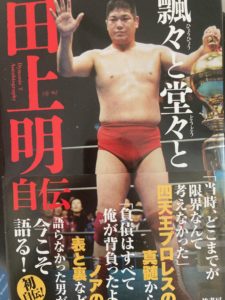
APOD: This book was excellent. Though it wasn’t as dramatic or full of flair as others, Taue lifelong story makes for a fun read. His more grounded viewpoint makes for a great contrast to Kawada’s sense of bitterness and Kobashi’s almost fantastical and idealistic take on pro-wrestling so it’s good to hear about this profession from someone who sees it purely as a job. At the same time this last chapter was also the most harrowing: over the course of ten years Taue was put through the mental wringer as he saw a close friend and comrade die, became a company manager in a baptism by fire, and struggled to navigate NOAH through storm after storm, to the point that the ark is almost completely lost beneath the waves. Aside from that he also had to deal with his own serious health problems and losing all of his life savings, having to start from the bottom at around 55 years of age. At a time when some people are lucky enough to retire Taue found himself working part-time jobs for scraps and was lucky to scrounge up $1,000 per month. But he still persevered and ended his story being as close to healthy as can be and happy with the life he has created for himself. His book was balanced enough between personal stories and details about wrestling that never shattered the illusion. He explained his techniques and what he learned from a practical perspective so the reader could see themselves in his position and understand the dynamics of his actions both in sumo and in pro-wrestling. And once again much thanks is needed to Kagehiro Osano who helped fill in any blanks in Taue’s memory so that the narrative was able to move forward without any gaps. All in all a fantastic read.
Final Rating: *****
Thanks for reading. Next up: MISAWA! MISAWA! MISAWA!