

5-Star BOOK Reviews: Akira Taue’s Autobiography, Parts III and IV
By Alex Podgorski on 4 April 2025
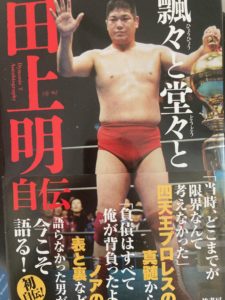
Akira Taue doesn’t describe himself as a wrestling fan. He didn’t have some kind of childhood awakening like Kawada, or any innate desire to be famous like Misawa, or a constant 24/7 obsession with it like Kobashi. For Taue, wrestling was a job, a means to feed his family. At first glance someone like that likely wouldn’t be earmarked as a big star. After all, most people presume that someone who grows up a fan of wrestling will dedicate more time and energy into succeeding than someone who views it through the lens of work and payment. But, as this section will demonstrate, Taue surpassed expectations and ended up improving so well and so dramatically that he ended up being one of the most critical utility players in any company from the past four decades.
You can read part one here.
Chapter 3: Joining All Japan Pro Wrestling
Taue describes meeting Giant Baba through his mentor San’yūtei Rakutarō and during that meeting Baba put Taue in a neck lock. However, once the deal is finalized Taue is signed not to All Japan Pro Wrestling but Japan Pro-Wrestling, a satellite entity managed by Riki Choshu with whom Baba had a working arrangement at the time. This decision stems from AJPW having an, at the time, “delicate” relationship with the world of sumo after wrestlers Hiroshi Wajima, Kototenzan (a.k.a. John “Earthquake” Tenta) and Takuetsuzan (a.k.a. Isao Takagi/ARASHI) all join AJPW. Taue is inspired by Yoshiaki Yatsu and vows to emulate his style as a professional wrestler.
Taue’s first impression of Baba is that he’s big but not intimidatingly so. He also notes that Baba was somehow both friendly and, from his initial interactions, stingy. Baba asks Taue “how much do you need?” in relation to salary/payment and Taue naively states an incorrect number and so his starting salary ends up being 150,000 yen per month. That number would steadily increase until 1996 when he wins the Triple Crown which enables him to extend his career at an age when most sumo wrestlers consider retirement. He also highlights the distinction between sumo and pro wrestling when it comes to personal freedom, especially as it relates to going out and drinking. There are some early instances of him being dragged out by Genichiro Tenryu, which he would try to avoid by saying that Kabuki was calling him for some chore or task.
When it comes to training the main people who taught him wrestling were Masanobu Fuchi and Haru Sonoda, until the latter died in a plane crash. Taue would commute from his apartment since he was already married and once he arrived at the dojo he would mainly train with Kenta Kobashi, Tsuyoshi Kikuchi, and Koki Kitahara. Because of his sumo background he had no problems with squats and other lower body exercises but he hated running and any upper body exercises, which he notes make up the core of pro-wrestling training. (APOD: it’s worth noting that in other books and interviews those around him described Taue as deceptively strong. Even though he looked tall and lanky he had incredible leg, core, and arm strength, which allowed him to throw people around much more easily. Kyohei Wada even noted that Taue could’ve been an even bigger star if he had Kobashi’s motivation). Taue also highlights how important it is to learn how to fall properly, especially as someone with different instincts stemming from another discipline:
“The difficult shoulder roll bump. Many wrestlers can’t do it now. When you’re thrown high into the air for a shoulder roll, it’s tough to control your body and time the landing. If you fail and fall on your butt, it can compress your organs, and if you fall on your feet, you can get injured. But in All Japan Pro Wrestling, it’s essential to be able to take a bump no matter how you’re thrown or where you fall, so it was tough, but I learned it well.”
After months of training Taue has his official debut on January 2, 1988 in a tag match with Giant Baba himself against Buddy Landell and Paul Harris, winning with a blockbuster after Baba hit his 16-mon kick to set him up. He couldn’t use his sumo shikona Tamakirin due to the previously mentioned fight with his stablemaster so he just used his real name. He also wore black trunks here and wouldn’t start wearing ruby red until about a year later at Baba’s suggestion. But to make sure people didn’t straight up call him Baba, Taue made sure his boots were red also instead of black like Baba’s. Taue also notes that Baba would give him lessons on what he called “grand-scale pro-wrestling”, which involved big, sweeping movements and striking poses that could be seen by everyone in a venue.
The first of the Four Heavenly Kings Taue mentions is Kobashi, with whom he spends lots of time training and practicing moves. Taue confirms what Kobashi noted in one of his books, that he was a practice dummy for the other wrestlers and thus took a lot of techniques and bumps in the dojo. Taue also confirms Kobashi’s story of being mistaken for him when he first arrived and recognizes that Kobashi became “conscious of him” due to, among other things, that case of mistaken identity.
Taue also takes the time to shut down a misconception about sumo wrestlers that transition to pro-wrestling being labeled as “dropouts”, stating,
“I had the pride of being a professional who made a living from martial arts, unlike amateurs.
People often say that those who come from sumo to pro wrestling are “sumo dropouts,” but I came to pro wrestling as an active and strong Juryo wrestler, so I took pride in being a “sumo graduate.”
At the same time Taue credits Kobashi with teaching him about the flow and structure of matches and also takes the time to thank Kabuki for teaching him a lot about “the intricacies of matches”. He also notes that Kabuki would take the time to teach him about selling, showing emotion, and reading the audience, all of which are critical skills that the sumo-trained Taue didn’t understand at first but would soon come to appreciate. Here’s one of those little nuggets of wisdom that Taue learned from Kabuki and wants to pass on to readers:
“To be able to have longer matches, I had no choice but to learn how to structure them. You can’t just rely on big moves to connect a match. Well, I didn’t have many big or small moves either (laughs). Still, if I didn’t learn how to connect moves during my rookie days, it would be strange if I suddenly had to do a big match and ended up performing poorly, making it look awkward even in the main event.
Compared to what I was taught, recent matches don’t connect the way they used to. The matches themselves have become smaller, and even after taking incredible moves, wrestlers quickly bounce back, and the one who was hit also retaliates just as quickly. “Doesn’t that hurt you?” The matches have lost their nuance.
I don’t know how the fans saw me, but I was desperate to learn the flow and structure of matches from Kabuki and to memorize everything by watching other people’s matches. ”
Taue describes these initial years as a baptism by fire with him learning more by getting beaten up than by being on offense executing big techniques. He got his ass kicked many times by the likes of Stan Hansen, Terry Gordy, and Bruiser Brody. And like the other three Kings, Taue, too, puts over the fearsome power behind Stan Hansen’s Western Lariat. When he wasn’t getting pummeled by those guys he was training with other sumo guys like Tenta and Wajima. Taue also tells a funny story about Wajima whereby, after Wajima shifted careers and became a trainer, one of his trainees overate and developed a stomach ache so bad that he farted in Wajima’s face with so much force and power that Wajima returned to the dojo wearing an eyepatch.
Another person who gave Taue lots of grief around this time was Tenryu, who showed no mercy to Taue in matches. He describes leaving bruised and bloodied often from Tenryu’s offense and when they’d go out drinking sometimes Tenryu would drag him back out or bring the party to Taue’s room without Taue knowing. Since Taue was already married (and may or may not have already had a kid by 1989/1990), he was more the responsible type and not necessarily one for wild action. When it came to the matches he had with seniors and top foreigners, Taue describes his experience as “like a lamb charging at a lion”.
Taue describes this period as a plateau following his impressive and high-profile debut. Despite being of higher seniority compared to other trainees it isn’t long before Kobashi surpasses him in terms of media coverage and fan interest. Comparisons start being made and career-long stories emerge of Taue allegedly being lazy and disliking practice. There’s one story in particular that keeps coming up: Baba guys Taue a bench press set but it soon finds itself in Taue’s garage, rarely used. When Baba visits Taue’s house Taue’s then-young son does says aloud “dad, you never used this even once” right in front of both his dad and Baba, leading to an awkward moment. However Taue says this was all exaggerated since he did practice but not in front of others and especially not in front of his son. The truth is that Baba was very fond of Taue and wanted him to succeed. Taue returned Baba’s kindness with diligence, and even made Shohei his son’s godfather.
Chapter 4: Formation of the Super Generation Army
Taue describes being completely left in the dark about Tenryu’s exodus and, as a result jumps right into the card and teams being rearranged. He starts teaming with Misawa, Kobashi, Kawada, and Kikuchi. Around May/June 1990 he debuts his new finisher the Golden Arm Bomber (not to be confused with Hulk Hogan’s Ax Bomber) which is the predecessor to his Nodowa Otoshi chokeslam. The GAB was created by Wajima and is a cross between a lariat and a throat hold slam. Basically he’d hold his opponent’s neck with his left arm like a lariat and then slam them down with his full weight. This became his signature technique because it still retained some image of sumo which helped Taue stand out from his peers. He also created his own combination technique which was an atomic drop/backdrop attack that could be seen in many of his 1990s tag matches. That move came at Baba’s behest, along with Baba’s trademark coconut crash, which Baba passed on to Taue as well.
Come June things get considerably worse for All Japan. Despite the overwhelming success of Jumbo Tsuruta vs Mitsuharu Misawa on the 8th the company continues to hemorrhage talent. Kabuki (arguably Taue’s most important mentor), Shinji Takano (his main partner and co-All Asia Tag Champion) and Yatsu (his inspiration) all leave for SWS. Taue describes this exodus as lighting a fire under his ass and he starts attending more training camps with the rest of the newly-christened Super Generation Army. But soon after Baba invites Taue back to Tokyo and tells him that, as a result of Kabuki’s departure, Tsuruta no longer has a main partner and so Baba suggests Taue fill that role. Despite being nervous Taue finds himself meshing very well with Tsuruta and it isn’t long before Tsuruta starts putting Taue over and praising him to the media (APOD: Taue doesn’t go into the public or kayfabe reason for switching sides, but publicly it’s explained that Taue defects to Tsuruta-gun after Misawa fails to win the Triple Crown from Hansen after his big June 8th win and then loses a rematch to Tsuruta on September 1st. As these failures reinforce the idea that Misawa’s pin over Tsuruta was indeed a fluke, Taue is said to conclude that it’s better to grow by being at Tsuruta’s side than in his crosshairs).
At the same time Taue discloses having a fear of heights which is why he’s reluctant to go the top rope. So overcome this he does other things that are decidedly not sumo-inspired like a Mexican-style tope suicida through the ropes, a heel hook and kneebar taught to him by Kabuki, and a jumping big boot that would later be called the Dynamic Kick, to be flashier and in line with changing expectations of style.
As a result of these changes, Taue notes that the audiences become “rejuvenated”. He observes bigger crowds more regularly 1990 onwards and also notices the crowd getting younger and more excited as well. And since there were major gaps in the roster, Taue’s own pay increases accordingly.
Taue goes through his Seven-Match Trial Series which leads to two important developments: 1) Misawa debuting the Tiger Driver ’91; and 2) it launches his singles feud with Toshiaki Kawada which he describes as a “significant gain” for both of them. As they fought each other in singles and tag matches Taue describes learning more about pro-wrestling including changing the flow of his matches, using more of the venue via ringside brawls, and further increasing the variety of his attacks.
As for Misawa, Taue notes that at the time he didn’t like wrestling him because there was too much of a contrast in their styles; specifically that Misawa was a bit too evasive and engaging with him was tougher. He also describes with somewhat ornery subtext that he hated the Tiger Driver ’91 bump, believing that it broke his neck at the time (APOD: it’s noted elsewhere that, aside from a slightly modified version used on Kobashi April 1991 and another on Steve Williams no long after, Misawa “seals away” the Tiger Driver ’91 for over two whole years and the move isn’t brought out again until 6-3-94).
Taue describes going through the Champion Carnival in 1991 and the only things he highlights are a decisive loss to Tsuruta, a loss to Danny Spivey, and a win over Cactus Jack. As the year progresses, when Taue’s not warring with Kawada he’s chasing tag championship gold alongside Tsuruta. Though he doesn’t win any titles or tournaments around this time he shows marked improvement year-over-year, especially during the Tag League tournament as he gets more falls for his side in the 1991 tournament compared to only one in the 1990 edition.
As 1991 draws to a close Taue does recall the Misawa/Kawada incident in which a fight breaks out between them that results in Kawada giving Misawa a black eye (APOD: there are more details on this both in Ichinose’s Four Pillars Bio and in the Misawa Supreme Triple Crown Champion book and I’ll get to the latter later). Then we get to 1992 and things start off strongly for him as he wins AJPW’s annual January 2 battle royal and collects the 1,000,000 yen prize that comes with it. From there Taue wins his first heavyweight level title, the World Tag Team Championships, with Tsuruta on March 4th. And then during the 1992 Champion Carnival he faces Kawada again and wins with his new move the throat drop (a.k.a. the chokeslam), though his is not meant to be high-angle but more of a quick neck-first drop to the mat as fast as possible. Then a few days later he faces Kikuchi and does a more “traditional” high-angle throat drop to show further dynamism, hence his new nickname “Dynamic T”. He also notes that this high-angle version is inspired by a video of a foreign wrestler doing it. He doesn’t recall exactly who it was but assumes it was The Undertaker (APOD: Paul Heyman is often credited as booking wrestler 911 as the first or most widely-known wrestler to use the chokeslam. However according to some sources Sid Vicious was said to use the same move as early as 1991). Then he notes the move was mastered in his June 5th tag defense against Misawa & Kobashi. This is the move that would become known as the Nodowa Otoshi.
Taue takes the time to put over Gordy and Williams as two highly skilled wrestlers and notes Doc’s growth as a performer as much as Gordy’s innate talent. However, things take a sudden turn in July when Tsuruta misses the Summer Action Series tour. Though he comes back once or twice afterwards come the end-of-year Tag League Tsuruta’s nowhere to be found due to his hepatitis diagnosis. With very short notice Taue finds himself going from Tsuruta’s understudy to Jun Akiyama’s mentor. This would be challenging on its own but there’s also the fact that Akiyama had only been wrestling for three months, yet as a team they end up with six wins and three losses in the 1992 Tag League. And even though they didn’t make it to the final round of the tournament, Taue and Akiyama show off some impressive tandem offense, including a diving neckbreaker/backdrop combo and a Nodowa/Backdrop combo that would later become the Holy Demon Special. Taue concludes this section by stating that, despite this promising start he was ill-prepared for such a sudden and dramatic demand for leadership, so when it comes to him “taking care” of Akiyama he simply concludes with the feeling “whatever happens, happens”.
APOD: This was a refreshingly straight-laced section of Taue’s book without any unnecessary flair or drama. As per his concluding words in Chapter 2 Taue saw this as work and thus embraced that kind of mindset. He did what was told of him, embraced a can-do mindset, and adapted as best he could. He was honest about his challenges, especially regarding challenging his own instincts from sumo that had been burned into his mind. Yes, he took his licks and got beaten up during his rookie years but it’s not like he was constantly hurt or injured to the same degree as someone like Misawa or Kawada. maybe that’s why Baba, Wada, and his seniors were trying to motivate him so much: if he really put 110% effort into this he could’ve been an even greater success story. As it stands, though, Taue notes how he was one of the biggest beneficiaries of Tenryu’s exodus and went from being possibly a third or fourth wheel in Chosedai-gun to Tsuruta’s regular right-hand man whenever Fuchi wasn’t around. This allowed him to learn plenty of things from Tsuruta directly and indirectly by observation and by tag team chemistry, which likely helped him catch-up to the other three Kings in terms of skill and technique. And thankfully Kagehiro Osano is still here to fill in any gaps as lots of stuff happens during this period, and even more is going to happen in the next section when Taue officially enters the Four Pillars Era.
Thanks for reading.