

5-Star BOOK Reviews: Akira Taue’s Autobiography, Parts I and II
By Alex Podgorski on 31 March 2025
Akira Taue is one of the most underappreciated wrestlers in modern times. He’s one of All Japan’s fabled Four Heavenly Kings yet in many cases he doesn’t get the same level of recognition as the other three. In fact I once read on TVTropes that the concept of “my friends…and Zoidberg” applied to him because he was so disconnected from the other core trio. And in some cases in the past there had been discussion to put Jun Akiyama above him in terms of ranking historic greatness and importance.
Naturally all of this negativity towards Taue is grossly out of place. Having read multiple books, magazines, and online interviews in both English and Japanese, it’s fair to conclude that Akira Taue is far more deserving of recognition than initially thought. All three of the other Kings have sung his praises. Giant Baba was also very fond of him, as shown by both the fact that Baba himself teamed with him in Taue’s debut wrestling match and bestowed on him his trademark red attire scheme. And of the Four Kings, Taue was the last one to release an autobiography, by a distance. With Taue being such a central figure in AJPW history it’s only fair that we take a look at his perspective on things as well.
Also, big thanks to Maffew on this one for connecting me with BAHU, who also translated this book and a few others. However BAHU’s translated book is a bit shorter than mine since he appears to have trimmed out some of the repeated details. Still, having that as a backup reference is critical since he went through what I’ve been going through as well: that some stuff gets mistranslated or slightly misinterpreted in English in ways that can completely change the meaning of a sentence. So big thanks to BAHU for his work on this as well.
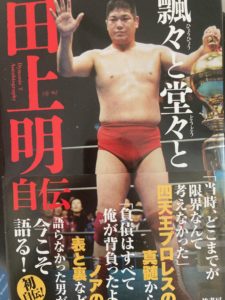
Aloof and Confident: Dynamic T Autobiography, Published October 18, 2023
Chapter 1: Youth
Taue opens with the fact that his memory is quite hazy by this point so he has brought in wrestling journalist and writer Kagehiro Osano to both fill in gaps and jog Taue’s memory when needed. Osano is an important name since he has also written two other tremendous 500-plus-page Japanese books that I’ll be getting to soon: Eternal Strongest Champion Jumbo Tsuruta and Supreme Triple Crown Champion Mitsuharu Misawa.
Akira Taue was born on May 8, 1961 to Genichi and Mitsuko Taue way in the outskirts of Chichibu City in the Saitama Prefecture. He was big for a baby, weight about 8lbs. at the time, which seemed to be a common trait in his family. Like the other Kings Taue’s family was, by standards of the time, poor. Unlike the other three, however, Taue doesn’t really recall coming from a broken or otherwise violent home. His father did discipline him and drink on occasion, but there wasn’t any excessive violence or neglect on his part. Taue’s father was a lumberjack and a carpenter who worked deep in the mountains until Akira was in kindergarten.
As a kid Taue describes himself as being “a brat”. He was undisciplined and tended to do whatever he wanted. If he went to kindergarten he’d play outside instead and only come in when it was time for lunch. He also tended to drink from other people’s milk boxes while on his way to school and in some cases would eat vegetables and livestock feed from nearby fields. As such, he tended to play alone more often than not and found interest in catching fish in the rivers, gathering nuts, and pitting big mountain stag beetles against each other. When he wasn’t getting exercise doing such physical stuff in the mountains he got more from walking 2kms each way to school. The building was dilapidated and mischievous Taue once fell through the ceiling into a classroom while playing hide and seek.
The degree of the Taue family poverty was touched on in Ichinose’s Four Pillars Bio but from how Taue himself recalls it doesn’t sound THAT bad. Yes his father would catch venomous snakes and either grill them in soy sauce or make sake out of them, but the family also had plenty of other farm livestock including goats, chickens, and a hunting dog, so it wouldn’t be accurate to say they were that destitute.
Taue describes having a part-time job as a kid like delivering newspapers, helping his father carry shiitake logs, and in the winters he’d work at a local tofu shop…while in elementary school. When he wasn’t doing any of this he was deeply immersed in sports, especially baseball given the widespread popularity of the Yomiuri Giants. He continued baseball into middle school but it was there that he also began doing sumo as well. He also notes that, as the tallest in his class, he would sometimes think to himself “I’m Giant Baba”. Little did he know that name would play a huge role in his life down the road.
He further describes himself as being good in math and science once in junior high but his baseball skills started to falter. He was assigned to be a pitcher but while he had good speed he had poor control which made it hard for him to succeed. As a result he diversified his school sports activities, joining the high jump, shot put, and track and field teams as well in the summer and speed skating in the winter. He also started practicing judo in middle school in the evenings for the purpose of becoming stronger. He didn’t have interest in becoming a wrestler at the time and judo was the only martial art available to him at the time. Had there been an opportunity for him to learn karate, which was far more popular at the time, he thinks he would’ve joined UWF instead of AJPW.
In 1977 Taue entered a nearby high school which specialized in agriculture, industry and food chemistry and joined their sumo team. Despite having a complex over his height (which stemmed from the difficulty in finding proper-fitting shoes and clothes that weren’t hand-me-downs), Taue finds himself excited at the prospect of visiting different places as a sumo competitor and so joins with enthusiasm. He credits his coach at the time, Yasumasa Hyodo, with helping him excel in sumo, to the point that his shikona/sumo ringname, Tamakirin Yasumasa, becomes a tribute to him.
At the same time, Taue is introduced to the highly disciplined and at times punishing world of sumo training. He learns how to fall for judo, but because the techniques and instincts there involved with curling up or falling to the side he would have a hard time adapting to flat back bumps/breakfalls once in pro-wrestling. He also notes that, back then, if you couldn’t do the splits properly a senior would sit on you and force it down. Though Taue himself was flexible enough to do this, countless trainees experienced this terrifying practice.
Taue also describes getting into a fight with the head of his year and getting suspended over it. Apparently this guy came at him and Taue broke some of the guy’s teeth with a head-butt. Then later on, in a scene straight out of some manga, Taue took on six guys at once and won. Though to be fair, Taue was much taller and had years of experience in multiple martial arts while most of them had no such experience. In the end he got suspended for two weeks, as did the leader’s minions, while the leader himself was suspended indefinitely.
Aside from the usual story of high crushes and first girlfriends, Taue also describes developing an early love for motorcycles. He got his license as early as he could and began riding around, and by the time he became a senior he no longer had the trademark sumo buzz cut and instead sported an almost Vince McMahon-like pompadour.
Chapter 2: Sumo Era
Upon graduating high school Taue describes being initially reluctant to actually join a sumo stable, despite his accomplishments thus far in his life, and would prefer hanging out with his friends. We then get an early explanation of the judo ranks, from top to bottom: Makuuchi, Juryo, Makushita, Sandanme, Jonidan, and Jonokuchi. In Taue’s case he finished his sumo career after competing in the Juryo division.
Anyways Taue describes receiving multiple offers from sumo stable leaders and from existing sumo wrestlers but he initially didn’t show any interest, to the point of trying to escape on his bike when someone came to his house. But in the end his mom convinced him to go into sumo out of “being filial”. He also notes that, had he ultimately remained headstrong and not pursued sumo, he wouldn’t’ve entered pro-wrestling either.
After competing in lower-rank sumo for seven years, Taue officially joins a sumo stable and he describes his life becoming unpleasant. However, unlike Toshiaki Kawada, whose two-year stay in Hell as a high school amateur wrestling trainee almost drives him to suicide, Akira Taue doesn’t have that hard of a life since he was scouted for sumo rather than starting from the very bottom. Still, he does loathe his initial sleeping arrangement, being forced to sleep in a large room with 20 other people and thus needing to stuff tissue in his ears just to escape the snoring.
Because he was a higher-rank assistant, Taue got to go out with his stablemaster and other seniors quote often. He describes going out to Roppongi with one master where he meets Akira Maeda and Nobuhiko Takada for the first time. He also got plenty of female attention at the time, including one particular fan that would follow him during his travels. People joked to him that she was his girlfriend but he shut that down since, a) she was right years older than him, and b) everyone called her “Kabagon” since she resembled a hippo.
Taue describes these initial years fondly, if for no other reason than for being able to see other parts of the country and to try local delicacies. Ironically, Taue prefers grilled food and can’t handle sushi all that well, even now.
In May 1986 Taue officially enters the juryo division but not after spending some time in the lower ranks as well in seasons in which he had poor performance. Juryo is an important ranking because it’s only at that level and above that a sumo wrestler gets a salary, which in his case was between 500,000 and 600,000 yen per month. However, throughout the year he falls back into a lower division at least once, which also causes him to switch between his shikona in the juryo division and his real name in the Makushita division. And just to hammer home the difference between juryo (2nd) division and Makuuchi (1st division), he describes having a sparring session with a yokozuna and that higher-ranked sumo wrestler threw him around effortlessly.
From here the discussion shifts quite dramatically to Taue retiring from Sumo. His initial explanation is “not wanting to be in the stable anymore” and describes one incident in particular as the catalyst for this departure. After losing a match during a tournament his master hits him with a bamboo sword, hurting his elbows in the process. Although his master is the one to have scouted him to professional sumo, Taue describes his master as being a scary, heartless person. At one point he tells his master he’s quitting but said master threatens him with a kitchen knife instead. It’s only after the master’s wife diffuses the situation that both sides leave the moment without things escalating further. Sure enough, Taue quits and then tells his girlfriend that he’s switching to pro-wrestling instead, cutting his topknot as a symbol of the end of this part of his life. He also describes contemplating becoming a truck driver at this point as well.
Taue briefly glimpses back to his time still in sumo and recalls how some of the contacts in that sport knew people in pro-wrestling, one of them being Genichiro Tenryu who, like Taue, transitioned from sumo to puro. This section concludes with Taue meeting Tenryu a few times as well as an associate of Tenryu’s named Master Rakuten putting in a good word to Baba to get him a job in AJPW. Because to Taue that’s what pro-wrestling was to become: a job and nothing more.
APOD: Taue’s life doesn’t come across as all that tragic, depressing, or filled with adversity when compared to the other three Kings. Yes he came from relative poverty but that was quickly overcome when he ended up scouted for professional sumo and doing well enough throughout his teenage years to get a motorcycle. And yes he endures some hardships in sumo and his tenure in that world ends dramatically and somewhat unfortunately. But at the same time it’s never established that he was either passionate about sumo or all that excited about pro-wrestling. He saw both fields as jobs and nothing more. But we’ll see if that mindset changes once he actually meets Giant Baba in person.
Thanks for reading.