

5-Star BOOK Reviews: Akira Taue’s Autobiography, Part VI
By Alex Podgorski on 14 April 2025
Akira Taue had an interesting career as the ultimate utility player in All Japan and beyond. He was a jack of all trades that could fit into any role and succeed in it. Even though he didn’t have much time directly in the spotlight he was always close by. As such it’s interesting to see how he pivoted from being Triple Crown Heavyweight Champion in 1996 to going through all the different roles the company asked of him. After all, this is a wrestler who looks at his profession as exactly that, a profession. With that in mind, let’s see how this through-and-through consummate professional observes some of the biggest changes in wrestling compared to some of his more idealistic and passion-driven contemporaries.
You can read parts one and two here, parts three and four here, and part 5 here.
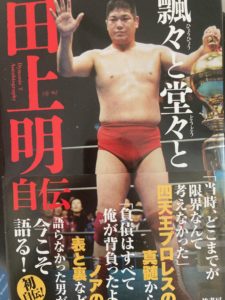
The pace picks up as Taue enters 1997. The first notable thing he discusses is Yoshihiro Takayama signing with All Japan, which he considers something of a big deal since Takayama’s probably the only person in the company bigger than him. He describes forcing to rely more on sumo techniques here and there to beat Takayama and notes the guy adapts to the AJPW style quite well. If was also during these later years with the influx of “outsiders” into All Japan that Taue, like others, embraces a “we must win against the outsiders” mentality. In fact Taue describes developing a specific technique called the kanuki suplex (sort of a sumo suplex/double inside armtrap suplex) to deal with Takayama and the other UWF-inspired wrestlers who like to get up close.
Taue describes feeling pressure win the Champion Carnival for the second year in a row but fails after his seven-match winning streak is ended by an exceptionally stiff Misawa elbow. Still, despite this disappointing performance, Taue challenges for the Triple Crown in July of that year. At the same time he starts feeling that the era of the Four Heavenly Kings is reaching its end so he shaves his head and says that this will be his last-ever challenge for the Triple Crown against Misawa. He notes that Misawa was in exceptionally rough shape but when it came to matches he still showed tremendous athletic skill in big matches. However, thinking back Taue notes that the style and extremes were the results of intense pressure and a constant need to up the ante to keep the audience excited:
“At that time the Four Heavenly Kings’ wrestling was brutal. I sometimes wonder why we were doing such things. Taking moves and landing headfirst was a regular occurrence, and since I had weight, I had to figure out how to dissipate the force so it wouldn’t be fatal… Besides that, all I could do was strengthen my neck. Compared to the moves the other Four Heavenly Kings were doing, my cliff-edge throat slam was probably nothing.
Back then, I never thought about where the limits were. I was just driven by the feeling of “I can’t lose to this guy!” That’s why there was no such thing as “this is the limit” for me.
Some wrestlers often describe the professional wrestling of that time as having a sense of trust, like “if it’s this guy, it’ll be fine,” but I never thought about it that way. It was always tit for tat… For me, it was just the feeling of “I won’t let these guys beat me,” or “I can’t fall behind these guys.” There was no way we could have done it if we were all buddy-buddy. Everyone was aiming for victory, and naturally, things escalated to that level.
Also, our mentor, Baba-san, told us, “Don’t have matches that end in a draw outside the ring,” and “Make sure to bring the match to a decisive one-two-three finish.” So I tried to follow that as much as possible. I think Baba-san told that individually not just to me but also to Misawa, Kawada, and Kobashi. In a way, we weren’t just facing our opponents and the audience, but also Baba-san.”
Taue skips ahead to 1998 and suffers a ligament injury in his left knee early in that year’s CC. But the style of All Japan wasn’t one to ignore injuries, so when he faces Kawada in the same tournament Kawada – his partner – attacks that injury with a Figure-4 leglock. At the same time Taue notes feeling frustrated if he couldn’t wrestle. He couldn’t distract himself with baseball or other pastimes when on recovering; as a result he, like other wrestlers, would come back to wrestling the moment he could move.
This injury proves to be minor so he comes back in time for AJPW’s Tokyo Dome show, where he learns that his initially chosen opponent is Futahaguro, a.k.a. Koji Kitao. However, this plan never materializes due to card rearrangements and Taue feels a bit disappointed since Kitao was a sumo Yokozuna and this would’ve been a big match for him.
Then Taue jumps forward again, this time to Giant Baba’s death and Jumbo Tsuruta’s retirement, two closely timed events that he more or less treats as one. He notes that after the Dome show Misawa takes him off to heal many injuries and assumed booking when not wrestling. He says Misawa took “full control”, however some other sources note that Baba still controlled the Triple Crown scene’s booking until he died. Still Misawa was given responsibility to build up the undercards and was given the freedom to make creative changes as he saw fit. Taue summarized Misawa’s ideas like this:
“”Think for yourself and assert yourself. However, always take responsibility for your words and actions,” Misawa’s ideology toward the wrestlers was called the Misawa Revolution. Wrestlers began asserting themselves individually. Kobashi and Akiyama formed Burning, while Misawa selected Ogawa as his new partner to form Untouchable, leading to shifts in the power dynamics.”
On the matter of Baba’s death Taue describes being kept in the dark about it like everyone else. And yet he was also somewhat shocked, having golfed with Baba as early as January 1999. He tries to win the vacant Triple Crown as a tribute to Baba but loses to Vader. As an aside Taue, like others, comments that Vader stank of sweat and wondered if he ever washed his wrestling costume and if he kept it smelling foul as some strategy.
Then Taue reminisces about Tsuruta and how he learned a lot from him, saying that Tsuruta taught him how to structure matches, timing, what to do when, and all the “comprehensive” aspects of wrestling (APOD: in other words, all the underlying issues and not MOVEZ).
After the Baba retirement show at the Tokyo Dome Taue, along with other wrestlers, joins AJPW’s new management structure. Taue is appointed as the chairman of the players’/wrestlers’ association, kind of like the head of the wrestler’s union. His new responsibilities coming from this new role conflicted with his new requirements as being part of the management side. He initially tried to reconcile these two roles by trying to get everyone to rally behind Misawa as much as possible.
1999 ends with the Tag League tournament and this time, with Kawada sidelined due to serious eye issues, Taue is put in a team with Stan Hansen. Though they didn’t win they got great reactions from the crowd since this arrangement seemed to echo the Battleship/Cannon team of Hansen/Baba of years past. They made it to the finals where they faced Kobashi & Akiyama in a losing effort. However, for that match Taue wore a gown gifted by Motoko Baba which had an incomplete oil painting on the back of Shohei himself. It was such a sentimental gesture that during the match the crowd even booed Kobashi who almost NEVER got booed. And in something of a repeating theme Taue recalls getting an order of “team up with Hansen” from Misawa just Baba once told him “team up with Kawada”.
As 2000 begins Taue starts hearing whispers of “Misawa going independent” but tries to brush them off during the first few months. But as Taue starts interacting with Misawa more through his backstage responsibilities he starts to hear more of Misawa’s venting and frustrations. Taue confirms the notion that Motoko held more power by virtue of being majority shareholder. So even if Misawa wanted to try new ideas, whether they were small changes or big ones, were outright rejected. There were also some personal hostility between Motoko and Misawa, such as her asking to deliver an unplanned eulogy speech on the one-year anniversary of Baba’s death and he, caught off-guard, has to do this anyway.
Things reach a boiling point once it comes time to contract renewals. At that point all AJPW wrestlers signed one-year contracts that renewed every March to coincide with Japan’s fiscal year. Misawa demanded that contracts be reviewed but this went nowhere so many wrestlers began withholding signatures. It was also around this time that Misawa and his close friend Ryu Nakata began planning to launch their own promotion in earnest. But since Misawa couldn’t pursue this direction as long as he was on AJPW’s Board of Directors, which is why he went along with what amounted to a voluntary (and intentional) dismissal from his Board position.
On the in-ring side of things Taue goes through business as usual, but as June begins talk of backstage turmoil seems to overtake the in-ring activities. Around this time Taue takes a nasty fall from the duo of Johnny Ace and Mike Barton which causes him to dislocate his shoulder and badly hurt his wrist. Still he fights on and wins the World Tag Team Titles for a record sixth time. Then in the days that follow Taue refuses to sign his new contract and even tries to get Kawada to do the same but doesn’t succeed. However despite Kawada not leaving with everyone else Taue doesn’t describe any change in interactions between them. “We were professionals, work was work,” Taue notes.
As for why he sided with Misawa, his main reason is because he didn’t like the way Motoko Baba was treating him. Misawa was already stretched thin as an in-ring performer and with Baba trying to keep everything the same (which effectively forced Misawa and the other wrestlers to keep wrestling in the same taxing in-ring style since other promotional methods were not available to them). So Taue joins Misawa in NOAH but not before thanking all of his mentors Tenryu and Tsuruta and, of course, Baba himself.
As NOAH forms Taue once again assumes a corporate role, this time as a nondescript Board Member. After finishing some prearranged AJPW events Taue starts noting the differences between AJPW and NOAH. NOAH under Misawa includes flashy production elements to create more of a sense of spectacle. Though much of the initial audience was drawn to NOAH due to Four Kings wrestling, these spectacular elements added to the experience. Taue, who was an avid motorcycle rider, even considered riding his Harley down to the ring but then decided against it since he wouldn’t have a way to back it out (APOD: I’m sure Biker-Taker would’ve been able to give him pointers on this). And unlike Kobashi and Akiyama, Taue keeps his original red attire color scheme but does change his entrance theme to somewhat showcase this theme of transformation. But towards the end of 2000 he decided to come up with a new move, hence the Ore Ga Taue (I Am Taue) Back suplex chokeslam that he can use with both hands.
“Why did I come up with it…? I thought, ‘I can transition from a Backdrop to a throat slam,’ tried it out, and it worked.” – Taue on this new move
But as NOAH begins its voyage, Taue doesn’t experience much personal success as a wrestler. He loses to Akiyama and Takayama on the early shows. Despite adding the Ore Ga Taue to his deep arsenal he still loses to Misawa in a big match to Misawa’s Emerald Flowsion. Taue also wanted to call this new move the “Emerald Float” but Misawa didn’t like it so they went with something else. He enters a world title tournament and loses in the first round to Vader yet somehow becomes inaugural champion Misawa’s first title defense. He also notes that he doesn’t like wrestling dodgy and evasive types, which is why he doesn’t have too many fond memories wrestling Yoshinari Ogawa.
On the other hand Taue does have good memories wrestling New Japan’s Masahiro Chono and Yuji Nagata and their styles allowed him to wrestle more comfortably. Though he rarely thought much of wrestlers from other companies he does recall getting into a bit of an intense back-and-forth with Chono, commenting that he would worsen Chono’s neck issues and force him to retire from in-ring competition (APOD: These kinds of pre-match statements or “verbal appeals” never happened under Baba and were something that many wrestlers – but mainly Jun Akiyama – had lobbied for many times to no avail. This new option was one of many reasons why wrestlers followed Misawa to NOAH).
On the backend side of things Taue doesn’t recall getting involved in booking/matchmaking all that much, nor did he get all too interested in MMA despite its boom at the time. He suspects that Chono and Misawa got along both personally and professionally around this time because both of them were advocates of pure professional wrestling but Chono was hamstrung by NJPW’s infatuation with MMA. Taue also provides an interesting comparison between MMA and wrestling:
“Personally, I saw mixed martial arts as its own thing and pro wrestling as its own thing. To be honest, I didn’t even consider it; I hardly watched MMA. I was living through pro wrestling, so I had no interest in it. It was a different world, and I didn’t see it as a rival.
In MMA, winning is all that matters, but in pro wrestling, it’s not just about winning—it’s also about how to satisfy the audience. That means you have to let your opponent showcase their strengths, and even if an accident happens during the match, you have to see it through to the one-two-three count or a submission.
MMA has rules that protect the fighters. But in pro wrestling, the rules are vague, and there’s basically no referee stoppage or doctor stoppage. That’s why, whether it was me, Misawa, Kobashi, or Kawada, we kept fighting even if we got injured during a match. That didn’t change even after NOAH was established.
Pro wrestling is about putting on a show. Even if you start bleeding, you don’t wipe it off. If you bleed, you show it. Pro wrestling and MMA are fundamentally different things.”
Years go by and the focus then turns to Kobashi’s GHC title reign. As Kobashi runs through challengers left and right Taue becomes the next in line. And around the same time Taue goes through another burst of momentum that sees him collect big wins with his new super-finisher the Chichibu Cement, a vertical suplex into a chokeslam.
But this is Kobashi we’re talking about, someone Taue knows all too well and knows that it takes so much more to put him down. So not only does he have to use the Chichibu Cement on the champion but also the Cliff Ore Ga Taue.
But as usual this is not enough especially since Kobashi has his own secret technique: the WRIST-CLUTCH Burning Hammer.
Taue notes that he needs to constantly come up with new moves due to age and not wanting to be left behind. He also notes that Kobashi’s moves were always riskier so to him this was fair play.
As he enters 2005 he gets involved in some big matches like a six-man involving outsiders like Genichiro Tenryu. Taue’s interactions with Tenryu stole the spotlight which leads to a sort of nostalgia run that sees him getting big reactions. So when Takeshi Rikio asks the audience whom they want to see him defend the GHC Heavyweight title against they overwhelmingly choose Taue. Then later in the year he pins Rikio to win that title, which is his first world title in nine years.
Taue ponders about Rikio as a wrestler. Though he was a higher-ranking sumo wrestler compared to Taue and came from the same generation as guys like Akebono, Taue suspects that Rikio had a harder time transitioning from Sumo to pro-wrestling. Then he discusses other bookings he goes through and describes a pattern of being thrown in wherever and excels because he’s a proven utility player. He then shifts back to his time as GHC Champion and recalls his first defense being against his former assistant Takeshi Morishima. That match was particularly emotional for Taue given this relationship and for this he brought out the gown with Baba’s image on it. Regarding Morishima Taue notes that while he was exceptionally strong, when he was bad he was REALLY bad. And because Morishima was heavier than him he had to come up with yet another move, this one being the Tsubuka Log Splitter, an off-the-ropes chokeslam that combined wrestling with sumo techniques.
Taue shifts gears to drinking and tells a story of Morishima, his assistant, getting drunk on his own and getting confronted by Baba. Morishima allegedly blamed Taue for making him drink (a fabrication) and Baba scolding Taue. There’s a tinge of bitterness here but it’s not like Taue’s words come across as vengeful towards Morishima or anything. At the same time he recalls Tenryu making him drink when he was a rookie and Baba going through the same under Rikidozan which is why Baba never forced his trainees to do the same. There also appears to be some comparison here between Morishima and Toshiaki Kawada as Taue said describes similar experiences when Kawada was drunk as with Morishima. His other two attendants were Takeshi Sugiura (who was a bit more mature because he already had a wife and child when he was starting out in NOAH) and Genba Hiranyagi who was apparently a worse drunk than Morishima, needing his mentor Taue to shoulder him as they left the bars. Taue also notes that Hiranyagi “looked like a corrupt magistrate” so he changed his first name from Tsutomu to Genba, which Taue questions.
Going back to the title situation history repeats itself as Taue’s reign ends after only two months as he loses it to Jun Akiyama ad the start of 2006. Akiyama holds it for most of the year until he loses it to Naomichi Marufuji, which is initially presented as a generational shift, but then he loses that to Misawa in December. With Kobashi sidelined with cancer Misawa frantically puts the title on himself and Taue gets another title shot in 2007. Aside from losing once again Taue recalls taking a nasty Emerald Flowsion Kai at the end and he describes making this match between two men in their forties being something about showcasing the style of their generation.
Taue observes that everyone in his generation is getting seriously worn down but because of business he still continues as much as he can. He recalls his 20th anniversary match which includes a segment with his daughter giving him flowers, though he describes not liking those kinds of sentimental moments. Then he recalls participating in his last-ever title match, either as champion or challenger, in a losing effort for the GHC Tag titles alongside Morishima.
APOD: As much as Taue talks about this extensive period there isn’t all that much groundbreaking described from his point of view. Everything he talks about has this matter-of-fact presentation and he doesn’t really go into details of passion, conflict, or internal strife. In some ways this facts-based presentation could come across as boring to some readers; and yet like some of you have commented this is very refreshing given the language used by some of the other Four Heavenly Kings. He looks at things objectively to some degree and he never comes across as a mark or as someone too dedicated to wrestling. Though he does show a healthy detachment to his career he still does reflect positively on some moments and occurrences. Given this interesting duality of detachment and dedication it will be interesting how he tackles the next and final section of his career, which will see him go from a wrestler, to a fulltime board member, to fulltime company manager.
Thanks for reading.