

5-Star BOOK Reviews: Mitsuharu Misawa’s Books, Part XIII
By Alex Podgorski on 12 August 2025
Before we continue our progress into NOAH I wanted to close as much as I can so I’m starting by finishing up the biggest books used so far here, Kagehiro Osano’s Supreme Triple Crown Champion Mitsuharu Misawa. This was an extensive volume that went into great detail on Misawa’s in-ring career and helped set the tone for Misawa’s shift from in-ring ace to head booker. As we go from Misawa’s time in AJPW to NOAH we will be shifting to other books that were started or cover the period from 2000-onwards. To that end, let’s look at the final part of SUPREME which covers the epilogue from 1999 to mid-2000, briefly touches on NOAH, and addresses some issues that Misawa dealt with during his time away from the ring ahead of his Exodus.
You can read part 1 here, part 2 here, part 3 here, part 4 here, part 5 here, part 6 here, part 7 here, part 8 here, part 9 here, part 10 here, part 11 here, and part 12 here.
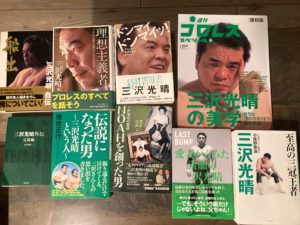
We begin here with the conclusion to SUPREME, which has thus far been an exemplary resource going over Misawa’s history as an in-ring performer. Osano notes that the era of the Four Heavenly Kings was collapsing and there was uncertainty over what would succeed it. Osano’s personal opinion on Misawa moving things away from a sport-like form is that it would drive customers away. However for Misawa this period was absolutely necessary because things simply could not continue under the old customs, structure, and most importantly, style. Misawa’s initial changes, including his notion of embracing freedom to speak and act as one wants while taking responsibility for those decisions, come as a shock. Because Osano is not privy to backstage stories and only comments from the public-facing side he can only comment on what information is available to him and thus writes that he hadn’t heard anyone talking badly about Baba (APOD: This is technically true but ignores the fact that, a) it said nothing of Motoko; and b) outward unhappiness and criticism towards someone as universally loved as Shohei Baba wasn’t going to come out of a family business in a country that emphasized unity and harmony above all else).
Next Osano credits Kenta Kobashi directly since Kobashi contributes a ton of information to help create this book. Kobashi once again thanks Misawa for everything and defends what they’ve done in the ring. Kobashi really hammers home that what he and Misawa did in the ring was special; it’s not something that any two people can do. Just because they were pushing the limits over and over doesn’t mean others should follow suit. Sometimes doing something particularly limit-pushing should be left alone and not used as a new threshold for later wrestlers to try and surpass. Osano also gives Kobashi room to challenge Osano’s initial notion, that the Four Kings’ wrestling peaked in 1998 with Misawa’s match with Kawada at the Tokyo Dome. Kobashi, who had three more epic singles matches with Misawa after that show, believes that the Four Kings’ story concluded in March 2003 in NOAH when he finally beat Misawa to win the title…despite taking a Tiger Suplex off the entrance ramp to the floor in the process.
“Of course, it was risky for both me, who was thrown, and Misawa, who executed the throw. I think it was a great throw. He didn’t shy away; he completed the throw until the very end. In pro wrestling, there are predecessors who first performed the techniques, and they get passed down. However, even a year later, no one does a Tiger Suplex from the entrance ramp. In that match, I fractured my orbital bone, and Misawa also crashed into the fence and had his jaw stitched up, but we were desperate to seize the era… it was as if we exchanged our bodies for it. That’s how difficult it is to obtain an era. By winning the match against Misawa on March 1, 2003… if that match had been within everyone’s imagination, I don’t think my era would have come. Because we were able to have a match that exceeded everyone’s expectations, that’s why I believe the era I desired came” – Kenta Kobashi
Osano and Kobashi put a heavy emphasis on that March 1, 2003 Misawa/Kobashi singles match (APOD: a.k.a. the greatest singles match of the 21st century) especially for its attendance. The match drew 16,700 to the Nippon Budokan on a rainy day, while according to Osano Riki Choshu’s inaugural World Japan event drew 13,200 at the Yokohama Arena and Shinya Hashimoto’s ZERO1 drew 10,500 at Ryogoku Kokugikan. Misawa and Kobashi vowed to create a match that represented “anything goes” in pro-wrestling, a match that would make wrestling fans proud and comparable in quality to any other sport.
There’s also a note on Misawa’s final match with Kawada at Destiny 2005 and the general conclusion from Misawa’s side was that things were “a bit off” between the two wrestlers because they hadn’t interacted in five years. At the same time Kawada takes a moment to highlight another of Misawa’s strengths:
“Misawa-san doesn’t dwell on failures; he says, ‘It’s okay, it will work out somehow,’ which is wonderful. That’s something I don’t have; I tend to overthink things. However, there were times when I was saved by Misawa-san’s words of ‘It will work out somehow.’ I don’t like being above others, but Misawa-san was the right person to take the lead. During the Super Generation Army era, Misawa-san was at the top, and then I was next.”
To which Osano notes that ultimately, despite some different narratives being put out there, Misawa and Kawada still got along in private:
“You know, what’s amazing about that person is that he is fearless both in the ring and in private (laughs). He doesn’t think about risks at all. If Misawa were to do what he did in today’s society, with compliance and the development of social media, every day would be like a tabloid show (laughs). He would throw fire extinguishers in narrow alleys and all. Normally, if something like that happened, it would become a big incident. That person is completely unfazed by such things. I think it was during the Tiger Mask era, but he once tried to confront a yakuza who had brought a katana in Oita Prefecture or somewhere. Normally, you would think about the risks afterward. It’s precisely because he had that kind of attitude that the name Mitsuharu Misawa could be preserved to that extent. If he were someone who feared everything, he wouldn’t have been able to leave such a name behind. He does things that are unimaginable for ordinary people (laughs). Of course, over a long relationship spanning 25 years, there have been many things. Still, in the end, Kawada still likes his senior Misawa.”
SUPREME concludes with an in-person interview Osano did with Misawa in November 2006, ahead of his GHC title challenge against Naomichi Marufuji. Misawa notes that this match would commemorate the 25th anniversary of his debut and notes that, a year earlier, he was looking to retire at age 40, but now he can’t do that. Misawa notes that his decision to challenge for the title stems from the fans chanting his name; as a result he feels he has to live up to expectations to keep the audience satisfied.
In terms of training, Misawa notes that he only taught Marufuji the basics but never imposed any direct ideas on him. That was Misawa’s way: he never told someone “do it this way”, preferring to let wrestlers develop their own styles and identities to help them stand out as performers (APOD: This is why in NOAH there was very much this sense of “anything goes” on big shows, with big moves happening all the time, in direct opposition to Jim Cornette’s mantra of saving the biggest moves for the main-event and not having undercard guys steal big moves from the headliners). Osano also asks Misawa his opinion on the Marufuji/KENTA GHC match from October 2006, to which Misawa responds that it’s nor for him to evaluate yet he does note it was an amazing match that heavyweights wouldn’t be able to do and is a perfect definition of NOAH’s new style (APOD: That match is widely considered one of the most influential matches of the past 20 years, and led to the proliferation of highspot-heavy flippy indy style wrestling. It wouldn’t be a stretch to say that you can trace much of today’s wrestling landscape back to this match and see how it inspired an entire generation of wrestlers).
Osano asks Misawa about the condition of his neck and Misawa responds, “it’s bad” and compares wrestling to walking a tightrope. At the same time he notes that he has to go in with the mindset “if it happens, it happens”, noting that everyone in wrestling is always next to injury. (APOD: Misawa’s basically repeating a lifelong mantra here and it’s quite interesting how this foreshadows and contextualizes his death in 2009). He also notes that he doesn’t have enough time to train due to his management commitments and the off-season it too short as well. However despite the strain on his body and some challenges with business trends Misawa tries his best to remain optimistic and hopes that NOAH’s wrestling will be spearheaded by a new generation and won’t lead to fans saying “back in the old days” nostalgia watching instead.
In the final epilogue Osano goes into a summary of why he wrote this book. He notes that it was intended to cover Misawa’s coming-of-age progression and his peak at the 1998 Tokyo Dome show. He also provides his own perspective on wrestling terminology, insisting that King’s Road/Royal Road isn’t what most people think it is:
“In a broad sense, the Royal Road pro wrestling refers to “bright, fun, and intense wrestling,” but Giant Baba’s Royal Road pro wrestling is orthodox American wrestling performed by wrestlers over 190 cm tall. The ultimate pro wrestling of the late Showa era, known as the Tsururyu confrontation, was born by adding the spice of the Tenryu Revolution, featuring Jumbo Tsuruta and Genichiro Tenryu. The Four Heavenly Kings Pro Wrestling, which was created to surpass the Tsururyu confrontation, was that of Misawa and his contemporaries. The All Japan Pro Wrestling of the Super Generation and the Four Heavenly Kings era was truly remarkable. I went through old interview notes and materials and checked footage, and once again, I believe there is no wrestling as amazing as that. As a result of competing with Baba’s wrestling and the Tsururyu confrontation, the purity was raised to the limit without creating a boundary, and I believe the Four Heavenly Kings Pro Wrestling is truly the ‘supreme wrestling.’”
APOD: SUPREME is an amazing book filled with rich details and interesting perspectives on an important period in Misawa’s life and career. It serves, perhaps unintentionally, as a supporting piece to Misawa’s own autobiography, since it covers the in-ring period that Misawa omitted when he wrote his book. Osano did everything he could to get Misawa to talk about his career which must’ve been hard for a man who apparently didn’t talk about specific matches and moments all that much. Osano also uses multiple perspectives throughout the book, including Kawada, Taue, and Kobashi, to add more context to Misawa’s biggest moments. Even if Misawa himself doesn’t say all that much about his matches directly, having his peers and those that experienced those moments with him share their thoughts in one place makes for an excellent read. It’s a long book to be sure, at over 540 pages but it’s more than worth it. For all the focus on Misawa’s death, it’s refreshing to see someone write so much about Misawa’s life.
Final Rating: *****
Thanks for reading.