

5-Star BOOK Reviews: Mitsuharu Misawa’s Books, Part X
By Alex Podgorski on 30 June 2025
This next section of Mitsuharu Misawa’s books is the murkiest so far as it covers the background that leads to his Exodus and the formation of Pro Wrestling NOAH. There’s lots of background information to cover and some important players, previously either ignored or relegated to ancillary figures in his career, come to the fore. There’s Giant Baba himself who starts delegating authority to Misawa that the Emerald Emperor previously didn’t have. There’s his wife Motoko, who goes from being a doting adoptive mother to the mother-in-law from Hell. Then there are the two Baba family handlers in Kyohei Wada and Ryu Nakata. Wada’s name has appeared a few times already in these reviews as both a firsthand witness to the Four Heavenly Kings’ in-ring greatness and as a close confidant of the Baba family. Although he has remained close relationships with the Four Kings wherever possible he is, at the same time, an unwavering Baba apologist. The other handler in question is Ryu Nakata who is Misawa’s close friend and another important person in dealing with Baba’s business. However, unlike Wada, Nakata was able to distinguish Shohei from his wife and stuck with Misawa more than he did the Baba family. These individuals’ perspectives will help us navigate the difficult waters ahead, especially as they shine new light on the events that lead to Misawa’s history-changing decision.
You can read part 1 here, part 2 here, part 3 here, part 4 here, part 5 here, part 6 here, part 7 here, part 8, here, and part 9 here.
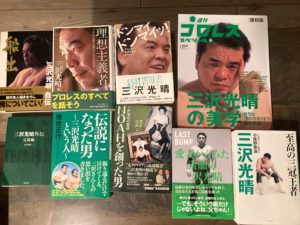
Shifting back to DEPARTURE for the first time in a while, Misawa explains that his desire to form NOAH wasn’t something rash or out-of-the-blue; it first came when Baba gave him booking control over All Japan’s undercard. It is never explicitly mentioned why Baba just handed the book over to Misawa away from Masanobu Fuchi without any sort of training or “handover”; Fuchi never says anything about it in his book and maintains a strict hands-off approach to discussing any turmoil because doing so would be rude.
Misawa summarizes his experiences in the Tokyo Dome and concludes that it wasn’t a good idea. Nevermind the fact that his body was a complete mess and it’s a fucking miracle he was able to wrestle at all, but from Misawa’s point of view the production did not match the venue. It was traditional All Japan in a venue without spectacle and the Tokyo Dome, cavernous as it is, is built for something more grandiose. The AJPW product was meant for more intimate venues or those in which the fans are closer to the ring, the only exception to this being the Nippon Budokan but that’s because the building’s internal structure is built for martial arts and so everyone, even those in the cheap seats, have at least a decent view of the action. Not so in the Tokyo Dome. So because AJPW didn’t adjust its presentation and visuals to fit the dome, Misawa concludes that those in the higher seats wouldn’t’ve had the most pleasant experience watching from so far away.
With this newfound authority (the Triple Crown title scene remains in Baba’s hands) Misawa is given freedom to realize his own wrestling ideas. Realizing that he doesn’t want other wrestlers to be constrained by the same stylistic limitations that led to the escalatory style of later Four Kings matches, Misawa embraces a decidedly pro-“freedom” mentality. There have been subtle hints of this mindset sprinkled in points in his past: his choice to enter wrestling because “it had no set forms”, his open-ended approach to raising his children, his freedom in using techniques during training, the removal of his mask, and how he kept adding new techniques to his repertoire that didn’t conform to a strict style. Additionally he notes,
“Occasionally, I would create a version that I personally wanted to see. Fans might not think much of it, but those who know the inside story might want to see what happens when two people who don’t get along in private face off in a match. It’s a bit mean, isn’t it? (laughs) But sometimes, that leads to quite a good match. Just because people get along well doesn’t guarantee a good match. It can turn into a cozy affair. Wrestling is really complicated in that regard.”
(APOD: This is the closest we get to Misawa outright stating “I made matches out of personal disagreements with my peers” which has been a longstanding narrative in the puro community as it pertained to, in all likelihood, Misawa’s relationship with Toshiaki Kawada. Though it’s not written directly it’s implied that he used his animosity with Kawada to make their matches better. However, at no point in anything I’ve covered thus far does Misawa make it seem like he and Kawada have an outwardly bad relationship in the same vein as, say, Bret Hart and Shawn Michaels. They were friends who got into arguments at times, yes, but who HASN’T?)
Misawa ultimately believes that wrestlers should have more input in what they in the ring, rather than sticking to the strict top-down approach from Baba. The best way to summarize Misawa’s initial mindset, which would serve as the foundation of NOAH, can be summarized this footnote in his second book IDEALIST:
“Founded by the author Mitsuharu Misawa in July 2000, this pro wrestling organization was established to pursue ideal pro wrestling with wrestlers and staff who share the same aspirations. While having traditional pure pro wrestling as its pillar, it values the wrestlers’ free ideas and sells matches that shine with individuality” – Misawa
Understanding that the level of in-ring intensity of the Four Kings was so high Misawa understands that letting this style continue is simply unsustainable. Not even wunderkind Akiyama could be expected to rise to that same level, especially since it’s established in the last section that he has panic and anxiety issues that complicate his daily life. As such Misawa seeks a different approach with the wrestling undercard as a way of unburdening everyone and letting new ideas flourish in All Japan. It is with this freedom that Misawa, as a booker, hopes that old and entrenched concepts will fade away and never-before-seen encounters and styles will get the fans’ attention. Some of the earliest examples of this include: NO FEAR doing old-school promos and trash-talk that is decidedly “unsportsmanlike” in the traditional Baba sense, adding and pushing talent from other promotions rather than having them simply serve as pinfall fodder for existing talent, and perhaps most symbolically, his teaming with scrawny junior heavyweight Yoshinari Ogawa in the heavyweight tag scene to show that traditional hierarchies are being broken. He also believes that the visual impact of two wrestlers “who are not particularly striking” would set them apart to the fans:
“Wrestlers of the past who frequently utilized ground wrestling as their primary technique were well-versed in effective fighting methods. Compared to modern wrestlers who focus on other moves and techniques, they undeniably have an edge. If drawn into ground combat, today’s wrestlers might find themselves overwhelmed by their superior skills. Ground wrestling not only drains stamina but also carries the unique fear of joint locks, which can decide the match in an instant if one lets their guard down. This requires heightened focus and is mentally exhausting as well.
When it comes to ground wrestling, the focus tends to shift towards tricky maneuvers rather than joint locks. However, in NOAH, Ogawa can be considered a wrestler similar to the skilled veterans of the past. As seen in what is called chain wrestling, his ability to seamlessly connect moves and transition to the next development is remarkable, making him a reliable tag team partner.
Like me, he is not particularly blessed in terms of physique. When standing against heavyweight wrestlers like Kobashi or Honda, his physical size inevitably pales in comparison. Thus, he has mastered movements that set him apart from others.” – Misawa, IDEALIST
Misawa’s changes weren’t those of a concerned staff member or employee: since the Babas didn’t have children of their own owing to Shohei’s gigantism the wrestlers of All Japan were, for all intents and purposes, their children, with Misawa serving as the company’s firstborn son. Misawa was aware of this perception which is why he, out of concern for other wrestlers’ wellbeing, began proposing changes wherever he could. In addition to his influence on matchmaking Misawa also had other ideas with which he wanted to revolutionize the company:
- He wanted to add a single entrance ramp rather than the traditional approach of wrestlers entering from opposite lockers rooms through the crowd;
- He wanted to enhance the audience experience with pyrotechnics to give it more spectacle
- He wanted to de-emphasize foreign wrestlers who seemed to benefit from Baba’s contract structure. In previous years foreigners were perceived to be paid more than native talent and did so for limited dates. With the availability of reliable and top-tier foreign talent shrinking Misawa wanted to kill two birds with one stone by putting more emphasis on Japanese talent both in terms of creative outcomes and in terms of payments
- He wanted to change the wrestlers’ contract structure to include more guaranteed downtime, more health benefits, pensions, and protections in case wrestlers got hurt or injured
- He wanted to include more input from the fans directly. For example in a sold-out Nippon Budokan show with the tickets already sold and guaranteed Misawa reached out to King’s Road (the company’s fan club) to vote on which of five singles matches should headline the show. The fans voted for a bout between Jun Akiyama and Takao Omori but this didn’t sit well with the other decision-makers in the company and in fact served as an important example of the growing rift in AJPW’s boardroom
After this Misawa describes becoming president the experience proves more difficult for him than expected. Though he does so out of gratitude to Giant Baba, out of attachment to All Japan, and out of responsibility towards others, Misawa does whatever is needed as he simply cannot “just run away alone”. And after Giant Baba’s sudden death Misawa finds himself involved in AJPW’s office affairs even more, which leads him to be filled with what he describes as “continuous anguish”.
A major part of this anguish comes when he first becomes aware of AJPW’s finances. For many years he wrestled without worry because there was a sense of security in following Baba’s orders, but once he became aware of how the company actually operated he became seriously worried. Misawa confirms what some of you have noted in comments many times already: that AJPW’s sole source of profit was ticket sales. Everything else – character merchandise sales, entertainment activities of wrestlers outside of wrestling, lectures, video game licensing, and everything else not directly related to the live wrestling events themselves – was managed through four internal subsidiaries controlled by Motoko. As a result Misawa wasn’t able to do proper accounting since he wasn’t privy to whatever money went in and out of these accounts. His proposal for a formal audit was soundly rejected with Motoko claiming she should be consulted directly before he could do anything. Misawa also observes that the wrestlers were more or less taken care of but the employees and staff “seemed to be working in a state of anxiety”.
I say “more or less” because for a while Motoko didn’t get too involved in the “fieldwork” of wrestling, but around the time Misawa begins taking on more executive responsibilities Motoko begins accompanying Baba on tours a lot more (APOD: these events are framed as being interconnected but from other readings it’s equally fair to conclude that Motoko’s more frequent accompaniments also align with Baba’s worsening cancer, which is still kept secret by the handful of people who know). As the promotion’s equivalent of a union leader, Misawa initially cautions Motoko on the way she talks to people, advising her “you should value the people around you more”. However, Motoko continues to dig her heels and becomes more involved in deciding matches and how things operate at venues. Returning to Baba’s request to treat them the same Wada is able to do this but Nakata couldn’t. To Nakata they were separate people and he couldn’t tolerate Motoko’s “unreasonable” requests.
Kyohei Wada also notes in his books that she was very much an integral player in the company’s operations but she left her husband to be the public face of the company. The expression “behind every great man…” applies here. However, part of her negative reputation reportedly stems from how she treated and spoke to those around her. Motoko allegedly came from aristocracy (or what would pass for such in postwar Japan) but she fell in love with Shohei Baba very quickly. The Babas absolutely adored one another, to the point that Shohei would instruct both Wada and Nakata to treat both of them as one person when it came to “taking care of me”. But Shohei’s marriage put him in a bind when it came to other interpersonal situations, especially once he named Misawa his heir and Misawa, acting on requests and demands from his fellow wrestlers, proposed changes.
Misawa notes that Motoko would veto any changes Misawa proposed to AJPW’s presentation, entrance scenes, and his matchmaking decisions. At one point she soundly rejects one of his proposals saying “Flashy things are not All Japan-like”. Though in this one situation this is applied to entrance scenes there’s also an undercurrent that applies this message to the in-ring wrestling as well. In another way Misawa was also channeling Baba’s message of “the fans are the sponsors” with his fan-voting scheme, and while those ideas get positive fan responses, in his words “the owner didn’t seem to like it”.
Misawa’s next point about including a guaranteed number of matches per year in addition to fight money per match is also dismissed, though here it’s implied that it was Shohei and not Motoko who rejects this proposal, even though Motoko was largely the behind-the-scenes person for the company.
Misawa’s inability to realize credible and significant change is also captured in LAST BUMP, co-written by his wife/widow Mayumi, who in all likelihood had many personal discussions with her exasperated husband whenever he came home:
“After the passing of his great benefactor, Mitsuharu became the top wrestler and representative director. He tried to introduce new ideas such as the establishment of an insurance system that was not yet in place, venue production, and card decisions that incorporated the opinions of the wrestlers, but was rejected by Mrs. Motoko Baba, the owner, who said it was “not like All Japan.” While managing, he also heard the swirling dissatisfaction from the wrestlers and staff. Mrs. Motoko, trying to protect the All Japan Pro Wrestling left by Baba out of love for her late husband, and Mitsuharu, wanting to establish a livelihood guarantee for the wrestlers while progressing in harmony with the times, remained at an impasse. He realized that he could not change others.” – Mayumi Misawa
As a counterpoint to Misawa’s perspective on this Kyohei Wada’s books come into play. Wada, who remained a personal attendant to both Babas for decades, had intimate knowledge of certain goings-on in All Japan and believes that, in some instances, the information given to Misawa was either tainted by personal dislike for Motoko (real or imagined) or incomplete:
“During this period, while Misawa’s body recovered, his heart became troubled. Without the need to participate in matches, Misawa frequently visited the company during the series. However, what he heard there were complaints and dissatisfaction from a large number of staff members, especially those in sales, directed at Mrs. Motoko Baba. At the same time, Misawa began to gain more insight into the company’s financial operations, which he hadn’t been very familiar with before.
Misawa began to think that the company had no future if things continued as they were, and he became proactive in listening to the opinions of employees. His natural eldest-son sense of responsibility emerged, leading him to think, “I have to do something about this.” However, in my opinion, the complaints of the employees and those of the wrestlers are fundamentally different. Office workers often vent about their bosses, using such grievances as conversation fodder while drinking. Moreover, employees who were not favored by the Baba couple were even more likely to harshly criticize them. I feel that Misawa may have taken these complaints too seriously. While I am well aware of Misawa’s earnest and company-minded personality, I also think that, in this instance, he was somewhat overly straightforward.
There were four affiliated companies under All Japan Pro Wrestling, and doubts arose about the transparency of their accounting. Additionally, Misawa began to question whether the proceeds from major events were being properly contributed to the company. Some employees even shared specific examples with Misawa.
For instance, one issue involved the revenue from a Budokan event, which amounted to several tens of millions of yen in cash. Ideally, this money should have been deposited in the bank immediately. However, since the Budokan events were usually held on weekends, such as Fridays or Saturdays, the accounting staff had no choice but to take the money home.
Mr. Baba, upon learning of this, said, “What if something happens? I’ll take care of it,” and brought the money home himself. Over the weekend, the cash was stored in Mr. Baba’s home safe, and on Monday, the accounting staff would retrieve it.
However, another staff member, unaware of the details, saw only the part where Mr. Baba took the money home. “Mr. Baba took today’s sales with him,” this staff member commented, and rumors began to spread, with embellishments, that the cash was being embezzled outright.
Regarding these financial suspicions, there were certain financial flows that only a select few understood. However, this was by no means a case of Baba-san “lining his own pockets”; it was on a completely different level.
In any case, the whirlpool of doubt that had begun to form within Misawa grew larger and larger due to his conflicts with Motoko-san after he became president. Eventually, it turned into an enormous tornado that would blow away All Japan Pro Wrestling itself.” – Kyohei Wada
These struggles cause Misawa to start drinking heavily – something he hadn’t really done before – do the point that he jokes that his liver might be damaged. Nakata, who’d hang out with Misawa after work, came to see things from a similar perspective, noting that Misawa wasn’t necessarily trying to change All Japan completely but his proposals were seen by the Babas to be so radical that they had to step in. Further flaring tensions was the Japanese bubble economy bursting, which caused more strain on the different sides and caused small issues that would’ve been ignored or quickly settled in a more successful period to bubble to the surface and lead to more arguments. As a result Misawa had to fight extra hard to keep things going as they were, making any sort of positive upturn in momentum all the more difficult.
“President Misawa wasn’t trying to change the company, right? He didn’t want to change it. But to keep the audience from leaving and to increase it, we had to keep making more and more efforts. To avoid a drop in sales, we had to try new things. But new things were completely forbidden. We couldn’t do anything from start to finish. Anything other than what Baba-san had done was entirely off-limits. There was even a time when we tried to bring Tenryu-san, but that was rejected. It was like being tied up with ropes all over your body, thrown into the ring, and told, ‘Now, fight.’” – Ryu Nakata
APOD: Reading through all of this it’s hard not to empathize with or feel sorry for Misawa. He’s in an unenviable position, appointed to a position of power but no authority to execute his will. From the beginning he tries to make positive changes that will help All Japan move forward: give more variety in style, protect the wrestlers, give them more money, and freshen up a product that felt somewhat stale. As someone who has binged through 1990s All Japan more than once I can attest to the production values feeling incredibly dated. Even if this doesn’t have that much effect on things in retrospect it must’ve been hard for the wrestlers to keep that pace and that style knowing that few big changes would ever be implemented. In a sad way Misawa’s struggles with the business side of things echo his in-ring challenges as well: he had to do more to get either the same or less and his success didn’t happen until he obtained complete freedom to do things as he pleased.
Thanks for reading.