
5-Star BOOK Reviews: Mitsuharu Misawa’s Books, Part I
By Alex Podgorski on 22 April 2025
Akira Taue was an easy wrestler to get through because he only has one book. Toshiaki Kawada technically has two but his second one talks about the ramen business and not wrestling so that’s not particularly relevant. Kenta Kobashi has published four books but there’s a lot of repetition across them so it wasn’t too hard to synthesize all that info into one cohesive timeline. Then there’s the last of the Four Heavenly Kings in Mitsuharu Misawa and, well…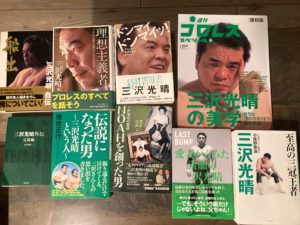
Top row, from left: Misawa’s self-published books
Departure: The Autobiography of Mitsuharu Misawa, published September 30, 2000;
Idealist, published April 13, 2004; and
Donmai, Donmai: A Message from Mitsuharu Misawa, published June 13, 2010
Second row, from left: Books about Misawa written by others
Misawa Mitsuharu Gaiden Complete Edition by Hirokazu Hasegawa, published October 31, 2009;
Mitsuharu Misawa: The Man Who Would Become A Legend by Masayuki Tokumitsu, published June 25, 2010;
Mitsuharu Misawa: The Man Who Created NOAH by Ryu Nakata and Makoto Honda, published July 18, 2007;
LAST BUMP: The True Face Of Mitsuharu Misawa As Seen By His Beloved Wife by Mayumi Misawa and Otsuki Marui, published July 30, 2010; and
Supreme Triple Crown Champion Mitsuharu Misawa by Kagehiro Osano, published in 2022
Magazine: Weekly Pro Wrestling Special Edition: Long Interview With Mitsuharu Misawa
DEPARTURE is pretty self-explanatory: it’s Misawa’s autobiography and covers everything up to NOAH’s formation and his initial plans and predictions for that company. IDEALIST is meant to be food for thought, almost like an academic inquiry into wrestling with Misawa explaining the mindset behind his wrestling and wrestling ideas from the perspectives of a wrestler, booker, and company owner, and has plenty of nuggets of wisdom from the man himself. DONMAI is a weird book: it’s more a collection of what look like blog entries with Misawa talking very casually about life, travel, behind the scenes stuff, and interpersonal relationships.
Then there are the books written by others. GAIDEN is like an epilogue or extra story intended to cover Misawa’s final year, almost like a written flashback sequence you’d see in a movie, and includes some interesting stories and anecdotes about the man’s life. LEGEND was written by a Japanese media personality with close personal ties to Misawa and seeks to convey how Misawa became such a legendary figure in Japanese wrestling despite not achieving the same degree of “fame” as guys like Muto and Chono. NOAH covers Misawa’s work in creating Pro Wrestling NOAH and also shines a spotlight on Ryu Nakata, Misawa’s close friend and essentially his business partner in putting that promotion together. BUMP looks at Mitsuharu Misawa the person (and in some respects the wrestler) from the perspective of his wife and widow. SUPREME is like the ultimate Misawa career anthology; if Ichinose’s Four Pillars bio is meant to go over the Four Kings while leaving no stone unturned then this book is meant to be the same just for Misawa (and in fact this one uses that book as a reference).
Lastly, the magazine on the right is a special edition dedicated to covering Misawa’s career and includes extensive interviews from the likes of Kobashi, Taue, Akiyama, Ogawa, Takayama, Vader, referee Joe Higuchi, and many others.
It shouldn’t be surprising that Misawa is the most covered of the Four Heavenly Kings. He was the biggest star of that period, achieved the greatest success, and unfortunately suffered the most shocking fate. To this day Misawa’s career is both celebrated for how exciting and boundary-pushing he was as an athlete while also being something of a cautionary tale for future wrestlers. And yet it seems like the warnings that emerged with Misawa’s death seem to go unnoticed with much of today’s wrestling focusing on the extremes and excesses of what he and his colleagues did while not focusing on the other, more subtle things they did as well that had just as important of an impact on wrestling. So hopefully on this journey we’ll get to see pro-wrestling from Misawa’s perspective and understand what made him make the decisions he made, both inside the ring and outside it.
DEPARTURE opens with a preface about the launch of NOAH. He explains that he was happy being in All Japan for “half his life” and didn’t complain about anything until he started working in management. After becoming more aware of “unclear aspects” of AJPW he started losing his love of pro-wrestling and at first thought better to quit. And since the ideas he had would’ve tarnished the specific ideals that Baba had cultivated he thought it better to step aside or step away than step on what Baba had accomplished. On NOAH he states that the wrestlers and staff followed him there of their own will.
Part 1: Birth and Childhood
“Mitsuharu Misawa” was born June 19, 1962 in Yubari City, Hokkaido. I put his name in quotation marks because technically that wasn’t his name at the time. “Misawa” is his mother’s maiden name and since she was still married when he was born his name was “Mitsuharu Kotake”. In GAIDEN the author speaks to Misawa’s mother Akiko and tells a story how she didn’t want to name him “Mitsuharu”. Because he was born premature and thus underweight as a baby his mother wanted both him and his brother to grow big so that they could help her later in life. Her initial plan was to call him “Hideki” because it meant “large tree” and she liked the kanji for it. However, during a postpartum stay in a hospital she entrusted the birth certificate to her husband but instead of going with “Hideki” he went with “Mitsuharu” based on the protagonist of some TV drama going on at the time. And while that name carried a kanji meaning “light” (光), Akiko believed that it would also symbolize a scalpel entering his body at some point. So depending on all these different situations the boy would’ve either been known as “Hideki Kotake” or “Hideki Misawa” if his mother had gotten her wish. But that didn’t come to pass because of his father.
It’s probably well known by now but of the Four Heavenly Kings Misawa probably had the roughest childhood. Like Kawada and Kobashi he would ultimately grow up in a single-mother household. But unlike Kawada, whose father died in an accident and was apparently a good father to his son, and Kobashi, whose father did argue with his mother a lot and hit him a few times to his recollection, Misawa’s father was regularly violent and abusive. He worked in the Yubari Coal Mine for a time but when Japan’s energy policy changed and the mine faced closure he began taking out his frustrations on his family. Misawa’s father was a noted drinker and would regularly abuse his wife without provocation.
The attacks weren’t just verbal. He often resorted to violence against Akiko-san and the children. He would get drunk with friends and co-workers and become increasingly aggressive, which over time led to his circle getting smaller and as a result him turning more towards his family as an outlet. In DEPARTURE Misawa recalls one of his earliest memories being of his mother taking him and his older brother to a nearby park and them sleeping inside one of those pipes that children play in. Though he doesn’t recall seeing it, his father allegedly stabbed his mother at least once with a kitchen knife. But he does remember seeing her beaten and, as a baby, never warmed up to his father or even so much as approached him when he was an infant. Misawa describes this as an early expression of defiance towards his father.
The family would go through more turmoil involving moving, separating, divorce, alimony demands from the husband, and the two children being temporarily split up between the parents. He would also find where she worked and drunkenly accuse guests and patrons of hitting on his wife. This continued until over time he stopped showing up. Akiko would later remarry when Misawa was in high school but neither of her children would adopt his new name and would thus refer to him as “oyaji”.
In DEPARTURE Misawa states that it’s better not to remember anymore and makes a short claim that’s directed as his father assuming he might read this book and tells him “stop showing your face in front of your family”. Though he mentions his mother remarrying later on Misawa doesn’t talk about him all that much, simply noting that he’s glad his mother found a good man and someone he could call “dad”.
As a child Misawa describes himself in different ways. On one hand he doesn’t recall having a complex from being from a single-mother household and is proud of his mother for working so hard to protect him and his family while not showing weakness. On the other hand he says that, up until elementary school, he was a spoiled and lonely crybaby who preferred playing alone and didn’t like crowds. He preferred to climb trees, run around in graveyards, and go on long bike rides. He also describes being bullied once he entered elementary school and apparently being hit by a car while riding his bike yet surviving unscathed because “at the time cars were higher off the ground”.
Misawa starts doing gymnastics from an early age due to what he considers and what others have observed as a natural flexibility. He says he could do backflips from elementary school. By the time he entered junior high he had many more friends and thus became far more outgoing, to the point that some people would say of him, “you’re so full of yourself”. At the same time he also describes himself as being a bit sheltered during his early years, especially when it comes to girls and sex (APOD: It comes across much more later on but apparently Misawa had a sense of humor and way of speaking that could be described as “crass” or “vulgar” especially in front of women. He really seemed to get a kick out of toilet humor, which becomes quite clear in DONMAI when he’s describing his day-to-day life: ‘Oh, my shoulder hurts, I might not be able to wipe today’, and stuff like that).
As a student, Misawa hated studying and was particularly bad at math. During one summer break he began contemplating career paths and the idea of becoming a wrestler entered his mind. Like Kawada, Misawa was a big fan of the program “8 o’clock! Everyone Gather!” and when he entered “professional wrestler” on a career hopes section his teacher reprimanded him for joking around. At the time he considered it even less likely than becoming Prime Minister. Still he was serious about it and so his teacher and his mother recommended he attend a high school with a strong amateur wrestling program so that he can develop strong fundamentals. He ended up attending Ashikaga Institute of Technology High School, which was something like a gathering place for elite amateur wrestlers in the region.
At the same time Misawa found amateur wrestling uninteresting and saw it as a means to get into professional wrestling. Anxious and impatient, Misawa recalls sneaking out of his high school dormitory and going to AJPW’s office. He waits outside their front door until a woman (Motoko Baba of all people) sees him and he expresses to her his desire to become a wrestler. She lets him in and there he meets Jumbo Tsuruta who tells him to come after graduating high school. After all, Tsuruta entered after graduating university so it’s not like there’s any rush for him. Misawa ultimately completes his three year amateur program but confirms not liking amateur program. Had he liked it as much as pro-wrestling, though, he claims he could’ve made it to the Olympics.
“First of all, it wasn’t fun. In national competitions, I see athletes who cling to amateur wrestling even after turning 30. I wondered what was so enjoyable about doing it at that age. It doesn’t lead to money. I understand that in amateur sports like baseball or basketball, it’s fun to play at any level, but amateur wrestling? Especially during practice, it doesn’t look fun just watching.”
Despite being scouted by the Self-Defense Forces and pondering attending universities Misawa doesn’t want to continue amateur wrestling any further, especially due to the restrictions involving maintaining a certain weight limit. At times he even wanted to drink toilet water he was so frustrated with weight loss requirements. To deal with these frustrations Misawa would often sneak out at night to meet with his girlfriend, but because he didn’t have any money he’d ask her for to pay for his train fare back to school. In the end Misawa sticks through the rigors of wrestling training until graduation and then immediately sets his sights on going pro. As for why, this quote from GAIDEN sums up his mindset towards pro-wrestling:
“Pro wrestling is a world where you can bring out the techniques you imagine. In martial arts, whether it’s judo or anything else, you just practice the techniques created by others and make them your own. Pro wrestling has no set forms. Or rather, even if there are basic forms, it’s a world where you can create your own. Sometimes it even allows for developments like in a manga. Being able to think for yourself from the beginning and create new techniques is very rewarding, isn’t it?”
There is a further comparison made with music from the same book that illustrates this philosophy:
“When you go to listen to music, if you want to see virtuoso techniques, like fast finger movements, you should go listen to classical music. However, there is no improvisation there. While the interpretation of emotions can be free, you can’t manipulate the score. If you want to enjoy improvisation and listen to skilled performances, there is instrumental jazz. But there are no vocals there. On the other hand, with rock and roll, which is positioned at the extreme of formal music education, you can design music freely, away from music theory. There may not be a final completion, but you can continue to create pop music that prioritizes passion.
Whether it’s professional wrestling, rock ‘n’ roll, or any form of entertainment, the concept of freedom is undoubtedly the greatest catharsis sought. There’s a world born from imagination that breaks the rules. There, designers in each field compete.”
APOD: This early section lays the foundation for Misawa’s career and the second half of his private life which will come up here and there, especially once he gets married and we see him from his wife’s perspective. His early life is straight up depressing and brutal and sadly will have a lingering effect on him to some extent going forward. Misawa has been said to have been a private person when talking about himself and it shows through these early passages: though he talks about himself we don’t get much into his relationships with others all that much. But once thing’s for sure: as we move deeper into his professional career we will unravel far more details about this celebrated and at times enigmatic personality.
Thanks for reading.