

5-Star BOOK Reviews: Mitsuharu Misawa’s Books, Part VIII
By Alex Podgorski on 20 June 2025
Mitsuharu Misawa carried All Japan Pro-Wrestling on his shoulders for more or less an entire decade. He wrestled in one of the most taxing and difficult styles the wrestling world has ever seen, to the point that his fate remains a cautionary tale on the excesses of the sport. Much has already been written on where mistakes were made and what could’ve been done to prevent his untimely death. But it’s also important to look at long-term trends and factors that affected him both directly and indirectly, especially since many of these factors were already in place when he entered his prime.
You can read part 1 here, part 2 here, part 3 here, part 4 here, part 5 here, part 6 here, and part 7 here.
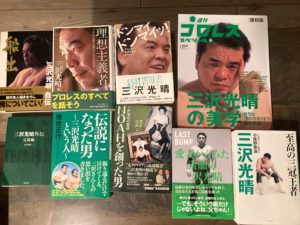
We begin this segment in the aftermath of the 1995 Champion Carnival and a general note on AJPW’s business. Misawa capitalizes on his CC victory and wins the Triple Crown title from Stan Hansen the following month; however, it is considered an underwhelming match. Around the same time there is a notable slowdown in AJPW’s business due to a number of factors. Throughout 1994 many smaller promotions pop up, leading to a diffusion of power as these newcomers vie for shares of AJPW’s audience. Then there’s the TV slot problem, with AJPW’s regular weekly show being moved from a one-hour slot at 12:30am on Sundays to a 30-minute slot at 2:35am on Saturdays. With these factors Baba publicly confirms what some of you have said in the comments in my previous reviews: that AJPW drew well in Tokyo but regional attendance varied. To this Baba advises that “reinforcing” regional markets becomes a key task for 1995. This focus sees mixed results: the Jan 1995 Triple Crown match between Kawada and Kobashi, held two days after the Great Hanshin Earthquake, is praised in the moment but receives stronger criticism later on. Additionally, Osano notes that much of Japanese society was on edge throughout the spring of 1995 due to the Aum Shinrikyo sarin gas attacks on the Tokyo subways and the leader of that group, Shoko Asahara, predicted more disasters – both natural and manmade – which (in)directly affects AJPW’s live attendance. Though business remains steady in Tokyo and other strongholds like Sapporo, even Misawa struggles with dwindling attendance. While he remains confident in his ability to send them home, it’s hard for him to feel confident when there’s little getting them in the door in the first place.
As part of this growing emphasis on in-ring quality two big matches happen that summer. First there is 6-9-95, a.k.a. the greatest tag match of all time, in which Kawada pins Misawa for the first time. Kawada expresses his satisfaction with finally beating Misawa while Misawa admits “I’m not superhuman” and confirms their next singles encounter would be for the Triple Crown. That bout takes place on July 24th and sees Kawada attack the eye and brawl viciously with Misawa. As usual their particular brand of match escalates in ferocity with head-butts, stiff exchanges, and throwaway suplexes. But despite Kawada’s best efforts Misawa more or less pulls a Hulk Hogan and starts eating Kawada’s best shots and knocks him dead with elbows to win the match.
After beating Kawada Misawa faces Taue on September 10thand then against Kobashi on October 25th, both of which are in AJPW’s main stomping ground the Nippon Budokan. This is an important match because it’s Kobashi’s first title challenge against Misawa and Kobashi believes that this match meant to show that Super Generation Army wasn’t always about friendly camaraderie. On top of that this match takes place immediately after Kawada’s epic match with Gary Albright. This would be the first of the Misawa/Kobashi sub-style of match and Kobashi was out to make a statement. What stands out to Osano is that, three minutes into the match Kobashi goes for an Orange Crush Bomb but kind of botches the landing, causing Misawa to land awkwardly on Kobashi’s left knee and hip. Still, they wrestle without stopping for over 35 minutes until Misawa plants Kobashi with a Tiger Driver ’91 to retain the title.
“That was the match where Misawa-san said, ‘Thank you, Kobashi.’ Before that, Kawada and Albright had a match, and I didn’t want to lose to that. The Triple Crown match has to be the best. Misawa-san never held back because of his personality. He was someone who directly embraced my passion for pro wrestling. That’s why we could have such a match in the Triple Crown and even in the Champion Carnival official matches. From around this Triple Crown match, my matches with Misawa-san started to become a brand in themselves.” – Kobashi
From here we shift to the 1995 Tag League and a summary of Misawa & Kobashi vs. Kawada & Taue tag matches. Kawada & Taue achieve significant momentum in the June tag match but more battles take place afterwards in October and November 1995 that leave Kawada & Taue ahead. They face off in the finals of the Tag League in what would become their ninth and final encounter under this combination. Giant Baba is, of course, watching from ringside doing commentary and notes during their match, “No commentary is needed for the fight between these four. The reasons for victory or defeat… there’s nothing more to say. I think the fight between these four is the best in the world.” Additionally as 1995 drew to a close Baba made more public statements to further distinguish his wrestling from others’:
“I don’t want this to be taken the wrong way, but I think it all comes down to one thing: ‘All Japan is serious.’ We’re not about talking trash about this guy or that guy. For us, pro wrestling happens in the ring. I want to say loudly, ‘Compare us.’ That’s all I can say about 1996.”
At the same time Misawa notes that 1995 was tough due to having a shorter off-season and therefore less time to rest. But because he believes in being in the right mindset he simply shrugs off his pain and doesn’t let negative sentiments regarding his work and physical condition take root. Misawa also gives his own thoughts on Baba’s comments and how word-of-mouth reputation becomes critical to promoting AJPW’s brand:
I’m the same way, but I don’t like doing things just to appeal to the audience. However, we have to offer something interesting enough to bring fans to the venue. That’s the tricky part (wry smile). One thing I can say is that we must never be satisfied with the present and must always strive for improvement. The key weapon in this is word of mouth from the audience. If someone who came to watch once says, ‘All Japan is exciting!’ and brings their friends, and those friends bring their own friends… that’s the only way. For that to happen, we can’t afford to have even one show where people say it was boring. Word of mouth may take time, but I believe it will pay off in the end” – Misawa
(APOD: These comments underline how limited Misawa and the other Four Kings were in the promotional and drawing aspect of wrestling. while it’s undeniable that all of them were among the best of all time once the bell rang, they didn’t have the same kind of tools at their disposal to market themselves. They didn’t do promos or angles, didn’t appear all that much on talk shows compared to other companies…for the most part, anyway. They had to sell themselves to both new and existing audiences on the strength of their in-ring work, which was extremely limiting. They relied so much on word-of-mouth since that was the only mechanism that couldn’t really be “messed with”: TV scheduling and magazine coverage were heavily politicized so they relied purely on appealing to the fans since Baba’s words were, after all, “the fans are our sponsors”.)
Moving on to 1996 it’s noted that the year is defined by the significant growth of both Akira Taue and Jun Akiyama. We get a summary of things I already covered in my review of Akira Taue’s autobiography: how strong he was, how much Baba pushed him at first, etc. There’s also a note on how, according to Baba, the fans were calling Taue lazy but Baba liked Taue’s easygoing nature. But even if he wasn’t as dedicated as, say, Kobashi, Taue grew thanks to being partners with Jumbo Tsuruta and then Toshiaki Kawada, which helped him blossom into a viable singles competitor. Despite having a lopsided win/loss record against Misawa, Taue was able to improve through 1996 by winning that year’s Champion Carnival and becoming the first Japanese wrestler to beat Misawa for the Triple Crown.
Reflecting on the differences between Misawa-Kobashi, Misawa-Kawada, and Misawa-Taue matches, Masanobu Fuchi noted that Misawa-Taue had their own unique “three-dimensional charm” stemming from Misawa defending against Taue’s multidimensional attacks:
“I think Misawa and Kobashi were aiming for 100% offense and defense against each other. It was an incredible match where they went all out, feeling like a thin line between good and bad defense. In terms of offense and defense, Misawa and Kobashi seemed to match each other the best. They received high praise from both the media and the fans.
However, Misawa and Kawada‘s matches often ended due to some kind of accident or happening before reaching 100%. From the fans’ perspective, it would end just when it seemed like they could deliver something even more amazing in terms of offense and defense. Misawa, driven by anger, would end up attacking Kawada unilaterally towards the end, completely ignoring the ebb and flow of the match, making it a dangerous encounter. Of course, Misawa and Kobashi also performed ruthless attacks against each other, but Misawa’s ruthlessness stood out against Kawada. Perhaps for Misawa, Kawada was an opponent who could show strong spirit.
Taue originally had the throat drop move, but he started performing the cliff-style throat drop, slamming opponents from the apron to the outside. If I remember correctly, the first time he did it was in the Carnival official match against Kobashi on March 21, 1995, at Korakuen Hall. Once Taue began using that move, it created quite a good exchange with Misawa. The thrill of whether you would take that move or not… it was similar to how Baba would defend against Fritz Von Erich’s Iron Claw or how it would be dangerous if you got caught in the Destroyer’s figure-four leg lock. That thrill existed with the cliff-style throat drop. He became popular due to his large physique, but compared to the other three, Taue lacked a bit of impact when he started using that move.” – Fuchi
The conversation shifts to Akiyama, who starts teaming with Misawa as a direct attempt at elevating the youngster to the level of the Four Heavenly Kings. Akiyama wins his biggest match to date on May 23, 1996, the night before Taue wins the Triple Crown from Misawa above, and wins the World Tag titles from the Holy Demon Army, becoming a dual tag champion in the process. Despite winning the titles alongside Misawa, Akiyama never actually wore the belt around his waist, feeling that it was too valuable for him and he still had a long way to go before he was worthy of calling himself the best in the world in either a singles or tag team context. Akiyama also notes that there was a noted difference between teaming with Misawa and teaming with Kobashi, noting that the latter would’ve tried coaching him on what to do while the former was much more laissez-faire in the ring:
“I think I was paired with Misawa because Baba-san probably told him, ‘Team up with him.’ I believe it was to show me what a top wrestler is like, to watch Misawa’s back. I think it was difficult for Misawa (laughs). If it had been Kobashi, we could have done it with just a glance, but it wasn’t like that. It was also difficult for me. Misawa was a senior, so he was probably sensing what I might do. But there wasn’t a ‘do it this way’ directive, and when I asked, ‘Is it okay if I do it this way?’ he would say, ‘Yeah.’ So, I felt like I was allowed to do things freely. I was free, but freedom is difficult. To some extent, you have to fit into a mold.” – Jun Akiyama
With this win the wrestling press tried to change the nomenclature of the time from the Four Heavenly Kings to the Five Strong/Five Strengths; however Akiyama had strongly denied this change from the beginning and continues to do so to this day.
“They said ‘from Four Heavenly Kings to Five Strengths,’ but I really dislike the term even now. I hate the very word. I thought to myself many times, ‘No, that’s not it’ (laughs). There might not have even been a thought of ‘Let’s catch up!’ or ‘Let’s surpass them!’ I felt like I was being shown something that was already complete… It felt like ‘If we climb the same mountain, we can’t reach it.’ So I started to think, ‘What do I have that those people don’t?’ and I think I went in different directions like thorough focused attacks and verbal communication. What I learned or realized from teaming with Misawa was that I couldn’t do the same things as this person. That’s why I think I started to think about various things. I think I could think freely because it was freedom. If I had been somewhat constrained, I might not have been able to think that way. For example, even if I went all out with words, Misawa never reprimanded me for it, and I was really free all along. And when I took action with Kobashi (forming Burning), it was because I was teaming with Misawa, but Kobashi was also the closest in terms of practice and everything. I kept hearing Kobashi say, ‘We have to do this ourselves!’ And when Kobashi declared a new era after winning the Triple Crown from Kawada (June 12, 1998, at Nippon Budokan), I thought, ‘The timing is now!’ There were no restrictions from Misawa regarding that.” – Akiyama
These aren’t the only developments during this period. Kobashi reaches the top as well by beating Taue that July to win the Triple Crown. Baba starts opening up All Japan, leading to Kawada facing Yoshihiro Takayama at a UWFi stadium show in September. And that year’s Tag League features a two-round-robin format, with each team facing off twice. This tournament concludes with Kawada & Taue beating Misawa & Akiyama in the finals in another absolutely epic 5-Star match.
APOD: Things appear to stabilize for Misawa at this point as he doesn’t appear to suffer anymore injuries or major setbacks. However, it’s clear that 1995 and 1996 are more about elevating others around him since he’s in dire need of fresh match-ups. And as much as things seem a bit less stressful in terms of negative coverage or setback, there’s this undeniable sense that Misawa’s positive accomplishments are shrouded in this sense of concern over shrinking attendance. Even though the biggest shows in Nippon Budokan continue to sell out, business slows almost everywhere else. Baba’s insistence on pure sportsmanship is beginning to take its toll on the company’s ability to draw in crowds. And even if we ignore some of the external factors affecting people’s general willingness to attend live events like the earthquake and a terrorist incident, AJPW really struggled with its ability to market itself. It’s a sobering lesson if anything: even if a product is world class it can’t succeed if it isn’t marketed properly. Though Baba would eventually open All Japan up, by the end of 1996 things would start to get…a bit excessive, as we will see in the next section.
Thanks for reading.