

5-Star BOOK Reviews: Mitsuharu Misawa’s Books, Part V
By Alex Podgorski on 2 June 2025
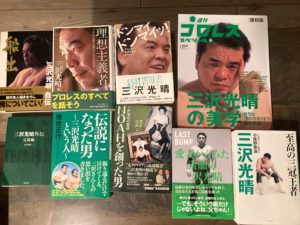
For this next section of Mitsuharu Misawa’s book coverage I’m going to have to pivot a little bit. Up to this point I’ve been using Misawa’s autobiography DEPARTURE as the starting point and adding details from the other books to add more detail or context where needed. But for this next part I’m going to have to shift from DEPARTURE to the bigger and more detailed book Supreme Triple Crown Champion Mitsuharu Misawa instead. The reason for this is, for whatever reason, Misawa chooses not to discuss anything about his in-ring career beyond his 1990 singles matches with Jumbo Tsuruta.
Personally I suspect that this decision is both thematically correct and closer in line with Misawa’s personality. As the name suggests, DEPARTURE seems to be themed around how he became a star and serves as a background to why he was leaving for NOAH in the first place (APOD: which, at the time, was still considered a highly controversial decision as many of the behind-the-scenes details were still unknown). Plus Misawa was known to be a very private person in general, and while it seems like he loves to talk about pro-wrestling a lot (APOD: as seen by how much thought he put into IDEALIST, which I’ll get to soon), it seems like Misawa prefers to talk about wrestling in a broad sense and doesn’t like shining the spotlight on his own exploits when doing so.
Anyways, by skipping ahead so significantly Misawa deliberately omits a significant chunk of his career: the continuation of (and premature conclusion to) his feud with Tsuruta, his first Triple Crown win over Stan Hansen, Kawada splitting off on his own, the official formation and rise of the Four Heavenly Kings, his time as ace all through 1993 through 1998, his many iconic matches, and his opinion on AJPW’s first Tokyo Dome show. Instead in DEPARTURE Misawa skips all the way to 1997-98 when the first seeds of disagreement and the tease of NOAH were planted. But before we get there we need to get caught up chronologically, hence our pivot to SUPREME and how it covers Misawa’s in-ring career.
You can read part 1 here, part 2 here, part 3 here, and part 4 here.
In SUPREME it’s mentioned that part of Misawa’s success came from AJPW’s main matchmaker at the time, Masanobu Fuchi (APOD: whom I will cover in more detail soon when I go over his own book as well). Fuchi was a huge proponent of pushing Misawa and Chosedai-gun into the main-event and having them go over established legends the way they did. One of the earliest manifestations of this philosophy was in the 1990 Tag League tournament in which Misawa and Kawada, then his right-hand man, would face legends of the past and either hold their own as long as possible or win outright. There were more instances of the former than the latter, such as when Misawa & Kawada went to a 30-minute draw against Terry Funk and Dory Funk, Jr., two revered legends in Japan.
While Misawa was positioned as a competitor on equal footing against native stars like Tsuruta, he had much less success against foreigners. Misawa & Kawada lost tag match-ups to the Miracle Violence Connection/Murder Torpedo Combination (Terry Gordy & Steve Williams) and to the duo of Stan Hansen & Danny Spivey quite a lot through late 1990 and into 1991. One of Misawa’s few notable wins was in April ’91 in a singles match against Dynamite Kid Tom Billington, but by that point Dynamite was seen to be washed up so it wasn’t considered a major accomplishment. As for Misawa’s attempts at beating the top gaijin in Stan Hansen, well, it’s noted that in one of their first singles matches Misawa is said to have landed 250 elbow smashes on Hansen yet he still lost to the Western Lariat.
Misawa’s first major successes against the Four Foreign Heavenly Kings (Hansen, Gordy, Williams, & Spivey) came in June 1991 when he pinned Gordy clean. A month or so later he and Kawada beat Gordy & Williams to win AJPW’s World Tag Team Championships, but their victory was short-lived as they lost the titles back to MVC following the finals of the 1991 Tag League tournament (APOD: that’s another great match, especially for those who might not be familiar with Doc and Gordy’s Japanese work). SPOILER ALERT:
“It was here that the Murder Torpedo team showcased their strength. Misawa was incapacitated by a combined powerbomb outside the ring, and in the end, Gordy firmly pinned Kawada with a powerbomb. The Murder Torpedo team achieved the first consecutive victory in the history of the strongest tag tournament and simultaneously reclaimed the world tag title. It would take another two years for Misawa to completely break through the wall of the foreign four heavenly kings. ” – Kagehiro Osano, Supreme Triple Crown Champion Mitsuharu Misawa
Before getting into the next section, Osano provides a small aside to give context to events that took place behind the scenes. Up to 1990 he was the main All Japan reporter for Weekly Gong, another other major print magazines covering pro-wrestling. The reason he stopped was due to a reporting controversy surrounding The Great Kabuki. Immediately after the May/June AJPW Summer Action Series AJPW asked its wrestlers to sign new five-year contracts to avoid more cases like Tenryu departing. Some people, like Kodo Fuyuki, Shinji Nakano, and Masao Orihara, didn’t sign and “fled” to SWS. As for Kabuki, both declined to sign a new contract and declined an executive role in AJPW’s backstage world. According to Osano, Kabuki met with Giant Baba the afternoon of July 25th to tenure his resignation. How exactly he knew these minute details Osano doesn’t disclose. However, no public announcement had been made by AJPW regarding Kabuki’s contract status so Osano, fast approaching his publishing deadline for the next issue of Weekly Gong, went ahead with the info he had regarding Kabuki without fully confirming it with All Japan. When AJPW read the story Osano was accused of having insider information and not confirming it with an external source.
This is where things also get a bit more personal. Osano had only “heard whispers” that “some executives” in AJPW didn’t want him specifically covering All Japan but there was never a formal edict regarding this. And since he considers his actions regarding the Kabuki situation to be legitimate reporting, these accusations hurt his feelings and professional pride. As a result, Osano voluntarily stopped covering AJPW for about six years, and so any interactions he had with Misawa and the other Four Heavenly Kings, of which there were many given his love of pro-wrestling and both sides frequenting the same places, were outside the framework of journalistic article writing and professional reporting. Osano describes this next period as him recalling and describing things from a more casual and friendly perspective, and he even managed to get close enough to Misawa to call him “Micchan”, a nickname Misawa only reserved for those in his innermost circle.
From how he saw Misawa interact with others Osano describes him as becoming “like Tenryu”: attentive to everyone, offering advice to both juniors and seniors, and talking to Giant Baba on behalf of an injured veteran too worried to bring up the topic of taking time off himself. However, Misawa was also unlike Tenryu in that he didn’t follow the social custom in Japan of the boss forcing underlings to drink with him and forcing them to get drunk when they didn’t want to, which aligned with Misawa’s very strong personal ethos of embracing personal “freedom”. Osano also describes how Misawa would jokingly ask Osano which of the two wrestlers spend more money, noting how Misawa was still competing with Tenryu in some way.
Much of this section discusses how Misawa and the Super Generation Army behaved on their personal time, that is, away from the ring, and Osano notes how they were by and large friendly and supportive of one another. Kawada adds his thoughts here, noting that he felt “much less constrained” with Misawa as the company ace and even though they had their differences, as all friends do, there wasn’t any outright hostility between the two. In yet another aside Kawada also adds more context to the small scuffle he got into with Misawa that I brought up in the last section. Apparently both of them were already drunk and Kawada decided to go home early, only to realize he forgot his bag. Upon returning to pick it up Misawa said something along the lines of “you’re being cheeky” in front of their juniors and Kawada couldn’t take that kind of disrespect then and there because he had to set an example for juniors who needed to stand up for themselves. So he punched Misawa and gave him a black eye. However, everyone who recalls this incident, including both Kenta Kobashi and Tsuyoshi Kikuchi who held the two (drunken) wrestlers apart, all conclude that this was an example of young people fighting without thinking ahead.
Shifting back to the wrestling, Osano returns to Misawa’s feud with Jumbo Tsuruta, with their next being their rubber match in April 1991. In a show of escalation from their earlier matches Misawa stayed in lockstep with Tsuruta for so long that Tsuruta was forced to hit three of his Greco-Roman Backdrops to put Misawa down, which surprised everyone but especially Tsuruta. But despite this loss the Tsuruta/Misawa continued and evolved, with their next chapter adding some more nuance and freshness to matches. Because Misawa hadn’t been able to hit Tsuruta with his Tiger Driver or Tiger Suplex finishers, something new was needed so in May 1991 Misawa debuted his facelock as a new finisher. While it might look like a simple resthold by Western standards, Misawa needed something like this to deal with larger opponents, of which there were many especially in the main-event slots. Misawa wanted something he could use against any opponent regardless of size, and he also added his own unique aspect to it by also twisting his opponent’s left arm with his leg while he trapped their face. And once again, credit needs to go to Masanobu Fuchi who recalls sparring with Misawa quite a lot during this period and was the first person on whom Misawa applied this technique to see if it would work.
“I think it’s an impactful move. The reason is that it’s surprisingly rare for both the one applying and the one being applied to see each other’s faces during a submission move. From that angle, moves like the cobra twist, Verne Gagne’s sleeper hold, and the figure-four leg lock by Destroyer and Ric Flair were ideal. Tsuruta also frequently used the sleeper hold to leverage his large body. With Misawa’s face lock, although Misawa’s expression is slightly obscured by his arm, you can see the agonized expression of the opponent simultaneously, making it one of the ideal submission techniques.” – Fuchi
After testing and improving on this technique throughout the summer of 1991, Misawa made history on September 4th of that year after successfully retaining his World Tag Titles alongside Kawada against Tsuruta and Akira Taue. That win was impressive but what really sold its significance was that Misawa won by making Tsuruta submit to the facelock, marking Tsuruta’s first loss via submission in ten years, with Tsuruta’s last loss by submission being on October 9, 1980 when he lost a best two-out-of-three falls match to Ric Flair for the NWA World Championship. (APOD: All of this happened during the early years of 1990s All Japan before Giant Baba decreed that matches could no longer end via submission. Though these matches were still in the spirit of Baba’s philosophy at the time, by 1994 or so submissions would be relegated to middle act wear-down techniques and near-fall fodder almost exclusively. In terms of a big AJPW match winning via submission they became fewer as the decade went on. The only three notable ones from this later period that I can think of that end with a submission hold are the last Tsuruta-gun/Chosedai-gun six-man in May 1992, Kawada vs. Kobashi in October 1993, and Kawada vs. Gary Albright in October 1995).
Misawa’s stock continued to climb, both in All Japan and in Japan in general. As he was this rising star of a new generation under Baba, Osano notes that at the same time New Japan was doing something similar with the Three Musketeers and how they, as younger guys, were booked very strongly in the 1991 G1 Climax tournament which more or less coincided with Misawa’s “facelock series”. By 1992 Misawa and Tsuruta were tied with two wins apiece and their next match in April ended with a draw. Unfortunately their feud never concluded because Tsuruta was sidelined with liver issues stemming from Hepatitis. Though Tsuruta would return to All Japan later on he was never a frontline/main-eventer ever again. (APOD: Tsuruta’s illness marked one of the most critical junctures in AJPW history. With his fall from the headlining spot All Japan lost its last major holdover from the previous decades. Since his feud with Misawa never formally concluded in the ring and the passing of the torch never completed enough people left this feud feeling either unsatisfied or wondering if Misawa really did have it in him to surpass Tsuruta. And without such a big star to serve as a pillar of main-event feuds Misawa and others around him had to shift gears in another way, namely creating a more shocking and limit-breaking style. It can be argued that Tsuruta’s departure gave birth to some of the more dangerous head-spike techniques, chief among them Dr. Death’s Dangerous Backdrop Driver. He had used that move in 1990 but because it led to injuries it was “sealed away”, only to be unsealed in 1993. Had Tsuruta remained healthy it’s likely that these extreme techniques might’ve either been used far more sparingly or not at all, leading to a different turn of events for all of the Four Heavenly Kings, the other wrestlers in their immediate orbit, and the subsequent generations of wrestlers and fans who took inspiration from their incredibly high-risk style).
With Tsuruta gone Misawa became more anxious due to growing pressure to become the ace more suddenly. As such Misawa was put in a program opposite Stan Hansen, the hardest-hitting wrestler in the company BY A SUBSTANTIAL MARGIN, despite having a growing collection of injuries, his most recent being a broken nasal bone courtesy of a botched Tsuruta forearm smash. Pessimism clouded Misawa’s mind throughout 1992 as he dealt with Hansen’s overwhelming power and in one of their first singles matches in the year he lost to the Western Lariat once again. The taxing and highly physical match-ups between Hansen and Misawa continued through the spring and summer of 1992 until August 22nd when Misawa pulled out all the stops and drilled Hansen with arguably the mightiest elbow strike he has ever thrown. Both men went down but Misawa still had just enough strength to crawl over and cover Hansen. One, two, three! Just like that Mitsuharu Misawa became the Triple Crown Heavyweight Champion.
“Until now, I never thought of it as ‘for the fans,’ but coming into today’s match, I realized how important the fans are to me, and I really wanted to win for them today. So, I’m very happy. Thank you so much.” – Misawa’s first comments during his post-match celebration and interview.
Reflecting on his position as the last holdover from the previous generation, Stan Hansen had this to say:
“When I came from New Japan to All Japan, I brought in a style that had never been seen before. There was a time when Choshu Riki came and the business improved. After Choshu left, Wajima Taishi briefly took the top position among Japanese wrestlers, and after that, Tenryu took over. In the spring of 1990, after Tenryu left All Japan with many wrestlers, it became my role to encourage the growth of young guys like Misawa and Kawada, and because of that, we were able to fight against a different young generation, which I think was good in its own way. After that, due to Jumbo’s thoughts, it became my role to fill in for Jumbo. Throughout the long history of All Japan, when Misawa, Kawada, Taue, Kobashi, and others were desperately creating their own era, it was the best time for business. At that time, young and new talents standing at the top for the first time increased new fans, and I believe it was the best in terms of event revenue. Therefore, my position and role was to fiercely fight to knock down and stop those coming up from below. Regarding the change in All Japan’s style, “Jumbo and Tenryu were significant, but since Misawa and the others were smaller, it gradually became a style where the larger ones defeated the smaller ones, yet the smaller ones persevered.
Matches that surpassed expectations emerged. Since it was impossible for them to confront big gaijin like Stan Hansen head-on, their style evolved through speedy movements and kicks, differentiating from traditional wrestling. This was a natural progression for them to survive in this business, and I believe that over time, the Japanese style gradually changed. Initially, fans witnessed them getting beaten without being able to do anything. However, they didn’t give up and pushed from below, eventually rising to the top, which likely resonated with the fans, who understood that they were genuine in the process. If they had been allowed to reach the top without any difficulties, the fans would not have accepted them. Although it took time, their growth into top positions was something I was happy about and proud of.” – Stan Hansen
As a final note we have this passage from Fuchi who opines that this series of matches with Tsuruta and Hansen, in which Misawa fought from underneath and chased them with that feeling of wanting to reach and then surpass them, were Misawa’s finest:
“Of course, I remember the matches of the Four Heavenly Kings, but the matches where he lost to Tsuruta or Hansen… Misawa’s matches during the phase of climbing up with the feeling of wanting to surpass these two and become the ace left a strong impression on me. The match in April 1992 where he suffered three consecutive backdrops from Tsuruta, and the series of matches with Stan Hansen in the following year are, in my view, Misawa’s best bouts. The cheers gathered for the advancing Misawa, and thanks to his efforts, fans came to All Japan Pro Wrestling at that time, allowing All Japan Pro Wrestling to reach its peak.” – Masanobu Fuchi
APOD: It’s a good thing that this book exists because it gives us so much more insight into Misawa’s career than the man himself was willing to write or able to write down. Let’s not forget that DEPARTURE was published in September 2000 when NOAH as a promotion was just about two months old. Between running and promoting NOAH, staying in acceptable ring shape, wrestling in big matches that lived up to his historically high standards (or at least tried to) and finding what little time he could to spend with his family, it’s no wonder that Misawa didn’t have any time to write about himself. Thankfully Osano did an incredible job providing detailed accounts of events that happened during this key period in Misawa’s life and contextualized them so that they could be further understood. He also does a great job of emphasizing that Misawa’s – and therefore AJPW’s – success was a team effort, and makes sure to credit as many players as possible. Personally I’m especially glad to see Fuchi given a lot of credit as the matchmaker/booker since he was an important go-between who balanced the office’s business needs and the wrestler’s in-ring needs.
In terms of narrative this section does a great job building towards Misawa finally achieving his big dream and winning the Triple Crown. It notes not only how he was dealing with creative setbacks through his win/loss record, but it also emphasizes the man’s inner turmoil. For an outsider or someone unfamiliar with pro-wrestling, who might approach such a subject with the preconception that “it’s all fake or predetermined so why care about it?” framing these situations as manifestations of Misawa’s own inner anxiety makes him more relatable. He isn’t just a wrestler or a performer of techniques in these matches; he’s someone who is expected to carry an entire promotion on his shoulders as the handpicked ace. But it takes two to tango in the ring and a company’s success relies on several parts moving together in concert. Misawa overcoming Hansen and working around Tsuruta’s crippling departure make his rise to the top feel all the more heroic. But as it’s often said in wrestling, winning the belt is the easy part; keeping it is where the real challenge lies.
Thanks for reading.