
5-Star BOOK Reviews: Mitsuharu Misawa’s Books, Part IV
By Alex Podgorski on 26 May 2025
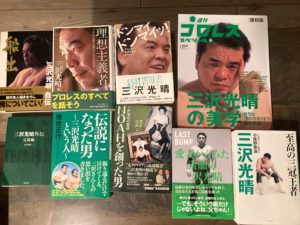
Mitsuharu Misawa is an interesting wrestler. He wore many hats over the course of his career: he was a trainee, an attendant to the company’s biggest star, a reluctant masked high-flyer, an ace, a booker, a promoter, and a company owner. Few people in wrestling have seen and done as much as Misawa; fewer still have been willing to talk about these things and preserve them in text. Even if some events might be embellished or kayfabed there’s always still some kernel of truth in what’s described. And for those of us interested in understanding the reasons why things happened the way they did, the many books covering Misawa’s life and career make for irreplaceable content.
You can read part 1 here, part 2 here, and part 3 here.
Misawa circles back for a moment to talk about May 14, 1990, which is the day he removed his mask and shed the Tiger Mask II gimmick. He points out how unusual this is since to his recollection most masked wrestlers get their masks ripped off by their opponents and thus desperately try to hide their faces when they do. He compares removing his mask willingly to the pleasure of coming out of a bath. At the same time he saw it as a bit of a gamble. He didn’t know how the audience would react and worried that they’d laugh or something. Thankfully they didn’t and instead embraced him as their next true star.
With him now wrestling under his true name, Misawa comes to terms with getting far more “direct” criticism and commentary from fans and journalists, which he comes to terms with as part of the job, whereas before the criticisms were aimed at the character and not the man. However, a particular comment really strikes him at his core which is when the wrestling media refers to him as “The Ace of Glass”, which allegedly stems from his tendency to collect injuries big and small. During the early 1990s Misawa was said to be frequently photographed with things like black eyes, a busted nose or lip, and a small strain here or there. But by 1994 according to SUPREME he was dealing with more serious and chronic problems:
“He was chronically plagued by injuries to his neck, back, and knees, as well as a fractured nasal bone, a partial dislocation of his right shoulder, a left acromioclavicular joint dislocation and ligament damage, a cracked sternum, and his absence from this spring’s carnival.”
Misawa’s initial thoughts on this name are as follows:
“At that time, I thought, “Are you kidding me?!” If someone is weak-hearted, they might get crushed by that alone. On the contrary, I’m not the type to dwell on things; I tend to think, “Well then, I’ll show you.” Looking back now, I appreciate that period because it shaped who I am today. However, the media can be really scary. Even now, I sometimes think, “They say whatever they want!””
(APOD: Misawa tries to undercut this term but in Ichinose’s Four Kings Bio the author devotes an entire chapter to this unfortunate nickname and how much it bothered Misawa. Ryu Nakata, Misawa’s close friend at the time and his partner in creating NOAH, would tell Ichinose, who was a reporter at the time, how much the term angered Misawa. So much so that he boycotted the Tokyo Sports Puroresu Awards ceremony for years which shook the fragile, political, and to some degree symbiotic relationship between pro wrestlers and the journalists that covered them. From Misawa’s perspective this term, though honest, ran the risk of damaging his credibility and drawing power. This was at a time when AJPW’s terrestrial TV slot was limited and much of the coverage came from print magazines and word of mouth. It was also a time when Misawa was trying to surpass Jumbo Tsuruta in some way and needed people to believe he was the strong and capable wrestler he claimed to be. As such any negative coverage ran the risk of turning fans off of him which would in turn put more pressure on him and his peers to shatter those preconceptions. Misawa would spend much of 1991 living up to that nickname but by 1992 he started pushing the envelope even further. It wouldn’t be a stretch to argue that Misawa spearheading a more physically taxing and escalatory wrestling style once he became ace and thus creating the Shitenno wrestling style he and his peers would develop and master could be seen as an overcorrection to these journalists. Also, for what it’s worth Ichinose very clearly states that he tried to find at least one actual document where “Ace of Glass” is printed but found nothing. He ultimately suspects this nickname resulting from a very bad game of broken telephone or something and Misawa got it in his head that the Tokyo Sports editorial team – who, again, were among the most influential reporters on wrestling in the country – had this mindset about him and it would influence their coverage of him and his matches).
Staying on the subject of Ichinose the next chapter kind of ties in with this theme as it’s another expression of Misawa’s supposed fragility: how Toshiaki Kawada gave him a black eye.
It was around September 1991. Misawa and Kawada went out drinking after a Budokan event and it turns out that Keiichi Yamada (Jushin Liger) was in the same place. Liger had a friendly relationship with All Japan and both he and Kawada were on good terms from their days as opponents in amateur wrestling. But Misawa was hostile to New Japan and saw the situation strictly through the lens of interpromotional rivalry and thus didn’t want to associate with “the enemy”. Not wanting to cause a fuss Misawa simply turned and left saying “I’m heading back”. But somewhere in his response he also allegedly said something along the lines of “I’m not like Kawada who says ‘let’s drink, let’s drink’”, making some sort of under-the-table insinuation about Kawada. In response, the usually nonchalant and reserved Kawada, needing to set an example for juniors, confronted his sempai and punched him in the face, giving him a black eye. Misawa decided to just leave after this and the black eye was attributed to a stiff shot suffered in one of his matches against Jumbo Tsuruta which was MORE than understandable.
In the following days that punch actually caused Misawa to lose some vision in his right eye while Kawada, distraught over the fiasco, sent a letter to All Japan saying he planned on quitting. However, Misawa talked him out of it after Kawada apologized to him. Interestingly, the wrestling media actually knew of this event but deliberately chose to turn a blind eye to it, as did Nippon TV. It is said that the rift between Misawa and Kawada formed that night and would lead both men down the path that would lead to their separation in 1993.
Anyway, back to DEPARTURE, where Misawa further expands on his decision to unmask, adding that with the mask he felt pressure to perform high-flying moves but wrestling as himself created no such pressures. Furthermore, high-flying would make it harder for him to reach the top of AJPW, especially since standing at the top was Jumbo Tsuruta. Misawa puts Tsuruta over something fierce once again, noting how the man had natural strength and physical talents and he didn’t even have to train all that much to maintain such an incredible physical form. Tsuruta lived up to his reputation on September 1, 1990 when he faced Misawa in a singles rematch and just beat the tar out of him. This was Tsuruta’s revenge, a vicious beatdown that somehow showcased Tsuruta’s angry side while also still showing his mostly unshakeable sense of composure (APOD: I covered that match here. It’s another 5-Star classic that IMO is better than their more historically significant June 8 match. It’s absolutely must-see wrestling).
With Tsuruta versus Misawa as a cornerstone, AJPW pivots towards a stable warfare dynamic with the old guard in Tsuruta versus Misawa and his cohort of rising stars. This was highly unusual for Baba’s All Japan, but given the loss of many wrestlers in the SWS Exodus Baba was largely forced to engage in unconventional booking. But to dismiss Misawa’s rise as being solely the product of that talent departure would undercut Misawa’s exploding popularity. Misawa was insanely over and his popularity was growing fast and he notes in DEPARTURE that there was an initial dip in attendance immediately after Tenryu’s departure but his unmasking more than reversed that. He even remembers Giant Baba stating, “This is the most profitable time. I’ve always thought being the president of pro wrestling isn’t something you should do forever. But you know, I have to say it myself, but right now, I’m a bit wealthy.” In simpler terms, Misawa was over, was a proven draw, and was also a capable wrestler in the ring. He was the perfect person to carry the company.
Misawa also notes another important factor: a demographic shift in AJPW’s audience. As he toured and did local spot shows he noticed fewer grandmas and grandpas attending and more women and younger children. Having women join was surprising because, up to that point, many of them almost willingly segregated into watching AJW/Zenjo and the melding of audiences like this wasn’t all that common. And yet Misawa observed women coming to AJPW shows with their boyfriends and soon becoming fans of AJPW themselves. There’s also this interesting little tidbit: “Once that happened, the venue was filled with an atmosphere like “no first-time visitors allowed,” making it difficult for new customers to join in.” (APOD: An audience being protective of their fandom and not being welcoming to new viewers? Why does that sound familiar?)
However Misawa acknowledges an existing problem: there was no method of attracting new people beyond “increasing the level of professional wrestling”. Translated, the only way for Misawa and company to draw bigger crowds was to increase the physical toll on their bodies by wrestling longer and more intensely. Misawa acknowledges the importance of the Four Kings as central to AJPW’s success and also notes how Jun Akiyama became involved with their work as well. With Akiyama’s inclusion the group became known as the “Five Strong/Five Strengths”, but in interviews Akiyama makes it clear he doesn’t want to be lumped in with them since he doesn’t see himself as being on their level. Misawa also recalls how Baba would tell him “do as you like” regarding matches; however this both contradicts Baba’s decree forbidding wins via submission and referee Kyohei Wada’s repeated and details recollections of Baba having a strict format on how he wanted matches laid out and his specific need to reduce the repetition of moves. So Baba giving his wrestlers freedom as Misawa describes seems a bit incomplete of a description.
Misawa pivots for a moment to discuss the MMA boom sweeping the country (this is in 2000 when DEPARTURE was first published) and notes that while he likes the technical side of MMA he believes that sometimes wins happen in disappointing fashion. However he does note that as the owner of NOAH he would be open to the possibility of mixed martial artists to compete against his wrestlers and fans would be ok with that (APOD: Oh, God, please no. Frye/Takayama was one fight in a thousand and was the firm exception to the rule. With the exceptions of that fight and Brock Lesnar, no wrestler enters an MMA fight and leaves better than how they entered. Good thing this never came to pass in NOAH). Misawa also positions pro-wrestling as more difficult because one has to have skill as well as popularity:
“In any case, if you call yourself a pro, you have to put on good matches that the audience can enjoy. It’s not about winning or losing. A wrestler who can draw a crowd, even if they are weaker, is superior as a pro compared to a strong wrestler who is unpopular. If winning and losing, strength and weakness are that important, then you might as well just fight without an audience. They often say that in a street fight, karateka or boxers are the strongest, but I wonder about that too. Both karate and boxing are fights within set rules. Each has its own distance. If you suddenly tackle and take their legs, they will definitely fall. Moreover, if it really turns into a fight, it’s not just about technique or strength. If you get scared, you lose, and no matter how badly you get hurt, the one who stands last wins (laughs). In other words, comparisons like “XX is the strongest” are meaningless.”
At the same time Misawa isn’t sold on the idea of putting more emphasis on entrances over matches, which to him is a key distinction between Japanese wrestling and American wrestling. Per IDEALST:
“No matter how exciting the entrance scene is, it means nothing if the match itself is boring. Some American organizations spend much more time on the entrance scenes than on the matches, but if the same were done in Japan, it would likely be ridiculed by fans. Japanese fans place more importance on the content of the match than on enjoying the process leading up to the entrance. This also reflects the differences in national character between Japanese and Americans.
The true appeal of professional wrestling often grows the longer the battle lasts. Of course, there are matches where the charm of professional wrestling is condensed into a short amount of time, but the structure, the variety of techniques, the psychological strategies, and the highlights overflowing within professional wrestling often increase in proportion to the length of the match.
The GHC Heavyweight Championship match against Kobashi held in March 2003 turned into a long battle exceeding 30 minutes. In this match against my greatest rival, I wanted fans to understand the essence of professional wrestling. In the fight against Kobashi, I was able to demonstrate all the strength I had and show the ultimate power.”
(APOD: I can attest to this from firsthand experience. I was at TNA’s Under Siege event in Brampton this past weekend and the main-event was, no surprise, Joe Hendry. Don’t get me wrong, Hendry was insanely over and people lined up for hours just to get a photo with him. But Misawa’s distinction above rang true for Hendry: the crowd ERUPTED for Hendry’s entrance but even when he was doing his shtick in the ring and after he won the match the reactions weren’t as big as for his first appearance pop. This isn’t meant to undercut anything Hendry has accomplished, it’s merely to point out that much of what Misawa is saying here is observable and not just an opinion).
Misawa continues contrasting pro-wrestling with MMA and other combat sports and notes one critical difference: taking falls. This is the secret and most important practice in the development of a professional wrestler. The more advanced the technique the more important taking falls becomes. Furthermore learning to take falls can only be learned during matches. Yes, you can spar or practice but there’s nothing like the learning-as-you-go nature of learning falls while a match is in progress (APOD: this echoes something I read in Bret Hart’s autobiography where he asks his trainers Hito and Sakurada when they’d teach him more advanced techniques and they respond “you learn as you go”).
Misawa also puts a heavy emphasis on flexibility, both physical and mental, which he attributes to personal sense. You either have it or you don’t. You can do repetitive drills and teach yourself how to fall in response to a certain move but this may or may not translate during a match. This is proven in how he wrestles singles matches with Kawada, Kobashi, and Taue. Misawa liked to practice new moves on Taue because even though he still had his sumo instincts he was big and tough and thus could endure some of Misawa’s experimental techniques like the Tiger Driver ’91. Then there’s Kobashi whom Misawa trusts absolutely and unequivocally; as such Misawa could and did go all out with Kobashi and because of that their matches surpassed AJPW and became their own sub-brand of wrestling match. As for Kawada, Misawa doesn’t trust him as much compared to the other two:
The more difficult the technique, the more likely it is that if they take it awkwardly, I will end up getting seriously hurt. For example, I can go all out with any technique on Kobashi, but Kawada isn’t the best at taking bumps, so I have to think carefully about what I’m doing. I hesitate with thoughts like, “If I use this technique and it hits him awkwardly, that could be dangerous.” As a result, when it comes to striking techniques, I feel like I can go all out without causing serious injury. That’s why matches between Kawada and me might seem harsh. It’s because I don’t trust Kawada, so it becomes that way. I can’t have the same back-and-forth exchange of techniques as I do with Kobashi.
(APOD: This is why, if you look at Misawa/Kawada singles matches they’re by and large slower, more mat focused, more brawl-heavy, and more limited compared to Misawa/Kobashi, Misawa/Taue, or Misawa/Akiyama. Despite their personal differences Misawa is never out to explicitly hurt or kill Kawada but because Kawada isn’t as muscular as Kobashi or as padded as Taue he has to hold back by comparison. And yet these matches have their own charm as well compared to what those others bring to the table).
We close this section with a somewhat inconclusive statement from Misawa and why he wrestled in such a brutal way:
“All the matches at that time were tough. If I think about wanting something better, something with more depth, the time proportionally increases, and the stamina consumption is tremendous. If you were to ask me why I was doing matches that felt like they could seriously kill me, I wouldn’t have an answer. It’s just that there’s a ring there, I guess. The necessity of unexpected match-making and production.”
APOD: This was a delightful section that dove into Misawa’s mindset about pro-wrestling and the setbacks he experienced. Things were never all that rosy for him and he had to deal with multifaceted problems all the time. As if the physical rigors of wrestling itself weren’t enough he had to deal with journalists being exceptionally critical to the point that he saw some of their comments as jeopardizing his future, challenges with drawing in new viewers while also satisfying existing audiences, to dealing with expectations set of him by his predecessors and how he deals with changing times and MMA specifically. Then there’s his relationship with Kawada which is by no means sunshine and rainbows yet these various sources paint their relationship as…well, normal. The original idea that they were best friends who stuck together through thick and thin was absurd. And like in real life even best friends argue and fight, and these tensions are amplified in the aggression-driven world of professional wrestling. Lastly we get some excellent insight to Misawa’s ideals and personal philosophies on wrestling and how he actually thinks about his actions in the ring. As someone who is still widely beloved among fans and who has been idolized by an entire generation of professional wrestlers it’s great to know how the man himself thought during this complicated period in his career…which will only get more complicated as we progress further.
Thanks for reading.