

5-Star BOOK Reviews: Mitsuharu Misawa’s Books, Part IX
By Alex Podgorski on 23 June 2025
This is the longest individual segment that I’ve written so far about Mitsuharu Misawa because it covers many important developments. As had been teased in the previous segments Misawa and his peers were getting increasingly drained from the stylistic demands of the in-house style with either plateauing or reducing payoffs. Business was mixed and there was growing reliance on the matches themselves to create buzz. These problems began to show in earnest through 1997 and 1998 as Misawa in particular is put through the wringer by spending almost 450 days as Triple Crown Champion after wrestling in arguably the greatest singles match of his entire life. But despite having plenty of critically acclaimed performances during this period, Misawa and his peers find themselves desperate for change. That change will come eventually through something called the Misawa Revolution, but before we tackle that period we need to understand more of the issues that led to its development.
You can read part 1 here, part 2 here, part 3 here, part 4 here, part 5 here, part 6 here, part 7 here, and part 8 here.
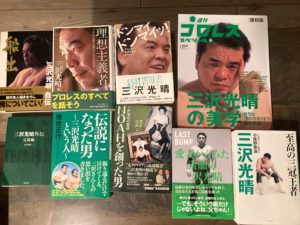
We open this section with a quote from Jun Akiyama shortly after the 1996 Tag League about the style escalating, to the point that he calls it “ultimate pro wrestling where you can’t take a bump”. Akiyama feels fear and concern that continuing in this escalating style will shorten his life. There’s also a useful analogy in Ichinose’s Four Kings bio to apply here as he notes that 1996 wasn’t all that bad for AJPW as a business but the Kings’ bodies were getting worn out day after day:
“Baba likely didn’t have the luxury to decide to abandon the familiar path and forge ahead on a different one. The driver, Baba, grips the steering wheel amidst familiar scenery. However, he adheres to the speed limit. That is Baba’s way, and the orthodox driving style of All Japan. Still, the tires wear down day by day. The role of the tires was played by the Four Heavenly Kings.” – Ichinose
(APOD: It’s also a bit ironic that the driver/bus analogy is used here since Akira Taue, who previously was dismissed as the weakest King “was a passenger along for the ride”, was actually so integral to the Kings’ success, that he could be considered the real driver in their matches. It’s also amusing that, before turning into a pro-wrestler, he contemplated becoming a truck driver).
At the same time the Kings themselves had, through training, reached a point higher than everyone else, which further corroborates Akiyama’s previous comments about not being worthy of being lumped in together with them as the Five Strengths. By 1997 there were very clear examples of techniques in which one couldn’t take a bump: Misawa’s throwaway German suplex, Dr. Death’s and Kawada’s Dangerous Backdrops, Kobashi’s Half-Nelson suplex, Kawada’s Sheerdrop Brainbuster, Gary Albright’s German and full nelson suplexes, and Akira Taue’s Cliff Nodowa. In response to these escalating techniques Misawa creates something unique to him: the spinning bump, a technique that avoids being driven to the mat by rotating in the air while jumping, simultaneously dissipating the impact (APOD: The closest WWE equivalent I can think of is the land-on-your-belly German suplex seen in the Kurt Angle/Chris Benoit match from Royal Rumble 2003). Misawa explains the creation of this new technique, as well as his willingness to take such dangerous moves, as the results of needing the audience to understand the pain he’s experiencing as a wrestler:
“There’s a pain that the audience can’t understand. If I get hit in a sensitive spot when the audience can’t see it, I can’t show that I’m in pain. When I get hit in the groin and can’t move, I think, “If I jump now, it would look bad.” Also, it’s hard to convey what happens to the head. If I get my neck caught, the audience wouldn’t understand. Ordinary people don’t fall on their heads. They wouldn’t fall on their backs either. So even if it looks painful, the audience doesn’t really get it, right? “It hurts way more than you think,” something like that. There are times I wish that would come across. Well, I don’t like taking any move, but I think if I start to avoid them, it would be time to leave the ring.” – Misawa, 2005
Referee Kyohei Wada is then asked about his experiences refereeing the Four Kings’ matches. Though I will cover his books in more detail later on, here Wada finds himself in a position of deciding whether to end matches on the wrestlers’ behalves if things get too risky. He recalls times earlier in the decade when he was telling someone like Misawa or Kawada that he was going to stop the match but the wrestler told him not to. He also recalls hearing someone say in the locker room, dismissively, “oh, I must’ve got a concussion again”. Here Kawada gives another accurate and somewhat depressing summary of why the wrestling continued to escalate:
“We had to keep doing more of what the audience wanted, and that raised the level. If we did anything beyond that, we wouldn’t know when we might die. So, in terms of attracting customers, I envied New Japan. Because only the customers who came to our matches could understand the quality of those matches.” – Kawada
(APOD: I can’t say I really blame Kawada for this statement because he and the other Kings were trapped. Business was either stagnating or slowing and so they had to rely more and more on their existing audience. To keep that particular group of people satisfied the Kings had to put more strain on their bodies and up the ante to the point that they were taking risks, as Osano puts it here, on a razor’s edge. Given how badly everyone was hurt during this period it’s no wonder that, once given the slightest taste of power and authority, Misawa starts changing things left and right in the hope of making the wrestlers’ lives easier, as we will see in the next section).
At the same time there the flipside of this argument courtesy of Kenta Kobashi. He claims that everyone knew what they were getting themselves into, that there’s no such thing as danger-free pro-wrestling, and that the style of wrestling was more about the story of elevating risk (i.e. I have to go farther than before to win this time) rather than the actual execution of that story through increasingly-risky head spike techniques:
“Four Kings Pro Wrestling is often said to be dangerous or risky, but that’s not really the case. It’s about the obsession with winning, that’s what Four Kings Pro Wrestling is. It’s about elevating the intensity to ‘more, more!’ in order to win. I had the feeling that I could do anything with Misawa. That’s why the Burning Hammer was created (laughs). We both had the attitude of ‘bring it on!’ We weren’t numb to the danger; we knew ‘this is dangerous, but if I don’t go this far, I can’t win against this person!’ Misawa also had the mindset of ‘if you can do it, then go ahead and try!’ I felt the magnitude of that attitude and openness. During the matches, I felt that ‘bring it on, but in return, I’m going to go all out too!’” – Kobashi
Another defender of the style is booker/matchmaker Masanobu Fuchi who played an integral role in developing all four of these wrestlers and their techniques. According to him, reducing the Four Kings’ wrestling to simple head drops is insulting to them and their legacies (especially Misawa’s, given what happened later), and it was more about the build up to those nail-biting interactions than the actual techniques that were used:
“It’s insulting to reduce Four Kings Pro Wrestling to just ‘pro wrestling where you drop someone on their head.’ That is indeed one element, but the true essence of Four Kings Pro Wrestling leading up to that point is a wrestling style that values techniques and evokes joy and excitement in the audience, and it was performed by people who could do that.
While dropping someone on their head can be a surprise, the thrill leading up to that moment is shown through fundamental techniques, and there is timing involved as well. The exchanges in Four Kings had a human touch. Even if you wanted to quickly establish dominance by executing a technique, there are plenty of moments where you end up on your back, catching your breath. Even if you want to cover quickly, the damage you’ve taken is too great to do so. I think that’s where the human element was present.
I believe today’s wrestling, which runs around to excite the audience, is also tough, but if it’s just back-and-forth techniques, it feels more like a battle between cyborgs rather than humans, and the impact of the techniques doesn’t come across. In Four Kings Pro Wrestling, there was a struggle to avoid techniques desperately, or after taking a big move, you would feel like ‘I’m done’ and roll out of the ring to escape; that had a sense of humanity. I think that’s where the audience could emotionally connect.
Four Kings Pro Wrestling attracted the audience from the process of showcasing that. And the Four Kings had a trust backed by solid technique. There was also trust from the fans that there would never be ambiguous matches. The nature of wrestlers is such that fans were surprised by it, but they were always striving for ‘higher, higher!’ and never satisfied with themselves, always aiming for more. For example, even though they could have used a submission technique, they still went for the three-count.”
Back to Misawa’s unique spin bump, Osano credits Misawa’s natural springiness and his gymnastics background as reasons for his ability to take falls on the nape of his neck as opposed to on his back or on his head (APOD: Mitsuo Momota, the son of Rikidozan who spent a long time in AJPW and who observed Misawa from his days as a rookie, also corroborated this and noted that it was something Misawa was born with). from his perspective no one else could do this and when he added a roll to his momentum he was further able to disperse the impact and not take all of hit in a jarring impact right to the head (APOD: there are many later Misawa matches that show this in action. He’d take a suplex and land either on his stomach or high on his nape and roll over, especially when taking moves at ringside. From reading this explanation it’s clear that Misawa’s gymnastics background ended up being critical to his success, and it’s no wonder that having that kind of experience might prove extremely useful to later wrestlers as well).
A great example of Misawa applying this bump is the next section which covers what is considered the peak of the Four Heavenly Kings wrestling: Misawa vs. Kobashi, January 20, 1997.
This has been covered extensively before but it is widely considered the pinnacle of the Misawa/Kobashi style. Meltzer ONLY rated ****3/4 when he first saw it but that was because he only ever saw the cut televised version of it. If he was watching it by today’s metrics, or had he rewatched the full unedited version I’m confident he’d rate it 6-stars or higher, it was that great of a match. Had Bret vs. Austin at WrestleMania 13 not happened I’m fairly confident this would’ve been voted Match of the Year and Misawa/Kobashi would’ve won MOTY three years in a row.
Going into this match Kobashi was struggling to reach the same summit as the other three Kings. He was champion but not ace, not by a long shot. Misawa, Kawada, and Taue were all above him in some way, especially given their respective backgrounds and previous accomplishments. Kobashi needed an upward climb to touch the same summit and was, in some ways, fingertips away. He beat Taue to win the title, retained against Stan Hansen, and went to a 60-minute draw with Kawada. But now standing across the ring from him was Misawa, his former partner. In Ichinose’s Four Kings Bio it’s explained that Misawa and Kobashi had the greatest chemistry out of any combination of the Four Kings because they understood each other better than anyone else. Misawa was able to unleash everything on Kobashi and vice-versa, leading to neither man holding back. As a result Misawa describes 1/20/97 as “a fight only Kobashi and I understand”, while Kobashi famously writes in many different places that he calls his mother and tells her “if something happens to me [in this match], please don’t hold it against Misawa”. Misawa sees this match as an opportunity to finally perfect his style of match, noting,
“But I wasn’t as strong as I am now [in January 1997]. Every single technique is important. I want to cherish each technique, and I don’t want to make mistakes. I want to have a good match for myself and for my opponent. Normally, when I’m wrestling with other wrestlers, it ends with wanting to have a good match. The opponent will come at you even more. I believe that’s what being a professional is about, and as a professional, you have to have those kinds of matches. I think that’s the fate of those who live in the ring. And I believe that leads to elegance.” – Misawa
In SUPREME, Osano goes over the match’s key details, noting how both men kept pushing at the same pace despite hitting exhausting and powerful techniques on each other. Baba is particularly impressed from ringside by Misawa’s ability to execute that spinning bump over twenty minutes in. They kept going for 42 minutes when Misawa, having run through everything in his arsenal, including executing a Tiger Driver ’91 that Kobashi kicked out of, blasted the champion with a running elbow smash to win the title.
After all of this Misawa praises Kobashi, stating:
“To be honest, considering the feelings before and after fighting Kobashi, it’s really tough (laughs). I’m already resigned to it. There’s a part of me that thinks, ‘If you can do it, then go ahead!’ and another part that feels, ‘If it’s come to this, I have to do it too!’ It’s a sense of trust that’s a bit different from the ordinary. I think, ‘If I’m going to be beaten by this guy, then so be it,’ and with him, I can go all out without holding back. So, after the match, it actually boosts my confidence. But still, it’s tough when I’m asked for ‘more than that, beyond that!’ (laughs). I don’t know if I can go any higher, but I believe this is my best.” – Misawa
From here we shift to the 1997 Champion Carnival where another important development occurs as Kobashi pins Misawa in a one-on-one setting for the first time. However this is a win with an asterisk because Misawa was working injured, having suffered a minor neck injury four days earlier after taking an Avalanche Exploder from Akiyama awkwardly and landing on the canvas head-first. Somewhat hauntingly Misawa states about the state of his body: “My upper body is numb; it might have affected my spine…”
In SUPREME the order of affairs is a bit off because Osano stays focused on the Misawa-Kobashi dynamic more, noting how Kobashi attempted to push further throughout the year, including in a Triple Crown rematch against Misawa in October that year. By that time Misawa already weighed 120kg but he was still pulling off dives and planchas to the floor because such high risks were needed to beat Kobashi. In response Kobashi launched Misawa with his trademark Half-Nelson suplex, aggravating Misawa’s neck pain. Things escalated further in the ring with multiple elbows, suplexes, kicks, counters, dives, lariats, and, of course, 2.9 counts. This time, Misawa’s Tiger Driver ’91 was enough to pin Kobashi and enabled him to retain the title which sent the crowd into a frenzy. It is noted that the Nippon Budokan crowd started chanting “Zen Nippon” after the match ended, which was a major factor in what came next in the Tokyo Sports Puroresu Awards. Osano, as editor-in-chief of Weekly Gong, attended the selection meeting for the Best Bout award and for 1997 it came down to the two Misawa/Kobashi matches as potential winners. Although Osano recalls voting for the October match as the best bout – in response to this unexpected chant and the fact that it was a memorial event in Nippon Budokan – in hindsight he thinks that the January 20 match was better overall.
(APOD: Here are both matches, for your consideration. Both are amazing and among the best wrestling matches you will ever see):
Osano turns the clock back to focus on Kawada and notes how he experiences his own developments against Misawa. He draws with Misawa in the opening round of the 97 CC (APOD: no orbital bone breaks this time), and then wins in about six minutes in the finals of that tournament which had a rare playoff conclusion since Kawada, Misawa, and Kobashi all finished the tournament with the same number of points. But once again when it came to Triple Crown matches Kawada fell short. However, the June 6, 1997 match between Misawa and Kawada is perhaps the most outwardly aggressive and intense out of all of them, with Kawada blurring the line between wrestling and fighting more than ever before. (APOD: prior to getting my hands on all of these books I believed the narrative that Misawa was intentionally antagonizing Kawada in order to bring out the best in him in their matches. However, so far I’ve found no explicit written proof that Misawa actually did this on purpose. But if there was ever a match that gave credence to this idea, it’s this one).
Aside from the match’s intensity and escalation in keeping with the in-house style this match is also somewhat famous for what is presumed to be a botched finish, with referee Wada failing to count to three when Kawada’s shoulder hadn’t moved. However Wada passionately denies this:
“’That was not a mistake. That was a kick-out. He kicked out, but his shoulder wasn’t up.’ I thought, ‘Hmm, he’s not kicking out,’ but I saw Kawada’s legs move. I thought, ‘Ah, he really is kicking out!’ but I couldn’t count. So I didn’t hesitate there. Misawa was like, ‘Huh!? He didn’t kick out!’ But I said, ‘He did kick out.’ Then the referee understood, ‘Got it!’ That moment was really just a split second, but there was a long drama between Misawa and me. And then Misawa threw Kawada, who was in a dead state, with a German suplex; that’s amazing. Wrestlers intentionally try to take the move, so they can be thrown accordingly, but he forcefully threw a lifeless body. And then I said, ‘Okay, I’m satisfied with this. It’s three!’ and raised Misawa’s hand, to which Misawa responded, ‘How about that!’ It was a conversation of ‘Well done!’ Actually, we didn’t talk, but it was a conversation in our hearts. In less than a minute, we were fighting intensely in the ring. I still remember that vividly. Because the responsibility was heavy, I can confidently say, ‘That was a kick-out,'” – Kyohei Wada
After this match Misawa begins to ponder how long he can continue wrestling like this. He notes that he definitely can’t have 100 matches like this in the future and he’s starting to feel desperate for something to change. At this point Misawa’s only 35 years old, which is in some ways considered the prime or peak for an average pro-wrestling. But Misawa is anything but average and he starts to think if some change can be realized to conserve his body. Kawada, too, reflects on how much the physical toll is taking on him and notes that, from here on out, he’s going to try and take a more “relaxed” approach to matches:
“I think I’ve reached a point of closure with Mitsuharu Misawa. Honestly, my body is falling apart. From now on, I want to challenge everything with a more relaxed attitude, rather than being overly motivated with ‘Misawa, Misawa!’ Today marks a closure, and I would be happy if those who supported us understood that this is the brand of Kawada and Misawa.” – Kawada
(APOD: Despite these comments Kawada would go on to have at least two more career-defining performances, one against Misawa in the Tokyo Dome and then a month later in one of his best-ever singles matches against Kobashi in June 1998).
Osano also notes that with this sense of closure on the Misawa/Kawada rivalry he concludes that this June 97 match might be the pair’s best outing (APOD: This is a growing sentiment elsewhere, especially with the pair’s much-vaunted 6-3-94 outing somewhat losing its luster over time). At the same time Misawa makes another important comment about defending the title and how this, too, proves to be a struggle as he has to balance living up to expectations in a title defense with conserving his body:
“There is a desire to defend the title as many times as possible. Looking back, I can’t believe I defended it seven times during my first reign. It was tough, honestly. I thought, ‘Can I really do it seven times?’ That was my honest feeling. It was painful, to be honest (laughs). But I want to protect my matches, and I want to be a role model and a wall for the younger generation. For that, I have to keep pushing myself. In a good way, now I feel like, ‘The young guys are working hard, so I have to work hard too.’ There are parts where the younger guys are making me work harder. I want to keep that going,” – Misawa
After defeating Kawada once again, Misawa cycles through more title challengers. That summer he retains against Taue in a match as is remembered for, among other things, Misawa countering Taue’s feared Cliff Nodowa with a midair rotation and landing on his feet. Then in September he defends against Jun Akiyama in a match that’s considered underwhelming (APOD: and in other places online is considered something of a burial of Akiyama compared to, for example, Kobashi’s first foray into Triple Crown matches three years earlier). We get more background info on Misawa’s singles matches with Akiyama, with how Akiyama adapted to such situations so quickly and how he “had multiple concussions”. In a surprising turn Akiyama describes here developing an outright phobia of Misawa’s spinkick which is another manifestation of panic issues he had been experiencing more or less since the start of his wrestling career. This situation is elaborated on a bit further in Ichinose’s Four Kings bio. Akiyama apparently experienced panic attacks and extreme bouts of nervousness that would cause him to sometimes go days without sleeping:
“I was troubled a lot. I couldn’t sleep. I fought matches without sleeping for 2-3 days. I overthought things, developed sleep disorders, and from there, panic disorder…” At that time, it could have been perceived as a form of shyness, so I didn’t find anything unnatural in his words. But looking back now, it seems that it was Akiyama’s defense mechanism not to let others notice his abnormal sweating.
“I was too embarrassed to tell anyone about my panic disorder. The only one who noticed was my wife. I felt like my brain malfunctioned under pressure. While taking a shower, my heart suddenly started pounding. I thought I was having a heart attack, so I went outside and had my wife call an ambulance. In the end, by the time I heard the sound of the ambulance, it had calmed down, but that made me afraid to take baths. I became scared of enclosed spaces. Shinkansen, airplanes… especially airplanes were tough. The moment the door closed, I would pinch the inside of my thigh to try to forget the discomfort through the pain. At that time, there were many singles matches with higher-ups besides title matches. When I thought about what I should do for those, my sympathetic nervous system would dominate, I would get excited, and I couldn’t sleep.” – Jun Akiyama in Ichinose’s Four Kings Bio
(APOD: I figured I’d include this to show just how challenging things were for Akiyama and how much physical and mental strength he had to display to not just wrestle in the ring but wrestle in this demanding style AND put on such incredible matches. For him to do so well in these matches despite these mental roadblocks is but another reasons why these wrestlers have earned so much praise over time).
Akiyama notes that initially he refused any sort of world title challenge because he didn’t consider himself worthy but come September 1997 with Baba’s blessing he accepted. However despite opening with a “monster” performance it’s noted that his timing was off. The subtext here is that Akiyama was dealing with the “weight” of the Triple Crown (read: pressure of the world title situation) while Misawa had his usual laundry list of nagging injuries somewhat holding him back. In particular Misawa collapsed his own bridge during a Tiger Suplex, hurting his own neck in the process. Still Misawa wins but he notes he is dissatisfied with this performance. Strangely this section completely ignores Misawa’s other two Triple Crown defenses, both of which were against Steve Williams, and one of them being the final match refereed by legendary referee Joe Higuchi. However I’ll capture more of Higuchi’s comments later on when we start talking about the formation of Pro Wrestling NOAH.
Staying on the subject of Akiyama, Osano notes that there’s a marked improvement in Akiyama’s wrestling between September 1997 and January 1998 when he challenges for the Triple Crown again. This match sees no problems with timing or pressure and Akiyama shows far more aggression and smoothness in his motions. He wrestles smartly and attacks Misawa’s neck with, among other things, a Pedigree, a Tombstone on the ringside mats, Tsuruta-style jumping knees, Akiyama stealing Misawa’s Tiger Driver, and some mat wrestling reminiscent of an earlier time. (APOD: This match is markedly different from Misawa’s singles matches with other guys and sees more storytelling through Akiyama stealing moves. It’s not as directly impactful as other Four Kings matches and is in some ways lighter and safer by comparison. But by no means is it inferior; in many ways it’s just as good as some of Misawa’s epic singles matches from his peak). However, as good as Akiyama is in this match (APOD: and he is VERY good), Misawa proves to be one step ahead as he turns the match around and ends the match with his newest invention, a sideways sort of Tombstone Piledriver that would eventually become known as the Emerald Flowsion.
(APOD: This move has been mistranslated time and again and was supposed to be called “The Frozen Emerald” in tribute to Misawa’s color scheme and because frozen emeralds shatter. However the mistranslated word “flowsion/frozian/frosien” seems to have stuck and is still used to this day).
Explaining the move Misawa states,
“It’s an application of the Oklahoma Stampede. When I first did it to Akiyama, the grip was reversed. That way, it falls vertically, but it’s difficult to shift your weight and takes time, so it became the current form. Well, the opponent realizes they’re in that position and tries to tuck their neck in, right? So, it becomes harder for any move to connect. But it’s easy to improve; you can transition into a brain buster from that position, adjust the angle based on the opponent’s ability to take the fall, and you can also enter from a body slam without switching grips. It’s a technique that allows for adaptability” – Misawa
After retaining once again at the end of February 1998 against Johnny Ace (APOD: Yes, Johnny Ace wrestled in a Triple Crown title match, imagine that) Giant Baba announces that AJPW will be making its first foray into the Tokyo Dome with the main event match being announced as Misawa vs. Kawada. Because of this announcement both Misawa & Kawada strive to win the 1998 CC but it’s Akiyama, not Kawada, who makes it to the finals, only to lose to Misawa. This is likely to keep Kawada fresh ahead of the already-announced Dome main event. But once again Misawa finds himself struggling with pain and injury. A few days before the tournament starts he begins experiencing lower back pain and then a singles match with Taue worsens his neck injury further. He also suffers from bronchitis due to a cold and ruptures a ligament in his ring finger. Then on April 9th, midway through the tournament, an examination reveals he has a fractured patella tendon. This is all incredibly painful, so one can imagine how much it hurt when Akiyama uses leg-targeting moves in their CC finals match like knee crushers, dragon screws, Figure-4s, and a sharpshooter (APOD: It appears that for all of Baba’s talk of wrestling being “gentlemanly” the wrestlers didn’t adhere to or uphold any sort of gentleman’s agreement not to attack obvious weaknesses or injuries. If anything being weak like that was expected to be exploited, as seen with many matches through the 1990s in which a taped-up body part was directly attacked, ignoring injuries, tears, and all of that. While we can debate whether that sort of approach is right or wrong ad nauseam, it can’t be denied that the wrestlers overcoming those sort of attacks is one of the appeals in this superhuman wrestling style). It seemed like Akiyama was destined to win and the entire match was built around that narrative…yet Misawa needed to win, otherwise there would be no point in him facing Kawada in the Dome. Thus Misawa channeled all of his mental strength to fight back and win, thus preserving his spot in the Dome while Akiyama had something of a consolation prize in an exhibition match with fellow Senshu University wrestling team alumnus Hiroshi Hase.
After this match Akiyama expresses his opinions on how mentally tough Misawa was for sticking through despite having so many injuries, yet at the same time he notes how such an attitude would be unacceptable in the present day:
“Top athletes must continue to stand in the ring without expressing pain… Misawa never said it out loud, so it became a given. Conversely, it felt like he was saying, ‘You guys, this is how it is!’ very forcefully, without speaking. So even if I was slightly injured, I never thought about resting. I was in the ring even after suffering concussions three days in a row. Nowadays, that’s unacceptable. It’s unacceptable, but I believe that’s what top athletes do. Regardless of the condition, once you’re in the ring, you just go for it. There’s no other way. Misawa had a bad neck, right? Until then, he would say ‘I’m fine!’ even when his neck was being pulled hard, but a few months before he passed away, I heard him say, ‘This is tough.’ At that time, his neck was so bad that he couldn’t move his arms behind his back, so I asked him, ‘Are you okay?’ and he said, ‘It’s tough.’ That was the first time in nearly 20 years that I heard him say ‘tough.’ That might have been his limit. He pushed past his limits, and I think he continued to wrestle for a few months after that. He was incredibly strong. His sense of responsibility as a top athlete was truly remarkable.” – Jun Akiyama
From here conversations shift to the Dome show itself, which had been rumored as early as 1996. Baba comments that he didn’t care about making a profit from this show; as long as the company doesn’t go into the red, they’re fine. To him this show is “fan service”. Rumors circulate that the show was meant to feature heavy involvement from WWF/E with Barry Windham and Justin Bradshaw playing a role (APOD: When I spoke to Bradshaw ahead of his Cauliflower Alley Club induction, he mentioned to me that he was allowed to participate in the 1997 Tag League because he didn’t think his WWF contract was going to be renewed). It’s further noted that WWF’s then-Vice President Bruce Prichard and Executive Manager Jerry Brisco visisted to observe AJPW’s wrestling and to established a friendly relationship between the two companies. However, this arrangement doesn’t fully materialize (APOD: in Chris Charlton’s book EGGSHELLS about wrestling in the Tokyo Dome Jim Ross states that AJPW believed that the initially proposed WWF talents weren’t over enough in Japan and thus weren’t worth the money being proposed) and a compromise comes in the form of Vader wrestling in an All Japan ring for the first time.
This section concludes with the Misawa/Kawada Dome match and how both men were under extra pressure to perform at a high standard despite ever-increasing wear-and-tear on their bodies. Misawa publicly comments on how his body is out of balance and he feels exhausted and after a Carnival match with Kawada he strongly suspects Kawada feels the same. There is an air of concern in Misawa’s tone as he doesn’t recall ever feeling this tired. Meanwhile, Kawada notes that while he knows he can’t return to his previous physical condition he will still strive for perfection by putting himself in the right mental headspace ahead of the Dome match. Then the match occurs. There’s a narrative that Kawada wrestles in a way that seeks to break Misawa’s body which is shown with Misawa’s unusually pained expression and exclamations that reach the 58,300 fans in the Dome. The accumulation of years of wrestling shows itself subtly in the match as Misawa’s usual bridges on his techniques are lower than usual. And after almost thirty minutes Kawada finally achieves his years-long dream of beating Misawa for the Triple Crown. What started six years earlier on AJPW’s 20th Anniversary Show and evolved through numerous brutal singles and tag matches has finally ended.
Though Kawada claims in his book that this was one of his proudest moments, Osano notes that this was far below their peak as performers. But that’s to be expected given the reality of their physical conditions. Osano notes that it’s a miracle Misawa could even stand in the Dome, much less wrestle. Though Osano notes that this was the biggest show in AJPW’s history, it was without doubt a sign that the era of the Four Heavenly Kings was over. The rest of SUPREME goes into an epilogue and provides supplementary information on what happens throughout the rest of 1998 and onwards. However from here, with the focus shifting more towards Misawa’s backstage challenges, SUPREME will move from being the primary focus to another supplementary source for the events to come.
APOD: This was a lot to get through but I felt it necessary because Misawa’s trials and tribulations during this period help setup the next section. With the Dome show concluded Misawa takes some much-needed time off from in-ring activity and begins focusing on the business side of things. It’s around this time that Misawa starts being more directly groomed to take over the entire company from Baba and so he is expected to handle more responsibilities. But as we all know this period would be marked by significant turmoil and backstage disagreement that would, ultimately, lead to the NOAH Exodus. By emphasizing all of the in-ring sacrifices experienced by both Misawa and his peers I hope to set the stage for the changes Misawa wanted to implement once he was blessed with authority to do so. But as we will see next Misawa’s proposed changes, most of which were done with the intent of lightening the load the wrestlers themselves faced, would be met with everything from backlash to further dwindling audiences.
I know there’s a largely depressing tone through all of this, especially how these men had to wear their bodies down to the bone [and then some] for the audience’s satisfaction. So to try and soften things ahead of the next section here’s a little treat for all of you for getting this far: a short clip of Misawa, Kawada, and Kobashi acting like goofballs on Japanese TV:
Thanks for reading.