

5-Star BOOK Reviews: Mitsuharu Misawa’s Books, Part XII
By Alex Podgorski on 28 July 2025
Last time we looked at Mitsuharu Misawa’s situation he was about to captain his ark into a maelstrom. He left All Japan Pro-Wrestling suddenly and under acrimonious circumstances, no longer able to continue dealing with constant refusal from Motoko Baba. Frustrated with arguments in the boardroom and uncertainty over AJPW’s finances, Misawa left to form his own company. But instead of having a manageable number of followers on his ark, Misawa and his right-hand man Ryu Nakata ended up having way more people aboard than what he had room for.
You can read part 1 here, part 2 here, part 3 here, part 4 here, part 5 here, part 6 here, part 7 here, part 8 here, part 9 here, part 10 here, and part 11 here.
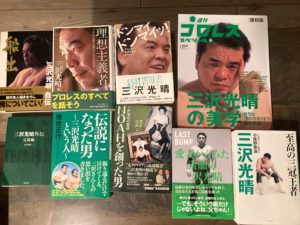
We begin this section with anecdotes from Nakata’s perspective. Though Misawa was the public face of this new promotion Nakata had the unenviable task of managing the money and business end of things. As noted in the last part, by the time discussions, press conferences, and negotiations all ended, Misawa had 50 people under him while the initially proposed budget for their operation was for something FAR smaller. It was only after the company’s formal management structure was finalized that Nakata realized that this still-unnamed promotion didn’t have ANY money. They had so little money that initial press conferences couldn’t be held at hotels; instead they’d use the Differ Ariake building which also served as their main business office and dojo. Nakata describes “borrowing from wherever he could” and chasing rumors that “the president of so-and-so company likes pro-wrestling” and going to those companies with Misawa, only for them to be dismissed. In one instance Nakata recalls a supporter agreeing to help them, only for him to suddenly pass away before anything could be finalized.
In another instance, Nakata recalls one company offering them a loan of ¥200,000,000 (about $USD 2million) but the conditions of the loan would leave Misawa and all of his followers as de facto employees of this company, which defeated the purpose of Misawa and co. “going independent” in the first place. Misawa, desperate to protect the livelihoods of his people, reluctantly accepted, only to be convinced to back out at the last moment after talking things over with Nakata some more. This led to some hostile arguments with the other company, who at times subjected him to hours of yelling and desk-pounding that would start at 9pm and end at 6am the next day. Misawa, in DEPARTURE, recalls a proposed partnership with Yoshimoto Kogyo, an entertainment company, but backed out for these same reasons.
Things were financially unstable for the promotion until the spring of 2001. Nakata’s wife was forced to sell her diamond-studded Rolex, valued at ~$13,000.00, for $5,000.00. Nakata, however, didn’t sell his watch – a Rolex GMT-Master first released around 50 years earlier – because it was a keepsake from Baba himself.
On the days he wasn’t scrambling with Nakata to try and secure funds, Misawa, in DEPARTURE, describes drinking on a nightly basis because it was a coping mechanism to deal with his intensely stressful situation. He recalls doing many public appearances and doing interviews, which made him feel like a celebrity. He admits he didn’t like having this type of spotlight shined on him; he would’ve rather used these opportunities to put over the other wrestlers but still accepted that he was the face of the company. By this time the name “NOAH” was already confirmed
But how did Misawa personally feel about the situation, taking his experiences with Baba and Motoko out of the equation? Well, he was very much torn. Misawa describes receiving letters from older fans who wanted him to continue the Royal Road style that made him and his colleagues famous. At the same time he wanted to appeal to younger audiences specifically and change things up (APOD: ah, the inevitable conflict between appealing to the established, entrenched audience and drawing in newer fans who might want something different…can’t satisfy them both). Misawa also admits to being bothered by AJPW fans calling him a “traitor” for his decisions.
Because of the tense and frantic situation, NOAH had to sell tickets for their first show as soon as possible. As you may recall in my Kobashi book reviews, initial plans were for NOAH’s inaugural shows to take place in October 2000. And in his book Nakata recalls offers to run this inaugural show in either Korakuen Hall or Nippon Budokan. But because the company had no money and everyone had families to support, they had to sell tickets ASAP. Even running in gyms cost a few thousand yen, which is a few thousand yen more than what the company had. So NOAH pushed its first event to August to make the most out of a panicked situation (though it also affected Kobashi’s surgery plans and would end up costing him over a year of his career).
Nakata also reveals that there was plenty of internal discussion on running the opening event from Nippon Budokan but they didn’t for two reasons. The first one was financial: NOAH had no money to run the venue and the owners of both the Budokan and Korakuen (a much smaller venue but one that’s still historically significant for pro-wrestling), require large deposits upfront. Second, Misawa didn’t think it was right to launch NOAH from such a big venue when it was still unproven in a smaller venue. To Misawa, it was more important to earn the right to showcase their product from the Budokan because he believed the audience would support them more if they worked their way up.
Ultimately Misawa and Nakata selected Differ Ariake as their home base. That 1246-seat venue was promoted as a space specifically dedicated to wrestling and martial arts, and it had dedicated office space as well that would double as NOAH’s dojo. Nakata recalls first approaching the owners of the venue before it was built because it would’ve been another venue in the Tokyo area to run AJPW events. the timing of this relationship proved beneficial because Nakata recalls asking the venue’s owners to install more women’s restrooms in the venue. His reasoning for this was that AJPW – and later NOAH – had a larger number of female fans and he noticed long lines at for the women’s restrooms at other venues like Korakuen, which in turn would cause said fans to miss matches. Nakata wanted to prevent this (and ensure more fans would be purely focused on whatever show they were there for) and the owners agreed; it’s said that Differ Ariake would achieve a significantly boosted reputation following these changes.
Nakata also took a direct role in the venue’s design to align with the success of NOAH’s first show. Knowing the critical importance of first impressions, Nakata worked hand-in-hand with Differ Ariake’s owners and design team to make sure it was a good experience from the audience’s perspective. To this end air conditioning was included, despite initial protestations from the owners. Tiered seating was added to make it easier to see the ring. Rather than have fixed seating, Nakata suggested versatile so that it could be used for various purposes. Then there was the office space above. Differ wanted ¥500,000 per month but Misawa could only afford ¥300,000. Also, with each passing interaction Nakata would approach the president of Differ to include more space in the venue. First it was two or three rooms for office space. Then two more meters, then two more, and more, until all of the floor space was used up by NOAH.
But despite some affordable space and some positives, Differ Ariake had one problem: it had a poor location. Unlike Nippon Budokan (located on the grounds of the Tokyo Imperial Palace), Tokyo Dome (right next to the busy Suidobashi station), and AJPW’s offices in Roppongi, Differ Ariake was located on one of the islands in Tokyo Bay and thus harder to get to especially for evening shows that may have ended past midnight. There were also other complaints by the NOAH staff like working in a poorly-ventilated building while the AC wasn’t fully operational, having to help remove weeds from the venue’s grounds to help with the owners, and cleaning dust. But Misawa led by example and refused to complain; Nakata argues that if Misawa shows signs of complaint then others would follow suit. Nakata also describes receiving lots of donations for NOAH, from fans and from NTV including office furniture and computers.
Nakata then pivots to the obvious question: out of all possible names, why did he choose Pro-Wrestling NOAH? After all, initial talks about the new promotion and the discussions from Baba’s side when he was still alive implied that, if Misawa were to leave, he’d “go do Misawa Pro-Wrestling as he wished”. Nakata was also apprehensive about this new chosen name since it wasn’t anything classical, nor did it adhere to any orthodox wrestling naming scheme. Misawa chose to name his promotion after the Old Testament story of Noah and his Ark for to conjure the very overt imagery of Noah and surviving the flood that destroyed the old world. Though Misawa wasn’t deifying himself, he saw his situation as he and his wrestlers embarking on an ark to avoid extinction and navigate new and uncharted waters. Ironically, Nakata also recalls that Misawa’s office would have a rat problem because their neighbor was a bread manufacturing company and rats would enter the Differ building in the winter, eat wrestlers’ snacks, and chew through phone wires until rat traps were installed.
As for why so many wrestlers chose to follow Misawa rather than stay in All Japan, DEPARTURE contains short interviews from some of his closest friends and allies. Kobashi’s first and he states that he was able to discuss things with Misawa frankly, which led to them having one mind when it came to their matches. Kobashi praises Misawa’s mental fortitude and again brushes off criticism about his style going too far, stating such escalation is necessary to beat Misawa and to overcome one’s own fear over using such techniques. He notes that Misawa isn’t the type to scold someone over a mistake and allows others to express themselves freely on ideas. However, if Misawa is stubborn about a specific thing he gets VERY stubborn about it (APOD: the Japanese word for standing/holding firm, “Ganbaru” is highly appropriate in this context and is the title of Jonathon Foye’s book on the Misawa/Motoko situation to which I contributed a few years ago. It’s a great book that adds more detail to this rich and interesting period in Japanese wrestling history).
Taue’s next and he praises Misawa’s in-ring skill (APOD: like that needs doing at this point). As a leader Taue believes Misawa’s good at taking care of his juniors and leads by example when it comes to managing relationships. Since wrestlers have close relationships that go beyond the typical Japanese boss-subordinate relationship you need someone special at the top who can really manage other people’s feelings and perspectives. Taue sees the NOAH situation as an opportunity for younger wrestlers to stand out and showcase what they can. He believes Misawa will steer the ship correctly and notes that he, too, will try to do more as he pleases going forward on his own path.
Akiyama’s next and the first thing he notes is Misawa’s relatively warm treatment of him during his initial start. To him Misawa’s way of speaking is usually taciturn and in a low voice, so even a single word or two carries much more weight and accuracy. Misawa also appears to be forgiving when the wrestlers go out drinking which Akiyama describes as extremely helpful given his initial mental roadblocks. Akiyama fully embraces the “freedom” aspect of Misawa’s NOAH and wants to create an atmosphere in which the wrestlers can create things that even surprise Misawa himself. Akiyama notes that under All Japan there was this overwhelming sense of “unification under one idea” which isn’t likely to be present in Misawa’s NOAH. Using himself as a comparison, Akiyama notes that he’s not good at listening but is good at expressing himself so when someone gives him an opinion he tries to reshape it into his way of thinking to try and convince them of his approach. He notes that this isn’t what a leader does and since Misawa doesn’t impose his opinions on others he makes for a quality leader.
Last is Yoshinari Ogawa, who describes getting into wrestling after seeing Misawa wrestle as a rookie. By the time Ogawa decides to join AJPW Misawa’s already on excursion to Mexico. Their early interactions in the dojo are overwhelmingly positive. Misawa’s approach to have them tag together is remarkably low-key with Misawa asking him at a bar after a show if they want to team together. Ogawa is initially surprised given the weight class division but Misawa confirms it’s ok, aligning with his Revolution changes. Ogawa echoes Kobashi’s above comments about Misawa showing exceptional mental fortitude in his ability to not show pain or the anguish he was enduring. Ogawa praises Misawa as trustworthy and reliable and expresses his confidence in both Misawa as president and in the NOAH he is going to create.
DEPARTURE concludes with Misawa preparing for, and eventually running, NOAH’s first event – also called “Departure” – as a two-night affair on August 5th and 6th. 1,800 people make it indoors but there’s so much interest that Misawa makes a bold decision: he sets up screens outside for some fans to watch for free. Though this is criticized as a business decision, Misawa’s wife Mayumi explains why it worked, as well as some of the other biggest changes Misawa would implement for this event and going forward:
“There was no dojo, no office. To put it another way, there was no funding to launch anything. Starting from nothing meant days spent running around with Nakata to gather sponsors. Pro Wrestling NOAH set sail at the event hall ‘DIFFER Ariake’ in the Koto Ward of Tokyo, which was undergoing redevelopment, thanks to the generosity of sponsors.
NOAH incorporated new ideas that had not been possible during the All Japan era. For the DIFFER Ariake opening matches on August 5 and 6, a large screen was installed for the audience that could not fit in the venue, costing 10 million yen. Although the management funds were tight, the staff intended to charge for admission, but Mitsuharu instructed them to make it free, saying, “It will definitely lead to something later.” In later years, new sponsors emerged from among those who attended for free.
In terms of production, laser beams were used before the entrance of the wrestlers, and a flower path was introduced during their entrance, with flames shooting up from the ring’s posts, enhancing the entertainment value and providing a live experience that rivaled concerts.
They also implemented match cards that incorporated the opinions of the wrestlers. Akiyama Jun’s wish to face New Japan wrestlers was granted, and Takayama Yoshihiro’s participation in mixed martial arts “PRIDE” was given the green light. Mitsuharu himself aimed to realize dream matches that fans desired, facing popular wrestlers from New Japan Pro Wrestling’s “Three Musketeers”—Muto Keiji, Chono Masahiro, and Hashimoto Shinya.
In addition to historic matches, they also held special events like fan appreciation days. During Halloween and Christmas, wrestlers transformed into special costumes and characters they had devised for “themed matches.” Initially, there were opposing opinions among the wrestlers, but due to the overwhelming popularity with fans, everyone began to participate from the following year.
As a company, they enhanced employee benefits. In professional wrestling organizations, when a wrestler is injured and unable to compete, their salary often decreases in stages as the duration of absence increases, ultimately leading to a state of no pay. Mitsuharu set a minimum guaranteed annual salary for wrestlers, focusing on stabilizing their lives during injury-related absences. Instead of leaving body maintenance to individuals, he mandated annual health check-ups like those in general companies. As a result, Kenta Kobashi’s kidney cancer was discovered early within a year. For wrestlers who transferred from other organizations, they investigated pension systems to confirm whether they had completed their payment periods, showing consideration for their second life plans.
As part of external activities, he cooperated with the Japan Transplant Support Association, driven by his feelings for Jumbo Tsuruta. Tsuruta passed away in May 2000 during a liver transplant surgery in the Philippines, just before Mitsuharu left All Japan. The shocking sudden death of the top wrestler led to the media waiting at Narita Airport for Tsuruta’s family returning from the Philippines. At the moment the camera flashes went off, Mitsuharu rushed to Tsuruta’s children, picking them up to shield them from the press. Since then, Mitsuharu participated in events for the Japan Transplant Support Association and continued to cooperate by setting up donation boxes at match venues.” – Mayumi Misawa
Misawa’s final words in his autobiography describe the matches on the inaugural Departure show being a bit…lacking. He suspects everyone was either tense or anxious over the company’s future. He suspects wrestlers having new costumes and new shoes as factors, likening it to being in a new skin for the first time. For his own match Misawa recalls Akiyama being out for something to prove and being both impressed and taken aback by how quickly Akiyama took him out of the match. These thoughts are abrupt, though, as Misawa focuses on proceedings as a show. He’s particularly happy about the use of lasers to make the show’s production feel more spectacular and how him switching from a jumper/jacket to a long gown for his entrance made such a big difference in his entrance. Lastly, he rates the first show a 60/100, but calls it a “good 60” and notes that they will continue to grow from here.
APOD: Misawa’s autobiography was one I was looking forward to reading the most but ended up the most disappointed by, hence the need to buy more supplemental material. The man is quite open about his personal life outside of wrestling and isn’t shy about admitting his own shortcomings as a person. And his rookie years are interesting as well since we get many interesting anecdotes about his experiences and thoughts as he goes through this period. But through it all there’s this sense that he’s only scratching the surface, only teasing with hints of ideas or goings-on that never go anywhere. Then, of course, there’s the biggest disappointment that he completely omits the entirety of his years as a peak performer, going from beating Tsuruta in June 1990 to discussing his plans for Departure. As a result we never get his personal thoughts on later matches, on how he feels as champion, on big changes around him, or on the period of the Four Heavenly Kings. For all of that we have to look at other books. Then again, it sort of makes sense that this book feels either rushed or incomplete: it was published in September 2000 and was probably meant to either serve as an accompanying piece to NOAH’s latest tour, or it was something Misawa could quickly release to supplement what little income he was getting from managing this fledging promotion. Either way DEPARTURE is a solid book that established who Mitsuharu Misawa the person is but leaves far too many details out to really feel like a comprehensive autobiography.
Final Rating: ****
APOD: Though this section wasn’t as shocking or revealing as last time it’s still filled with some interesting developments. The stories about Misawa and Nakata frantically looking for funds are filled with speculation: as most of you know by now NOAH had yakuza ties which were confirmed later by Akira Taue and Nakata was directly named as someone involved. Now obviously Nakata wasn’t going to reveal any of that in 2007; however, reading between the lines during that section about going from company to company implies that Nakata may or may not have been in contact with them during this period. It’s not referenced here but I read Vader’s autobiography and he recalls approaching Misawa at some point in 2000 when Differ Ariake was already completed and he implies Misawa was already aware of his obligations to the yakuza. However this is at best heresay and neither Misawa nor Nakata ever approached this matter as it related to NOAH. Still, there’s plenty of interesting information here about Misawa’s ambitions and the decisions he made as he tried to keep his promotion alive. Now we know how he was able to get NOAH started; next we’ll see how the company improves going forward.
Thanks for reading.