

5-Star BOOK Reviews: Mitsuharu Misawa’s Books, Part XVII
By Alex Podgorski on 13 October 2025
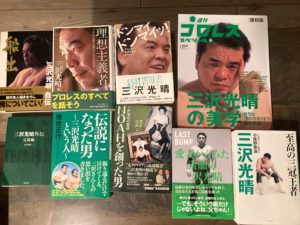
Last time we took an in-depth analysis of Mitsuharu Misawa’s death. This next section will cover perceptions of him and how many of his peers viewed him in the aftermath of his passing. Much of these summaries or views on Misawa will come from a very special edition of Weekly Pro Wrestling which devoted an entire issue to Misawa. Some of the entries included in this magazine were initially published in 2002 based on who was interviewed. It also includes a few comments from Misawa himself about different people as well.
You can read part 1 here, part 2 here, part 3 here, part 4 here, part 5 here, part 6 here, part 7 here, part 8 here, part 9 here, part 10 here, part 11 here, part 12 here, part 13 here, part 14 here part 15 here, and part 16 here.
Hiromichi/Samson/Kodo Fuyuki’s up first and he was a friend of Misawa’s as early as the 1980s. Both he and Misawa recall being scolded by seniors for trying flashy moves but once Misawa was in the same position he didn’t impose that same restriction on his juniors. One day Yoshinari Ogawa asks Misawa if he can use the Tiger Driver and Misawa replies, “Sure, go ahead”.
Misawa also makes an early clarification in this section about NOAH and how it’s supposedly about freedom. It is, but not entirely:
Freedom and selfishness are different. They don’t always realize how many people helped them get where they are. Do they really think they got here by their own power? They need to understand how many people moved to fulfill their wishes. They say, “I’ll take responsibility myself,” but they’re not in a position to do that yet. They just need to work hard to get there. No matter how strong you are, being able to draw crowds is something else entirely. Pro wrestlers don’t just have to be strong. I want them to know more about the world. Just being serious about wrestling isn’t enough. – Mitsuharu Misawa
Misawa also makes an early point that reinforces his “live for today, don’t worry about tomorrow” mindset, and recalls his mentor Jumbo Tsuruta giving him nutritional advice yet Misawa just ate whatever he wanted. He distinguishes stubbornness from selfishness and states he always strived to never reach the point of selfishness.
Fuyuki states that his friendship with Misawa transcended the senpai/koudai relationship. They got along very well with Misawa being one of the first to welcome Fuyuki into AJPW’s dojo. Misawa notes that he wasn’t the type to leave a friend suffering, especially if said anguish was taking place right in front of him. This is why Misawa hurriedly arranged Fuyuki’s retirement ceremony after he was diagnosed with cancer and had to stop wrestling as a result. Misawa didn’t do so for loss or gain, but merely to help out a friend in need.
“To be honest, after FMW went under, I had to look after the wrestlers, and I didn’t know what to do about the costs of surgery and hospitalization, so it really helped. Even on May 5th at Kawasaki, it was because NOAH sent so many wrestlers that it was a full house. But this isn’t a matter of debts and credits between Misawa and me. It was simply Misawa’s kindness, and I’m the kind of person who accepts kindness. Maybe the people at NOAH will get mad at me for saying this (laughs). But that’s just the kind of relationship Misawa and I have. I’m allowed to rely on Misawa, though I do it a bit hesitantly. No matter what, Misawa is kind. I know how to take advantage of that, because I’m good at that sort of thing (laughs).” – Hiromichi Fuyuki
Next is Mitsuo Momota who was involved with NOAH from the very beginning. Momota observed Misawa’s natural springiness from the moment he began training in the AJPW dojo and attributed it to something Misawa was born with. He also notes that Misawa never complained after matches and attributes it to an incredibly rare mental strength. These personal characteristics, combined with Misawa’s strong dedication to freedom and giving wrestlers more leeway to be creative in the ring, convinced Momota to join NOAH during the Exodus in 2000. Momota also notes that Misawa entered AJPW without much fanfare and wasn’t highlighted as an elite (APOD: I guess being a national amateur wrestling champion wasn’t ‘elite’ by AJPW standards) yet he still showcased both compassion and manliness throughout his professional live which, to Momota, was admirable.
Next is Big Van Vader who describes Misawa as the star quarterback wherever he wrestled. Vader describes a mutual respect between himself and Misawa which later developed into a deep sense of trust. Vader notes it’s hard to really and truly trust someone in wrestling but he could definitely trust Misawa both as a wrestler and as a businessman. He describes Misawa’s matches as like being on a rollercoaster and notes a similarity in this experience to New Japan matches during the same period. Sadly there isn’t much more as Vader sidetracks into talking about his own accomplishments, his bad decision in signing with WWF while still recovering from injury, and being astonished that Yoshihiro Takayama’s popularity skyrocketed despite losing all of his MMA fights.
After that we get Kenta Kobashi who, once again, focuses on his rivalry with Misawa and suspects it might’ve been one-sided on his part. He suspects Misawa didn’t see him as a direct rival but saw their matches together as opponents as expressions of Kobashi’s desire to challenge Misawa and Misawa went along with it. He takes immense pride in the Four Heavenly Kings’ matches and describes them as his wanting to have fights that no one else could have or put on.
Then it’s Jun Akiyama’s turn whose initial perception of Misawa was based on his work as Tiger Mask. Akiyama was exceptional in some ways as he entered into the company as the sort of elite Momota described earlier. But Akiyama didn’t feel jealousy from anyone and certainly not Misawa. Still, Akiyama was somewhat humbled when he first took Misawa’s first elbow, the impact of which doesn’t come across on TV no matter how well it’s shot on camera. As a partner Akiyama describes Misawa as ‘distant’ due to their very different positions on the card at the time. But even though he was booked to “surpass” Misawa by beating him in the ring Akiyama believes that he never achieved this. He also thinks that Misawa never imposed anything on him and that, if anything, he thinks Misawa had the more challenging role in their matches as someone who had to lead a largely-inexperienced Akiyama through pretty much everything. When it comes to facing Misawa one-on-one Akiyama states that no single strategy or mindset worked on Misawa because he was so hard to read and his style was such a mix of different things that no single approach worked.
Akiyama also notes that in some ways it’s a good thing that he never truly surpassed either Misawa or Kobashi because there’d be nothing for him to do had he achieved this. In some ways Akiyama believes that even if Misawa’s physical ability were to decline he still won’t be fully surpassed (APOD: In other words, Misawa’s aura would never fade). Lastly, as a boss Akiyama states that Misawa never outright rejected anything but if he had objections to something he’s do so passively by saying something like “that’s a bit tough” or “that might be difficult”.
Next is Naomichi Marufuji who was Misawa’s personal attendant for three years and arguably his biggest and most successful protégé. Marufuji describes never being scolded but Misawa would only get angry if a mistake was repeated, not for a first time. Misawa was also generous to him, letting him keep the change after Marufuji bought meals for his charge and letting him eat whatever he wanted as a trainee. In a more general sense Marufuji doesn’t recall anyone ever saying a bad word about Misawa behind his back. Marufuji attributes this to perhaps Misawa’s natural charisma and people naturally wanting to follow him.
Akira Taue’s next and though he first thought Misawa as quiet and reserved, he isn’t surprised that the conversation around Misawa has centered on his “greatness”. When they were still in the Kekki-gun (“Uprising Army”) stable they just determined Misawa was the leader based on seniority and age. Once they split they rarely spent time together; even when they ended up splitting a hotel room together they barely spoke to each other with Misawa playing one of his handheld games and Taue just read a book. And yet Taue assures that Misawa always took care of the people who followed him. Taue concludes by describing Misawa as “a stubborn old man loved by everyone”.
Then there’s another surprise in the form of Rusher Kimura, who by puroresu standards is FUCKING ANCIENT, being born in 1941, and at one point became a retainer for Baba for many years. He faced Misawa a few times over the years, both when he was masked and later after his unmasking. He followed Misawa to NOAH stating it just “felt natural” to do so. He and Misawa kept conversations short and direct, but here Kimura states he respected Misawa for working so hard as a wrestler and as a promoter.
The next is an entry from a female sports reporter in Tokyo who observed Misawa on a few occasions. Her name is Yuko Shimakura, apparently the first female reporter to cover pro-wrestling in Japan. Her presence bewildered some wrestlers who noted, for instance, they couldn’t walk around the locker room in towels (or less) and talk the way they did with male reporters. When she talked to Misawa for the first time, rather than be “overly considerate” he would make jokes to try and make her more comfortable. This had a domino effect on other wrestlers who, beforehand, felt awkward around a female reporter, but then warmed up to this at-the-time novel idea. She recalled him being cheerful and to her recollection he never lied to the media. The only time he ever got truly genuinely angry was if he believed someone betrayed a sense of duty. An example of this was when someone leaked to her that Takeshi Rikio joined the company and she went to Misawa to confirm. Misawa confirmed but politely asked her not to write the story because it had not been officially announced by the company. Which she respected because he had been so considerate to her, even if neglecting this story led to her being scolded by her boss.
Next is wrestler Tamon Honda who was an Olympic-level amateur wrestler and knew Misawa from those pre-AJPW amateur days. Though they were mostly in different weight divisions they did face off in a few regional tournaments which fermented a rivalry. Honda notes that during wrestling tournaments Misawa was someone who could be relied on to score points in team matches. And as noted early on in part 1, Misawa worked extremely hard to cut weight to drop an entire weight class/division so that he could perform in the National Sports Festival which was held in his home region of Tochigi. Unfortunately Honda doesn’t say much more about Misawa due to them ending up being so far apart as professional wrestlers. Yet there’s an undercurrent in his words about how he still ended up signing with AJPW and staying with NOAH, later becoming a trainer for the latter company. These details create a sort of unspoken understanding of Honda’s respect for Misawa. As a quick aside, Honda notes that it’s very difficult to fully apply amateur wrestling techniques to pro-wrestling and if you do try to use them they can disrupt the flow of a match which risks taking the excitement out of matches.
Next is famed referee Joe Higuchi, who followed Misawa to NOAH after refereeing many big Misawa matches. At first Higuchi didn’t have any special impression of Misawa, noting that he was simply tough enough to survive the initial training. He was also one of those traditionalists who didn’t like trainees using “special moves” as part of their growth process. He didn’t think trainees needed the springy Mexican style because to him it was dangerous and full of obstacles at ringside. But Misawa had a natural affinity for this lucha style. That said, Higuchi believes that if Misawa had gone to train in America instead of Mexico he would’ve been even better than he was.
Then the conversation shifts to Higuchi’s final match as a referee in 1997. After getting his retirement ceremony Misawa greeted him and said “thank you for your hard work”. This is a common enough phrase in Japan but apparently this helped bridge the gap between Higuchi and Misawa as individuals. This thoughtfulness is what led Higuchi to work with Misawa in NOAH despite of his limited capabilities in his old age as he believed Misawa was genuine and trustworthy. As a person, Higuchi deeply admires Misawa for having so many virtuous personality traits at – at the time – such a young age.
“It’s not just that I praise him because he’s the president. I think it’s amazing that, at his age, he possesses the most important Japanese values—humanity, loyalty, compassion, and thoughtfulness. I used to just think he was a good young man, but now, he’s leading so many staff and wrestlers, earning everyone’s trust, and working hard.” – Joe Higuchi
On the wrestling side Higuchi deeply respected Misawa’s stoicism and his unwillingness to show anger in the ring.
“If he’s in pain, or in a festive mood, Misawa doesn’t show those feelings outwardly. Instead, he tries to silently show the intensity and excitement of pro wrestling to the fans. He endures the pain and keeps going, and he never complains afterward. Of course, he might not be satisfied with himself. He might reflect and think he could have done better. Basically, in this business, if you don’t fight back when you’re attacked, you’ll just end up a weak man. Right? There are all kinds of things going on inside, but he doesn’t show them on his face—he shows it with his body in the ring. People who show everything on the outside are shallow. Those kinds of people are the first to run away.” – Higuchi
Higuchi contrasts three different wrestling eras in Japan: Rikidozan’s, Baba’s, and Misawa’s. The first had no rivals as it was introduced to Japan as a sport that moved people. Baba was presented as an elite sportsman who transitioned from baseball and, lacking in combat sports experience, had to start from the ground up by taking falls. Like Kobashi would decades later, Baba would have to work harder than everyone else to be respected in this new field. Misawa took from Baba and built himself from the ground up and Higuchi noted that Misawa really wanted to realize his own vision of wrestling which Higuchi encouraged from a distance.
Higuchi also recalls Misawa being particularly close to Haru Sonada, calling their relationship almost brotherly. They had similar personalities which is why Misawa learned quickly when receiving guidance from Sonada.
The next section piggybacks off Higuchi’s because of mention of a tournament match between Misawa and Shiro Koshinaka refereed by Lou Thesz. Tomomi Nagare, another Japanese wrestling historian with special knowledge on Thesz, goes into this next section. Back in the 80s, there was some sort of special series chronicling the life of Rikidozan and Thesz came to Japan to contribute. Nippon TV asked him to show off some wrestling stuff and they wanted Thesz to show off some of his moves. One of those is of course Thesz’s Greco-Roman Backdrop, which is THE big move in puroresu. And his sparring partner for this demonstration? A very young Mitsuharu Misawa. This wasn’t a worked Backdrop by the way, but something more akin to a shoot one. Young Misawa took the move and, being less than a year into his professional career, groaned and grimaced in pain from it, to the point that Thesz outright refused to do another one when the NTV people asked him to. Years later Thesz passed down his throw-from-the-navel Backdrop to Tsuruta and Tsuruta applied it his matches with many people, including Misawa. While Misawa was frustrated with the pain and damage of that technique, it set in motion a chain of events that would lead to Misawa developing a reputation as “a master of taking bumps”.
“That young boy doesn’t have much muscle, but his tendons are wonderful, and his reflexes are outstanding.” – Lou Thesz on Mitsuharu Misawa early in his career
Nagare recalls Thesz wanting to take Misawa to San Antonio to train him alongside Tully Blanchard as Tully’s new sparring partner. As booker of the San Antonio territory, Thesz wanted to create a new wrestling boom built on Tully vs. Misawa. However, Joe Blanchard, who represented San Antonio in the then-still-very-much-alive NWA, knew Baba wouldn’t part with his star pupil so willingly.
There’s another entry from another female sports reporter who states,
“I think he’s one of those adults you can really respect. He’s someone you want to become, someone you aspire to be. He must have a pure heart. While there are many bad adults, he really stands out as a proper adult. Probably as a man, too. I think about 8 out of 10 ordinary women would be captivated by Misawa-san.”
A third female reporter, Etsuo Marui, echoes what the others have said: that Misawa doesn’t lie. This third reporter notes that wrestling is one of those fields where ‘a white lie for the sake of excitement is acceptable’, yet Misawa still does not lie. She notes that he’s much more expressive during interviews and when talking to reporters. She also notes that Misawa is a man admired by other men, which is extremely rare.
“For example, being straightforward, pure, and single-minded—these are manly qualities for some. But Misawa’s manliness is different. It’s a manliness with tolerance, after understanding and accepting everything. That’s Misawa-san’s manliness. That’s why so many wrestlers admire and rely on him.”
Next is Yoshihiro Takayama who noted that, at first, he had few interactions with Misawa and, at first glance, didn’t understand why Misawa was at the top since he didn’t think he could connect with Misawa at first. It wasn’t until Takayama watched Misawa face Vader in the second AJPW Tokyo Dome show. But later on, Takayama notes that Misawa was able to bring the best out of him. Takayama reinforces the notion that Misawa would take moves head-on and no matter what Takayama threw at him Misawa always maintained his composure. With this Misawa would have a different psychological effect on his opponent: unlike Kobashi, who’d fire up, Misawa brushing everything off showcased his mental strength and thus forced Takayama to rethink what he was doing and/or hit even harder. On the promotional side, Takayama notes that Misawa’s mindset was “you’re free to do as you please but clean up your mess if you’re going to do things your way”, which Takayama appreciates.
Last in this magazine is Yoshinari Ogawa who further reinforces the notion that Misawa picking him as his new partner was a rebuke to Baba’s traditional way of doing things. He’s confident that had he stayed in All Japan he wouldn’t’ve ever reached the top level, thinking he was pigeonholed into a specific role and would’ve stayed there forever under the old All Japan system. Ogawa noted that he suffered a few notable injuries in his twenties and never got any major training opportunities compared to guys like Kobashi or Kikuchi. But he still wanted to surpass them. Once he was made into Misawa’s partner, Ogawa had to use whatever tools fit his size and physique, which meant reversals, submission holds, and tricky moves. Lastly, Ogawa notes that as GHC Heavyweight Champion (this was recoded in 2002) he notes that despite being top singles guy he knows that no matter how hard he tries he will never, ever, surpass Misawa.
Another useful text in all of this is a book titled Mitsuharu Misawa: The Man Who Became A Legend by Masayuki Tokumitsu, a reporter and son of TV personality Kazuo Tokumitsu. He was also apparently close friends with Misawa when he was alive and recalls drinking with Misawa many times over the years. I’ll cover this one a bit differently and list key details as bullet points:
- Masayuki first met Misawa at AJPW’s 20th anniversary show and was introduced by his father, who stated his son was a big fan of Misawa’s. Misawa responded to this was “Thank you very much. If you like me that much, come visit me sometime.”
- Their friendship grew over time: at first Misawa would invite him out to eat and then they’d play volleyball together. That first volleyball game was actually some kind of charity event that he attended because he made a promise to someone. Misawa actually recalled a letter Masayuki had written to him when he was much younger about creating a new move and Misawa playfully told him “we can’t do such a move”.
- Later on, Masayuki noted that during Misawa’s funeral they played many of his favorite songs which were tonally out of place: they weren’t funereal dirges or somber songs but heroic anthems and uplifting themes that stirred a fighting spirit. This made some people forget that they were at a funeral.
- Masayuki also confirms stories about Misawa’s self-reliance and how he didn’t pass that many responsibilities onto his juniors. He did a lot of stuff himself and even gave his assistant extra pocket money on holidays.
- Masayuki noted that Misawa really wanted his friends and guests to feel comfortable and not feel obliged to feel “considerate”
- Misawa was very much into manga, video games, and obscure films. He liked films starring Tom Hanks and Jackie Chan
- Misawa gifted Masayuki with the boots he wore in his January 20, 1997 Triple Crown match with Kenta Kobashi (a.k.a. their best singles match ever together) noting that those boots couldn’t be worn after that
- At another wrestler’s wedding, Misawa allegedly revealed the names of that wrestler’s past girlfriends in order and noted to everyone in the venue, “He is strong in grappling, so I think he will be very active at night!” Everyone laughed.
- Misawa, like Bret Hart, didn’t always like wrestling Big Van Vader because Vader smelled bad since he didn’t always watch his tights
- Misawa was invited to a drinking party setup by an acquaintance of his and left shortly after it started because, in his words, “There was a haughty and pretentious woman. I can’t enjoy drinking with someone like that”. Apparently someone at this event was being condescending towards his juniors so he left and encouraged his juniors to meet him somewhere else.
- In another situation, Misawa and Masayuki were at one of Misawa’s favorite bars in Asakusa when a female patron was talking down to the chef loudly. The chef was a wrestling fan and this woman was loudly criticizing his food. Since Misawa couldn’t bring himself to shout at a woman, he shouted at a nearby patron who may or may not have been her date. After an awkward silence, the woman left the restaurant while saying “Hey, Master, today’s food was delicious.” Word soon spread of this and wrestling fans started showing up at these small places where Misawa went drinking. Some people became wrestling fans just by interacting with Misawa in these small establishments.
- Misawa as a promoter was by no means a wealthy man: Masayuki believes that he only paid off the mortgage on his house a week before his death. He spent a lot of his money on others, including his wrestlers, his friends, and those in his employ. He would pay wrestlers’ tabs, which sometimes got really hefty given that they’d all drink until 6am. The only time Masayuki had ever seen someone treat Misawa was when one restaurant owner offered food to him and his crew for free.
-
“He [MISAWA] was truly a person of a great era, reminiscent of someone like Ichiro or Hideo Nomo in professional baseball, and he reminded me of the late Akira Ogi, known for nurturing talents and being a natural leader. People admired him, and those who take on everything must use an incredible amount of energy to live, far beyond what an ordinary person can imagine.” – Masayuki Tokumitsu
- When Misawa realized that almost 30 wrestlers followed him to NOAH, well over his original intention of like 5 or 6 people, his response was, , “Since they followed me, I’ll take care of everyone.”
- One of Misawa’s original intentions for wrestling was for it to be seen as a bit more luxurious. To this end, one of his earliest ideas was that if someone were to drive to a NOAH show there should be a bellboy/valet to park your car. He also wanted wrestling to be seen as a cool job.
- Masayuki, who had musical aspirations, once handed Misawa a CD of Giacomo Puccini’s Nessun Dorma as sun by The Three Tenors as a possible accompanying piece. It was never used, as NOAH and much of 2000s wrestling went heavy into power metal ballads instead.
- One lesson Misawa parted on others was, “You can just take this money and walk home if you want. You can think for yourself about how to use any leftover money if you take a taxi. Alternatively, when you can earn your own money, you can do the same for your juniors who are struggling financially. It would make me happy if you could think about such things when you see this 10,000 yen bill.”
- Masayuki was one of those people who questioned why NOAH’s second show after its first show was some small town in the middle of nowhere called Minase. Misawa’s response was that, like Baba, he had to value local arenas for the future of the wrestling world” and attributed it to a promise made during the All Japan days. It worked out in the end though, as the expected crowd of 2,000 became 6,000.
- In the years that followed doing another Minase show became harder due to budgetary and other constraints. Misawa looked for alternative ways to have those shows, such as combining it into another nearby show or sending only rookies, all out of Misawa’s deeply-held belief to fulfil his promises and maintain relationships with those who had been good to him.
- Masayuki noted a strong contrast between Misawa the person and Misawa the wrestler, noting that the letter had something called “broad perspective” and chose his movements based on the fans’ perspectives:
-
“Baba often said, “You must perform movements that can be understood even by those watching from the very back of the second floor at the Budokan.” Misawa once shared a similar sentiment: “If you’re just doing ground techniques in a large venue, the audience sitting far away will find it boring. Professional wrestling in a small venue and professional wrestling in a large venue are completely different, except for the fact that they are ‘serious.'”
Keiji Mutoh, the current president of All Japan Pro Wrestling, is said to even pay attention to the camera angles during television broadcasts. Perhaps it was greatly influenced by what he learned in the home of show wrestling, America, but according to sources from TV Asahi, which broadcasts New Japan Pro Wrestling matches, he considers the angle that looks best when projected on the Tokyo Dome monitors when executing techniques.” – Masayuki Tokumitsu
-
- According to all Three Musketeers, all of them have said nice things about Misawa, mainly about his sense or genius knowledge of wrestling. Of the three, Shinya Hashimoto was most excited about the possibility of a singles match with Misawa.
- Misawa was once approached in a bar by a fan who asked to take a wrestling move. Misawa obliged and gave him two of his famed elbow strikes. The first one was “light”: it made a very loud noise but didn’t really hurt. Then he gave the second one, which was a REAL Misawa elbow. Masayuki doesn’t go into detail about what happened next, only noting that Misawa probably held back to some degree. He leaves the fate of that hapless fan to the reader’s imagination.
-
“There are those who think differently. “It’s not good. We should create matches where the outcome is decided by moves like the reverse crab hold or arm lock,” he said. However, Mr. Misawa dismissed such old customs as meaningless and even disliked them. In fact, he taught the Tiger Driver to Yoshinari Ogawa and praised the way it was executed in his own writings.
“The difficult thing about managing a wrestling organization is that, unlike jobs that deal with objects, the product is made up of individuals who have their own will. Even if you tell a young person, ‘You should wrestle like this,’ it can’t be realized immediately, and I don’t think the audience would be pleased. Moreover, since pro wrestling is a world of skill, if you become stronger, eventually, you won’t be told anything.” – Misawa
Misawa often spoke this way and felt that he had experienced far more contradictions than moments when the opinions of ‘higher-ups,’ including senior wrestlers, were helpful. Whether young or veteran, once they step into the ring, they are all professional wrestlers. The job of a professional wrestler is to find their own unique expression and captivate the audience with a fight that comes from the depths of their being. – Masayuki
- According to Masayuki, Misawa never bullied younger wrestlers (APOD: Keep in mind that Masayuki first met Misawa in 1992, many years after Misawa first met Kawada and a year after the 1991 Black Eye incident. However, much of the retrospective views on the relationship between Misawa and Kawada paints both their friendship as less thick-and-thieves as originally described and their more heated interactions as expressions of friends blowing off steam and not ‘backstage shoot fights’) because he had experienced at times unreasonable demands from his seniors and didn’t want to pass on the same lessons or actions onto his juniors.
- Masayuki got firsthand words from Misawa when they learned of two other wrestlers’ deaths in the ring. The first was when Plum Mariko died in 1997, to which Misawa responded, “We professional wrestlers are always fighting on the edge of death. Shock and surprise are natural, but I doubt Plum regretted anything. If we are serious about our matches, such accidents can happen. We must never become emotional and blame the wrestler who executed the move.” Similar words were said when ARSION trainee Akemi Kondo died in 1999 at age 23.
- Masayuki strongly believes that Misawa was fully aware that he might die in the ring at any point and carried that mindset for over a decade, regardless of his health. But he continued to do so anyway, both out of responsibility for others and out of passion for what he loved.
- In a weird sort of way Misawa had one of his dreams realized in the aftermath of his death. Five days afterwards, on what would’ve been his 46th birthday, several representatives of the top wrestling promotions and members of the Japanese government established a new licensing system for wrestlers aimed at preventing recurrence of accidents. In this way, pro-wrestling was recognized as a sport and not “an entertainment event” which in some ways helped Misawa realize his dream of creating a system that could, in some manner, protect wrestlers going forward.
APOD: This was a long entry that dealt with a lot of opinions about Mitsuharu Misawa either as a wrestler or as a person. It was meant to highlight more of how he was perceived by peers, other professionals, and by close friends. He was long seen to be a private person so reading all of these stories helps give more context into how the man thought, acted, and made decisions. It’s clear that he was well thought of by pretty much everyone, not just for his wrestling skill but also his selflessness and strong personal values.
So now that we’ve covered his death and how he was perceived both in his prime and in the years closer to his death. The next section will cover what I think is the best part: Misawa’s own thoughts about wrestling, promoting, booking, and all of that. All of these facets were written down in one book which I will cover at length because a lot of it applies just as well today as it did twenty years ago.
Thanks for reading.