

5-Star BOOK Reviews: Mitsuharu Misawa’s Books, Part XV
By Alex Podgorski on 8 September 2025
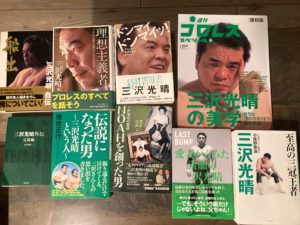
This next section looks at Mitsuharu Misawa’s life and career from a slightly different angle. Here I’m going to cover the book DONMAI, DONMAI: A Message From Mitsuharu Misawa, published posthumously in 2010. This is a completely different book from everything covered thus far: it’s basically a collection of bi-weekly blog posts from Misawa’s blog during the 2000s. It’s also structurally different from everything else thus far: a book written in Japanese that reads horizontally left-to-right instead of a normal Japanese book which is right-to-left. The title meant to be a Japanese take on the term “Don’t Mind”/Don’t Worry, with the idea being that if Misawa was speaking casually to the reader in an izakaya to create this sort of two-way conversation and talking about everything and nothing.
For me this feels like a bit of a time capsule or a trip down memory lane because the text here is written in the first person from Misawa’s perspective and he clearly uses 2000s-era internet lingo. For you kids out there, before there were emojis people used to write with things called “emoticons”, like \(^O^)/. Misawa has these terms sprinkled throughout the text which makes it both dated and hilarious. On one hand this book is meant to be more of a casual look at Misawa’s life with lots of talk about everything about being a pro-wrestler aside from the in-ring stuff. On the other hand there’s plenty to gauge from reading between the lines here with Misawa’s comments painting an interesting picture about how things were going for him.
You can read part 1 here, part 2 here, part 3 here, part 4 here, part 5 here, part 6 here, part 7 here, part 8 here, part 9 here, part 10 here, part 11 here, part 12 here, part 13 here, and part 14 here.
2005 & 2006
Misawa talks about an October tour and notes he has been getting mail from fans saying he should stick to major cities. Misawa rebuffs this by saying that not everyone can travel so far and he appreciates young children and elderly fans coming to see them when they do smaller shows at local markets.
The tone shifts dramatically as Misawa describes suffering a neck injury in November 2005 when he tucks his head in too much. This injury leaves him struggling to swallow food and water for several days. However, this time he does take time off to heal and dismisses it as simply part of his job.
Two weeks later Misawa suffers another injury, this time in a match with Doug Williams. While in a corner Misawa intended to throw an elbow up but his neck hurt so much he couldn’t turn all the way so the two wrestlers ended up colliding together. Misawa suffers a cut above his eye that apparently bleeds quite profusely so he goes to a hospital immediately after the show ends. Apparently Misawa hates hospitals in general but this time he doesn’t hesitate to go. There’s a bit of a bright spot here as Misawa ends up in Niigata while on tour and is surprised to find a fan/friend bringing him to dinner and there’s Hayabusa waiting for him. This is about four years after Hayabusa’s terrifying injury and by this point he appears to have found some kind of steady work in the music business so at least he can support himself. Misawa is moved by Hayabusa’s resolve despite his physical state and uses that to motivate himself.
Christmas and New Year’s come and go. Misawa suffers a cold towards the end of the year and decides to buy a bunch of DVDs during his time off, including Ocean’s Twelve and a Star Wars box set. He also apparently enjoys Spider-Man 3, Harry Potter, and Die Hard.
We get back to the first NOAH tour of 2006 and by the fourth day (January 12) Misawa experiences pain in his coccyx, which came from the fact that his coccyx has become misaligned. The pain was manageable on some days and not on others, leading him to use painkillers intermittently. Misawa emphasizes that he’s starting to have more days where the pain might reach a point where he might skip competing (APOD: he suggests he’ll appear at a show but not wrestle), but he feels privilege when he can wrestle in front of a crowd without anyone knowing he’s in such pain.
Misawa talks about how he dislikes sunbathing, which is why he’s so much paler compared to many wrestlers. He also can’t sit still even when he’s at home so when he goes to soak in a tub he brings his Game Boy Advance with him. This also sometimes happens when he goes to the toilet and he ends up so engrossed in whatever game he’s playing that he still sits after finishing his business and sometimes his legs get numb from sitting for so long.
Misawa is asked about a match with Takeshi Morishima and Misawa straight up says “I think it’s better for you to actually watch it rather than me talking about it”, which is probably why, even when he was alive, he wasn’t one to talk about this match or that match and preferred encouraging viewers/readers to catch NOAH either on TV or (ideally) live and judge the quality for themselves. On an unrelated note, by March 2006 Misawa talks about going bowling as part of some promotional gig and notes he had a slight dislocation in his left shoulder.
Misawa isn’t the only person getting injured, it seems. He talks about visiting Kotaru Suzuki who was on the injured list having surgery and then while attending a Pro Wrestling SEM event (NOAH’s developmental league), Genba Hiranyagi dislocates his jaw in two places. Go Shiozaki and Makoto Hashi are also still injured around this same time (APOD: This is about four months or so before Kobashi’s cancer diagnosis). Misawa also notes that his house is quite busy: aside from his wife and two kids there are were also three cats, a turtle, and a bulldog.
Misawa also hates Golden Week because he hates crowds and prefers to take a break when ordinary people are working on weekdays. As part of this Misawa notes that when NOAH’s tours end – usually on a Sunday – he drinks from late at night until like 7am in the morning and gets a kick out of going in the opposite direction of all the salarymen rushing to work on Monday morning. He also tells a quick story of how Kotaro Suzuki, fresh from his injury, would drink with Misawa and ramble about nonsense like “humans will eventually live in colonies”.
Misawa also notes that he doesn’t like talking seriously in social settings and veers towards humor. For example at weddings, whereas most people would “cheerlead” the couple of honor Misawa would “bring them down” with his particular brand of jokes.
In May 2006 Misawa describes having to take barium as part of a health check and it caused him to experience a terrible digestive situation. Barium, mixed with a laxative, caused him to become constipated and then when that passed he describes the aftermath as “like a rocket was launching”. Speaking of food and digestion, Misawa responds to many fan letters saying it must be nice for him to travel across the entire country and trying different foods and drinks by describing by noting that he actually spends most of his time in other cities going to the hotel, venue, and gym. And even if he wanted to try new foods he wouldn’t usually have that luxury since most of those places would be closed once he was done wrestling that day (APOD: I can attest to this from personal experience. For anyone contemplating visiting Japan, be advised that many restaurants, bars, and izakayas do not operate on the same open-till-late schedule. Many open for lunch, close in between, and reopen for a few hours in the evening. Lots of places have last call at 10pm. Really, most of the late night spots are concentrated in Ginza, Shinjuku, Roppongi, and Kabukicho, at least as far as Tokyo is concerned. You might find a chiller drinking atmosphere in Osaka, though). While on tours Misawa describes having maybe one day off if he’s lucky: most of the time he goes straight back to the hotel or to the bus for an overnight ride to the next destination. He also warns anyone seeking to become a professional wrestler to make sure they’re not easily prone to motion sickness because that might be a problem for you if you do.
Unfortunately, the ghost of the “Ace of Glass” returns as throughout 2006 Misawa describes collecting more small injuries. A cracked ligament here, an injured right shoulder there. An X-ray shows that one of his bones, which is supposed to be round, is deformed and pointed. As a result Misawa finds it difficult to wipe during this period. But he balances out that brief bit of toilet humor with very real, very serious practical consequences of wrestling on everyday life:
“If you fracture your elbow or shoulder and can’t use your dominant arm, it’s really inconvenient. By the way, when this happens, it’s easier to eat with a fork. The tough part is the bath and, of course, the toilet. When you have an injury, you can’t warm it up most of the time, so you can’t even get into the bathtub. If you injure your neck, you have to support your head with one hand while washing with the other, and even a little pressure can hurt. When I injured my knee, of course, I couldn’t use a Japanese-style toilet. When I hurt my back, it was tough because I couldn’t brace myself. If I try to brace myself, I get a sharp pain in my back. ”
Misawa talks about the outdoor wrestling shows which he generally doesn’t like but does them out of duty to NOAH. He talks about some places having no showers so, during August when Japan is at its hottest, he recalls wading into a makeshift kiddie pool to cool off after wrestling, only to find the water ice cold since they were in the mountains. A few entries later he describes catching another cold, which becomes a fever, yet he still wrestles in matches and attends parties for people that’ve helped him out.
In a completely random tangent Misawa provides dating advice for readers and connects the present (APOD: Okay, so late 2006/early 2007, when these early entries were written) with how nervous he was during his teenage dating years. Misawa recommends going to a zoo or an aquarium since amusement parks can require tons of walking and being able to handle thrill rides. He also strongly emphasizes having a look on your face that makes you look relaxed, even if you’re not on the inside. On a related note, Misawa doesn’t particularly like Christmas and suggests that the season is better for women and children than it is for men due to travel and gifting arrangements. Another reason he dislikes the season is year-end parties and other “obligatory functions” in which he has to drink in a social setting in which he might not be fully comfortable. But if he has duties to others, those come first. He also uses this opportunity to thank people who make the trek to DIFFER Ariake for NOAH’s annual Christmas show, which he is especially proud of.
2007
Misawa opens with what appears to be a match in which he suffers a concussion. He suspects a ringside powerbomb is the culprit and this time he notes it’s the first time he has completely lost his memory of a major event. He has to go to the hospital in an ambulance (two things he hates), and then states the last time he went to the hospital right after a match was when he broke his nose in a match with Tsuruta and had to work the next day. He doesn’t go into it further but there’s an underpinning of “another injury but I still have to continue” throughout this section.
On the subject of injuries Misawa describes a sort of duality with how his body heals. On one hand when it comes to minor injuries like cuts, bruises, bleeding, and small tears he notes that while he tends to get these often he heals pretty quickly. On the other hand Misawa’s bi-weekly posts keep opening with him talking about his neck and back. He describes being unable to sleep due to the pain on some entries. Though most people seem to notice and worry about his more visible injuries, Misawa himself is more concerned with what cannot be seen, especially with his neck. He does everything he can to hide these issues from others, even in these blogs, as he shifts the conversation to something completely unrelated like cars or his pets. He also recalls getting hooked on Yoshi’s Island for the DS when he’s unable to sleep or in the bathroom. “After big matches, my body aches in every joint. It can’t be helped, but it’s a tough job”, notes Misawa. He also notes that, at this point in his life and given condition, when asked what his hobbies are Misawa replies, “Napping”.
After lots of rambling about weather, colds, and washing machines, Misawa briefly mentions his trip to New York in 2007 for a Ring of Honor show. This would be, of course, ROH Glory by Honor 2007, in which Misawa defended the GHC Heavyweight Championship against KENTA. Misawa puts KENTA over on the blog, admiring him for working hard, and understanding KENTA’s challenges in being a junior facing full-fledged heavyweights. He also sidetracks to mention his first impression of his hotel room in Philadelphia and how spacious the room is, though he’s surprised to find no ashtray in his room (APOD: This is probably the first time anyone mentions Misawa’s smoking habit. It might not be all that big of a deal in the grand scheme of things that is the picture of Misawa’s health, it’s another attribute that you can add to the list of things that was making Misawa’s overall condition worsen as the decade wore on). Apparently Misawa was trying to find the location where Rocky was filmed but couldn’t find it and at the ROH show apparently Nicolas Cage was there but the NOAH guys didn’t get the chance to take photos with him. Once again Misawa says nothing of his match with KENTA or anything particular about the event but does still take the time to say thanks to the ROH fans in Philadelphia and New York, even if they won’t read this diary.
Misawa closes 2007 talking about the brutally difficult travel in Hokkaido given how much it snows up there (APOD: for you travelers out there looking to see a part of Asia that’s closer to the wilderness of Canada or snowier parts of the United States, Hokkaido’s your best bet) and some of his biggest moments. He feels proud of defending the GHC world title in the US, is thankful for everyone who came to support Kobashi’s return on December 2nd, and then tells a story of his trainee Ippei Ota, a frequent target of jokes in these diaries, botched copying one of Misawa’s signature moves on a SEM show which made Misawa burst into laughter.
2008
Misawa opens the New Year and once again he gets sick from a cold passing around the NOAH dojo. This time, however, he also experiences gastroenteritis but then lightens the mood by describing how he can’t tell the Briscoe Brothers apart unless their mouths are open and he can see that Mark is missing some teeth.
Then in March there’s a major development: Misawa opens by saying he can’t move his neck. After his Budokan match he goes to the hospital to get a CT scan of his brain and an X-ray of his spine. The tests show no issues with his brain but do note that his cervical spine is sprained, which Misawa describes as being ten times worse than “normal” whiplash. It’s here that Misawa describes experiencing pain when brushing his teeth and washing his hair, which other sources have attributed to him developing osteophytes. Misawa tries to smooth things over with this announcement, saying “I’ll hold my head with one hand while brushing my teeth” and that he’ll do his best while feeling uncomfortable. (APOD: It’s at this point that Misawa really should’ve considered quiet retirement from in-ring activity. His body was fast approaching the point of no return but due to falling business and mounting pressure to take care of all the NOAH wrestlers, staff, and their families, he kept going).
Two week later and Misawa’s neck is still hurting. Misawa waxes philosophical for a moment, talking about appreciating his health and not taking being healthy for granted. If he gets better Misawa expects he’ll repeat the same cycle of forgetting and repeating, attributing this to human folly. In the next entry he notes he knows his neck won’t ever fully heal due to years of accumulated injuries, but at least for the moment he seems to be recovering enough ahead of the next tour. Then in April he twists his left knee; although it isn’t a major injury, Misawa does describe feeling “extreme pain” from it. From a business standpoint Misawa also addresses questions about why NOAH doesn’t have a league/tournament like New Japan’s G1 or All Japan’s Champion Carnival. Misawa attributes this to wanting his wrestlers to give their all in every match and not wanting his wrestlers to feel added pressure in “official” matches which could lead to wrestlers working through injuries or possibly aggravating lesser ones.
In April 2008 Misawa has a match with Bison Smith and takes his finisher the Bisontennial (Styles Clash) which hurts his chest. Misawa is harsh about his own performance in this match and apologizes for “going home” sooner than expected and rushed to the finish because of how much pain he was in. come May his ribs are better but his knee is still giving him problems. Later that month he finds himself in the Coventry Skydome for an event and recalls a delay from the staff managing event. Misawa describes having to stand and then sit down over and over as part of the event as akin to performing slow Hindu squats. Then there’s the actual match which Misawa admits that he definitely wasn’t in perfect condition for. That said, he’s grateful to the Coventry fans (APOD: There might be a factual mix-up here: Cagematch has a report on an event in May 2008 called ‘NOAH vs. UK’ which took place not in Coventry but at the Farington Leisure Centre in Oxfordshire. That show was headlined by Misawa & Kotaro Suzuki facing Bison Smith & Mark Haskins and is said to have drawn 300 fans. Misawa also notes that there was a second event the next day but there doesn’t seem to be any digital record of it) and says to the fans who attended:
“Although I don’t think it will reach them, thank you to everyone who came to watch (hat tip)ノ”
And then…well, there isn’t much of note from then on. Most of what he writes from June to September is pretty mundane: no new injuries, no seasonal illnesses, and no major developments either in his life or in NOAH. There’s a brief note about Misawa being worried about the state of the economy going into 2009 but there’s nothing further. Then there’s an epilogue from special publisher Rika Kayama, who put this book together to shine a positive light on Misawa’s life in the aftermath of his sudden and tragic death in 2009.
APOD: If you want to find more of Misawa’s diary translations you can visit the NOAH Arkive blog managed by superfan Hi5ame. For me though this book was an interesting change of pace as it was filled with a more casual look at Misawa’s life. It is true what many sources have said: that Misawa was extremely private and didn’t talk about himself all that much. Even in these diary entries Misawa keeps things casual about himself but doesn’t take a deep look at his own life or talk about his wife or children. That stuff is saved for other places. The stuff I’ve included in this entry is what I think would be most interesting for you to read but to be honest I had to skip through A LOT of repetitive and relatively boring content that I don’t think most of you would care about. Stuff like weather, in-jokes that probably get lost in translation, and some mention of other NOAH wrestlers’ blogs that feel like they’re part of the story yet aren’t quoted or explained. That said, this book has some incredible insight into Misawa’s firsthand experiences during the final years of his life. Like I mentioned above the Ace of Glass returns and Misawa collects more injuries at a time when he should be far more careful. This concludes with his cervical spine injury and I don’t know what’s more terrifying: Misawa’s description of the injury and its consequences, or how he more or less fights through it when his body is screaming for him to retire already. There’s a brief note here about him doing some sort of speaking engagement but there’s no indication that he finds a new career path there.
Final Rating: ***3/4
All in all this is an interesting book as most Japanese books are, but there are better ones out there for wrestling fans to enjoy. That said, Misawa was very much thankful to anyone and everyone who came to see him wrestle when he was abroad, so to those who attended Ring of Honor in 2007 and two UK shows in 2008, know that Misawa appreciates you showing up to cheer for him.
Thanks for reading. Next time, we look at the tragedy that all of this has been leading to: the death of Mitsuharu Misawa.