

5-Star BOOK Reviews: Mitsuharu Misawa’s Books, Part XVI (The Death of Mitsuharu Misawa)
By Alex Podgorski on 29 September 2025
“It would be an honor to die in the ring…” – Mitsuharu Misawa.
How prescient.
Much of what I’ve been writing thus far about Misawa has been leading up to this. It’s the most infamous aspect of his wrestling career and indeed his life. In a way it has overshadowed everything he did in the ring and in a weird sort of way it immortalized him as well. For as much as he was a beast inside the ring and looked like someone who could survive anything anyone threw at him, Misawa was, in the end, mortal. And it’s incredibly unfortunate that had to remind us of that in such a shocking way.
Misawa’s demise had been teased piecemeal throughout this book review series. From moments talking about his natural springiness, to moments where he described feeling neck pain, to the last section where he was diagnosed with a spinal injury, there was this unshakeable sense that Misawa was wrestling on a razor’s edge each time he stepped into the ring. That said, Misawa himself mentioned a few times that he understood the risk, that he fought through the pain whenever he could, and that he lived for the moment and didn’t think about the future all that much.
“Even I don’t fully understand the depth of professional wrestling, which is what makes it interesting. The combination of fun and severity is what’s great. That’s why I feel like I want more and more.” – Misawa, THE LAST BUMP
You can read part 1 here, part 2 here, part 3 here, part 4 here, part 5 here, part 6 here, part 7 here, part 8 here, part 9 here, part 10 here, part 11 here, part 12 here, part 13 here, part 14 here and part 15 here.
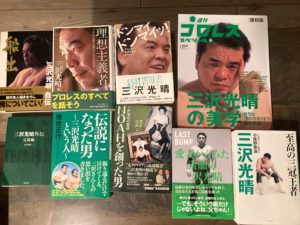
Over the years Misawa’s wife Mayumi had come to distinguish between Misawa the wrestler and Misawa her husband and noted that the latter still carried some baggage from his youth. As noted part 1, Misawa’s father was a violent and abusive man to whom the wrestler never warmed up. By the time his parents separated and Akiko, his mother, married a new man, Misawa was more or less on his own. But some of the habits he developed during this time crept into their relationship at home: he would sometimes be demanding to his wife and would get annoyed during ceremonies and processions. He took a hands-off approach to raising his children and at one point openly acknowledged that he “didn’t know how to be fatherly” towards them when they were falling behind in school. Mayumi suspects that Misawa’s complete focus on himself stemmed from him not being able to express his true wants to his mother when he was a child because of how hard she worked to raise him and his brother and so now he was projecting those unfulfilled wants and needs onto his wife. This, she suspects, had a huge impact on his personality and his values, especially regarding his hatred towards selfishness. It also manifested in how he perceived authority: his dedication to self-reliance led to him rarely, if ever, really imposing his will on his juniors, which affected how he ran things in NOAH. Many wrestlers have stated that Misawa never gave explicit orders or instructions, merely suggestions. He also believed that one of the reasons things might’ve gotten out of hand in NOAH was because Misawa “had a hard time saying ‘no’ to people”.
Mayumi and wrestling reporter Itsuo Marui, who co-wrote LAST BUMP together, summarize one of the aspects that made Misawa so legendary despite not coming across as “superhuman” in the same spirit as, say, Giant Baba:
“Wrestling fundamentally differs from other sports in that it includes the concept of “taking the opponent’s moves,” known as “bumps” in wrestling terminology. If one cannot take a bump, they cannot protect their body. Furthermore, the exchange of techniques, where one absorbs the opponent’s move before countering, is essential and is one of the charms of professional wrestling. Opponents who faced Misawa all agreed that he “took the moves head-on.” Although wrestling is a fight, the goal is not to injure the opponent. There are techniques that one would not attempt without trust in the opponent’s skill, believing, “This person can handle it.” Even legendary matches built by Kenta Kobashi and Toshiaki Kawada contained secrets that were only revealed in their bouts against Misawa.
To respond to any advanced technique requires a body capable of withstanding impact, skill, and an unyielding mental fortitude. Misawa was one of the few wrestlers who could take bumps with his neck. The greatness of wrestler Mitsuharu Misawa lies in his ability to take bumps. If there is a legend, it is his extraordinary mental strength as a master of taking bumps.”
In LAST BUMP Mayumi describes the day Misawa died, June 13, 2009, as just another day. The only notable differences were increases in Misawa’s shirt size and how many painkillers he took. Meanwhile there is another book that I found that expands on Misawa’s physical state a bit more leading into this date: 6.13.2009: The Last Message Left By Mitsuharu Misawa, written by Shoichi Hasegawa, published in 2015. This book describes how Misawa had developed osteophytes by 2007/8 and how he was describing his general sense of pain far more vocally than before. LAST BUMP also notes how he would sometimes have to use his toes to wriggle into putting on pants, how he’d have to move his head up and down while leaving his hand in place while brushing his teeth, and how even tucking in his chin was painful. However, he had to keep going.
Mayumi prefaces Misawa’s final match by noting two similar incidents that took place earlier. The first was in August 1997 when Plum Mariko, a trainee for JWP Joshi Puroresu, suffered a head injury during a match and then died the following day. She was eighteen years old. Two years later Emiko Kado, a trainee for ARSION, suffered a similar sort of head injury and passed away five days later. She was twenty three. On the men’s side there was Masakazu Fukuda, an amateur standout from the same high school as Misawa and Kawada, who received a flying elbow during a match and died from a subsequent subural hematoma (APOD: the latter being the same sort of injury Katsuyori Shibata suffered after that match with Okada in 2017). Another one mentioned is Shinya Hashimoto’s sudden death from an aneurysm in 2005 at age 40. She also admits that, when deaths do happen, the discussion focuses on finding an immediate or most proximate cause possible, though this isn’t always possible. This oversimplified way of analyzing wrestlers’ bodies and the deaths that happen neglects both the accumulation of damage over time and the very real possibility of freak accidents.
Mayumi recalls a time when Misawa was asked by an interviewer what he would do if he was on the receiving end of a botched move or something accidental, to which he replied he wouldn’t want an apology from his opponent.
“Apologizing would be disrespectful to the opponent. If I apologized, it would mean that the wrestler’s move was never truly executed.” – Misawa
She also recalls previous conversations about retirement, first noting how wrestler retirements often lack credibility, using Atsushi Onita’s many false retirements as an example. However, Misawa wanted to stick to his personal convictions and noted that if he were to retire from wrestling it would actually stick. After all, for many years he was also a representative of Giant Baba’s All Japan and Baba’s 1990s shift was founded on, among other things, regaining and then keeping fans’ trust over sensational performances. Anyways, after all was said and done, in May 2001 (when NOAH was still in its first year) Misawa confided in Mayumi that he planned to retire at 50. Assuming his death never happened, this retirement would’ve been around August 2011. Mayumi also recalls how adamant he was about this decision, making sure that he was sure and that he wouldn’t ever consider walking back or regretting that decision. He even goes so far as to emphasize the words “absolutely not!” when asked about a comeback with such rare intensity that he almost spat as he spoke. Misawa also made it clear that he wouldn’t do a retirement tour or even an announcement ahead of time. Basically his plan was that one day after a match he’d grab the mic and say ‘I’m done wrestling, that’s it, thank you’.
She further contextualizes his final day by noting how NOAH’s fortunes had worsened in recent years. The most damaging change was the loss of terrestrial television and a reduction in any remaining broadcasting rights fees with what few other broadcasting networks still carried it. To try and drum up interest, Misawa tried elevating another rising star, Go Shiozaki, by teaming with him and them winning the GHC Tag Team titles together. Then they had a defense against the team of Akitoshi Saito and Bison Smith on June 13th.
In 6.13 it is noted that there were two young doctors at ringside. Shiozaki notes that Misawa was sweating more than normal in this match but still this isn’t considered a big deal. In a pre-match interview Misawa dryly notes that he can’t do anything about his current condition but will do his best to make it through. Of course, everyone notes that Misawa would never outright state that something’s bad: professional wrestler or not, Japanese ‘maintain harmony’ mentality or not, Misawa simply wasn’t the kind of person to worry others.
The match began around 8pm local time with entrances. It went over twenty minutes up. Up to 8:15 nothing was out of the ordinary. The match went through the typical peaks and valleys. Misawa, sluggish by his historic standards but still going strong, played his biggest hits on a babyface comeback. Then he got caught in Bison’s Iron Claw and took an Iron Claw Slam from the ropes. That slam had a big impact but Misawa took most of it on his ass so it wasn’t all that jarring. Then at 8:43pm Saito tagged in, landed a knee strike, and lifted Misawa up for a Backdrop.
Then it happened.
Misawa went down.
And never came back up.
Sensing that something was wrong the referee rang the bell to stop the match. Satoru Asako, a wrestler who had retired and transitioned to role of trainer, dashed out of the locker room where he was attending to Jun Akiyama and attempted CPR. Fans began to catch on that something was wrong and began screaming Misawa’s name. Meanwhile, wrestlers began filing out of the locker room, clearly distressed.
Misawa was asked, “Can you move?” and Misawa responded “NO!” and told the ref to stop the match.
Misawa wasn’t lying flat on his back as he would normally to sell a move; instead he was on his side, somewhat bent at an angle, motionless. However there wasn’t any immediate surprise from the audience: by Four Heavenly Kings standards that Backdrop wasn’t all that severe. Still the two ringside doctors, who were fans of wrestling who got to know Misawa personally and attended as a show of support, entered the ring to help Asako. An AED device was brought in to check for a pulse and at first there was one. An electrical signal could still be found in his heart but there was no signal circulation anywhere else in his body. Fumio Ochiai, a ringside photographer for Tokyo Sports, stopped taking photos and between relaying messages to the newspaper’s office on what going, prayed. Kenta Kobashi, resting on his bus after his match, hurried out just in time to catch Misawa being placed into an ambulance, an artificial respirator covering his face, making it impossible to read any expressions it might show.
“We do not know the condition of President Misawa, but all the players are praying for his safety. Although today ended in this way, we will definitely come back to Hiroshima again. When that time comes, please treat us well. Thank you very much for today…” – Takeshi Morishima relaying a message to the 2,300 in attendance nervous and frantic over Misawa’s then-unknown condition
An ambulance arrived about twenty minutes after the initial impact to take Misawa to the nearby hospital, a feint pulse still detected via its onboard machinery. However, intubating him was proving difficult as his veins were deflating like a balloon losing its air. As all of this was going on Mauymi was walking their dog for a long evening walk. She began her walk at 9:30pm, twenty minutes after the ambulance came to take Misawa. By 10pm she was on her way back and then made it home thirty minutes after that.
About ten minutes later, at 10:10pm, Mitsuharu was pronounced dead by hospital officials.
So how exactly did Mitsuharu Misawa die?
As sad as it is that a wrestler died doing what he loved, the shock of his death fueled speculation almost immediately. Questions and investigations arose into what exactly killed Mitsuharu Misawa and if something, or someone, could be blamed. Reading unofficial discussions around the time, some of the initial blame fell on Akitoshi Saito, the man that delivered the Backdrop, which led to some early witch hunt-style accusations that he killed Misawa, fueled by duty-bound requirements of the police to investigate whether he committed an act of foul play out of resentment. Dave Meltzer originally reported it as some kind of spinal injury, though how he of all people got this information so early remains a bit dubious. In more recent years retrospectives on Misawa’s injury have summarized it semi-accurately – and gruesomely – as an ‘internal decapitation’.
One of the most important people to shine light on this matter is Takuma Sadamori, an assistant professor in the Intensive Care Unit at Hiroshima University Hospital. He was on call for that night. That particular hospital also had some of the most advanced medical equipment in the country: if another hospital lacked the equipment needed to treat a traumatic injury like a heart attack or a limb amputation then they were brought to this one. He was also, coincidentally, a wrestling fan and was familiar with Misawa’s exploits alongside the other Four Kings. Yet here he was trying to save Misawa’s life, and when that failed, he had to determine how things went wrong.
Sadamori had managed to get Misawa’s heart beating again but it stopped after about five minutes. Multiple intravenous injections of adrenaline failed to get his heart going on its own and wore off after about five minutes each. With each failed attempt Sadamori weighed in on the consequences of what could happen if resuscitation happened. Misawa’s brain was being deprived of oxygen. The possibility of brain death or being in a vegetative state grew ever larger. Then Sadamori made the difficult decision to halt efforts and pronounce Misawa as deceased.
Within 20 minutes wrestlers began to arrive in the hospital, some of them already having been told the news by one of the ringside doctors who had accompanied Misawa to the hospital. In what is perhaps the most thematic and symbolic aspect out of all of this, Kobashi, despite not having any immediate blood ties with Misawa, was allowed into see Misawa’s body at the request of Misawa’s family, owing to their storied history as both partners and as opponents.
“Misawa, thank you for your hard work…” – Kobashi’s words to Misawa as he held Misawa’s now-cold right hand, the same one with which the Emerald Emperor hit him with countless elbows over the years.
But then came an equally hard matter: determining cause. Within moments the hospital’s public relations team was being swarmed the media who were demanding answers. Some by-the-minute wrestling sites and forums were already announcing Misawa had collapsed but not that he was dead. Then updates became more frantic. Soon “death of Misawa” began making the news. Eventually a PR official from the hospital made the announcement that Misawa had died at 22:10 but the cause was, as of yet, unknown. This allowed the media to disperse and gave Sadamori time to assess the situation.
Akitoshi Saito gave some initial reports and noted that when Misawa went up for the Backdrop he was still “fine”. But when Misawa reached about shoulder height – so about mid-move – he suddenly felt heavier. Had Misawa already been unconscious or experiencing cardiac arrest then he wouldn’t’ve been able to life Misawa up at all. Even if he were strong enough to deadlift ~260 pounds on his own, such a thing would’ve been impossible with the speed and fluidity of these specific wrestling techniques.
Given the enormity of the situation, Sadamori made the unconventional decision to perform both a CT scan and an MRI to determine a cause of death. This allowed Sadamori to perform a more complete autopsy and determine a cause of death with more accuracy than with only a CT scan. Once the results came in Sadamori had as close to complete a picture as possible. For posterity’s sake here are the exact words as written in the 6.13 book, translated as close to accurate as possible:
“After conducting the MRI scan, Sadamori was left speechless by the results. Misawa’s cervical spinal cord was completely severed. Humans have nerves running from the brain to the lower back, and any severance along this pathway results in paralysis beyond that point. In Misawa’s case, the cervical spinal cord was completely severed around the first and second vertebrae among the seven bones in the neck. It was not merely a “damage” level; it had been completely severed as if cut with scissors. The moment he saw the MRI image, Sadamori immediately understood the cause of death. This was the cause of Misawa’s death. Dr. Takeda, shown this image, was also left speechless. He had never seen a case where the severance was so complete. Such symptoms were typically seen only in cases of hit-and-run accidents, where a person might be dragged for several meters or have their head twisted multiple times. However, strangely, there were no signs of damage to the cervical bones. No fractures or dislocations were observed.
This is not merely the impact of a backdrop. Moreover, it is not that Misawa failed to take the fall. Nor is it a tragedy that occurred due to the accumulation of long-term damage. Although the cause is unknown, at that moment, a shock equivalent to a hit-and-run accident was inflicted not on the cervical vertebrae but solely on the spinal cord. Therefore, there were neither fractures nor dislocations; only the spinal cord was severed. (Could such a thing actually happen…?)
Faced with a case he had never seen before, Dr. Takeda was at a loss for words. On the other hand, Dr. Sadamori, upon seeing this image, immediately understood why Misawa had said “stop” after the backdrop. At the moment of the backdrop, the spinal cord must have been severed, causing Misawa to immediately suffer from respiratory distress. In this state, he could no longer breathe. However, there was still oxygen left in his body. Even though he could not inhale, he could exhale due to the recoil. Since the spinal cord was severed, he could not move his body. However, the brain was functioning normally. Misawa sensed the abnormality at that moment. He told referee Nishinaga, “It’s no good,” and said “stop.” This was because there was still oxygen left in his body.
And as he finished exhaling the last of the oxygen, Misawa lost consciousness due to lack of oxygen. Even though the remaining oxygen in his brain was gone, there was still oxygen in his body. During that time, his heart was still beating, so it was not instant death. After losing consciousness, the heart continued to beat for about three minutes, according to Sadamori’s speculation. At this point, the cause of Misawa’s death had not been announced. Only Dr. Takeda and a few doctors from Hiroshima University, including Sadamori, knew the details. Sadamori immediately contacted Misawa’s wife, who had just received the news in Tokyo. First, he introduced himself and explained that Misawa had been brought in a state of cardiac arrest. Despite desperate resuscitation efforts, his heartbeat had restarted once but then stopped again. Resuscitation efforts continued, but at 10:10 PM, they were discontinued. The cause of death was spinal cord severance… Sadamori conveyed the facts calmly. On the other end of the line, Misawa’s wife simply responded, “I understand. I will come to Hiroshima early tomorrow morning,” with solemnity.”
APOD: This is the closest and most accurate description of events out there surrounding Misawa’s sudden and unfortunate death. It was written with firsthand accounts and secondhand recollections from the individuals who were on scene and who acted in professional and official capacity to deal with such a traumatic event. While we here in the fandom can debate whether these statements are fully true or if there’s some kind of obfuscation being done, I sincerely doubt that anyone involved with making professional medical diagnoses would lie or bend the truth for entertainment reasons, especially given how badly it gone for such liars if they ever confessed to doing so.)
Back in LAST BUMP Mayumi briefly recalls the swarm of messages she received upon returning home. The first person to reach out to her was Kotaru Suzuki, Misawa’s personal assistant, who contacted her on both her cellphone and home voicemail. Judging by how many calls she was getting she initially presumed it was an injury, which wouldn’t’ve been unexpected given the shape he was in. Then another call from Ryu Nakata confirmed that the worst had come to pass: Misawa had died. And then as she dealt with the shock, Dr. Sadamori contacted her with the news as written above.
“I had already prepared myself for the possibility of accidents or even death in this line of work. Although I was never told to be prepared, I understood the common sentiment of ‘understand my feelings’ in everything, and I had that resolve. After heading to Hiroshima, there was no time to cry. Without my signature, I couldn’t allow anyone to meet, and I thought I had to complete the procedures to bring him back to Tokyo no matter what.” – Mayumi Misawa
Mayumi then skips ahead a bit and mentions that 25,000 people had come to Misawa’s public memorial service held on July 4th, a few thousand short of the 28,000 who attended Giant Baba’s memorial service a decade earlier.
“There is a reason why he was so beloved. He taught us the fighting spirit of not giving up and the strength to push forward toward our goals. I felt a sense of familiarity in the childlike spirit that peeked through. Despite being a top wrestler, he remained a down-to-earth hero. And while there is no “superhuman legend” to showcase power, the very act of being considerate of others and acting with empathy, which he upheld throughout his life, was a legend in itself.” – Mayumi
The epilogue to LAST BUMP contains Mayumi’s direct feelings over the immediate and long-term aftermath of Misawa’s death. At first she describes crying for quite some time but her words aren’t those of someone in extreme grief or agony, but of someone who went into this death shocked yet not blindsided. For Mayumi it seems like Mitsuharu’s death was a very likely eventuality, not because of how he wrestled but because of the nature of his work in general. Even if he toned down the specific things he did and stopped taking bumps on his neck, the nature of what he did damaged his body to the point that death loomed overhead at all times. Though she still feels pain and sadness in the wake of his death (APOD: this book was released in 2010 around the one-year anniversary of his death) she still feels pride and in what her husband was, both in the ring and at home.
APOD: Misawa’s death was a big wrestling story when it happened. Despite his family invoking a law that kept the cause of death private [I have no idea where Meltzer got this story to be honest because Mayumi mentioned nothing of the sort in LAST BUMP and Dr. Sadamori is on record releasing a cause of death to the police and other officials as a necessity to rule out foul play and thus save Akitoshi Saito from manslaughter/negligent homicide], the story made nationwide sports news but other ‘highbrow’ news agencies barely mentioned it. The only exception to this being NTV with broadcaster Kazuo Tokumitsu devoting twenty minutes of his morning show to talking about Misawa [his name will come up in the next section because I believe his son wrote an entire book about how Misawa became a ‘Legend’ which further cements Misawa’s image after death]. Across the pond TNA and ROH paid tribute to him. WWE made no major statements, which is somewhat justified since he had no connection to them whatsoever; however Jim Ross did write a short obituary on WWE’s website putting Misawa over bigtime having watched DVDs of Misawa’s matches many times. The only person to do anything visual was when CM Punk wrote “MISAWA” onto his wrist tape in his first match after news came out. And here we are, over fifteen years later, and Misawa’s name still lives on. He’s still fondly remembered both in his home county and around the world. And if I’m being honest I wanted to get through this black cloud as soon as possible because there’s still a lot to cover about him. Even though his career – and sadly, his life – came to a sudden and tragic end there’s still something legendary about him. He’s similar to Eddy Guerrero: someone who died way too soon yet has been immortalized long after his passing. And considering that Misawa also wrote down all of his biggest and most important philosophies as a wrestler, booker, promoter, and manager, into one book, there’s still a lot about his LIFE that I still think is worth focusing on much more than his death.
Thanks for reading.