

5-Star BOOK Reviews: Masanobu Fuchi’s Book, Part VII (FINAL)
By Alex Podgorski on 18 November 2025
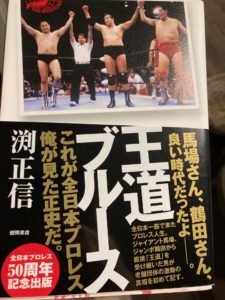
With this entry we will conclude Masanobu Fuchi’s book. This last section goes over the rest of the 1990s and then switches to much more dramatic material. In the span of about a year Fuchi loses his beloved boss, his best friend leaves for America and then dies on the operating table, and then the company he devotes his life to is torn apart from the inside and he’s tasked with deciding its future. It’s a lot for one man to handle but as he has already shown, Masanobu Fuchi isn’t one to shy away from challenging situations.
You can read part 1 here, part 2 here, part 3 here, parts 4 and 5 here, and part 6 here.
Fuchi opens Chapter 7 with Jumbo Tsuruta (of course) passing on his jumping knee technique to Jun Akiyama. Apparently there’s an entire thing in Japan about people actually passing on techniques from master to pupil, instead of people just stealing from each other in other parts of the wrestling world. One of the most noted examples of this is Tsuruta being taught Lou Thesz’s Greco-Roman Backdrop from Thesz himself and thus adding it to his repertoire. Then the Four Heavenly Kings would fine-tune that same move for their own ends while still tracing it back to Thesz, in some sort of wrestling version of a family tree. In the case of the jumping knee, Fuchi recalls seeing OG Nature Boy Buddy Rogers use it and mentioned it to Tsuruta, which led to Baba giving is blessing for Tsuruta to start using it. Fuchi also mentions that most people mess this move up because they lean forward on execution whereas Tsuruta was able to more or less stay in place when landing his.
Then he goes back to talking about Tsuruta some more, specifically his declining health and how he couldn’t really enjoy himself anymore once he was diagnosed with Hepatitis B. To Tsuruta’ Fuchi’s misfortunes with money and women were paltry compared to his own health issues and Tsuruta was sure to remind him of this when he was still alive. Even Tsuruta’s wife would tell Tomomi (Jumbo’s real first name, which is decidedly feminine hence him becoming “Jumbo” as a pro wrestler), to hang out with Fuchi as a means of forgetting his woes.
While Fuchi was keeping Tsuruta company outside the ring, in the ring he pivoted down the hard as the Fou Heavenly Kings took center stage. At this time he found himself facing Giant Baba many times. He noted that Baba’s moves really hurt because he was strong and bony, which made even easy-looking moves like the Coconut Crash much more painful, especially his knife-edge chop since he had a bony protrusion in his pinky finger. On the same note, Fuchi believes that Baba really wanted to go out to izakayas and hang out with fans like a normal person but couldn’t because of his size and stature.
According to Fuchi Baba tried to be considerate to fans wherever possible. When the Great Hanshin Earthquake occurred in January 1995, Fuchi was one of the voices opposed to holding the scheduled wrestling event given the circumstances. He thought it was better to refund the tickets and have wrestlers volunteer in providing air to the disaster-stricken region. However Baba’s wife Motoko disagreed was strongly in favor of the wrestlers encouraging the victims through their wrestling. Ultimately Baba decided that all the wrestlers scheduled for that event would donate their pay to the disaster victims.
Fuchi skips ahead a bit to keep the discussion on Baba with the next subject being Baba’s final days. Fuchi, like many people, was kept in the dark about Baba’s condition and when he missed a date for the first time in over a decade or two, Fuchi was worried but Baba downplayed it as a cold. When things were reportedly getting more serious he is told it’s things like a bowel obstruction or something like that. Then the day came when he learned of Baba’s passing. He described as being more shocked then sad, only losing his composure and started crying when the media began airing footage of Baba over the decades. Also apparently Antonio Inoki came to visit when the press weren’t around.
1999 gets worse for Fuchi when Tsuruta announces his retirement and his departure for America as he will go teach in Oregon. Tsuruta’s retirement ceremony is held in March of that year and AJPW also hosts two major events within months of each other: a Baba appreciation event in the Nippon Budokan which draws about 28,000 people and their second Tokyo Dome – billed as Baba’s Retirement Show – which draws an estimated 65,000.
Shortly after this, Fuchi began getting a bit more in tune with AJPW’s backstage situation. Now, as per what he noted in his intro, he wouldn’t speak negatively of anyone. He reiterates this point by describing his reticence regarding AJPW’s boardroom meetings as chaotic and him taking any position could be seen as unnecessarily righteous:
“After Baba’s passing, the internal situation of All Japan Pro Wrestling continued to be chaotic. I was also given an executive title and frequently participated in company meetings, but it was true that there were conflicts even in those settings. However, it would be rude to reveal the details of that time, so I will refrain from doing so. It would only make it seem like I had a righteous cause.” – Masanobu Fuchi
However, the next big shock for Fuchi is Tsuruta’s death in 2000 from complications during a liver procedure in the Philippines. Fuchi was expecting there to be some equally big tribute ceremony for Tsuruta. However, the tribute organized by Misawa was, by Fuchi’s standards, underwhelming, with it being limited to Tsuruta’s three children holding his portrait on the entrance. Fuchi confronted Misawa angrily over this but Misawa said nothing. Fuchi understands that Misawa has much more to deal with at the time, including possible issues with NTV.
Fuchi glosses over the NOAH Exodus and his initial decision was that, at 46 years old, he should retire. He was just about to return to his family home in Kitakyushu when he receives a phone call from Toshiaki Kawada saying he stayed with AJPW and that Motoko was “motivated” to keep AJPW alive. This convinced Fuchi to keep going a bit longer. When he met Kawada in person after their initial press conference to discuss AJPW’s continued survival, Fuchi recalls being shocked at Kawada’s continuing with All Japan. Apparently, AJPW meat so much to Kawada that ‘Dangerous K’ was moved to tears by the prospect of the company dying out so quickly and unfortunately:
“I love All Japan. The All Japan Pro Wrestling that Baba-san created. So I don’t want it to end easily. It absolutely cannot end like this…” – Toshiaki Kawada
(APOD: Fuchi undercuts his own importance to AJPW’s survival here. Though Toshiaki Kawada was still a big name in puro in 2000 he couldn’t carry the company alone. Kawada NEEDED someone else to be there with him and Fuchi was the right man for the job. Fuchi’s presence added weight to Kawada staying and helped the promotion survive as more than just one man’s desperate attachment to something with one foot in the grave. It wouldn’t be inaccurate to say that Fuchi changed the course of wrestling history by deciding to stay with Kawada to keep AJPW alive.)
Fuchi, along with Kawada, goes to New Japan to negotiate how the next little bit is to play out. Discussions take place involving Fuchi, Kawada, Riki Choshu, and Katsuji Nagashima of NJPW. Fuchi openly asks why NJPW isn’t trying to book matches with Misawa’s crew to which Nagashima responds, “It’s the All Japan banner. If we wanted to, we could crush it, but we value All Japan.” Fuchi takes this as motivation to work his hardest to not get crushed so easily.
Fuchi’s last memory of this period isn’t about wrestling per se, but about family. Around the end of 2000 All Japan is still alive albeit with a skeleton crew with undercards filled by freelancers from other promotions. Around this time Fuchi returns home to Kitakyushu for a local show and stays at his family home. He drinks with his father and as they prepare to go to bed Masanobu’s father notes how others in his wider family praise him to his father. “The other day, when I returned to Shonai (my father’s hometown), my eldest brother said, ‘Masanobu is something else.”
Fuchi (the wrestler) doesn’t say anything but in his bed he feels his own tears welling up as this marks the first time his father ever praises him for his wrestling career.
The book’s epilogue notes a few other big happenings in 2001-2: another big AJPW Tokyo Dome show headlined by Stan Hansen’s retirement, multiple legends coming out to do another tribute to Giant Baba, and Motoko handing control of AJPW over to Keiji Muto. Then Kawada retires but this time Fuchi chooses to stay close to AJPW a bit longer while others like Jun Akiyama and SUWAMA assume key backstage positions in the company.
By being somewhat close to a management position Fuchi is better able to understand the difficulties of being a wrestling manager/promoter. To this end he recalls how tight a ship Baba ran when he was alive and how, despite sometimes never making a profit himself, Shohei Baba would to his best to ensure wrestlers were taken care of.
“Baba-san often said, “As a president, I take pride in never having delayed payment for wrestlers or employees, not even once. If someone says that’s just a given, then so be it (laughs).”
I had a vague sense that the company had faced several critical situations, but no matter the circumstances, Baba-san always smoked his cigar calmly. A president must be like this. If they are anxious, the employees will become uneasy.
There were times when, after paying the wrestlers, employees, and foreign wrestlers their fees, as well as accommodation and travel expenses, Baba-san ended up with not a single yen for himself.
“What’s this, am I working for free this series?”
He and Motoko-san would look at each other and laugh about it.
During the era of the Four Pillars, when the Nippon Budokan was packed to capacity seven times a year, we wrestlers received bonuses three times a year and would go on a family trip to Hawaii once a year.
Now, I receive welfare pension every two months. Thanks to Baba-san and Motoko-san for continuing to pay into the welfare pension for the wrestlers’ retirement. Those wrestlers and employees who were part of Baba-san’s era and are over 56 years old must be receiving the welfare pension. It’s a grateful situation.
After Baba-san passed away, suddenly people started saying things like, “What was All Japan Pro Wrestling like?” or “Baba-san was like this,” but when I look at the faces of those talking, I am surprised. Do these people really know about that era? Outsiders shouldn’t say whatever they please. Everyone has passed away, and I have become one of the few living witnesses. Therefore, I want to properly preserve the things I have seen, heard, experienced, and remembered in a tangible form, which is why I have put this into a book.” – Masanobu Fuchi
APOD: Fuchi’s book was certainly interesting but in my opinion it wasn’t as groundbreaking as I expected it to be. It came across as bit soft, partially on purpose given Fuchi’s gentlemanly decision to not speak ill of the dead. Granted that’s an honorable thing to do but I still think Fuchi glossed over too many things that would’ve made this into a more complete book. He doesn’t discuss handing the book over to Misawa in any way. He doesn’t talk about many of the undercarders and other veterans he faced in the ring, including luminaries from WWF, WCW, the NWA, and beyond. And from his tone Fuchi seems WAY too caught up in the Jumbo Tsuruta mythos, painting him with as much of a reverent brush as WWE paints its own core crew of legends. But aside from that, Fuchi has a few interesting anecdotes about his life and career that make for a quick and interesting read. Though for those of us who are already as deep into the wrestling bubble as this, Fuchi’s relatively surface-level discussions and analyses fails to go beyond scratching the surface on important subjects.
Final Rating: ***3/4
As always, thank you for reading. Next on the docket, Jumbo Tsuruta’s books.