

5-Star BOOK Reviews: Masanobu Fuchi’s Books, Part VI
By Alex Podgorski on 11 November 2025
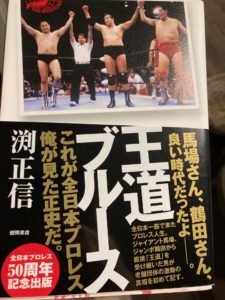
At last, we get to the most noteworthy section of Masanobu Fuchi’s books: the 1990s and the era of the Four Heavenly Kings. This section covers the first half of the decade and sets the scene for Misawa to take over in the wake of the big SWS Exodus (which Fuchi doesn’t discuss because, again, he doesn’t want to be outwardly negative towards anyone). As one of the men pulling the strings behind the scenes during AJPW’s most famous periods, Fuchi’s recollections are quite valuable. But how honest and detailed will he be when it comes to these famous wrestlers and the impact they had?
You can read part 1 here, part 2 here, part 3 here, and parts 4 & 5 here.
Fuchi begins by noting that AJPW’s dojo had been quiet and empty before he left on excursion but when he returned it was livelier with guys like Mitsuharu Misawa & Toshiaki Kawada having already gone through training and debuted. Fuchi introduces Misawa and immediately sings his praises. From the get-go Misawa checked almost every box: his gymnastics background made helped him stand out so the point that Baba was openly praiseworthy of him from early on. He doesn’t say much about Kawada, only that “he admired Misawa”. However, the subtext here implies that while both men were exceptional trainees, Misawa was simply more exceptional in almost every respect. That said, Fuchi observes an initial challenge ahead for both of them: their small stature would make it difficult for them to handle the many big men who ruled the roost like Baba himself, Stan Hansen, Tsuruta, and at least at the time they were rookies, Bruiser Brody.
Fuchi glosses over Baba’s initial plans and how he wanted to build AJPW around Tsuruta and Tiger Toguro (Kim Duk) but the latter left before those plans could come to fruition. He does note that both Great Kojika and Great Kabuki were filling important roles on the roster, with Kabuki being “immensely popular” upon return from America (APOD: Fuchi kinda undersells this description of Kabuki in a major way. From what I’ve read several times already from comments Kabuki was an enormous draw for All Japan and helped them have one incredibly profitable tour during the 1980s which almost never happened). Because of how successful those guys were during that time, the idea of Misawa becoming the ace of all them seems farfetched at first.
Mitsuharu Misawa
Next Fuchi pivots to the whole Tiger Mask situation and first notes how the OG Tiger Mask – Satoru Sayama – was so popular he might’ve outdrawn Antonio Inoki himself. However, Fuchi credits Sayama’s opponents more than the man himself, especially Dynamite Kid whom Fuchi recalls wrestling and praises him for his sharp movements and being small in stature but still powerful. Fuchi even recalls wrestlers in American confusing him for Sayama and how Tiger Mask defeated Chavo Classic for the junior title.
Fuchi summarizes something I’ve already covered in my Mitsuharu Misawa books review, how Baba had a short conversation with Misawa while Misawa was in Mexico and asked him if he could jump from the top rope. When Misawa answered positively, he was quickly brought back to Japan and rechristened Tiger Mask II. However, Fuchi speculates that one reason AJPW obtained the rights to the masked character was because of a supposed falling out between NJPW and Tiger Mask creator Ikki Kajiwara. At the same time, Fuchi also recalls Baba frequently praising Misawa’s potential as another reason for him being chosen to dawn the mask.
“That guy is amazing. He’s already great as he is.” – Giant Baba on Misawa before he donned the Tiger Mask, circa 1984
However, as Misawa himself and those who chronicled his career noted, Misawa didn’t enjoy portraying Tiger Mask. He struggled with the pressure of living up to such lofty standards and, as such, didn’t enjoy this period. Fuchi also notes the major difference in their physiques: Misawa was five inches taller and 40 pounds heavier, even in his junior heavyweight days. Expecting Misawa to be as fluid and lightning quick as Sayama was nonsensical. Still the audience expected flying techniques from Misawa as they had from Sayama and while Misawa could execute these techniques as well as his predecessor, they put added strain on his heavyweight frame. As such Misawa’s time as Tiger Mask II was mired with injuries and pain to his joints. Even though he added new techniques to his repertoire to further distinguish himself from Sayama’s Tiger Mask like the Tiger Suplex and the Tiger Suplex ’85, Misawa often reached out to Fuchi for advice. For Fuchi this was understandable: Sayama only wrestled as Tiger Mask for about two-and-a-half years while Misawa did so for over twice that. However, Fuchi doesn’t give specific examples of the advice he gave Misawa, only noting “I shared my ideas in my own way”.
From there Fuchi presents Misawa’s unmasking as a direct response to Genichiro Tenryu’s SWS Exodus. Fuchi recalls May 14, 1990, the day Misawa unmasked, as a major date in AJPW’s chronology. With reports of AJPW on the brink of collapse dominating the coverage of AJPW, Misawa declared that, “If this doesn’t gain popularity, my career as a wrestler is over.” However, a bigger story from that same day emerged: in a main-event tag match between Giant Baba & Jumbo Tsuruta and Terry Gordy & Steve Williams, Williams slammed Baba into a corner exceptionally hard which caused immobilizing back pain.
It was around this time that Fuchi was made booker/matchmaker for AJPW and the thought of Baba himself being unable to wrestle was seen as catastrophic for AJPW. Baba had spent years cultivating a specific image: no matter what challenges he faced Baba always responded with grace and composure. Even when NJPW would shit-talk AJPW publicly Baba would chew on a cigar with an air of serenity. But this time things were different, with Baba describing the pain of that slam as sending an electric shock down his back. In response, Fuchi takes Misawa & Kobashi out to the bars and encourages them to “step up” to solve this crisis by having them target Jumbo Tsuruta. Fuchi also meets with Tsuruta soon after and lays out his plan for the two of them to “crush” their younger challengers.
As part of this grand plan, Fuchi describes a specific match that laid the foundation for what was to follow: the six-man tag that took place on May 26, 1990 that led to Misawa drawing first blood with an elbow smash on Tsuruta. And, as has become pro-wrestling canon,
Misawa’s.
Elbow.
Is.
God.
Fuchi recalls Tsuruta’s initial response to Misawa’s elbow. Though he told Tsuruta to remain calm and Tsuruta replied “I’m calm, I’m calm” he was anything but. Tsuruta, who very much followed the Baba template and showed control and composure at all times, unloaded on Misawa with an uncharacteristically fiery display of violence. Even Baba himself told Tsuruta “Hey! Don’t crush them!”.
Misawa’s push only continued from there. He beat Tsuruta on June 8, 1990 and soon after became the first Japanese wrestler to make Tsuruta submit. In that latter case Misawa used a facelock technique that Fuchi had taught him which Fuchi describes as a sort of chokehold Karl Gotch taught him but in Fuchi’s hands the move was seen as “too plain” so he stopped using it. This facelock, combined with the powerful elbow strike, were Misawa’s tools to deal with bigger heavyweight opponents that would otherwise overwhelm him. But despite these tools Fuchi was convinced that Tsuruta being the wall that Misawa couldn’t easily overcome served as the foundation for the feud’s success.
“Surely, many fans watched with skepticism. The key was whether Misawa had enough skill to exceed those expectations, and his earnest fighting style far surpassed what fans had imagined. That is why All Japan Pro Wrestling became even more exciting than when Tenryu was around.
Even so, the central figure remained Tsuruta. Tsuruta stood as an enormous wall, squarely accepting the challenges of Misawa, Kawada, Kobashi, and Taue, and clashing fiercely with them. He was the greatest contributor to nurturing the later “Four Pillars.”
The “Jumbo Tsuruta is the strongest” theory was substantiated by his crushing of Misawa and others amidst the intensifying Four Heavenly Kings wrestling era.
There was even an instance when Misawa, after defeating Tsuruta in a singles match, was so overwhelmed with emotion that he burst into tears.” – Masanobu Fuchi
Toshiaki Kawada
After more of the same talk about how Tsuruta as the company’s strongest wrestler defined this feud, Fuchi finally talks about Kawada. He notes Kawada lost his first 205 matches (APOD: which makes Kenta Kobashi’s much-discussed losing streak seem paltry in comparison) and notes how Kawada initially had a “cute” face that later became more menacing. He also notes that over time Kawada’s view of Misawa shifted from ‘admiration’ to ‘rivalry’. In terms of advice, Fuchi recalls telling Kawada to master taking breakfalls; however, compared to Misawa, Kawada initially struggled to master this aspect so strongly, likely owing to Misawa’s gymnastic background helping him. In response, Kawada put in double the amount of training hours. Furthermore, Fuchi noted that Kawada had a mischievous or rascal-like personality which Fuchi suggested Kawada introduce to his matches. Kawada showed this immediately with his stepkicks (APOD: now known as the Kawada Kicks, used by guys like Seth Rollins and Will Ospreay, among others) which pissed off Kawada’s opponents to no end. And even though Kawada didn’t have an outward gimmick in the traditional American sense, Kawada’s personality as “the mischievous brat who never listens to others” resonated with fans (APOD: which makes sense given AJPW’s growing popularity with families and children at the time).
Kenta Kobashi & Akira Taue
Fuchi introduces Kobashi and corrects a presumption that he was he who rejected Kobashi when it was in all likelihood Haru Sonoda who did so. He briefly summarizes how Kobashi made a life-changing decision to enter AJPW’s dojo at twenty years old despite having a stable blue-collar job at the time and admiring Kobashi’s dedication to training. He also introduces Taue who joined around the same time but struggled more in training than Kobashi due to his time as a sumo wrestler engraining certain instincts in him. (APOD: I’ve covered both Kobashi’s and Taue’s biographies extensively and you can check those out here and here to get their perspectives). Fuchi presents these two as beneficiaries of the Tenryu Exodus since they were thrust into prominent positions due to AJPW’s roster being so clearly thinned out after the Exodus completed.
After Tsuruta left All Japan in July 1992 due to illness Fuchi’s initial plans fell apart. Without a target for Misawa and the Super Generation Army to aim for, Fuchi decided that it was more important to build a new rivalry for Misawa. He concluded that this quartet would draw money if they fought each other, hence Kawada joined Taue to create The Holy Demon Army and the birth of the Four Heavenly Kings of Professional Wrestling.
“As the booker, my ultimate mission was to “fill the Nippon Budokan seven times a year.”
While I planned the match cards, the matches themselves were entirely dictated by the abilities of the wrestlers. I didn’t give them any advice.The hallmark of the Four Pillars was the elimination of ring-outs and disqualification finishes, ensuring decisive outcomes within the ring. This idea came from Baba.
‘I may not have big sponsors, but the fans are my sponsors. We must treasure the fans who come to the venue. We must never betray them.’With this belief, the organization adopted the slogan “Bright, Fun, and Intense.”
“Intensity is necessary because it’s pro wrestling, but if it’s always just intense, fans won’t stick around. Compared to when we were in our 20s and 30s, there are now more women and children coming to the venues. To ensure those fans return, it has to be bright and fun.”The intensity was carried by the Four Pillars and Hansen, while the “bright and fun” aspect was represented by the Family Army versus the Villainous Society. That was Baba’s vision.” – Masanobu Fuchi
Fuchi compares Misawa to NWA Champions of the past and notes how Baba saw Misawa as resembling them in terms of how he possessed a strong sense of responsibility.
“Those who bore the NWA banner were beings above even the champions. You must fulfill your duty as someone who carries the banner of All Japan Pro Wrestling, just like the NWA champions did.” – Giant Baba to Mitsuharu Misawa
Of course, Fuchi notes that all four of these guys pushed themselves like crazy, trying to surpass one another. He believes they all came together at the right time and place for their legendary matches to be born. At the same time, he recognizes that some of their moves and actions were risky and dangerous with fans raising concerns about their health. He also notes how the Four Heavenly Kings had many copycats who wanted to replicate their matches and style. However, Fuchi strongly thinks that these guys had certain distinct traits that makes it impossible for anyone to copy what they did in the ring:
“Amid intense exchanges, there were moments when the action would stop, and they would glare at each other. They would gauge the opponent’s damage and think, “What should I do next?”
Within the movement, there was always a sense of “timing.” Today’s pro wrestling is non-stop action.
I believe the four of them learned this sense of “timing” from the matches between Tsuruta and Hansen.
After one exchange or a big move, there would be a brief moment of glaring at each other, followed by a split-second transition to the next attack with a “Alright, here we go.”
Tsuruta learned this “timing” from Baba and inherited it. In other words, Four Pillars Pro Wrestling carries the “royal road” bloodline that originated with Baba.” – Masanobu Fuchi
(APOD: This is, in essence, what Fuchi argues is the crux of Four Kings’ wrestling: not just crazy head-drops and escalating risk, but a dedication to balancing motion and stillness to create teases in matches that may or may not come true. The anticipation of something possibly connecting is just as important as the completed execution itself, which seems to be lost on many people who’ve attempted to replicate this specific style over the decades).
Fuchi concludes this section with a brief mention of guys like Jun Akiyama and Stan Hansen. He doesn’t go into Akiyama’s career all that much yet but notes that Akiyama lost consciousness during Four Kings’ matches quite a bit during his early career as he was largely unable to keep up with the Four Kings’ intensity (APOD: This isn’t meant to be a slight against Akiyama but Misawa, Kawada, Kobashi, and Taue were in such a league of their own that even a university-level elite like Akiyama couldn’t match their physicality. But he brought something altogether different in his matches with them that make him, at the very least, an entertaining alternative to Kobashi in Four Kings tag matches).
Fuchi also praises Stan Hansen for going the distance to be the new main threat for the Four Kings despite being over forty which by wrestling standards is “old man territory”. For his efforts Baba would be particularly grateful – and therefore generous – to Hansen for his dedication and notes how Harley Race and The Destroyer received similar treatment from Baba for their loyalty as well.
Fuchi closes with some final remarks about Baba and how he reportedly cried during the Four Heavenly Kings’ matches. Baba flatly denies all of these claims, many of which stem from announcer Ken Wakabayashi making bold proclamations during intense matches and speculating that Baba, not being immediately responsive, was choked up by what he was witnessing. Baba’s response to all of this was, “I am Giant Baba. I wouldn’t lose my composure and cry.” The only time Fuchi recalls seeing Baba cry was during Haru Sonoda’s funeral since he assumed personal responsibility for booking that flight to South Africa. All that being said, Fuchi notes that the era of the Four Heavenly Kings was exceptionally profitable for All Japan. He confirms that the company ran at a loss for many years but during the Shitenno years Baba made enough profit to pay off debts owed to Nippon TV. However, Baba jokes that he shouldn’t’ve paid all of them off since those debts could’ve been used as leverage in later negotiations between AJPW and NTV. Finally, Fuchi notes that this situation between wrestling promotion and broadcaster would have significant impact in just a few short years.
APOD: There is still quite a bit of discussion on the Four Kings in the next chapter, which will also introduce Jun Akiyama to the mix. Fuchi paints an interesting picture about these men and how they rose to become one of the most famous quartets in modern wrestling history. To paint a whole picture Fuchi fully admits that some of the things the Four Heavenly Kings did were indeed risky and dangerous but he understands their perspectives. Fuchi contextualizes the head-spike direction of the Shitenno style by noting that it was borne from a need to both surpass a previous generation and make up for a shrinking roster of interchangeable opponents. Fuchi asked an interesting open-ended question about what would happen if guys like Terry Gordy, Ted DiBiase, most of the SWS Exodus crew, and of course, Jumbo Tsuruta, were all still around either collectively or individually. Would the Four Kings style have evolved in the way it did? Would those four wrestlers reach the top of All Japan? Hell, would Misawa even unmask in the first place? These ideas are merely food for thought, but we’ll know a bit more about Fuchi’s booking in the next section.
As always, thanks for reading.