

5-Star BOOK Reviews: Jumbo Tsuruta’s Books, Part XI
By Alex Podgorski on 11 March 2026
Now we enter more familiar territory as Jumbo Tsuruta pivots to facing Mitsuharu Misawa and beginning a years-long intergenerational feud. Section will cover the second half of 1990 and parts of 1991 with lots of attention given to big matches along the way. There will be some overlap here with my Mitsuharu Misawa books coverage, but this time we’ll look at these same events from Jumbo’s perspective. We’re also going to be treated to a few interesting anecdotes and nuggets of wisdom from Tsuruta about how he perceives matches and, after so many chapters devoted to outside criticism, some answers to those same critiques from the man himself.
You can read part 1 here, part 2 here, part 3 here, part 4 here, part 5 here, part 6 here, and part 7 here, part 8 here, part 9 here and part 10 here.
Shortly after Tenryu’s departure, AJPW faces another shocking scene as Giant Baba suffers an injury while wrestling. During a tag match between Baba & Tsuruta and Gordy & Williams Gordy sends Baba into a corner way harder than expected which injures Baba and leaves him unable to leave the corner under his own power. Concern over Baba is framed as a foreshadowing of AJPW’s trouble in the coming months. However, a solution seems to be waiting in the wings on the undercard: right before this match Tiger Mask unmasks and reveals himself to be Mitsuharu Misawa.
We get some comments from Misawa about how he received a letter while recovering from knee surgery asking him not to fly unnecessarily. Misawa notes that Tenryu’s departure didn’t directly influence his decision to unmask but it did motivate him. That said, Tenryu encouraged him to ditch the mask when they spoke. Kabuki also confirms that the unmasking was not a prearranged decision and he, from commentary that night, was just as surprised as everyone else. To prove this, Misawa kept the Tiger Mask tights and shoes for a few more weeks before his new trademark emerald green gear arrives.
Masanobu Fuchi, described as the on-site foreman for All Japan during the time (i.e. booker/matchmaker) states that AJPW had no trajectory besides Tsuruta/Misawa and so Misawa was the only one to bet on. However, Misawa was smaller than Tenryu and didn’t have the image of being strong but he was good at taking hits. Therefore, Fuchi instructs Misawa and his cohorts to bring youthfulness and unpredictability to their matches if they want to stand a chance against Tsuruta. In an interesting twist, Fuchi notes that the initial announcement of Tsuruta vs. Misawa for June 8th doesn’t receive that strong of a reaction. However, that changes on May 26th in that six-man tag match that sees Misawa debut his famous elbow.
The elbow was Misawa’s response to Fuchi’s directive to “go all out” against Tsuruta. Misawa also claims that his decision to start hitting elbows was a coincidence, stating that his elbow was, at the time, the only part of his body that wasn’t injured. Misawa recognizes that, at the time, “strikes were the way to go” but he wasn’t happy using kicks because the motion was too large. There was also an element of process of elimination: Baba had the brain chop, Tenryu had the reverse knife-edge chop, and Tsuruta had the jumping knee. As for the viciousness of Misawa’s initial elbow smash, he wanted to send a message telling Tsuruta not to mess with him and that “if he kept acting like king of the hill, it would be dangerous for him” (APOD: Misawa has also stated in the past that his elbow was meant to be thrown like a whip and even though he practiced over time he sometimes had a hard time hitting a moving target with pinpoint accuracy). Further adding to the heat between Misawa and Tsuruta is Misawa’s public comments regarding Tenryu’s departure: Misawa, like Baba, has amicable and respectful tone on the matter, unlike the betrayal-heavy comments from Tsuruta.
Osano gives some background to the relationship between Misawa and Tsuruta. Skipping some stuff we already know, Osano states that, as an amateur wrestler, Misawa was scouted by the Japan Self-Defense Force Physical Education School. They were so interested in him that, allegedly, they called Tsuruta telling him to tell Misawa not to join All Japan. However, Tsuruta refused to go along with this and supported Misawa all the way (APOD: Even if that conversation never happened, there’s no way Misawa would’ve spent another 3-4 years in amateur wrestling. His writings and comments I’ve translated made it crystal clear that he saw amateur wrestling as a means to an end, that being getting into professional wrestling and getting the opportunity to realize his creative ambitions and get away from a world in which he’d be left utilizing someone else’s techniques). Misawa notes that he was the first formal attendant in All Japan and was assigned to Tsuruta. However, since Tsuruta had a subdued personal life, much of Misawa’s attendant work was limited to doing his laundry. Tsuruta didn’t treat Misawa as an attendant, but as a friend and younger brother worth mentoring.
Come June 8, 1990, everyone was expecting Misawa to do his best but even Baba noted that there was a noted gap in their physiques. Baba’s comments also underscored how Misawa winning could also wound Jumbo’s pride, which he was careful not to do since he couldn’t risk losing Tsuruta as well. Tsuruta’s offense during the match is framed as Tsuruta asking Misawa if he could be entrusted with carrying AJPW into the future. However, once the finish came about, Osano suspects that Tsuruta’s decision it build it around him being a victim of his own momentum and Misawa capitalizing on that allowed Tsuruta to protect his aura while giving Misawa the win he needed. It was also done in a way that lacked finality and gave enough reason for a rematch down the road. Ironically, Osano recalls talking to Tenryu after this and Tenryu was surprised and a bit frustrated that Tsuruta was so animated against Misawa yet so reserved against him.
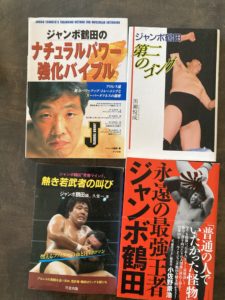
After Misawa got the three-count, there was plenty of attention given to his reaction and his post-match celebration. While Misawa described crying tears of joy after feeling such immense pressure before the match, Tsuruta is noted to have “cried silently” beyond anyone’s view. However, Tsuruta did note in SECOND GONG that he wanted Misawa to grow even bigger and he was nowhere near being done. Also, in GONG Tsuruta lists his twelve favorite matches. Here they are, in chronological order, WITH LINKS:
- Jumbo Tsuruta & Giant Baba vs. Dory Funk Jr. & Terry Funk – October 9, 1973
- Jumbo Tsuruta vs. Giant Baba – December 12, 1975
- Jumbo Tsuruta vs. Verne Gagne – March 10, 1976
- Jumbo Tsuruta vs. Rusher Kimura – March 28, 1976
- Jumbo Tsuruta vs. Terry Funk – June 11/12, 1976
- Jumbo Tsuruta vs. Billy Robinson – July 17, 1976*
- Jumbo Tsuruta vs. Jack Brisco – August 28, 1976
- Jumbo Tsuruta vs. Mil Mascaras – August 25, 1977
- Jumbo Tsuruta vs. Dick Slater – May 1, 1980
- Jumbo Tsuruta vs. Abdullah The Butcher – January 22, 1981
- Jumbo Tsuruta vs. Genichiro Tenryu – June 5, 1989
- Jumbo Tsuruta vs. Mitsuharu Misawa – June 8, 1990
*Match is recorded as going to a 70-minute draw
More from GONG here with Tsuruta’s definition of a great match. In his mind, a truly great match is one in which wrestlers demonstrate “unique mastery and performance”:
“Mastery and performance are crucial perspectives that influence the quality of a wrestling match. At the same time, they carry significant risks. If you step out of line, it can devolve into a ‘glamorous spectacle.’ To establish a serious competition, you must not compromise the flow of the match while meeting the audience’s expectations, showing your performance within the limits that do not cross the line. The abilities that both wrestlers possess clash as individual personalities, and only then can the audience evaluate it as a great match.” – Jumbo Tsuruta, The Second Gong, 1999
Here is also Tsuruta’s professional evaluation of Misawa, per BIBLE:
Mitsuharu Misawa
Date of Birth: June 28, 1962
Place of Birth: Hokkaido
Height: 185 cm
Weight: 110 kgWhen I was a rookie, you couldn’t become a wrestler without being big. Now, even at around 180 cm, you can do well depending on talent and effort.
During middle school, he was part of the gymnastics club. At Ashikaga Technical High School in Tochigi Prefecture, he excelled, winning the national amateur wrestling freestyle championship.
In 1981, upon graduating high school, he entered the world of All Japan Pro Wrestling. In 1984, he went on a tour to Mexico, where he learned the essence of Lucha Libre. After returning to Japan in August of the same year, he debuted as the second Tiger Mask and gained popularity. The following year, he defeated Kuniyaki Kobayashi to claim the NWA Junior Heavyweight Championship.In Misawa’s case, what compensates for his relatively small stature as a wrestler is his high level of athletic ability. His skill in maneuvers like the diving elbow from the top rope and the elbow suicida to the outside is greatly attributed to his background as a gymnast in middle school.
At the time he entered high school, Misawa was only 171 cm tall and weighed 71 kg. For someone aiming to become a professional wrestler, his small frame was his biggest concern. However, Misawa somehow had the conviction that he would “definitely become bigger.”
In the amateur wrestling club in high school, he built upon the flexible and springy muscles developed through gymnastics, acquiring muscles with power and endurance. His body grew as he wished.After turning professional, Misawa engaged in serious strength training and practice, steadily growing from junior heavyweight to heavyweight. At that time, the athletic skills and “functional muscles” he developed through gymnastics came into play. Although gymnastics may seem unrelated to combat sports at first glance, it has become a significant strength supporting the current Misawa.
Misawa emerged from being just another young talent to my true rival starting from the match on June 8, 1990, at the Nippon Budokan.
The semi-final that day featured a match between the Triple Crown Champion Terry Gordy and Hansen. In other words, my non-title match with Misawa took precedence over the Triple Crown unification match as the main event. This match was significant in predicting the future of All Japan. I believe the fans were undoubtedly aware of this as well.
I attacked Misawa with big moves like jumping knees, suplexes, and powerbombs. Misawa, on the defensive, often found himself flat on the mat. Confident of victory, I executed a brainbuster, but Misawa evaded it and hit me with a back drop. However, I could read this movement. I intended to counter by crashing my body into him to push him down. At that moment, Misawa flipped his body and surprisingly secured a pinfall victory over me with a half crab hold. It was the first time in my nine years as a wrestler that Misawa defeated me. Misawa remarked, “I was surprised myself. However, a comeback move doesn’t count as a 100% victory,” and I commented, “If you think you’ve conquered me with this, you’re still naive.” However, I secretly acknowledged the ability of Misawa, who is 11 years younger than me. As I approached 40, I also felt that my peak was gradually coming to an end.In August 1992, he challenged for the Triple Crown Championship, moving from Jumbo Tsuruta to Stan Hansen, and successfully captured it. He established a record of seven consecutive title defenses until June 1994. Although he temporarily lost the belt to Steve Williams, he reclaimed it in May 1995. In May 1998, he lost in a Triple Crown match against Kawada, but he did not relinquish the position of ace in All Japan.
In ETERNAL Osano pivots to discussing the next generation of wrestlers alongside Misawa or below: Kawada, Kobashi, Kikuchi, Taue, and Isao Takagi, and, up until the Exodus, KOKI KITAHARA! Apparently Kobashi, Kikuchi, and Kitahara were dubbed “The Three Crows” while in training. With Misawa moving to a headline position, Kikuchi would take his place as Tsuruta’s attendant and would note that Tsuruta wouldn’t drink all that much, getting red after one drink and then switching to oolong tea. For his efforts, Kikuchi would be rewarded with a singles match against Tsuruta…Tsuruta’s first following that loss to Misawa. Tsuruta beat the piss out of Kikuchi, leading some to argue that Kikuchi managed to get more monster out of Tsuruta than Misawa. Kikuchi also credits Tsuruta beating him up as a reason fans paid attention to him as a FIP. This led to one match in which Tsuruta was said to dislocate Kikuchi’s jaw with a boot and then realign it with a lariat. These constant beatings from Tsuruta and Kikuchi’s persistence in response would lead to Kikuchi earning his nickname “Fireball Kid”. Kikuchi’s presence opposite Tsuruta benefitted Jumbo as well since he made Tsuruta’s strength appear twice as great. Kyohei Wada credits Kikuchi as the first through-and-through junior to be in King’s Road main-events, and his ability to endure pain made Kikuchi even more popular than Kobashi for a while.
The next problem comes on July 30th when Kabuki declines a contract extension and a promotion to an executive position and instead goes to SWS. In addition, Yoshiaki Yatsu stops appearing earlier that month and signs with SWS on August 7th. In response, Taue is moved to Tsuruta’s side so to make full use of his size, sumo experience, and Tsuruta’s experience as a big wrestler facing down a wider field of smaller opponents. Tsuruta would praise Taue for his movements and how well he took Tsuruta’s lessons to heart. Taue also notes that both Tsuruta and Fuchi would take him aside after matches, recall specific things from the match that just ended, and would suggest to him how to improve.
“He gave a lot of advice about matches. Instead of saying “Do it this way,” he would say, “It might be better to do it like this.” During matches, when I came back and tagged out with Fuchi-san, he would give me detailed advice. After the match, he would talk about the overall flow, saying things like, “At that time, you did it this way, but it would’ve been better to do it that way.” He taught me various aspects of building matches, spacing, what needed to be done… a comprehensive approach to creating professional wrestling. Tsuruta-san was a smart person, so he was skilled at structuring things. Learning his logical methods of match-building became a valuable asset in my professional wrestling career.” – Akira Taue on Jumbo Tsuruta
(APOD: While Taue was never as strong on offense as Misawa, Kawada, or Kobashi, he did all the little and less noticeable things extremely well which made him a perfect fit among the more offensively minded other three. Massive credit to Tsuruta for sharing useful knowledge with Taue so that he could apply it in the years ahead).
At the same time, Tsuruta uses his performance in this match to show his thanks to the fans that stuck with him following Tenryu’s departure. Per ETERNAL:
“I haven’t been headlining for over ten years for nothing. Honestly, I’m glad we had a sold-out crowd today. After the mass departures, I felt I had to meet the expectations of the fans who kept supporting us in such a situation, so I worked hard. One of the conditions for being at the top is how much effort you can put in when the company is in a pinch. Today, I wanted to show the fans that the ace of All Japan Pro Wrestling is undoubtedly Jumbo Tsuruta!”
Fuchi notes that Tsuruta would get genuinely angry in matches opposite the Super Generation Army because he found it humiliating that his protégés/juniors would get the best of him. His anger and ferocity were, at times, not performance. According to Wada, Misawa being his junior was a deciding factor in his anger coming out more than against Tenryu. Tsuruta saw Tenryu as an equal but Misawa was his pupil/student/kouhai. Even if AJPW had, under Tenryu, moved away from these generational hierarchies in booking, Tsuruta still held onto those structures in different contexts. On October 1, 1990, Tsuruta accidentally breaks Misawa’s nose and doesn’t seem as apologetic about it. On October 19, 1990, in the first Tsuruta-gun/Chosedai-gun six-man, Tsuruta targets that injured nose without mercy. Wada notes that Tsuruta had to be kept strong so that the younger generation’s chase actually meant something. Tsuruta kept his end of the bargain, bringing out his inner monster even more than with Tenryu which benefitted Misawa and his peers. We see this in the Misawa/Tsuruta rematch on September 1, 1990 which differs from the June 8th bout with its greater sense of aggression and a heavier, more emphatic finish.
“Strategies and tactics don’t work on that man. It’s better to just go all out from the start. I don’t think Mr. Tsuruta can stay at the top for another 10 years, so I want to establish something unshakable before he declines. But that man might be able to go on for more than 10 years. His physique, stamina, and speed…it’s strange how none of that deteriorates over the years. Well, if he were to suddenly drop, it would be a bit sad. But he’s a monster. Because he’s a monster, it’s worth defeating him. Only by defeating such a monster can you truly reach the top” – Mitsuharu Misawa’s comments to Weekly Gong following his loss to Jumbo Tsuruta
(APOD: I covered that match here. It’s definitely must-see classic that has better wrestling than the June 8th match even if it’s less historic.)
At the same, Tsuruta rebukes these comments that he’s a monster and that he’s still so strong because he puts a tremendous amount of effort into his training that he hides from everyone. This way he can slow down his inevitable decline. He also uses this opportunity to say that he’s confident that AJPW will crush SWS and even though Tenryu’s new promotion might have some strong gates at first, they won’t be doing well three or five years down the road (APOD: How prescient. SWS would fold in June 1992 after two years and change in operation). Still, Tenryu weighed heavily on Tsuruta’s mind, with Tsuruta going so far as to comment on SWS’s first big show in Yokohama Arena on the same night as the first Tsuruta/Misawa six-man tag in Korakuen Hall.
We skip ahead to April 20, 1991, which is Fan Appreciation Night in All Japan. That show featured a sold-out crowd of 2,000 in Korakuen Hall and is headlined by a six-man tag between Tsuruta’s Army and Misawa’s Army. The fans who went there were so happy with the match chanted every wrestler’s name one by one, then they chanted “All Japan” and finally they chanted for Baba, who was sitting at ringside. (APOD: Not hard to see why. 4-20-91 is as easy a 5-Star rating as it gets. Absolute must-watch)
Next we get a few more comments about Tsuruta from other wrestlers. First is Taue who summarizes his experiences in singles matches with Tsuruta as “frustrating” because he’s attack and attack over and over and Tsuruta would remain calm. This would weaken Tsuruta’s opponents’ resolve because they’d come to see the futility in their attacks. Having also taken Tsuruta’s fabled Backdrop, Taue concludes that Tsuruta “isn’t an ordinary person”. Next is Kawada, who, as you may recall from my covering of his book, initially viewed wrestling as “like sludge” until he saw Tsuruta wrestle Mil Mascaras in 1977. Years later, when choosing between New Japan and All Japan, Misawa introduces Kawada to Tsuruta and Kawada is moved by Tsuruta’s superstar presence and was convinced he was a special kind of person. Kawada also recalls a sort of miscommunication in which he was purportedly thrown out of Tenryu’s Army but then sent back when Tsuruta kicked him out of his/the regular army’s locker room as well. Kawada also recalls being thrust into a major position after Ashura Hara got fired and he found himself in tag matches opposite Tsuruta. He was shocked and left in awe over Tsuruta throwing top foreign wrestlers around “like toys” and laughing while he was wrestling. Tsuruta, Kawada concludes, didn’t lack anything.
“I thought I’d try to provoke him since he always seems so relaxed. It would be interesting if I could make him angry. Well, once you make him angry, it becomes a big deal because he doesn’t stop (laughs). But the thing is, he doesn’t show his true Jumbo Tsuruta unless you make him angry, so I kicked him in the face. The persistent headlocks and sleepers were because those moves don’t depend on height. But in the end, it was really difficult to provoke someone who is so relaxed.” – Toshiaki Kawada following a singles loss to Jumbo Tsuruta in 1991
Mixed in here is a pivot forward to the 1991 Champion Carnival which sees, among other things, Tsuruta besting Stan Hansen in the finals and retains the Triple Crown against Misawa two days later. These two big wins in quick succession leave Tsuruta uncharacteristically talkative, which leads to him publicly challenging Hulk Hogan and throwing more shade at Tenryu:
“The number one in All Japan Pro Wrestling is definitely Jumbo Tsuruta. It’s not anyone else, not Hansen or Misawa, it’s me. To make the fans understand that, I have to do this much. Well, it seems like my contemporaries, whether it’s Tenryu or Choshu, are a bit lacking in energy, so I need to show that this generation is still not going to lose. Personally, I want to fight Hulk Hogan, who is said to be the best in the world, even just once… I would be okay with losing, but I want to go at it head-on, fighting with all my might, and have the fans see that is my current mindset after defending my title. Whether it’s a world championship match or at the Tokyo Dome, or the National Stadium, I want to fight with all my strength.” – Jumbo Tsuruta
Osano speculates that Tsuruta’s unusual remarks about Tenryu and Choshu relate to those two experiencing issues in their home promotions. Tenryu assumes responsibility for the Koji Kitao incident with John Tenta from April 1st which leads to him resigning from three positions within SWS while Choshu was moving away from in-ring wrestling towards booking/management. Tenryu tells Osano in more present-day terms that Tsuruta’s comments were accurate and Tenryu had heard critics call SWS boring.
Going back to peer evaluations, Kobashi’s next and, of course, he has plenty to say as arguably the most talkative of the AJPW alumni. Kobashi first notes that Tsuruta had an incredible ability to regulate stamina and control his breathing in a way that allowed him to rest without actually showing that he was resting. Tsuruta would always be moving slightly and would catch his breath more subtly and take far fewer breathers than anyone else which made him look much stronger by comparison. Kobashi likes to talk about wrestling from a practical/practitioner’s perspective without breaking kayfabe and notes how Tsuruta’s flying bodyscissors drop/Thesz Press was such an effective move despite its lack of visual appeal, likening it to a mat crashing down on you. He also throws a what-if scenario out and speculates that Tsuruta’s set in motion the chain of events that led to Steve Williams “unsealing” his forbidden Dangerous Backdrop, and AJPW moving in the head-spike direction while also reinforcing the notion that danger comes with the territory.
“Tsuruta-san’s moves, like the Jumbo Lariat and Jumping Knee, were effective, but the Flying Body Scissors Drop also worked well. Being big, it felt like the mat was crashing down on you. If Tsuruta-san had remained healthy, Williams’ Dangerous Backdrop might not have even been created. Williams started using the Dangerous Backdrop after Tsuruta-san retired from the front lines in 1993. My own abilities were increasing, so I wish I could have faced Tsuruta-san at a higher level and taken his backdrop. I had also taken Williams’ Dangerous Backdrop. In that case, Tsuruta-san might have changed the angle depending on the opponent, thinking, “If this doesn’t work, I’ll try an even more amazing angle!” Such exchanges are how pro wrestling evolves, and I believe it’s something that fans find “interesting” to watch.
It’s natural for pro wrestling to be dangerous. Evolution occurs because we build bodies capable of withstanding it and learn how to take falls. Therefore, after 1993, as someone whose ability to take falls had evolved, I had the desire to experience Tsuruta-san’s ultimate backdrop.” – Kenta Kobashi
APOD: This looks like a good spot to conclude this section since we’re left with this image of Jumbo Tsuruta being unstoppable. This section has focused on the start and peak of the Tsuruta/Misawa rivalry and how Jumbo became the ultimate goal for Misawa & co. to chase. I made sure to include as many direct quotes from the wrestlers themselves as possible so that we could get as close to a direct and honest opinion of Tsuruta as possible from the people who experienced him during what is widely considered either his prime or his career final peak. And once again, these younger guys highlight an important point about Tsuruta that can be applied to many other wrestlers as well: they got so much out of Tsuruta because they got him to show emotion. Taue describing attacking Tsuruta with no response as “frustrating” is a very insightful point. Sure, maybe having a stoic opposing force no-selling your offense makes sense in Japanese wrestling psychology but on a global level it might not appeal to every audience. Wrestling needs give-and-take/a sense of tug-of-war for most audiences to really get into it which is why emotion and expressiveness matter so much. Tsuruta getting pissed off, either in kayfabe or for real, really added to his matches. And from the perspective of his juniors, who found themselves hitting a wall, it’ll be interesting seeing how they adapt to this immovable object standing before them.
As always, thanks for reading.