

5-Star BOOK Reviews: Jumbo Tsuruta’s Books, Part XII
By Alex Podgorski on 13 March 2026
This is the penultimate entry in my coverage of Jumbo Tsuruta’s books. Here we’ll look at Tsuruta’s final years in wrestling, his transition to academia, his retirement, and his passing. We’ll also conclude two of the books I included in this coverage. With Tsuruta moving away from the ring we’ll get the chance to peer more into Tsuruta’s mind. ETERNAL and SECOND GONG have a few notes on Tsuruta’s theories and I think it’ll be interesting to see whether these high-concept philosophies can be applied to the world of professional wrestling.
You can read part 1 here, part 2 here, part 3 here, part 4 here, part 5 here, part 6 here, and part 7 here, part 8 here, part 9 here, part 10 here, and part 11 here.
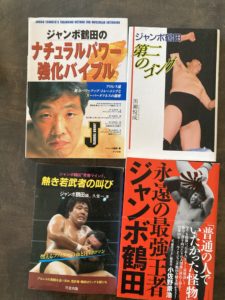
We begin this section with…RESEARCH! In ETERNAL Osano describes Misawa and Kawada going back to the drawing board following Tsuruta’s dominant run in the 1991 Champion Carnival. With Tsuruta bulldozing everything in sight and adopting the crossface chickenwing as a specific counter to Misawa’s elbow spam, the younger guys decide to look for new techniques of their own. After careful planning, on September 4th Misawa & Kawada defend their World Tag Team Titles against Tsuruta & Taue. In that match, Misawa scores a stunning upset with a submission victory over Tsuruta using his new facelock. This is the first time that Tsuruta has ever submitted to a Japanese wrestler and the execution of this finish elevates Misawa further without diminishing Tsuruta. That same month, Kawada combines the dragon sleeper and cobra twist/abdominal stretch into one technique, called the Stretch Plum. (APOD: In ETERNAL Osano frames the Stretch Plum as Kawada’s invention; however, this isn’t true as the move gets its name from joshi wrestler Plum Mariko. This isn’t a new phenomenon, either; many of wrestling’s sickest moves were actually invented by joshis including the Jackhammer [Jaguar Yokota], The Vertebreaker [Megumi Kudo], The Death Valley Bomb/Driver [Etsuko Mita], The Air Raid Crash [Mariko Yoshida] and The Victoria Driver [Kyoko Inoue*])
*Some sources say it was Kotetsu Yamamoto but I’m not sure if that’s the same move.
This talk of submission holds brings up a quote from Masanobu Fuchi who explains the importance of submission holds as a counterpoint to Giant Baba’s insistence on three-count decisions. Fuchi argues that a submission hold can focus the audience’s attention for longer than a mere three seconds, which creates a discussion on whether it’s better to have a short but higher peak or a lower but longer peak. Fuchi cites Tsuruta’s sleeper hold and how he used his bigger body for leverage as a means of exhausting is younger challengers. And for Kawada, the Stretch Plum is a means of reducing his movements in the ring which helps since, in that singles match against Tsuruta, he found himself wrestling while running a fever of 38 degrees Celsius.
Osano jumps ahead to the 1992 Champion Carnival and the final singles match between Tsuruta and Misawa. This match ends in a 30-minute draw, leaving the score between them at one draw, one win for Misawa, and two wins for Tsuruta. Kyohei Wada gives a brief summary on the feud saying that Misawa was able to build his stamina so that he would take hits and tire Tsuruta out.
After that things begin to accelerate and turn downhill. After a few more months of strong performances (APOD: including what is widely considered his last stand, a stellar match on June 5, 1992), Tsuruta disappears from the ring with what is publicly announced as a re-aggravation of a left ankle injury. This marks the first time in almost seven full years that Tsuruta had taken any time off for injury so the media treats this as a very serious matter. Behind the scenes, Tsuruta had been undergoing treatment for his Hepatitis since his first diagnosis but the illness hadn’t caused any side effects or flare-ups until July 1990. He misses all shows until mid-August 1992 and stays on tour until AJPW’s 20th Anniversary show that October. During this time some people notice he looks a bit thinner but no one makes anything of it. Incidentally, upon his return Misawa pins Hansen to win the Triple Crown and Terry Gordy pins Tsuruta in a tag match (APOD: Alas, any rub Gordy would get from that clean pin would be gone by the following year). Though Tsuruta gets a rematch against Gordy & Dr. Death a short while later, it’s Taue who gets the fall for his side in a clear sign of changing times.
In terms of Tsuruta’s illness, pretty much everyone is kept in the dark about it, even Fuchi, his closest friend in the company. Jun Akiyama, who was in training at the time and served as Tsuruta’s attendant, had no idea of what was going on. His only hint of anything being wrong is Tsuruta claiming to be tired all the time. Osano goes into a little summary of the in-ring interactions between Tsuruta and Akiyama, the former praising the latter from the start and having high hopes for him. Akiyama also notes that even when Tsuruta was ill he hid it so well while wrestling that no one could tell he was anything but himself. As a parting gift, Tsuruta passes down his jumping knee bat to Akiyama who’d go on to use it for the rest of his career.
ETERNAL goes into Tsuruta’s health deteriorating due to his liver enzymes spiking. He loses a lot of weight while in hospital, with Baba saying he looks like he did when he first joined All Japan. With Tsuruta gone from the front lines, Akiyama is suddenly thrust into the spotlight as Tsuruta’s replacement alongside Akira Taue in the 1992 tag league tournament. That year ends with a new generation of wrestlers taking over as Tsuruta’s time as an active wrestler appears to be over. Osano goes into personal details, apparently having had many phone conversations with Tsuruta while he was in hospital. Later on the media would report on Tsuruta’s sudden retirement due to Hepatitis. Tsuruta reasons that he wouldn’t be able to get into good enough shape for the regular tours and one of his top liver specialists gives him the choice between “wrestling and life” and he makes an obvious decision. However, much of these initial reports happen in a whirlwind of sudden discussion and Tsuruta is misquoted. He confirms he’s taking time off to recover as much as he can but, as if 1992-3, doesn’t formally retire. As a gesture of support, one of AJPW’s announcers plays Tsuruta’s entrance theme once he’s discharged from the hospital and returns home.
After making an appearance on a Fan Appreciation Day, Tsuruta reads a book by a doctor at Chigasaki City Hospital who had published a new book on how to cure Hepatitis B. After meeting its author and his staff at the hospital, Tsuruta embarks on a new lifestyle, one that allows him to wrestle but with strict caveats. Specifically, Tsuruta cannot do singles matches, have extra strenuous ones that will tire him out, and he must avoid kicks to avoid possible laceration of the liver or spleen. After just over a year, Tsuruta returns on October 23, 1993, and begins a period of “enjoyable pro wrestling”. Though he does well enough, Tsuruta notes that he has lost about 10kg of weight and was gassed after only ten minutes.
Shifting gears a bit here to the other book SECOND GONG which focuses more on Tsuruta’s academic life. After a few appearances on tours managed very carefully by Baba himself, Tsuruta pivots towards graduate studies in coaching. At 43 years old, Tsuruta becomes a graduate student at Tsukuba University. He completes a master’s thesis titled “Challenges Facing Modern Wrestling—The Theory and Practice of Jumbo Tsuruta” and graduates in March 1997. During this period he also serves as temporary coach for the All Japan Women’s Judo Team and he does some guest speaking appearances for the Japan Sumo Association. The academic life brings a different kind of strain for him: in GONG it’s noted that during his first year he’d commute to and from school three hours each way, five days per week, to get two years’ worth of credits in a single year…and get A grades in all classes. His academic pursuits also get him covered by ordinary media as well, showing him outside the confines of pro wrestling.
Through these pursuits Tsuruta’s focus gradually shifts: what starts off as him seeking a way to help develop a more formalized and beneficial training regimen for wrestlers evolves into a way to teach body conditioning and training methods from wrestling to the general population, as a sort of alternate wat of bringing wider recognition to pro wrestling.
He also begins a career as a touring lecturer at Keio University and Toin University in Yokomama and his alma mater Chuo University. During some lectures he’d show videos of his matches with the aim of improving basic physical fitness. His favorite strategy, per GONG, was to fast forward to and pause at moments where he was in a disadvantageous position to get laughter from the audience, and then use that image and how he bounced back from that as examples of improving physical fitness. And apparently at Keio University he would also teach some willing students “joint locks”.
Years later Kawada, having given up wrestling and settled into his life running his Menjarasu K ramen shop in Setagaya, notes that Tsuruta was exceptional because he thought ahead, unlike many wrestlers who seek extravagance. Kobashi, after his retirement, also credits Tsuruta for opening new post-wrestling paths for wrestlers (APOD: Kobashi has, apparently, become a lecturer at Shobi Gakuen University, though it does not specify in what field).
Tsuruta continues making sporadic appearances as a wrestler until 1998, competing exclusively in tag matches as promised. His final matches takes place on September 11th that sees him team with Baba and Rusher Kimura against Fuchi, Haruka Eigen, and Tsuyoshi Kikuchi. A few months later Giant Baba passes away. Tsuruta then makes a difficult decision to resign from All Japan completely, including from his role as an executive. This is because he had applied for a researcher’s J-1 visa to teach in the United States and turning that down now would be a major missed opportunity. Tsuruta also feels drawn to life in the United States for several reasons, one of which being that he can actually find clothes that fit him there. He is well aware of the language barrier and, based on previous experiences, the likelihood of racial discrimination. However, despite a back-and-forth with his wife, he is compelled to pursue this anyway because he sees teaching abroad as a personal challenge as much as a second life. He also states in GONG that he wants to use this opportunity to explore wrestling as a reflection of mental structures and real-life situations in different countries from a sociological perspective and wrestling as a sports entertainment industry from an economic perspective.
SECOND GONG digs a bit deeper into Tsuruta’s philosophies and includes a note on how the philosophers of Ancient Greece whose ideas laid the foundation for modern Western society, practiced wrestling as a means of keeping their whole bodies strong:
“About 90% of ancient Greeks were practitioners of wrestling, making it a very active sport. Plato and Aristotle praised wrestling as an excellent competition. Wrestling requires the entire body to be strong. For example, in soccer, you use your lower body, but your upper body doesn’t get trained as much. However, wrestling trains the whole body. In the past, the pentathlon included events like long jump and high jump, finishing with wrestling. A balanced body, a beautiful physique that works in any event, not a bulky body built through bodybuilding, captivated artists.” – Jumbo Tsuruta
Tsuruta expands on this and argues that a wrestling match is structured into three parts: the opening act is a ritualistic display of ancient Greek wrestling; the second part is entertainment wrestling that emphasizes fun; and the third is genuine martial arts. This emphasis on ancient Greece stems from Tsuruta’s studying of Japanese literature and he finds a connection to a literary concept of elegance and vulgarity. In Tsuruta’s mind, elegance refers to form while vulgarity is a mass of energy in the world of expression. Expression without beauty lacks refinement while lesser vulgarity leads to formalism. These two aspects need to be balanced.
Tsuruta compares photos of himself wrestling and sees connection to Greek sculptors and believes that, in his wrestling, he could recreate artistic expressions from 2,500 years ago. He concludes this discussion by stating that wrestling education shouldn’t lean too much on technical discussions but devote just as much time on aesthetic conversations. He also suggests that wrestlers need lifelong education to be truly balanced. For those seeking wrestling as a profession, Tsuruta proposes transforming education to reflect an Athenian value system that combines liberal arts education and strength. He emphasizes that wrestling needs to also budget for wrestlers’ post-grappling lives with things like pension and better mechanisms for a post-wrestling transition (APOD: Tsuruta’s ideals on wrestler care reflect bits and pieces of both Baba’s and Misawa’s individual practices. A widespread criticism towards All Japan was that their wrestler salaries were much lower than NJPW’s, with ace Misawa at one point being paid the same or slightly less than NJPW’s junior heavyweights. What isn’t included in this, however, is that Baba automatically deducted a percentage for a de-facto pension for wrestlers [which many guys like Kawada and Kobashi were thankful for], that Baba gave out cash bonuses to his top stars if he liked their matches, and that he often worked around the Japanese tax system with creative accounting so that wrestlers would have easier time managing payoffs. As for Misawa, he was adamant on improving wrestler salaries and putting Tsuruta’s ideals into practice with more injury care, better health benefits, and partnerships with various companies that would help NOAH wrestlers transition to life out of the ring.) As an aside, Tsuruta recognizes the public acknowledgment in the US that wrestling is staged through that 1997 New Jersey court case and he states he doesn’t want such a thing to happen to wrestling in Japan.
Review: SECONG GONG looks a bit more philosophical and gives more insight into Tsuruta’s mind, but it isn’t as detailed as ETERNAL nor does it provide as many firsthand notes as BIBLE. Much of it was complementary to the other two books and, while it had a few unique details, there’s a lot more to gain from BIBLE, which I’ll go into a bit more in the next section.
Final Rating: ***3/4
Now we go back to ETERNAL. After announcing his retirement from professional wrestling, some sort of incident occurs backstage. Osano mentions “a certain wrestler” being vague to Tsuruta about All Japan’s money and a misunderstanding over the circumstances surrounding Tsuruta’s departure to America. The ambiguity in this section is Osano’s and is intentional, though from how it is written this is heavily implied that this “certain wrestler” is Misawa. (APOD: This is one of those unresolved ambiguities that leave the reader wondering. There had been hints of an issue between Misawa and Tsuruta during the latter’s retirement ceremony and both Motoko and Tsuruta’s wife glowering at Misawa during proceedings. It’s not definitive, but the subtext here implies Misawa, struggling to understand AJPW’s complicated finances, either had an issue giving Tsuruta a final retirement payoff or he had questions about the money Tsuruta had made as landlord of AJPW’s original dojo. The timing of the affair seems to have set Tsuruta off, which is strange considering Tsuruta gave Misawa his full support during the NOAH/NTV negotiations).
That said, Tsuruta does get his formal retirement ceremony inside a sold out Nippon Budokan on February 20, 1999. He announces he will be a guest lecturer at Portland State University and, for the first time in his life, sheds tears in a wrestling ring.
Osano uses this conclusion to try and tie up some loose ends. From his time covering AJPW he noticed a distance between Baba and Tsuruta and that Baba trusted Tenryu more. As an example, Baba, who was said to be intimidating to his own wrestlers, once ribbed Tenryu. While drinking with Kobashi, Tenryu orders is kouhai to “go get some rice”, a Japanese term for getting cash, from Baba. Baba, in turn, hands Kobashi a big bag of rice. When Kobashi returns with it, Tenryu scolds him, only to find yen hidden in the rice. Then Baba snuck up behind Kobashi and the three of them partied for the rest of that night. On a more serious note, Osano further points to the fact that both Tenryu and Misawa – two men Baba entrusted with AJPW’s future – pinned him cleanly in the ring while Tsuruta never did. Osano also brings up the obvious lack of conclusion in the Tsuruta/Misawa feud, and asks the obvious question as to whether Misawa and his generation can really say they surpassed Tsuruta when none of them ever really beat him.
Sadly that’s not everything. We have to deal with the elephant in the room, that being Tsuruta’s untimely passing. Six months after moving to Portland, Tsuruta suddenly back in Japan, hospitalized. His liver condition had worsened and he developed cirrhosis. Rumors swirled as to his whereabouts: he was reported to be in Gifu and, by April 2000, he was seen in Australia. Due to Japan’s strict laws on organ donation, he had to travel outside the country to find a suitable donor. One had been found in Manila and he went there for a liver transplant. Unfortunately, during the operation he began to bleed uncontrollably which ultimately cost him his life. Allegedly, a match had been found in a South Korean citizen living in Japan, but according to Osano all South Koreans living in Japan had to get organ transplants through a single hospital and Koreans got priority when matched with donors of the same nationality. So Tsuruta pivoted to Australia and then the Philippines. The doctor who performed the surgery was highly experienced, yet during the final stages of the surgery Tsuruta began exsanguinating.
Osano concludes with a note saying that while Tsuruta wasn’t the best wrestler, he was definitely the strongest based on how he executed his techniques, hence the title of his book, ETERNAL STRONGEST WRESTLER JUMBO TSURUTA.
Review: ETERNAL was an amazing book though it was a slog to get through. Osano’s an incredibly thorough writer, as expected of the former Editor-in-Chief of a premier weekly wrestling magazine. But sometimes he has horrible pacing issues, forcing the reader to take a step back when introducing a new concept. That has its benefits but those come at the expense of proper linear pacing and flow. There were also more instances of translator error here than in any other of my book translations thus far, all of which relate to dates and numbers. Because most of the numbers are written as words and therefore kanjis, several dates were at first written incorrectly. So thank you to come of the reader comments for helping clarify in case I mistyped something, especially as we covered the 70s and 80s. Anyways, ETERNAL was a dedicated and honest look at Tsuruta’s life and career and it helped create this mythological aura about him. He was human at the end of the day yet this text made it seem like he was so much more.
Final Rating: ****3/4
APOD: That basically wraps up coverage of Tsuruta’s final years in wrestling and his excursion into academia. His death was, naturally, unfortunate, but it would be a stretch to say that there was a direct connection between his wrestling career and his death. He got Hepatitis in utero and it remained dormant for decades. He took as many precautionary steps as possible to wrestle without worsening the toll on his body and his sudden death comes across as a consequence of Hepatitis-related surgery. His is a tragic death though nowhere near as harsh or shocking as Misawa’s. Osano did a great job presenting Tsuruta as this larger-than-life figure who really was exceptional compared to everyone around him. I have one more piece to write about Tsuruta’s books which will pull more from his BIBLE book which has more evergreen content. So with ETERNAL and SECOND GONG focusing on Tsuruta’s life, BIBLE will look at ideas that are far more timeless and applicable long after his career came to a close.
As always thanks for reading.