

5-Star BOOK Reviews: Akira Hokuto’s Books, Part XII (Final)
By Alex Podgorski on 25 May 2026
Welcome back to my coverage of Akira Hokuto’s books. This is the final entry as we will be going over Hokuto seemingly tying up as many loose ends as possible. It’ll cover her wedding, one of her final big matches, and then we get into a series of thoughts and recollections. Here Hokuto gives some of her thoughts on various people around her and some of her peers, and then we’ll get into a series of testimonies from many people about what they think of Hokuto. Not only will this include several of her fellow AJW wrestlers, but also some journalists, her mother, her noted adversary Shinobu Kandori, and even Antonio Inoki himself will make a cameo. Let’s get to it.
You can read part 1 here, part 2 here, part 3 here, part 4 here, part 5 here, part 6 here, part 7 here, part 8 here, part 9 here, part 10 here, and part 11 here.
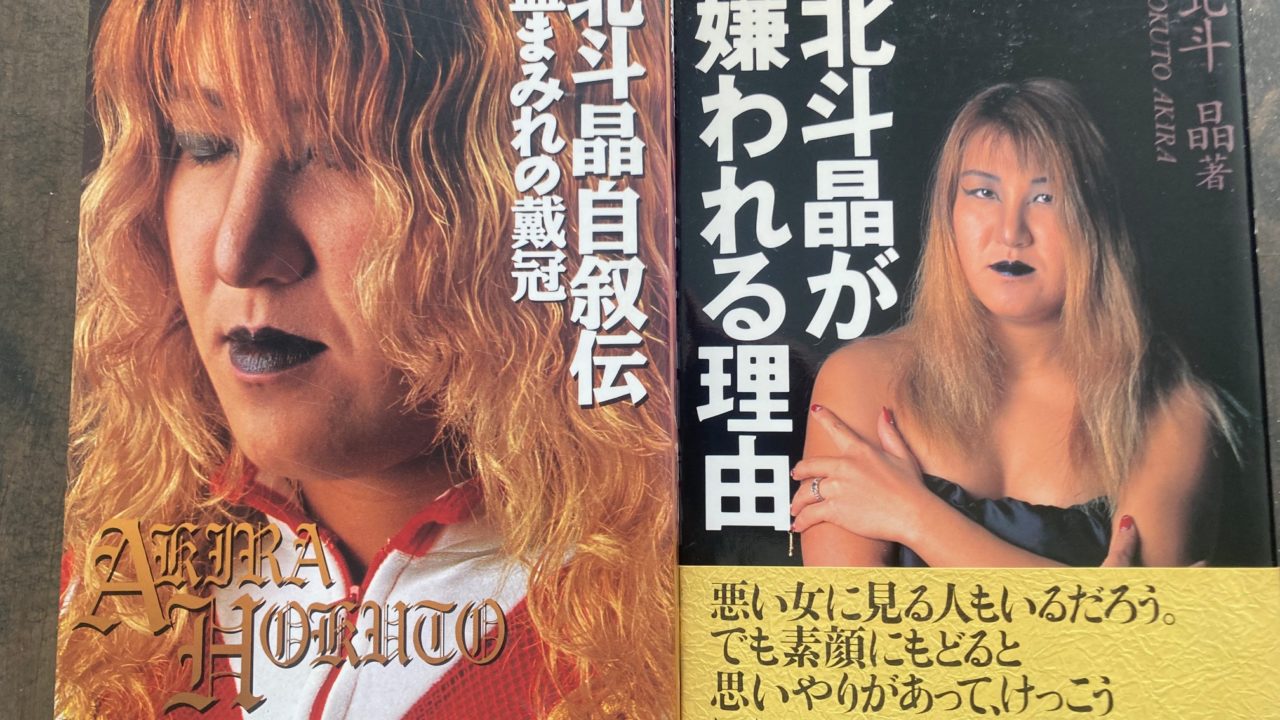
Part 12: Marriage and Final Thoughts
Shortly after she accepts his proposal, Hokuto and Sasaki visit each other’s families. Her family is receptive of him but at first she’s worried his mother might object to her blonde hair as something reminiscent of the Sukeban/delinquent culture. Sasaki tells her not to worry and for her to be herself rather than put up a front. The two families meet without a hitch and everything goes smoothly. She then sidetracks for a moment to discuss continuing her wrestling and speaks with Kunimatsu Matsunaga, whom she credits for supporting her many times in the past. She also speaks to the wife of veteran reporter Tarzan Yamamoto and gets more support from her as well. Hokuto’s plan is for their engagement to be kept secret until after NJPW’ G1 Climax. Her reasoning is that she doesn’t want people to think any underperformance on Sasaki’s part would stem from his being distracted by an upcoming wedding. However, at the end of May Sasaki tells Hokuto that the two of them will be on the front page of a newspaper despite NJPW’s protestations.
Hokuto spends the next few days dodging the media, going so far as to change her cellphone number. But not only do the reporters still track her down, one unnamed reporter threatens her in not-so-subtle terms that if she doesn’t answer their questions they will write whatever they want, including things she wouldn’t want them to. Hokuto doesn’t state whether she agreed to their terms but does state that everyone in her family kept quiet just as she had wanted. Two days later NJPW and AJW have a joint press conference surrounding the wedding and Chairman Matsunaga approves Hokuto continuing to wrestle, effectively ending one of the Three No’s of the company, at least on paper.
The summer of 1995 comes and goes with Hokuto wrestling a few matches culminating in a big singles bout at The Destiny Climax on September 2nd against Manami Toyota. Hokuto glosses over the match’s content, only noting that she lost and that Toyota was cunning for using Hokuto’s own move against her (APOD: That match is truly awesome, ****3/4 from me). At the same time, Hokuto is a bit critical of Toyota and says that even though Toyota’s wrestling is top-notch Hokuto doesn’t see her as the vanguard of any new era and says that Toyota’s “era” started and ended with that three-count at the Budokan. Hokuto’s also a bit critical of the press calling Toyota “princess” and “queen” and summarizes that since Toyota was her underclassman it is only natural for Hokuto to lose to her at some point.
Hokuto also goes over some of the stresses associated with a wedding: guests not RSVPing, seating issues, delays in getting to and from the venue, and ensuring people’s names were spelled correctly. Both she and Sasaki admit to not worrying about being the stars of the show at all since both are long accustomed to performing in front of much larger audiences. She also makes a point to note that she legitimately enjoys Sasaki’s company and that their marriage is the farthest thing from a publicity stunt. As an example, Hokuto tells a story of wanting to get her navel pierced since it was in fashion at the time but Sasaki said no. A few days later they go jewellery shopping for wedding rings and Hokuto sees a ribbon-shaped ruby ring for ¥1,200,000. Sasaki doesn’t even flinch and buys them. In another instance, Hokuto recalls struggling to find the “perfect wedding dress” from the ones in the stores so Sasaki tells her to have one custom-made since this is a once-in-a-lifetime event.
Shifting back to wrestling for a moment, Hokuto summarizes the state of the entire wrestling industry in Japan as being in an autumn period with winter fast approaching. Hokuto doesn’t name names but states that she knows a few people male and female who shouldn’t have become wrestlers and are treating it too much like a part-time job or who only entered it to make a quick buck during the summer period. She also wonders if women’s pro wrestling is approaching a dead end (APOD: Hokuto wasn’t too far off the mark here. AJW plateaued starting in 1996 following the end of the Interpromotional Era. Despite a solid roster, AJW’s fortunes would sour by August 1997 and then the company would implode and declare bankruptcy. Many women quit to go freelance or start their own companies. Most of these new startups failed sooner or later and AJW itself folded in 2005. As for Hokuto, she’d continue wrestling for AJW sparsely and shifted towards GAEA and then full freelance before wrestling her final match in 2006 for Kensuke Office). She compares herself to Tora-San The Vagabond, someone who disappears for a while and then reappears out of nowhere. This is the life she wants to live when it comes to wrestling. She also uses this opportunity to address the book’s title: The Reason Akira Hokuto is Hated is because she thinks she’s number one, that everyone is watching her, and she always gets what she wants. At the same time, she thinks that people wouldn’t like her from only their first impression yet by the second or third time you meet her you’d think she was actually a nice person.
And now for the drama, opinions, and a bit of mud-slinging. This will basically be a rapid-fire round of Hokuto sharing what’s on her mind about different people.
Hokuto hears talk of AJW being amazing but limits that to the techniques shown in the ring and the sheer number of matches per year (APOD: That number still falls below what WWF/E wrestlers endured during the 80s and 90s and featured a much more grueling travel schedule). She also thinks that AJW can’t really call itself the best because its rookie class isn’t all that top-notch, especially after hearing some comparisons to JWP and GAEA’s rookies, which were more promising at the time. She also accuses someone in AJW of nipping young talent in the bud rather than nurturing new talent, which she argues will affect the company’s ability to survive.
Next Hokuto talks about her bestie Bull Nakano. Hokuto attributes Nakano’s continued success to her Nakano’s desire to be “like Antonio Inoki or Giant Baba”, and dedicates herself to wrestling accordingly. At the same time, Hokuto and Nakano bond over being so carefree in their personal lives, which makes them stand out from their peers.
Next is Aja Kong, whom Hokuto calls both “too strong” and a “genius”, echoing what so many others have said. To LCO (Etsuko Mita and Mima Shimoda), Hokuto says “do whatever you want already!” and that’s it. She calls Chaparita ASARI a weirdo and didn’t want LCO to turn into a ragtag band of both outcasts and weirdos. Though she thinks ASARI is cute when she smiles, the fact that she smiles so rarely makes Hokuto think ASARI might secretly catch chickens to suck their blood. Then she mentions Yumi Fukawa and says “this girl is tiny but her boobs are huge (I’m not a lesbian or jealous)” Yeah, okay. Fukawa had a gimmick of a cute fighting girl and Hokuto’s only hope was that she didn’t get typecast into the same repetitive catfights and could actually wrestle properly.
Next is JWP the promotion which Hokuto says is represented by Dynamite Kansai and Mayumi Ozaki. Those two she considers serious wrestlers while the rest of their roster looks like idol wrestlers. She recalls the JWP fans screaming at her to stop bullying Ozaki when they were wrestling and also recalls Kansai knocking three of her teeth out with a kick. She’s the real deal and warns fans not to play around with her.
Next is Devil Masami and Hokuto, unsurprisingly, has nothing but nice things to say about her senpai. People think that the two didn’t like each other but in reality Hokuto has a lot of respect for Masami. Yes she was scary but at the same time Masami taught young Hisako Uno manners, property handwriting, and the correct ways to address people. On one occasion Masami gave a rookie Uno a piece of bread and rather than eat it Hokuto kept it in her dorm room until it got moldy. Then Hokuto pivots towards Shinobu Kandori and decides to write a pseudo love letter to her that’s half insults and half yuri-bait. Hokuto calls Kandori out for looking more manly, growing bald, and wearing attire that makes her look like an acorn spiky old man. But since she’s married to Sasaki she won’t fall for Kandori. She also asks Kandori to stop peeing standing up and wearing briefs and hopes that they don’t get reborn in the same generation and finishes with “From Chako-chan ♡” (“Chako-chan” being the nickname those closest to Hokuto call her).
Finally, Hokuto addresses her husband Kensuke Sasaki and says most of his career is still ahead of him (APOD: 100%. Sasaki’s career would really take off starting in 2000 and from there he’d basically wrestle all over the place. Aside from a badly timed split with NJPW in 2002 Sasaki would basically become the ultimate freelancer and be a big star all over the place, with his biggest career moment hands down being his epic bout with Kenta Kobashi at Destiny 2005 in the Tokyo Dome).
After going over a few more positive notes on the future and her current state of happiness, Hokuto concludes that she wrote this book over the course of only three days and acknowledges that it might be incomplete. That’s why there’s a whole section ahead containing testimonies from various people who’ve known her either in per personal life, professional life, or both. These testimonies will add context to things we’ve already seen or unearth new details.
Kazuhiro Kojima, Weekly Pro Wrestling Editorial Department Reporter
Kojima, who covered joshi extensively during the 1990s, opens his testimonial with the notion that he wants all women’s pro wrestlers to be happy. However, he makes an exception with Hokuto wanting to have her cake and eat it too. He doesn’t want her to return to the ring out of concern for her health. He recalls seeing her collapsing the moment she enters the locker room and witnessed her take painkiller injections multiple times. He thinks that there might easily come a day when Hokuto retires on the spot due to the accumulation of pain and injuries. This, he concludes, is no way to live and cannot possibly be construed as happiness. Still, Kojima notes how dedicated Hokuto is to meeting fan expectations.
Bull Nakano
Nakano opens that Sasaki’s the perfect partner for Hokuto because they’re both wrestlers and thus understand each other fully. At the same time, Nakano says that it’s best for her to nod along when listening to Hokuto talk. Whenever Hokuto enters a room, the atmosphere changes: sometimes it brightens, sometimes it becomes tense, and sometimes it becomes noisy like a typhoon. Once Hokuto starts talking she doesn’t stop and sometimes it becomes hard to follow her. If Hokuto catches on to this yes-man behaviour she gets angry and bossy until her mood improves. Aside from this, Nakano says they’ll be friends for life and will watch over each other in the long run.
Aja Kong
Kong congratulates Hokuto on her marriage and uses a mix of flowery and professional language when doing so. She sounds like she’s writing a departure email from someone leaving a company after a long time working there. But then she starts to slowly reveal a few layers of personality. Apparently the AJW staff once conducted a poll called “Top 3 People I Absolutely Don’t Want to Be With” and the results, in order, were: Hokuto, Yumiko Hotta, and then Kong. And yet of the three of them Hokuto is the first to get married which Kong says gives her hope. Kong recalls helping Hokuto and training with her and in exchange she and her peers like Kyoko Inoue and Bat Yoshinaga were teased. In one instance (not necessarily attributed to Hokuto) Kong had her face colored black with a marker and she was called Oni-gawara Gonzo (The Creature From The Black Lagoon). Apparently Inoue & Yoshinaga had it worse: one time Hokuto got bored and had Yoshinaga act like a dog and Kyoko take her on a walk around a parking with a rope around her neck. And yet the three of them – Kong, Inoue, and Yoshinaga – consider these good memories overall. Kong concludes by saying she doesn’t expect Hokuto will change following her marriage, but she does hope that Hokuto broadens her understanding of pro wrestling since her lack of knowledge of other wrestling makes Kong cringe.
Manami Toyota
Toyota respects Hokuto for pushing her own way through and strives to make everything fit her life as much as possible. That said, she doesn’t think Hokuto’s iron will to keep going will keep her in the ring much longer. Hokuto’s painkiller injections are growing in frequency and in number, which leads Toyota to think that Hokuto’s becoming more about words than actions. As for why Toyota finished the Destiny Climax match with Hokuto’s finisher, it’s because she wanted to both frustrate and humiliate Hokuto, and it worked. Toyota wishes she can get married and have kids by 30 (APOD: Sadly this doesn’t come to pass based on Toyota’s interview with Bull Nakano from five years ago) and hopes that having a kid might be good for Hokuto’s body because it might let her have rest being away from the ring.
LCO (Mima Shimoda & Etsuko Mita)
Shimoda opens by saying that Hokuto is someone who can turn both good and bad situations into positives. She calls Hokuto an almost motherly figure when it came to their treatment in LCO. Mita echoes this, recalling how she’d get scolded for making mistakes in the dorm because she was clumsy. Mita also recalls one instance she contemplated running away but Hokuto approached the situation delicately and encouraged her to think from a different perspective. When it comes to injuries, Mita observes that she and Hokuto are polar opposites: she’s a hypochondriac while Hokuto will suffer serious injuries and almost brush them off. Mita admits she wished to be like Hokuto someday but realizes that’s largely impossible because Hokuto’s so special. This is especially true given her wedding: Mita and everyone else seems shocked that it has actually happened given how strictly the no dating rule was enforced. She concludes by saying that the current Etsuko Mita exists primarily thanks to Hokuto (APOD: and by 1996-7, Mita and Shimoda, as LCO, would go onto become arguably the biggest and best tag team in joshi for years to come).
Chaparita ASARI
ASARI, whom Hokuto called a weirdo, almost quit but didn’t thanks to Hokuto. Drawn in by the glamour that pro wrestling showcased, once the reality of training and daily life set in she realized it wasn’t what she wanted and did everything she could to avoid wrestling, yet she didn’t have the guts to actually officially quit. ASARI would skip tours, underperform in training, and lock herself in the dorm, was considered a problem by AJW management (APOD: My guess is that AJW didn’t fire her because they needed someone like her on the lower card or something). So deal with this problem, ASARI was assigned to Hokuto, which terrified her. However, Hokuto’s first words to her were “I’m here for you”. This made ASARI want to follow Hokuto and ASARI never felt abandoned by her.
Yumi Fukawa
Fukawa calls Hokuto “amazing” repeatedly and thinks her life is truly exceptional. She attributes these to Hokuto’s many hardships and her commitment to following through on what she says. She wishes she could wrestle Hokuto but notes her own physical condition isn’t ideal at the time so it isn’t likely to happen.
Takashi Matsunaga, President, All Japan Women’s Pro-Wrestling
Matsunaga opens with a story Hokuto/Hisako Uno recalled when she was a trainee. One day while walking along the edge of a rice field Hokuto and fell in which caused a sickle lying there to get stuck in her head. She couldn’t pull it out with her hands so she used her feet and when she got home her parents just told her to put some mercurochrome on it. This added to her reputation for toughness, but Matsunaga also notes that she was also kind-hearted. She always stayed behind to sign autographs for every fan. When she broke her neck she was told she wouldn’t live a normal life, let alone continue wrestling, yet she persisted nonetheless. Also, Matsunaga address one of the unanswered questions from BLOOD SOAKED, about how her doctor would never approve her continuing wrestling else he lose his license. Here, Matsunaga implies that her fans pressured him into giving his stamp of approval during her petitioning campaign.
Nagaharu Imai, AJW Ring Announcer
Imai opposes Hokuto continuing wrestling for a number of reasons. First, Hokuto’s health isn’t that good. And second, he explains that AJW’s retire at 25 rule was meant to facilitate the women re-entering “normal society” and following expected life paths. While traversing the country on the regional tours, Imai recalls Hokuto giving staff a hard time, yet to him this was an expression of Hokuto’s strong will. When meeting different people Hokuto would use these little tricks to try and remember people like writing something noteworthy about them on the back of their business cards. If he were to describe Hokuto in one word it would be “plutonium”: beneficial to many people if used peacefully but a hydrogen bomb-level threat if angered or used incorrectly. He had many arguments with her over wrestling ideology, one of which led to an heated confrontation that almost led to blows and, over time, led to a renewed respect for her.
Rossy Ogawa, AJW Director of Planning and Public Relations
Ogawa opens by noting that Hokuto had a more masculine aura during her first few years. Since he believes that women’s wrestling should be defined as wrestling by women, less feminine wrestlers like Hokuto, Kong, Kansai, and Kandori were considered “rule-breakers”. He notes that during her first few years she had a sharp personality but then around 1989 she softened somewhat, which he attributes to her falling in love (APOD: Something that goes completely unaddressed in these books is Hokuto’s first marriage to Antonio Gómez Medina, better known as Mascara Magica II/Talisman Jr., a wrestler and booker for CMLL. Hokuto never mentions him but Ogawa implies that this marriage softened Hokuto’s overall attitude and made her more considerate towards others and rededicated herself to showing a more feminine appearance). Around the same time, once back in Japan Hokuto became the leader of the rookie class and Ogawa compares her to the warden at a juvenile detention centre. Despite her piercing glare, sharp tongue, and openness with her criticism of, well, everything, she showcased an outstanding degree of leadership when nurturing those for whom she was responsible. He says that she is the wrestler who thinks about the organization the most (APOD: This is hard to believe considering how much Hokuto describes her being selfish and self-centred when making outrageous statements and making matches about her) and admires her more down-to-earth mindset. He makes a rather unflattering analogy by saying that the girl at the casual bar is better than the beautiful hostess at the high-class club.
Devil Masami
Masami didn’t want to write anything about Hokuto but the subtext here implies that she was ordered to. She describes herself as being indifferent to pro wrestling, even when she was actively engaged in it. Rummaging through her memories of Hokuto, the one that stands out the most is of meeting her father before meeting her. This was during an earlier era and Masami implies that Hokuto’s father went out of his way to visit the venue for his daughter’s sake, perhaps to plead for her to be accepted as an applicant. Masami is perplexed at his actions because while it makes sense for a father to do what he can to make his daughter’s dreams come true by accepting her into AJW he’s robbing her of an ordinary, hardship-free life. Because of that, Masami is very surprised that Hokuto manages to fulfill both her own dreams of becoming a wrestling superstar and per parents’ dreams of finding happiness long-term.
Dynamite Kansai
Contrary to popular belief, Kansai doesn’t hate Hokuto as much people think. That said, she is still critical of Hokuto’s selfishness. Kansai accuses Hokuto of pushing others down in order to survive and, in interpromotional matches, would grab the tastiest portions for herself. Though she respects Hokuto for getting married and getting to continue wrestling while doing so, she thinks that marriage isn’t every woman’s dream, certainly not her own. Kansai shows a more traditional mindset, arguing that Hokuto’s marriage doesn’t mesh with wrestling and thinks it shouldn’t be allowed because it would be tough on all parties involved, not just the woman. Kansai also admits she doesn’t watch other women’s matches, though she does like men’s wrestling, especially Toshiaki Kawada’s and Nobuhiko Takada’s. She concludes by saying she probably wouldn’t want to wrestle Hokuto going forward since marriage would leave her “domesticated” and she prefers Hokuto when she was younger and more rebellious.
Masatoshi Yamamoto, JWP Representative
Yamamoto is someone who was on the receiving end of several sharp-tongued Hokuto promos in the past. For some reason, he would respond politely while Hokuto would be far more brash and, uncharacteristic by stereotypical Japanese society, ruder. However, these interactions were limited to dealings involving the Interpromotional Era’s arrangements; outside of that context Hokuto would be far more polite and normal. As for where she would get her material for her promos, Yamamoto says that Chaparita ASARI would eavesdrop on his meetings with Ogawa and relay information to Hokuto in secret.
Shinobu Kandori
“Oh, she got married. Huh. I read about it in a magazine and thought it was a costume parade.”
Fans
There’s a handful of account from fans proclaiming how proud they are to be Hokuto’s fans. These are exclusively female fans and most of them talk about admiring her wrestling while/after getting married or how she stood out when she was a rookie. A few talk about how she overcame that neck injury and how inspiration of a story that was.
Matsue Uno (Akira Hokuto’s Mother)
From her childhood Hisako was never someone who lied, tried to be a good kid, or pretended to be someone else. She was genuine. Her dedication to wrestling was such that she had a match the day before her wedding and didn’t care if she attended the ceremony injured or in a wheelchair. Matsue recalls reading Hokuto’s autobiography and being shocked at its contents, thinking that her child would never do such things. Because of that Matsue warns that her daughter might not be a “good wife”, though this reads like a sort of in-joke.
Kensuke Sasaki
Sasaki believes that even if they didn’t meet in North Korea, they would’ve gravitated towards each other eventually. Her unusual ring name resonated with him and when he saw her crying in the Pyongyang hotel, he felt the need to intervene. He expected her to say it wasn’t any of his business but instead she opened up and they went back-and-forth in a conversation that went on for so long that the media guy disappeared without either of them noticing. He gave his honest thoughts based on his own experiences but notes that, had he not seen how anxious and worried she looked from a distance he might not’ve approached her in the first place. As for her continuing wrestling, Sasaki doesn’t care whether she does or not as long as she doesn’t do anything half-heartedly.
Antonio Inoki
Inoki opens with a comparison between American and Japanese women’s pro wrestling, calling the former a low-level accompaniment to men’s wrestling and the latter much more significant. Recalling the women’s role in Collision In Korea, Inoki was proud that the women got such a big response from the audience. He notes Hokuto has a “shine” that few other women possess and wants to support her however he can. Regarding her marriage, he notes it’s not that unusual and describes how track-and-field competitors have children and return to the sport. He’s also asked about her being called the female Inoki and he focuses on the revolutionary things she has done.
Tarzan Yamamoto, Editor-in-Chief, Weekly Pro Wrestling
Yamamoto opens with a bold claim that Hokuto became a “male” wrestler by carrying the same weight as all the other women’s wrestler combined. Not literal weight, but media significance. He argues Hokuto learned to wield the power of the media to her advantage. He notes that the trend had always been for men’s wrestlers to be the main focus and women the side attraction. Men would seek to be in the (wrestling) media as much as possible while women would not. However, there were only two exceptions to this rule: Chigusa Nagayo and Akira Hokuto. He even goes so far as to call GAEA, Nagayo’s promotion, a men’s wrestling promotion. He goes as far as to say that Hokuto underwent a metaphorical sex reassignment and become a male wrestler, which turned her into a traitor who abandoned AJW. She is said to have further fanned the flames in AJW by currying favor with the wrestling media for selfish reasons, which goes against the spirit of AJW. He concludes by saying that Hokuto losing to Toyota at Destiny Climax was a victory for women’s pro wrestling because Toyota protected the sanctuary of women’s wrestling from this “male” wrestler and now her only remaining ally is the wrestling media.
APOD: And with that, Akira Hokuto’s second book comes to a close. This book covered a shorter timeline but seemed to ask deeper questions about why Hokuto was (allegedly hated). She gave her own possible answer which was alright, but in my opinion the testimonials from other parties were far more interesting. In keeping with Hokuto’s overall sense of honesty openness I was expecting a bit more of the same from the many outside contributors. Sadly, at least as far as this book is concerned her peers didn’t say anything too revealing or inflammatory. Whether that’s for kayfabe reasons or not is hard to answer. As for the other contributors, the most biting critique came from, unsurprisingly, the wrestling media, who looked at her life and career from wider and more critical lenses. Naturally they had their own biases – especially Tarzan who seems to think that Hokuto could no longer be considered a women’s wrestler – so we have to take their words with a grain of salt. Still, as a book this was an interesting read though not as gripping as BLOOD SOAKED. It feels like an accompanying piece to her main book, which makes sense given she wrote it in three days and admitted to leaving some stuff out of the finished product.
Final Rating: ****1/4
As always, thanks for reading. Next up on the docket: Jushin “Thunder” Liger.