

5-Star BOOK Reviews: Jushin Liger’s Books, Part XI
By Alex Podgorski on 13 July 2026
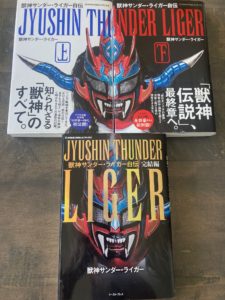
Welcome back to my coverage of Jushin Liger’s books. So far in this series there hasn’t been all that much in the way of juicy gossip or scandalous revelations, but this time we get closer to such things than before. This section covers a five-year-or-so period from 2004 to around 2009. This is an important period in NJPW’s chronology as it goes over what is widely known as the company’s Dark Age (Liger himself also acknowledges it as such). This period is defined by backstage chaos, personnel and structural changes that leave wrestlers caught in the crossfire, significant management changes, and growing internal strife, all of which Liger responds to with a mix of personal recollections and carefully curated responses that don’t rock the boat too much. Liger also opens up about the death of someone very close to him, which shows us more of the man behind the mask. Then another big story will show Liger’s darker side, and I don’t mean his evil alter ego.
You can read part 1 here, parts 2 & 3 here, parts 4 & 5 here parts 6 & 7 here, part 8 here, part 9 here, and part 10 here.
Liger opens this chapter with a discussion on the various newcomers to the BOSJ tournament. Among these, the wrestler that stands out the most to Liger is “American Dragon” Bryan Danielson. He was brought to NJPW by referee Tiger Hattori, who saw him training at NJPW’s LA dojo. Liger praises him for his delicate techniques, skill at structuring matches, and his fighting spirit. Yet Liger notes that Danielson always had a plain look and was surprised when he won the WWE Championship years later. Liger also mentions Katsuhiko Nakajima and Ebessan as two Japanese wrestlers who did well during their first New Japan appearances.
Around this same time Liger starts touring the indies and smaller promotions and in the process tries to pick something up from any good wrestlers he can find and in some cases encourages bookers to push individuals Liger finds impressive. Liger expresses a particular fondness for Michinoku Pro Wrestling (MPW)’s local shows in Tohoku which seem to beam with a comforting local touch. Despite their significantly smaller scale, Liger sees something touching in multiple generations sitting together on mats around the ring, which he considers to be closer to the original scenery of professional wrestling. Liger also recalls talking to fans who recount the differing experiences of watching in big metropolitan venues and more relaxing countryside shows.
As Liger enters 2004 he has a big match in the Tokyo Dome where he defeats NOAH’s Takashi Sugiura for his GHC Junior Heavyweight title. As another company’s junior champ, Liger defends against wrestlers trying to reclaim the title for the sake of the company. One of these is Mitsuo Momota who, despite being well into his fifties, compensates for his drop in power, stamina, and speed with augmented willpower. Liger uses this moment to discuss how techniques fit the wrestler. Despite no longer using the Shooting Star Press, Liger, at the time, still uses moves like the Ligerbomb, Avalanche Frankensteiner, Brainbuster, and the Fisherman Buster. Liger believes in using moves that fit one’s body’s characteristics. Since he has short legs and stiff joints, he applies techniques that cover those disadvantages. Going move-by-move, he added the jump to the Ligerbomb to add impact to a powerbomb limited by his short height; the Avalanche Frankensteiner was done to add more of a drop effect; the Fisherman Buster was added to make up for his poor bridging ability; and the aerial body scissor/Thesz Press doesn’t require much jumping ability. While he was still able to do the SSP as of this book’s publishing, he stopped wanting to long ago after seeing other wrestlers perform it more gracefully than him and he wanted to give younger wrestlers that opportunity while he perfected other techniques better suited to his stature.
Around the same time Liger forms a new stable called Control Terrorism Unit (CTU) which allows him to wrestle as a proper heel for the first time in his career. Liger found this both necessary and liberating since being a heel gave him more range as a wrestler and top wrestlers are capable of switching between roles without difficulty. Over time, CTU goes from purely serious to slightly comedic in nature, mixing unserious promos with serious wrestling to remind everyone to never underestimate them. Liger credits Gedo and Jado with teaching him more heelish characteristics.
The lighthearted tone ends with a shift to discussing Shinya Hashimoto’s death in July 2005. Liger and Hashimoto had been close since their rookie days. Back when it first happened Liger was so grief-stricken he refused to make any memorial comments for over a year. At first a formal call announcing his passing went out to individual wrestlers with the promise of follow-up information. But when Liger never got more details he called back and shouted at NJPW staff angrily for the first time ever. A cloud of depression followed him to the point that people started to worry about him (APOD: These words seem to echo Chris Benoit’s reactions to Eddie Guerrero passing though, thankfully, without the same tragic outcome). Liger also credits Hashimoto for introducing him to his now-wife, which serves as further proof of their closeness. This turns into a conversation about Hashimoto’s son Daichi, who later became a wrestler yet never achieved anywhere remotely as much success. Liger attributes this to a tendency among second-generation wrestlers to nurture their careers purely within their parents’ organizations, which doesn’t help those younger wrestlers grow as much as clashing with other young wrestlers of the same generation (APOD: There is also a much weaker perception of wrestling as a “family business” in Japan compared to pretty much every other market. Children are encouraged to find their own successes outside of their parents’ fields and following in their footsteps has a stronger tinge of nepotism or favoritism that clouds them far more heavily than it does elsewhere).
Liger takes a moment to discuss the Three Musketeers in general and how they compared to Inoki. While Hashimoto carried the banner of Fighting Spirit inherited from Inoki and had his own ambitions, he was also pure and perhaps a bit naïve. Muto was his opposite: far more charismatic and willing to see a decision through without caring about others’ opinions. Lastly, Chono was somewhere in the middle, balancing both worldviews, which is why he was able to balance wrestling and booking for a time. This topic leads to another shocking incident in Chris Benoit’s death in 2007. Liger describes hearing the news as “heartbreaking” and couldn’t understand it at first. To him it didn’t feel real. This blends with a discussion on Eddie’s sudden death two years earlier which Liger attributes to WWE’s tough schedule and Guerrero struggling in the top position. Liger recalls a similar dark period in the early 2010s when he spent most of the year abroad, away from his family. This left him feeling extremely homesick and made him question what he was doing, especially given how the wrestling machine was ready to replace him at any time:
“There are always wrestlers ready to replace you immediately. Financially, it might be rewarding, but continuing in that environment involves great risks. To distract themselves, some might turn to alcohol or drugs. Even someone as simple as me has moments when my feelings waver, so wrestlers who are prone to assumptions need to be careful. Currently, our top wrestlers not only participate in regular series but also often have media interviews and overseas tours during their off time, so it must be tough. The company probably takes good care of them in that regard. Once again, wrestling is a harsh profession.” – Jushin Liger
The next chapter is titled “The Dark Age of New Japan Pro-Wrestling” which, according to Liger, began around mid-2005. One of the initial events of this era is Tatsumi Fujinami being replaced as company president by someone named Kusatsuru Masaru, but he only lasts one year and is replaced by Simon Inoki. Although Liger got along with Simon, he was perceived to be easily manipulated by either his wife or his father-in-law Antonio. The translation leaves something ambiguous here as it notes that “Mr. Inoki’s decisions leave big match cards changed at the last minute or took a long time to be decided”. Given the context it’s unclear whether Liger’s talking about Simon or Antonio/Kanji in this case. This leads to an impression of staff being tossed around, which worsens company morale. While Liger and his juniors aren’t affected all that badly, the heavyweights are which affects the company’s bottom line. So much so that Antonio Inoki’s controlling share is bought out by video game company Yuke’s. Liger notes that without that company’s help, NJPW would’ve been taken over hostilely by another company, though he doesn’t name it. Despite this help, however, there are changes to the contract system that leads to some wrestlers having their contracts frozen. This leads to widespread talent departure, unwillingness to sign new contracts and, from Liger’s perspective, a series of mechanical and dispassionate negotiations akin to a personnel purge.
Around this time, there are internal discussions of many junior heavyweights leaving to start their own company. Liger blames these tensions on a returning Riki Choshu, who is brought back as on-site supervisor (read: booker/matchmaker). For many people, Choshu being able to come and go as he pleases leaves them with an allergic reaction to him. The initial masterminds behind this new promotion are Osamu Nishimura and Tatsumi Fujinami. The promotion is initially called Muga World Pro Wrestling, but is later renamed Dradition. Since Liger was seen as the spokesman for all the juniors, Nishimura and Fujinami try convincing him first. However, Liger doesn’t fully believe that all the right support systems are in place and tells the juniors not stay. It’s a close call, however: Liger himself almost leaves but ultimately choeses to stay, partially out of gratitude towards Kotetsu Yamamoto and NJPW for bringing him in. He also claims that Hiroshi Tanahashi, then still a midcarder, contemplated leaving to wrestle in the United States (APOD: This one’s a bit unclear: while there was interest from WWE to bring Tanahashi they ultimately picked Kenzo Suzuki instead in what in one of their biggest international blunders to date. Tanahashi being rejected by WWE would’ve left him with few viable options in the United States, especially with TNA having a working relationship with NJPW and ROH having one with NOAH).
Liger expands on the Choshu issue and his return which leads to a heated in-ring confrontation in front of fans. Choshu makes some inflammatory comments which Liger calls selfish. This promo, masterminded by Fumihiko Uwai, is framed as a shoot promo with many people being unprepared for them backstage. Liger calls himself simple-minded and admits he got manipulated by Choshu’s words. He explains that his anger towards Choshu stems from accusations that Choshu, as booker, deemphasized the junior heavyweight division and treated them as less important than the heavyweights despite their popularity.
Around this time NJPW appeared to work more with other promotions, including Choshu’s Riki Pro, Apache Pro Wrestling (which sees Kishin Liger appear for the first time in ten years), and HUSTLE. That last one is particularly important because, unlike the others, it involves celebrities, which invites a different audience from normal. This is a risky proposition since any bad publicity from such interactions risks degrading the genre if shown on TV. However, Liger isn’t too worried about HUSTLE’s existence so long as no one gets hurt unintentionally. He compares pro wrestling to a toy box and says it’s okay to have various characters.
NJPW’s new regime continues its trial and error phase until it seems like they settle on a new champion in Tanahashi. Liger omits Brock Lesnar almost entirely, reducing him to a mere footnote who couldn’t continue defending the championship due to contractual troubles (APOD: I’m not sure to what extent Liger was privy to specific backstage details but ignoring Lesnar’s involvements in NJPW is a big misstep, at least from a historical perspective. Lesnar was a HUGE deal in NJPW and the whole fiasco with him relinquishing the title belt was another major blow to NJPW’s public perception that shouldn’t go unmentioned). When Tanahashi wins the IWGP Heavyweight Championship for the first time and does his “I love you” promo, Liger, like many veterans, thinks it completely disconnected from old New Japan. Many people didn’t get it or outright rejected it at first, but with time Tanahashi’s “I love you” got over.
Tanahashi’s rise to the top was slow and arduous, however. Liger recalls one incident that Mr. Matsui read in Tanahashi’s book in which Liger beat the crap out of Tanahashi for making a big mistake in a match. However, the accounts differ on exactly what happened. In that book, Why Hiroshi Tanahashi Was Able to Change New Japan Pro-Wrestling, Tanahashi recalls a match two years into his career against Katsushi Takemura (so around 2001). As it unfolded, Liger attempted a dropkick thinking Takemura was getting up. But he didn’t so Tanahashi ended up kicking nothing and creating an awkward atmosphere that continues until the match ends. Upon returning backstage, Tanahashi is confronted by “the face of a demon” in the real, unmasked Liger who chews him out for that botched dropkick. But before Tanahashi can fully explain himself Liger beats him until Takashi Iizuka interferes from nearby to save him. Tanahashi blames his lack of knowledge for picking the wrong move to make and credits Liger’s beating for making him more determined.
Liger’s recollection of events, meanwhile, goes like this. He recalls teaming with Tanahashi (which would’ve put this in either 2002 or 2004) and giving Tanahashi advice post-match. When Tanahashi innocently asked, “Wouldn’t it have been better to do it this way?” Liger sees this as a veteran-like act from someone acting above his station, leading to a beating. Liger admits that he’s hot-tempered, but he provides a relatively paper-thin justification by saying that seniors always scolded juniors, even when Liger himself was a rookie, and that it just comes with the territory (APOD: I’m sure we can argue about this forever as outsiders looking in and I’m sure that there were similar cases of such “discipline” in American promotions before the ubiquity of the internet, smartphones, and other “spotlight changes”, but at least in this case Liger being overly angry during a time when they can’t afford to have pushed stars make rookie mistakes does make sense from a certain point of view).
Although by 2017 Liger has stopped using physical punishment, he does still have a verbal temper which must make life hard for rookies given he’s a stickler for manners and etiquette. When asking a trainee if “so-and-so is here” and they respond “I don’t know” Liger thunders at them (APOD: his words, not mine) and says “Don’t just say they’re not here! The normal response is to say you’ll look for them since you can’t find them, right?” Although Liger considers current-day seniors kinder compared to his rookie days, Liger observes that prospective pro wrestlers are, by and large, selfish and they need to have certain behaviors drilled into them from an early age. For example, when visiting a dojo, he threatens an entire crew with 3,000 squats because he finds the toilets uncleaned.
Circling back to the original topic, Liger praises current-day (~2017) Tanahashi to the moon for becoming the company’s ace and successfully appealing to different people:
“I think Tanahashi is currently the best wrestler in our company. He has convinced fans and wrestlers with old values as well. Even though Okada and Naito have been rising, in a broad sense, I still feel Tanahashi is unbeatable. As a champion, I think his way of fighting is the best. Winning by drawing out the opponent’s strength to the limit means, conversely, that he himself has the skill and range as a wrestler. The old NWA champions traveled all over the U.S., fighting challengers from each region. That way, the audience thought, “Next time, we can win!” and supported their local wrestlers, wanting to come back to the venue.” – Jushin Liger
Liger closes this discussion looking at two of Tanahashi’s contemporaries, Togi Makabe and Katsuyori Shibata. Liger has as much respect for Makabe as he does Tanahashi since Makabe sacrificed a lot to help NJPW improve during their dark age. Makabe was said to carry the spirit of Showa-era NJPW and carried himself with a strong sense of integrity. On Shibata, Liger didn’t have much of an impression of him at first. When he joined, Katsuyori didn’t make any attempt to ride his father’s coattails and did everything on his own. When Shibata left, Liger understood and echoed a sentiment from Inoki which was something along the lines of “rivers always flow into the sea”.
APOD: This was far more interesting and insightful with Liger showing more of his true self through these stories and recollections. His explanation of his techniques is interesting as he focuses on practicality and masking his limitations. This practicality extends to the darker time in Liger’s career and life, as seen with the deaths of Hashimoto, Guerrero, and Benoit. One hits him hard and the other two he sees as results of an extremely harsh and unforgiving industry that’ll leave even the most respected veteran behind if they’re not careful. Liger was also a bit more critical here compared to previous sections and paints Riki Choshu as a major reason for NJPW’s troubles, especially as his booking decisions seem to leave some wrestlers underappreciated. Liger also, perhaps unintentionally, affected the course of wrestling history by not supporting a junior heavyweight talent exodus to Dradition; had that happened then it’s possible NJPW’s Dark Age would’ve gotten even worse and harder to survive. And refreshingly Liger admits that he’s far from perfect and I’m sure many people will see his backstage behaviour as proof. Yes he’s physically and verbally punishing which, once again, likely stems from sumo traditions that bled into pro wrestling decades ago. However, Liger made it clear he wasn’t acting maliciously; if anything he had high expectations of those being pushed and wanted to eliminate any possibility for mistakes to be made in his own way. The only thing this section was missing was more insight into his thought on Inoki’s departure given how much Liger respected the man and a bit more on Brock Lesnar given how much he was supposed to help the company only for his tenure to leave NJPW in an even deeper hole out of which they had to climb.
As always, thanks for reading.