

5-Star BOOK Reviews: Jushin Liger’s Books, Parts VI & VII (Super J Cup Edition)
By Alex Podgorski on 8 June 2026
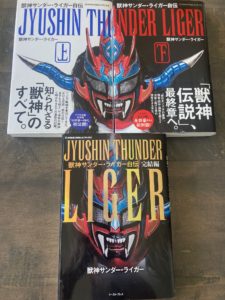
Welcome back to my coverage of Jushin Liger’s autobiography. You’re in for a treat this time as we get two chapters covering important topics: Liger’s thoughts on other wrestlers and his career magnum opus the 1994 Super J Cup. Many of the people to wrestle Liger around this period and in the J Cup itself would go on to become legends and highly influential figures in the business: Eddy Guerrero, The Great Sasuke, Ultimo Dragón, and Chris Benoit, just to name a few. We’ve heard these men’s opinions of wresting in NJPW and Liger before, and now we get the inverse. Also, Liger reveals one of the secret masterminds behind the J Cup, someone who, up to this point went uncredited despite playing such a pivotal role in putting that tournament together.
You can read part 1 here, parts 2 & 3 here, and parts 4 & 5 here.
Chapter 6: The Great Junior Wrestlers
Liger opens with his memories of working with Tatsumi Fujinami and forming a stable called Dragon Bombers. Fujinami was thinking outside the box and wanted to create a separate stable system from any that existed beforehand. At inception, Dragon Bombers consists of Liger, Shiro Koshinaka, Black Cat, and Takayuki Iizuka. However, there is little support on this project from NJPW management so it doesn’t lead to much. Liger uses this situation to compare the leadership styles of Fujinami and Riki Choshu: Choshu was forceful and pulled everyone strongly like in a senpai/kouhai relationship while Fujinami was much kinder but, consequently, more indecisive. A consequence of Fujinami’s friendlier approach was that Dragon Bombers would briefly include two sumo wrestlers from Samoa, but they caused so much trouble that they ended up getting dismissed.
After this Liger pivots to a match with a wrestler named Takeshi Misawa (APOD: no connection to the much more famous Mitsuharu), who has since become a medical trainer in NJPW. Their match, which takes place on December 19, 1989, ends abruptly when Misawa suffers a cervical spine injury (APOD: okay, one connection) which is attributed to a dropkick from Liger. Liger recalls Misawa forgiving him for the kick and states that Misawa had injured his neck earlier and attempted to train it without rest via neck bridging exercises. Liger states that this is the only time he has ever hurt anyone that badly in his career. He also says that it’s a good thing this incident happened earlier in his career; if it was later he’d have a much harder time forgiving himself and he’d struggle to continue wrestling.
From there Liger shifts to another wrestler often considered his rival, Pegasus Kid, a.k.a. Chris Benoit. Though Liger considers himself someone who stayed in place as the “symbol of the juniors”, Benoit is perhaps the most emblematic of the idea of arriving, facing Liger, getting recognized, and moving up. Liger calls Benoit a “wonderful wrestler” who did all his chores properly and never had an ill word spoken of him. According to Liger, Joe Daigo, NJPW’s overseas booker, found Benoit and sent him over along with another wrestler named Daryl Peterson. While Peterson was big and talked big, he wasn’t very serious and skipped chores, which eventually led to his dismissal. Conversely, Benoit adapted quickly to the Japanese wrestler lifestyle. Liger understands that American and Canadian cultures centre more on individualism, yet Benoit remained stoic and worked hard no matter what. In the dojo, Benoit would grit his teeth and, in the event of a miscommunication, would brush bad things off. Liger compares Benoit to other foreigners like Pat Tanaka or Scorpio, who would spend a lot of time on a riverbank and would sometimes cry, either out of frustration or homesickness. Benoit, on the other hand, would never show weakness and handled every challenge that came before him. In terms of NJPW’s more recent roster, the closest in comparison to Benoit would be either Prince Devitt or Jay White. However, Liger also notes that Benoit’s offense was incredibly powerful, perhaps a bit too much for a junior heavyweight, and says that Benoit wrestled more like a true heavyweight.
Liger’s next focus is Owen Hart who, oddly, doesn’t get as much of a ringing endorsement as he does stateside. Liger states that Owen could do anything, yet he doesn’t think Owen had much of an impact in Japan, despite being the first foreigner to win the IWGP Junior Heavyweight Championship. Liger thinks that Owen was a wrestler that was hard to emotionally connect with as a performer. From his own personal recollections, Liger prefers wrestlers who come at him aggressively and thinks Owen was better paired with someone like Hiroshi Hase (APOD: Hase confirms this as well: in one of his books he confirms that arguably the best match he has ever had was with Owen in Stampede. Sadly I can’t find footage of that particular match).
Next is Negro Casas, who was brought to NJPW through Black Cat since Casas admired Riki Choshu. His style was closer to the aggressive Japanese style so he was more comfortable in a New Japan ring. And yet despite that typecasting, Casas also used the majistral cradle invented by his father Pepe Casas a lot, which made for an interesting contrast when he wrestled.
Liger pivots for a moment to talk about himself and his experiences in America. Having never been invited over when wrestling unmasked, Liger was happy to learn Brian Pillman had recommended him to WCW and they agreed to bring him over. Liger’s match with Pillman at Superbrawl II was, and still is, adored by many, and he recalls hearing AJ Styles say he was inspired by Liger [in that match]. Liger also tells a story of traveling with Pillman. One time they were in a hotel and Liger was dealing with jet lag when Pillman banged on his door. Liger opened the door to find a drunken Pillman along with two topless blonde women in tow. Despite the offer, Liger isn’t up to it and declines so Pillman leaves with both ladies, laughing.
Next is El Samurai, another “great” wrestler in Liger’s eyes. Since he did amateur wrestling, he had a solid foundation and was reliable as both an opponent and a partner. For some reason, Samurai would rarely, if ever, practice, which had the added benefit of reducing his chances of getting injured. He hardly even did any weight training so most of his exercise was limited to running. And yet Liger once asked him if he was Pinocchio because, one time, Samurai hurt his leg, lay down backstage, and after a few minutes it would be healed on its own. Liger suspects that maybe Samurai practiced in secret (APOD: He wouldn’t be the first). Liger sidesteps to tell another funny story: sometimes on rural/provincial shows wrestlers would share bathrooms with fans. On such occasions, “everyone” (i.e. the wrestlers) would wear Samurai masks which would lead to fans shouting “Samurai’s taking a dump” from outside. This was done to conceal the wrestler’s identity, yet when Shinya Hashimoto did it, fans could clearly tell it was him since the mask would spread out sideways.
Next is Eddy Guerrero who, like Liger had experiences wrestling both masked and unmasked. During Eddy’s unmasked days, Liger observed him as a talented albeit unremarkable wrestler. Though he was good, he was simply in a crowded field and thus didn’t stand out, unlike Benoit, who, once again, showcased power different from everyone else in his weight class. However, when Eddy transforms into Black Tiger II, Liger notices a marked shift in Eddy’s wrestling ability:
“As Eddy wrestled more, it became clear that he wasn’t just skillful; he also had speed, stamina, and actually harbored incredible power. That’s when I realized, “This guy is a genius.” His use of the ropes and his sense of distance with his opponents were outstanding. He created a different image of Black Tiger from the original. At that time, Chris and Black Tiger had a singles match in the provinces that lasted over 20 minutes, and the two put on an amazing match that even the reporters gave a standing ovation for. Because of those two, the depth of New Japan Junior was definitely enhanced.” – Jushin Liger
After Eddy we get Liger’s thoughts on Dean Malenko, who Liger describes as having a solid foundation and various techniques in his arsenal, both of which stem from his training under Karl Gotch. Liger recalls meeting Malenko ahead of his one and only WWE match in 2015 and he recalls Malenko comparing his days training on mats in Gotch’s garage with NXT’s seven different and specialized rings in their Performance Center. After this, Liger talks about Ultimo Dragón and how his sense of balance was extraordinary. Liger mentions Universal and its decision to import lucha libre to Japan. Liger respects Ultimo deeply and at one point was using his quebrada (a.k.a. the Asai Moonsault) in his matches but stopped because he was hitting his foot on the ringside barricade too much. Liger also notes that Ultimo’s a shrewd businessman and has a different way of thinking when it comes to wrestling, promoting, and training. Apparently Ultimo has a mansion in Mexico filled with masks of famous luchadores, including one belonging to the El Santo. Liger concludes by sating Ultimo has produced and trained many talented wrestlers, but of course his biggest success story is definitely Kazuchika Okada.
Chapter 7: The Legendary First “Super Cup”
Liger opens with his memories of a champion vs champion battle with Shinya Hashimoto in February 1994. One special feature of this match is Liger’s special costume, called “Battle Liger”, which showcases his physique far more than when he’s fully costumed. He also jokes that he had more battles with other heavyweights backstage: not in the form of fights but bench pressing contests. In their primes, Kensuke Sasaki would bench press 180kg and Keiji Muto 175kg while Liger, a junior heavyweight, could come close with 170kg. Strength like this allows Liger to powerbomb the much heavier Hashimoto in their match, which filled Nippon Budokan with roaring cheers. Then Liger goes off on a tangent about Hashimoto stories: how he would go all out when interested in something, how he spends the equivalent of hundreds of dollars to make his own tofu from scratch, and how he bought long-handled pruning shears to catch pit vipers from which he’d make snake liquor (APOD: I’m sure Akira Taue would’ve loved to share such stories with Hashimoto).
The topic then shifts to Liger’s career masterstroke, the 1994 Super J Cup. Liger is quick to share the credit around with everyone involved, but it’s noted that Liger was the one to reach out to a specialty magazine called “Bakuto Pro Wrestling” to talk about the proposed event. This led to a roundtable discussion involving various wrestling figureheads, including Atsushi Onita and, for some reason, Minoru Suzuki.
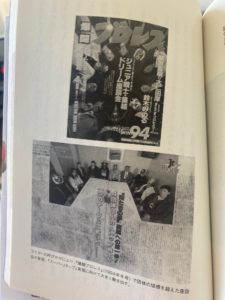
Top: The magazine cover for the special issue covering the Super J Cup
Bottom: A photo of the roundtable discussion of the power-brokers that made it happen
Once the various companies and representatives came together and several people expressed overt enthusiasm in the show, Liger went ahead and got NJPW’s blessing. Liger also makes it clear that he wasn’t doing this solely for the business impact it would have; his priority was to have fun as this is the crux of his wrestling philosophy: “If it looks fun, then just do it!”, says Liger. By looking at this event, he argues that if he’s having fun then the fans would as well.
Additionally, Liger credits another previously uncredited person for the Super J Cup’s creation and success: his wife. He describes her as an even bigger wrestling fan than himself, and at one point she would follow the Funks around. So one night he told her of his idea of the Super J Cup and she shouted with excitement. After hearing her response, Liger goes to Mr. Nagashima, an important figurehead in New Japan, who asks if Liger got permission from the other organizations to use their talent. Liger tells him that there was no need to get the promotions’ approval since all the wrestlers had given their own individual approval and to him that was enough. The event goes on as planned, though Liger does note that All Japan doesn’t join in, telling him that they’re too busy with their own matters. “Tch, boring”, Liger tells himself afterwards.
After going through all the formalities with other promotions, Liger asks his wife whom she thinks should participate. Both of them ended up getting most of the wrestlers they wanted, but Liger also invites Gran Hamada to participate but he can’t for “various reasons”. After getting MPW’s Great Sasuke and Super Delfin, Sasuke asks that TAKA Michinoku wrestle as well. Onita lobbies for the recently returned from excursion Eiji Ezaki, now repackaged as Hayabusa, to participate and Onita requests that he wrestle Liger specifically, which Liger accepts. Liger recalls being very impressed with Hayabusa and his sense of guts do hit such a quick dive and his willingness to use Liger’s own SSP finisher on him. Liger also notes that Hayabusa’s sudden disappearance from the wrestling world due to his spinal injury was a huge blow to the wrestling world.
Liger also talks about his match with The Great Sasuke in the semifinals which is best remembered for its unexpected conclusion. Sasuke botched a springboard attack but rather than conceal it or ignore it, Liger mocked it, only for Sasuke to surprise him seconds later with a Frankensteiner. Liger attributes this to a superstition he adheres to: “The one who suggests something first never wins”, and admits Sasuke got the better of him on the big stage (APOD: I covered the entire Super J Cup here, it’s an amazing show and the Liger/Sasuke match is one of the best you’ll ever see). Several NJPW office bigwigs watch the event from backstage, including Choshu, who was head booker at the time, and wish Liger luck with the event despite some minor concerns with some of the smaller guys (specifically TAKA). The event becomes an overwhelming success and it leads to a breaking down in the wall between major and indie promotions. Liger also answers a question some might still have about this event: why Gedo performed so strongly. Liger attributes this to Gedo’s push in WAR and sees this tournament as a means of testing Gedo’s skills. Though he was far from his best, Liger does observe in Gedo a great sense of timing and ring positioning, both of which tend to be largely ignored in favor of cool moves. Liger concludes that he’s proud of the recognition he has received from his peers and once again thanks his wife and credits her as the shadow producer of the Super J Cup.
APOD: This was fun. Liger was a bit more honest here than he was in previous sections and gave the closest thing to a “shoot promo” on people he liked and disliked. He was far from neutral, given how much he praised Benoit and came across as indifferent to Owen Hart, two men who were simply adored during the 1990s. The best thing in Chapter 6, though, was his observations of Eddy Guerrero and how he went from being unremarkable while unmasked to a special performer when masked, just like himself. As I noted in the previous section, wrestling while masked does help a wrestler fine tune their senses and abilities when their field of vision isn’t fully open. It also helps a wrestler express themselves more creatively to overcome the constraint of being unable to see the wrestler’s face. These are important lessons worth repeating since a common criticism that persists to this day is on how modern wrestlers often lack the expressiveness or emotional connection with the audience when executing their techniques. As for the Super J Cup chapter, the real kicker was Liger crediting his wife for playing such an integral role in preparing the roster and giving her feedback. It was basically the real-life version of a fan fantasy booking a one-night tournament with a wrestler granting her wishes in real time. It’s no wonder that show was lauded so highly back then and remains a widely-hailed classic.
As always, thanks for reading.