

5-Star BOOK Reviews: Jushin Liger’s Books, Part XIII (FINAL)
By Alex Podgorski on 31 July 2026
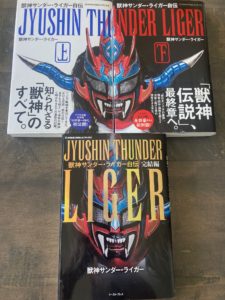
Welcome back to my 5-Star Book Reviews. This will be the last and final chapter of my coverage of Jushin Liger’s three-part autobiography, written and overseen by New Japan Pro-Wrestling. It’ll be the longest section thus far since I’ll be finishing Part Two and going over all the best elements of Part Three. This will cover a five-year period from 2015 to 2020, during which many interesting things happen to Liger. These include: his one and only WWE match, his return to the British wrestling scene, his final Best of Super Juniors appearance and final challenge for the IWGP Junior Heavyweight Championship and, of course, his retirement tour. There will also be interviews and excerpts from some of the most important people in his life and career, including his wife and son, his archrival Naoki Sano, his inspiration Tatsumi Fujinami, his successor Hiromu, his friend Tanahashi, and his gimmick’s creator.
You can read part 1 here, parts 2 & 3 here, parts 4 & 5 here parts 6 & 7 here, part 8 here, part 9 here, part 10 here, part 11 here, and part 12 here.
Liger takes a brief moment to spotlight a new crop of junior heavyweight trainees, particularly Sho Tanaka, Yohei Komatsu, and Hirai Kawato (APOD: Who’d go on to become SHO, YOH, and Master WATO, respectively). Then he pivots to WWE and discusses his one and only match under that banner when he faces Tyler Breeze for NXT TakeOver: Brooklyn. According to Liger, it was unprecedented for a popular New Japan wrestler to be invited to WWE, which made it a big topic. Initially WWE reaches out by way of Prince Devitt (Finn Balor) and William Regal, with Regal doing most of the legwork trying to contact Liger for the match. Since Liger is “analog” and unfamiliar with computers, Liger advises Regal negotiate the match via Tiger Hattori. Regal is documented as saying that WWE recognizes that their previous lightweight division failed but now (i.e. 2015) they want to try again. Since Liger was the catalyst for that 1990s transformation, Regal wants him to come over to add credibility to proceedings. Liger recalls feeling a bit cautious over additional appearances, particularly after Regal invites Liger to coach in NXT (APOD: Considering what’s been unearthed thus far, Liger’s temper would’ve gotten him fired à la Bill Demott within a few months).
Since this is his first time in a WWF/E production (APOD: but not his first time in a WWF-involved show as he had a blink-and-you’ll-miss-it interaction with Vince at Wrestle Summit 1990), Liger’s amazed with the scale and atmosphere of the venue. Before his match he has some brief exchanges with former NJPW co-workers Balor, Regal, Dave Finlay, Giant Bernard, Dean Malenko, and Robbie Brookside. Then, at Gorilla, both Vince McMahon and The Undertaker wish Liger luck, which makes him nervous for the first time in a long time. Upon returning to Japan, Liger discusses the experience and notes that it’s better for someone to be a ninety-point wrestler who understands English than a 100-point wrestler who doesn’t. In hindsight, Liger attributes his WCW success to the character which allowed him to get away without speaking as much. There’s also some minor subtext here that implies that, by the time Liger returned, the seeds for Nakamura’s departure were already planted.
Liger skips ahead through 2016, briefly mentioning matches with KUSHIDA and various junior titles, before setting on his next big topic, Will Ospreay. He recalls hearing a story of Ospreay’s parents buying a ring for the younger man so that he could train in his backyard. When they face off at Revolution Pro Wrestling (RPW) in November 2016, Ospreay pays tribute to his idol by wearing a Liger-like costume and gives him a mask he wore as a souvenir. There’s a brief pivot to THAT Ospreay/Ricochet match, which Liger calls a “worldwide sensation”, and then Liger mentions that Ospreay’s also skilled in catch wrestling. Liger’s likewise surprised by Ricochet: despite his typecasting as a flippy wrestler, Liger recalls him having impressive core strength. From these examples Liger concludes that foreign wrestlers that Japanese wrestlers can’t match, which forces those Japanese wrestlers to compete by showcasing other areas of expertise.
Another skip occurs, this time to 2017 and Liger’s final appearance in the Best of the Super Juniors Tournament. After finishing with a record of 1-6, Liger addresses rumors of his imminent retirement by saying he doesn’t plan on hanging them up anytime soon. He proves this by wrestling more in the UK, particularly for RPW. As he travels Liger recalls some aspiring wrestlers asking him if he can put in a good word for them in New Japan. Liger doesn’t say whether he did so or not and instead mentions Bad Luck Fale’s dojo in New Zealand and the possibility of a NJPW dojo in America (APOD: this comment appears to ignore the original NJPW LA Dojo, operated by Simon Inoki). As NJPW expands its international ambitions, Liger acknowledges that while its in-ring content is impeccable, the language barrier remains a major problem. This segues into Liger’s work on commentary and how difficult he finds it communicating without bias. Liger cites a discussion on Tetsuya Naito throwing the IWGP IC title around and how he finds it distasteful, which leads to commentators accusing him of being overly critical. Liger tries to expand his commentary skills but this proves challenging. Some days he reaches out to talent and asks them questions before their matches so that he can weave those feelings into his words. On other occasions he finds himself shouting “amazing” without reason.
Around this time Liger starts appearing on variety shows, which he considers an important aspect of promotion since wrestling shows are, by that point, only broadcast on terrestrial TV late at night. He also spends more time in the dojo to oversee training, and sees promise in many rising stars, especially Katsuya Kitamura (APOD: Kitamura is a prime example of how much more serious drug use is in Japan. He was an Olympic hopeful for the 2012 Games in London but tested positive for steroids which ended his Olympic dreams. Despite that, he trained in NJPW for a few years and was booked like a Japanese version of Bill Goldberg. Tragically, he suffered a career-ending concussion, retired from wrestling after only three years, and then died three years later at the tender age of 36).
From here Liger’s second book includes a special discussion with Liger and Go Nagai, the mangaka behind the original Jushin Liger manga and the creator of the Big Van Vader character. Nagai recalls being a wrestling fan since the days of Rikidozan and watched many matches with Rikodozan and the Sharpe Brothers on street TVs. They discuss Vader for a moment, with Nagai recalling a conversation with Inoki on the need for a truly fearsome foreign masked wrestler, which led to Vader being conceived. Regarding Vader’s fabled steam-projecting armor, Nagai states the original vision was for it to expel steam whenever Vader removed it, but the practical effects expert made some mistakes in the creation which led to it functioning differently from how it was imagined. Nagai was also there for Vader’s debut and recalls feeling serious concern when fans rioted.
Liger asks how the Jushin Liger manga and anime were conceived and Nagai explains they were in response to the surging popularity of robot-themed anime like the Gundam series. Nagai’s idea was to do something slightly different and create a robot with more human elements, almost like “bio armor”. Since there was a toy company backing him, Nagai explains he had to take two characters, Liger and Demon Dragon King Dolga, and combine them. Despite his creative work going in one direction and the NJPW wrestler in another, Nagai doesn’t have any issue with what the wrestler did since he trusted Keiichi Yamada and NJPW to interpret the character their own way. Nagai asks if there will ever be a second generation Liger but Jushin states that this isn’t likely to happen.
There’s second discussion chapter, this time with Liger’s wife Chikage and eldest son Takamitsu. Because their family home is in Fukuoka, Liger has his own private dorm room in NJPW’s dojo and spends months on end away from home, especially during regional and international tours. Chikage admits to being a massive wrestling fan and almost took the bullet train from Fukuoka to Tokyo to attend Genichiro Tenryu’s retirement to see him in person. Apparently Takamitsu inherited this fandom from his mother and is likewise very devoted to pro wrestling. He’s also part of a friend group with other sons of wrestlers so he doesn’t feel anything special from being a wrestler’s child. Chikage acknowledges the writings calling her the “shadow producer” of the Super J Cup and is both excited and embarrassed whenever she receives this recognition. After talking about Liger as a father an interacting with wrestlers throughout his life, Takamitsu is asked if he ever considered following in his father’s footsteps. He says no for two reasons: he dislikes pain and because he wants to appear in front of people by his own power (APOD: this is an extremely common and almost expected mindset in Japan where each generation must achieve something without family help). Both of them conclude by saying that, at home, Liger asks a lot of questions about how wrestling shows are perceived, not just his own matches but others as well, only for both to usually sidestep by claiming to not have watched whatever specific show he was talking about.
Part Three, which was published three years later, opens with the start of Liger’s long road to his retirement match. To symbolize the start of this road, Liger appears in a “Pro Wrestling Masters” event series involving Keiji Muto, Akira Maeda, Tatsumi Fujinami, Riki Choshu, and others. After an encounter with Masahiro Chono, Liger’s asked if he’d consider transitioning to an office job but he declines saying it’s not for him. There’s a brief discussion about Liger’s post-career travel plans and his number one travel spot is Banff National Park (APOD: He’s got good taste. Banff is one of the most beautiful places in Canada and I highly recommend it for any visitors).
Liger skips to 2018 and the event STRONG STYLE EVOLVED. The initial plan was for Liger to wrestle Rey Mysterio but Rey got injured so Liger faces then-IWGP Junior Heavyweight Champion Will Ospreay instead. Liger recalls his feelings from his first fight with Mysterio and his initial response to that match announcement is “bitter laughter”. Liger, like many people, had misgivings about wrestling Mysterio, but in hindsight he realizes Mysterio was truly special and is happy to have faced him. Liger also admires Mysterio for winning the WWE Championship, saying that this kind of junior who wins heavyweight titles is what Liger aimed to become. Once Mysterio’s healthy, he teams with Liger and Hiroshi Tanahashi to face Marty Scurll, Cody, and Hangman Page. Having such “unique” participants makes it harder for Liger to put the match together, saying
“In pro wrestling, the more people there are, if everyone just does what they like, it ends up being a mere showcase of moves. But in the end, the opponents were all skilled wrestlers.” – Jushin Liger
Next Liger discusses his final IWGP Junior Heavyweight Championship challenge, which comes after then-champion Taiji Ishimori taunts him. Liger brushes it off at first, but after talking it over with his wife he decides that if he loses the title challenge he’ll announce his retirement. The idea of finally hanging up his boots wasn’t sudden; he had been considering retirement for years. At first he wanted to hold off retirement until he was “completely broken” but something about this scenario added additional symbolism and meaning to his decisions. Despite out-powering Ishimori on a few occasions, Liger fails to win the title he loses. He puts Ishimori over for completely changing his image and, despite his small stature, his ability to withstand immense punishment.
On March 7, 2019, Liger holds a press conference and announces his retirement will take place at the 2020 1.4 Tokyo Dome show. Liger describes feeling like a cheerful living funeral, with many people caught off guard by the announcement. Muto jokes with him asking rhetorically “You’re going to make a comeback anyway, right?” but Liger channels a message from Genichiro Tenryu, who tells him that it’s better to retire gracefully after wrestling to your heart’s content. One of the few people who knew of Liger’s announcement ahead of time was Chairman Takamatsu, who orchestrates the idea of having Liger retire at the two-night Wrestle Kingdom 14 since Liger debuted at the start of the Heisei Era and it would be fitting for the character to retire at the end of the Heisei Era.
After this announcement, Liger is flooded with offers for one final appearance, both in Japan and from abroad. He accepts wherever possible, either in a wrestling capacity or as a special guest, including Hiro Saito’s 40th Anniversary Match. During this time Liger faces Tatsumi Fujinami’s son but their match isn’t that good since Liger finds the kid sloppy and without subtlety encourages him to change jobs.
In July Liger goes to Mexico for the final time and he finds the country erupting in “Liger-Mania”, with tickets for his show selling faster and at higher prices than CMLL’s Anniversary show (APOD: By comparison, this would be like John Cena’s Last Match at SNME selling out faster and with higher-priced tickets than WrestleMania). His big match sees him wrestle in a four-way bout with Negro Casas, Carístico, and Último Guerrero. Everyone enters the venue in some Liger-themed costume, Liger himself has sexy female dancers perform for him, and once the match ends he’s gifted a two-meter statue that has to be mailed to his home. As a quick aside, Liger’s wife accompanies him this time since she wants to see the country that insired him to become a wrestler, but after three days she’s struggling with the cuisine and ends up finishing the rest of the week-long tour eating nothing but curry rice.
In July Liger appears for Pro Wrestling Zero1 for the first time and teams with Great Sasuke to face Shinjoro Otani and Ryuichi Takaiwa. Liger still has a deep respect for Otani since he worked hard for every fan no matter how big or small the audience. Otani’s philosophy was that “a customer who buys even one ticket looks like a god” and as one of the main people in charge of Zero1 Otani would carry tickets in his bag to “feel the weight of each one”.
Then in September, Liger finds himself dealing with “a line that should not be crossed”, which references Liger’s feud with Minoru Suzuki and Suzuki ripping off his mask. While Liger knows that photos of his real face are everywhere these days, Liger finds Suzuki’s actions unnecessary. This leads to a “you took my mask I’ll take your head” dynamic between them and the fourth and final appearance of Kishin Liger. Liger never planned on bringing this character back for this retirement tour but Suzuki’s actions push him to that extreme. Their match sees Liger don his “Battle Liger” alternate costume but, once again, Liger loses despite fighting valiantly. However, instead of a post-match beat-down, Suzuki prostrates himself and bows in respect to Liger afterwards. (APOD: I reviewed that match here. It was solid but not quite as emotional or as thematically fitting as expected).
Liger spends the next few months preparing for his final match and dealing with the political arrangements needed to bring all the necessary players into it. Liger specifically wants Fujinami to be involved given their extensive history together and the fact that Fujinami’s the last remaining OG New Japan wrestler capable of getting involved. His original intent was to involve a cornucopia of people, including Satoru Sayama, Gran Hamada, and Ultimo Dragon. But if he were to have gotten his way NJPW would’ve had to hold three Tokyo Dome shows to fit them all in. He also mentions some of the people who tell him he inspired them to become wrestlers, including AJ Styles, Dragon/Ryu Lee, and El Phantasmo. Liger appears to be particularly fond of Lee’s wrestling style and credits him as a skilled performer who knows how to utilize space, which makes him ideal to carry NJPW’s juniors to a global level. But when it comes to who Liger’s true replacement is as the centrepiece of the junior division, he thinks that is undoubtedly Hiromu Takahashi.
“It’s true that Ospreay is an amazing wrestler who has shown great performance across weight classes, but I trust that Hiromu will lead the juniors. Even now, Hiromu is such a flashy wrestler, but I’ve been watching him since his days as a bald rookie. He was incredibly dedicated to training, was earnest, and worked hard towards his dreams. While many rookies quit, he debuted, went through a long overseas training period, and reached the top of the juniors. I believe it was fate that he made it in time for my retirement, and I’m sure Hiroshi will stand before me as the champion. I sincerely wanted to face the strongest man in the juniors head-on in the end.” – Jushin Liger
As another element to his retirement, Liger announces that he will retract his retirement if he manages to defeat the duo of Hiromu and Dragon Lee on WK14 Night Two. Though few people expect him to lose, this headlining-grabbing statement is enough to add more interest into what is likely to be his final match. Speaking of final matches, Liger’s final non-NJPW bout takes place in Australia as part of a cross-promotional affair with FALE DOJO that sees Liger and Robbie Eagles face Bad Luck Fale and Jack J. Bonza. After that, a three-night special event takes place at Korakuen Hall celebrating Liger’s final appearances in the venue. One of these sees Liger face Okada and score a few near-falls on the champion before losing to the Rainmaker Lariat. Liger admires Okada’s diligence and selflessness in his training, which he showed by refusing to give up and admitting when he didn’t know how to do something but worked hard to learn anyway.
The event finally comes, January 4, 2020, and Liger receives a monstrous ovation for his penultimate match. Given its retirement parameters, no one holds back despite their age. Liger takes the fall from Ryusuke Taguchi and everyone raises their hands as a gesture of gratitude to the audience. The following night, Liger finds himself opposite Hiromu who, true to his promise, won the IWGP Junior Heavyweight Championship from Will Ospreay (APOD: In an amazing match that’s worth seeing at least once). But once again, in another close and competitive bout, Liger loses the match despite unleashing everything he has. Now he can retire without regrets and calls this a perfect 100-point retirement. Post-match, Hiromu says something about carrying the torch for Liger with some vague interpretation of “surpassing them”. Liger doesn’t think it’s necessary for Hiromu and his generation to surpass Liger since Liger never saw himself as trying to surpass Fujinami or Sayama. Instead, Liger recommends Hiromu continue creating something new, which he thinks is more important.
On January 6th New Japan hosts Liger’s official retirement ceremony. While he refuses to let anyone make him cry, his wife, son, Tanahashi and Tenzan all have red eyes before long. Liger’s especially honored when they play a taped video message from Antonio Inoki, who makes a brief statement about working hard and passing on dreams to the next generation. Liger goes on to state that he won’t return to the ring unless someone casts a spell on him to give him the body of a twenty-year-old. As such, he predicts his work will shift to a consultancy role and semi-regular commentary. Liger concludes with a message of thanks to everyone who supported him throughout his career.
The book shifts to a series of interviews, the first being with Hiromu. He recalls seeing Liger wrestling in the G1 and the sight of a much smaller man facing heavyweight is, according to him, “the thrill of professional wrestling”. He considers Liger a special existence and starts talking about Liger as a trainer during the dojo. Liger was called “the boiling pot” and many trainees felt his wrath over the years. Apparently Liger doesn’t like ambiguities (APOD: ironic given the nature of his mother tongue) so when Hiromu accidentally adds the word “probably” to an innocent question Liger roars at him. Liger’s training sessions are unforgiving as he pushes the trainees well past their limits and makes them to hundreds of dropkicks and painful sparring sessions. According to Hiromu, Liger received some training from Kiyoshi Tamura (APOD: A shoot-style wrestling pioneer involved in UWF, Fighting Network RINGS, and MMA) which may explain why his training sessions are so intense. Hiromu tells a story of when Liger first started balding and he tried to change his hairstyle as a result. This leads to him donning a reverse Mohawk and “resembling the Ultimate Warrior”. Liger asks everyone their opinion but the trainees are either too scared to answer or can’t tell if he’s joking. A week goes by and Liger decides to shave it off completely and starts attaching a black wig to his mask.
Hiroshi Tanahashi’s the next interview and he opens with something called “Circular Route 8 Theory”. This was an Inoki idea and it presumes that people inside Circular Route 6 are enthusiastic pro wrestling fans while those outside Route 8 are unenthusiastic ones and must be appealed to. For a time in New Japan it was believed that the company and the wrestlers only focused on Route 6 and within, but Tanahashi is said to have expanded their view to Route 8 and beyond. Tanahashi’s intention was to satisfy existing wrestling fans and give non-fans a positive image of wrestling simultaneously. On Liger’s retirement, Tanahashi recalls feeling sad when it was announced because he was a “Liger Kid” who grew up watching the Beast God. When he first won the world title during the Dark Era, Tanahashi says that crowds always woke up and became more animated whenever Liger’s music played. Then he recalls a lesson from Liger’s training: the difference between play pro wrestling and NJPW Strong Style is the anger. NJPW’s dojo isn’t a friendly neighbourhood gym and being a wrestler isn’t a permanent job. You can never do things half-heartedly since you can be cut at any time.
Tanahashi likewise credits Liger for being instrumental in breaking down the wall between weight classes, citing Liger’s battle with Shinya Hashimoto as the catalyst. Additionally, from Tanahashi’s perspective the Super J Cup had an industry-wide impact when it came to acknowledging other promotions. On the Shooting Star Press, Liger reveals seeing something similar in the manga Fist of the North Star called the Nanto Suichoken and he decided to adapt that to the ring.
The next interviewee is Naoki Sano, who doesn’t say much new or groundbreaking beyond a few training stories that basically reinforce what’s already been said. The only exceptions are a shared memory of Kuniaki Kobayashi telling both Sano and Liger after one of their matches in 1989/90 that ”you guys will die someday”. However, both men brush off such concerns. There’s also a discussion on Sano joining NOAH in the early 2000s to learn different styles; however, after wrestling Misawa and Kobashi Sano concludes that deep down there aren’t that many significant differences. Also Sano has a restaurant in Kyoto called Yakiniku Takuma which might be worth a visit.
Lastly, there’s Tatsumi Fujinami, Liger’s childhood inspiration. He recalls Liger’s days as a trainee and since he didn’t have any noteworthy accomplishments or impressive stature, he’d have to ask to participate in certain training sessions. There was a two-year period during the 90s when Fujinami didn’t wrestle due to a back injury. To help improve some of the company’s daily functions, Fujinami tried to create a stable system similar to Sumo, hence the Dragon Masters Liger joined shortly after donning the mask. That particular stable didn’t work but Fujinami’s system remained and improved over time. Today, NJPW’s roster is rigidly divided between stables. Like others, Fujinami was surprised when Liger announced his retirement but jumped at the prospect of participating in his final match. The rest discusses staying healthy after wrestling, with Liger vowing to do whatever he can to look as good as 66-year-old Fujinami did at Liger’s retirement.
APOD: With that my coverage of Jushin Liger’s books has come to a close and honestly, I think we got what was expected. Liger was diplomatic throughout, milquetoast with some opinions, and rarely shared any groundbreaking or thought-provoking ideas. Much of what was written was wrapped in that typical don’t-rock-the-boat mentality which, once again, trades emotional depth and resonance for casting a wider net and appealing to more people. Liger’s perpetual optimism is similar to Kobashi’s; however, Kobashi was far more willing to criticize things, even things he liked, whereas Liger mostly criticized his own past mistakes. The few occasions that Liger began talking about something argumentative or controversial he mostly skimmed the surface and gave the usual answer of “from my perspective…” Granted, that’s very admirable and mature but at the same time it doesn’t paint as detailed a picture as one might expect. It was almost like a tease that something might go further but never would. That said, some of Liger’s discussions on the mechanical and practical aspects of pro wrestling were interesting, especially in relation to his chosen techniques and how he worked around his physical limitations. All in all, Liger’s story made for some interesting reading but he’s nowhere near as captivating a storyteller as those we’ve covered before.
Part 1: ***3/4
Part 2: ***3/4
Part 3: ***3/4
As always, thanks for reading. Next on the docket: Jun Akiyama.