

5-Star BOOK Reviews: Jushin Liger’s Books, Part IX
By Alex Podgorski on 25 June 2026
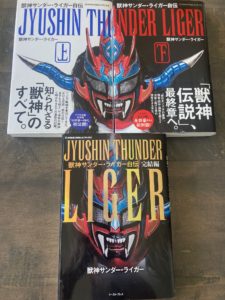
Welcome back to my coverage of Jushin Liger’s books. This section will cover the final chapters of his first book, going from late 1996 to early 2000. Liger will give us his thoughts on a dream match with another masked legend, his opinions on the next generations of junior heavyweights, his role in creating a new title, and a few minor anecdotes about some backstage or “curtain-unveiling” incidents. Liger has made it clear thus far that he isn’t one to rock the boat and make strong claims, but he does dance around this by recalling his observations from the time.
You can read part 1 here, parts 2 & 3 here, parts 4 & 5 here parts 6 & 7 here, and part 8 here.
Chapter 10: The Late 1990s
We begin with the dream match between Liger and The Great Muta, an encounter two years in the making. Liger describes this as a “special case” given the uniqueness of the Muta character. Faced with Muta’s demonic personality, Liger is forced to answer with a sinister alter-ego of his own now known as “Kishin Liger”. The first thing Kishin does is spit poison mist in Muta’s face, stealing Muta’s signature spot in an eye-for-an-eye situation. Liger is fully aware that he was doing completely different things in this match compared to his usual fare but that was the point. His rampaging was his attempt at immersing himself in his own world while Muta did the same. Liger summarizes the whole thing as an exciting experience because he was able to be a different Liger than usual (APOD: I covered that match here. It’s an awesome match that you can enjoy without knowing anything about either gimmick). Kishin Liger would appear three more times: in 2006 in a match against Bad Boy Hido; in a tag match in 2012 opposite Taichi and TAKA Michinoku; and in 2019 when he was feuding with Minoru Suzuki.
Liger uses this topic to segue into his personal hobby of building monster models. Liger’s family wasn’t all that wealthy when he was a kid but when he did have money he’d spend it on either wrestling stuff or Kamen Rider merchandise. It was only once he was training and staying in NJPW’s dojo that he began collecting model kits. There have since been a few photos and videos published of Liger away from the ring, either in the dojo or at home, with his personal space filled with models, especially of Godzilla.
1997 begins with Liger winning the J-Crown’s eight belts from Ultimo Dragón, several months after he originally conceived of the idea. However, by that point the concept was starting to fall apart with individual wrestlers expressing interest in only one title or another. Liger loses the J-Crown to El Samurai in July 1997 and the J-Crown passes to Shinjiro Otani a month later. Then in November the then-WWF demands Otani return their Light Heavyweight Championship to him, even though Liger claims it was a belt from Vince McMahon Sr.’s day and not recognized by the present-day regime. As another parting joke of sorts, Liger notes how each J-Crown champion would be accompanied by swimsuit-clad models to add some glamour to proceedings but by the time he got the J-Crown the number of women would decrease.
From here Liger discusses some other junior heavyweights to come up during these later years. First there’s Tokimitsu Ishizawa, a.k.a. Kendo Kashin, whom Liger introduces as a mysterious guy with top-notch wrestling skills who practiced submissions a lot. However, Ishizawa doesn’t appear interested in adopting the junior style Liger represented and stuck with submissions. Liger doesn’t want to impose any rules on his underclassmen and respects their freedom to choose a style so long as they respect certain boundaries. That said, Liger observes a lack of motivation in him and suspects Ishizawa didn’t know what he wanted to do. Ishizawa behaved weirdly, and at one point he ripped up an awards certificate for no apparent reason. In six-man matches, Liger and Samurai would team with Ishizawa and their combined experience would compensate for the chaos Ishizawa would cause. Liger isn’t as diplomatic when discussing him as an opponent, however, and describes him as a clumsy wrestler with slow timing on his moves and a noted lack of showmanship. Even Hiroshi Hase, who always knew how to critique people in a more political way, said that Ishizawa had no athletic ability beyond martial arts.
Next Liger talks about Dr. Wagner, Jr., who first came to NJPW in the late 80s and then returned a decade later. Unlike most luchadores, who focused on high-flying stuff, Wagner focused on heavier, solid wrestling owing to his lower centre of gravity. Liger recalls thinking Wagner having too thick of a body to wrestle him with proper junior heavyweight techniques. Wagner was also said to be intellectual by wrestling standards and was quote handsome for a masked wrestler, especially compared to his father. Liger also includes a brief note on Wagner’s younger brother Silver King, who briefly wrestled in NJPW as Black Tiger III, and noted that he was burly like Wagner but lighter and thus easier to wrestle.
From there Liger shifts to Yoshihiro Tajiri, who comes to NJPW from Big Japan. Liger’s first impression of that Tajiri is “skillful” with smooth and flexible wrestling technique. Liger also expresses surprise that Tajiri succeeded so much in WWE and credits Tajiri for having solid ability needed to last over there (APOD: Tajiri also wrote a book in 2022 titled “What Pro Wrestlers Are Showing The Audience”. It was translated into English well enough and if you can get passed some minor errors and Engrish misinterpretations, you’re in for a very insightful book that explains pro wrestling beautifully). Speaking of WWE, the book includes a brief passage about Chris Jericho. He, like Owen Hart, didn’t wasn’t a bad wrestler by any means but he didn’t leave a strong impression on Liger. Liger also notes that if he had, Jericho would’ve become a rival for him and his appearances in NJPW would’ve lasted longer than his once-and-done appearance as Super Liger and a few tours in 1997. Next Liger briefly mentions European arrivals Franz Schumann, Ian “Doc” Dean, and Robbie Brookside. Because there was no internet at the time, NJPW management had no way of doing background checks on recommended wrestlers. But Liger challenged their skepticism and went to bat for these wrestlers to get them work.
1998 begins with Liger participating in that year’s January 4 Dome show, which is highlighted by Riki Choshu’s (at the time) retirement event. Choshu wrestles five opponents that night, culminating with Liger. Choshu wins all but one of his matches, his only loss coming to Takashi Iizuka. But as he covers Liger after hitting with a lariat, Choshu tells Liger “I’m counting on you”. Liger says these words are open to interpretation and he goes on to understand this to mean Choshu is entrusting all of NJPW to him, not just the juniors. There’s a bit of a tangent about Choshu’s odd behaviour in the early-to-mid-2000s, including an event in October 2004 that Liger notes is emblematic of the company’s “dark period”, but we’ll go into that in further detail later on.
Midway through the year Liger suggests Mr. Nagashima approve the creation of the IWGP Junior Tag Team Championship, which he attributes to the excitement towards juniors in NJPW at the time. Liger pats himself on the back, saying that Nagashima, who came from TV broadcasting, listened to him a lot, as did Choshu, the head booker, following Liger’s success with the 1994 Super J Cup. The inaugural champions end up being Shinjiro Otani and Tatsuhito Takaiwa, two younger wrestlers only six years into their respective careers. In response, Liger and El Samurai, the two “elder statesmen” of the division, would embrace the role of “grumpy veterans” taking on these youngsters as a means of putting them over even further. Liger compares this period to present day NJPW (at the time, ~2017) and notes the junior style had evolved so much that Showa-Era Liger wouldn’t be able to compete with the new kids no matter how hard he tried. At the same time, he believes these newer matches are a bit too polished and lacking in competition, and believes that tension and a sense of danger are necessary in matches. Liger ends up winning these tag belts six times with a different partner each time. Of these, Samurai was his best partner since they shared many similarities. Liger praises Samurai for being “like water”, taking on whatever shape was needed in the moment. Because of this, everyone trusted Samurai, either as a partner or as an opponent.
Next we get to 1999 and, of course, the first topic is the infamous January 4 incident between Shinya Hashimoto and Naoya Ogawa. Liger gives a quick summary of events from his perspective: Ogawa, belonging to Antonio Inoki’s satellite Universal Fighting Organization (UFO) entity, launches an illegal attack on Hashimoto. Their match is declared a no-contest and a brawl breaks out between both sides’ seconds. Since he isn’t privy to any clear evidence, Liger doesn’t comment on whether or not Ogawa did this on his own or under someone’s direction. But Liger does recall Hashimoto calling out Inoki for masterminding this angle, which causes Riki Choshu to leave backstage to confront Ogawa in the ring. This, Liger concludes, makes everything feel more serious, yet it’s also enough for him to conclude he doesn’t need to involved as well. At the same time, Liger thinks that Hashimoto was holding back to an extent in order to protect pro wrestling and concludes that this whole fiasco shouldn’t have ever been showed to the public.
As for his opinion of Ogawa himself, Liger is once again praiseworthy of a talented individual. Ogawa had incredible pulling strength and despite being an Olympic silver medalist, he never acted arrogantly. Liger had always been friendly with Ogawa and they were always polite in their various interactions. Liger further speculates that someone may have used Ogawa as a tool to pursue their own selfish interests.
However, there’s another event on the same card that draws Liger’s ire: the match between Kensuke Sasaki and Atsushi Onita. But Liger isn’t mad at either of the wrestlers; he’s mad at the crowd for throwing garbage at Onita. To him this crossed a line since other spectators could’ve and likely were injured from objects flying around and he thinks it’s unnecessary for angry fans to dirty the ring with trash (APOD: Liger might be right but Onita had MASSIVE heat with the audience, unlike pretty much anyone else in the country. No doubt there’s a line out there somewhere that separates being such a good villain people want to throw trash at you but still want to see you perform, and being so hated people want to assault you out of actual malice. Where Onita fell relative to that line depends on whom you ask). When it came to other NJPW wrestlers, Liger recalls many of his peers being “allergic” to Onita, with some going so far as threatening to boycott the Tokyo Sports Puroresu Awards ceremony any time Onita won anything.
Regarding Onita, Liger respects his decision to make his own way. While he finds Onita’s focus on deathmatches strange, he recognizes that those matches had an impact on not just pro wrestling but the wider public as well. To dismiss him as bad or useless is pointless (APOD: I don’t think many wrestlers have a problem with Onita’s skill; their issues likely stem from his handling of money and his untrustworthy penchant for fake retirements in a country in which one’s word and public statements are meant to mean something). Liger is asked his thoughts on Onita as a wrestler, particularly when he was junior heavyweight champion in rival All Japan. Liger says Onita as a bog standard junior heavyweight didn’t impress him, but FMW Onita left a much stronger impression.
In June 1999, Tatsumi Fujinami replaces Seiji Sakaguchi as NJPW’s president and Sakaguchi moves to the role of company chairman. Liger glosses over the various changes in leaders and makes it clear he doesn’t care about the political side of the operation, only the wrestling side. Liger recalls hearing some wrestlers make demands of the front office but he himself never did so. This is because Choshu once told him that doing so is meaningless since even if they get criticized the office people can’t get into the ring and wrestle. Liger compares these words to something going on at the time with Tetsuya Naito making public demands of NJPW’s then-owner Takaaki Kidani. Liger doesn’t think such a dispute would be resolved which is likely to leave an unpleasant aftertaste in everyone’s mouths. Liger is then asked if he would ever take on front office work and he quickly says no. if he did he wouldn’t be able to enjoy himself and splitting his focus between the ring and the office would be too much for him.
Come November, Liger wins the IWGP Junior Heavyweight Championship for the tenth time. Soon afterwards, Liger makes an unusual statement calling NJPW’s junior division “lukewarm” and uses this as a pretext to go on excursion to the US and Mexico. Liger does this as a means of making himself the enemy of the entire division, arguing that, as champion, he has the most influence and can do as he pleases. To further add some deadly intent to the division, upon regaining the title in December 1999 and entering 2000, Liger starts winning title matches much more quickly. The most notable of these quick defenses takes place in February 2000 and sees Liger crush Minoru Tanaka in about five minutes. Liger’s reasoning is that he wants to conjure similar images as that of “Killer Inoki”, when Antonio would wrestle in a way that left his opponents incapable of predicting what he’d do. Liger recalls rewatching old Inoki matches and feeling an emotional connection to them and compares them to some more recent matches which take place in front of filled venues yet the audiences leave quickly once everything’s over. Meanwhile, In Inoki’s day the venues would be filled AND the fans might linger a bit afterwards to let the match settle.
Liger suspects there has been a change in fan attitudes over the generations: whereas present-day fans would politely thank him after a match (which he’d interpret in his head as someone telling him “good job at work”) in a prior era fans would be harsher and sometimes be more vocally critical. Though Liger appreciates the politeness, he thinks that some occasions necessitate a more direct response from the crowd so that someone wrestling in a boring way can correct themselves before settling into the wrong pattern.
Liger’s comments about “lukewarm” opponents ends up biting him in the ass as he ends up being one of many NJPW wrestlers to fall victim to Inokism. In his case, Liger ends up facing Don “The Predator” Frye. However, Liger isn’t as upset or disappointed with this match as people watching were. Liger credits his training in koppu as the reason he was able to last ten minutes against The Predator. Despite being frustrated with losing, he still found the match itself thrilling and exciting. Two months later Liger faces IWGP Heavyweight Champion Kensuke Sasaki in a champion versus champion singles bout. Liger compares wrestling Sasaki to fighting a punching bag: no matter how much or how hard he hit he couldn’t tell if it was affecting Sasaki. Despite there only being a ten centimetre height difference between them, Sasaki was way bulkier and was able to demolish Liger with his superior power. And with that the first book comes to an end, save for a chronological timeline of events.
APOD: With that we reach the end of Part One of Liger’s autobiography. Part Two will cover the period from 2000 to 2017 and then later Part Three will go from 2017 to 2020. In the meantime, Liger’s writing has been fairly insightful thus far but not groundbreaking, especially compared to Akira Hokuto’s books just before this which, while still presented in kayfabe, were believable and inflammatory enough to be perceived to be real. Liger was political throughout this section, complimenting people left and right while only writing bad things about anyone on few occasions. On one hand we shouldn’t expect anything stronger or directly confrontational from these wrestlers. On the other hand Liger, compared to the Four Kings, Jumbo Tsuruta and Hokuto, lacks depth in his storytelling. Though he isn’t as outwardly delicate with his words as Fuchi, he’s still going out of his way to be humble which translates into a book that reads as a bit too safe. The only real shock from Part One was that his wife was the secret producer of the Super J Cup. Let’s hope that Part Two, which covers NJPW’s noted Dark Age of the 2000s, will at least have a few twists in the tale.
Final Rating: ***3/4
As always, thanks for reading.