

5-Star BOOK Reviews: Jushin Liger’s Books, Parts IV & V
By Alex Podgorski on 3 June 2026
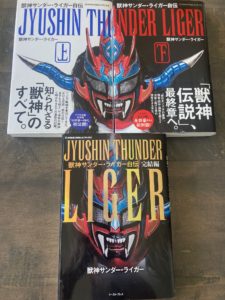
Welcome back to my coverage of Jushin Liger’s books. Today we’ll cover Liger’s post-excursion period back in New Japan, the things he goes through to improve and distinguish himself from his peers, and how he became the Beast God of Thunder. Because there will be coverage of both periods of his career I’ll refer to him as both his real name “Yamada” and then “Liger” once he dons his costume. We’ll also get a few more stories about his interactions with specific people, one or two shoot fights, and a brief glimpse at his first major rivalry which ended prematurely due to an industry-wide event that was mostly associated with rival All Japan but, as it turns out, hit New Japan as well.
You can read part 1 here and parts 2 and 3 here.
Chapter 4: Triumphant Return
Yamada returns to Japan and is brought up to speed about what has happened in his absence. Among other things, he recalls a story of Akira Maeda and Keiiji Muto getting into a fistfight in a ryokan which gets so out of hand the usually polite owners go from saying “thank you for coming” to “please never come back”. Upon returning to the ring, Yamada finds himself in a slump, unable to show progress over some of his peers and despite executing the Shooting Star Press for the first time. Faced with several critics telling him he was a better performer before the excursion Yamada decides to learn the martial art Koppō/Koppu. This is a secret martial art originally introduced by Antonio Inoki in preparation for his MMA fight against Leon Spinks. Inoki’s original intention was to bring Funaki and Muto along but Muto wasn’t interested so he asks Yamada to take his place. He initially declines because he doesn’t think his short limbs and stiff joints would work; however, Funaki convinces him by explaining that Koppō is suited to the Japanese body type so he should still check it out. This became a lifelong and core part both Yamada’s personal and professional lives as he trains diligently in Koppō for a good six years during the off-season and continues it well into his old age. He also trains in jiu-jitsu and states that he isn’t fond of embracing any sort of training that’s just done for media attention or pretending to have mastered any discipline. Not long after this, Yamada has a rematch with Funaki that includes many Koppō elements and this match is much better than his previous ones. Even his Koppō sensei, Master Horibe, praises him for his improvement.
Around the same time an outside force invades New Japan from Takeshi Pro Wrestling in response to some of Inoki’s provocations. This leads to a riot, objects being thrown into the ring. Though it is said to do good business, Yamada doesn’t like the idea, feeling that these people are “dirtying New Japan’s ring.” In retrospect, Liger now sees this event from more perspectives and chalks up his earlier irrationality to a youthful decision to prioritize his own feelings. He also credits trainer Kotetsu Yamamoto for helping him mature, telling Yamada, “a pro wrestler must never be underestimated by amateurs; however, the more respected you become as a wrestler, the more you have to bow your head.”
Going further down this line of thinking, Liger explains that now that he has experience appearing on TV shows and that pro wrestling has to have a good relationship with the public, he isn’t as focused on himself and the in-ring aspect as he used to be. To that end, he explains that this is why he doesn’t complain about or criticize modern pro wrestling because it draws such large crowds (APOD: This is debatable, especially with New Japan since it experiences greater business fluctuations compared to All Japan with higher peaks and lower valleys. Even by the easiest measurable metric – Tokyo Dome numbers – NJPW hasn’t reached the same numbers as the 1990s after almost thirty years of trying).
After some random anecdotes about putting weight in his underwear to increase his official weight, Yamada skips to the second UWF and its effects on NJPW. With the loss of Nobuhiko Takada and Kazuo Yamazaki, Yamada feels lost at first since beating and surpassing them was still a goal for him. He is also present for the Maeda/Choshu incident, described here as “an act against the way of professional wrestling”. After shoot kicking Riki Choshu in the eye, Maeda refuses to accept responsibility, which led to a very unpleasant atmosphere backstage. NJPW even offered to send Maeda on an expedition to Mexico as a form of self-reflection but he balks and defects to UWF instead. Incidentally, Yamada explains that while he was invited to join the group that formed the first UWF, he isn’t approached this second time.
Yamada is asked his thoughts on the UWF and he is initially confused why they wanted to start a new promotion centred on this new style since, from his observation, their wrestling is identical to how NJPW wrestlers train and spar. The wrestling he is pursuing has that same foundation but has extra elements added to entertain a large audience. Yamada’s critical of the wrestling magazines and fans criticizing the application of join locks and claiming “that’s not fully executed there” and accuses the magazines reporting on UWF at the time of creating a different narrative that he considers akin to brainwashing.
At the same time, not wanting to be made fun of by the UWF, Yamada competes in fights he describes as MMA bouts against the like of Don “Nakaya” Nielsen and Yoshiaki Fujiwara. Despite his best efforts, he is crushed by Nielsen’s kicks in the first bout and in the second he only manages to take Fujiwara down but can’t manage to capitalize on that once on the mat. After this, he embarks on another tour of the UK which includes a brief stopover in Germany. While competing in CWA in Germany, Liger wrestles Steve Wright for the CWA Middle Heavyweight Championship. For his entrance, Liger comes down dressed as a ninja but in this case he ties the mask too tight, which causes Funaki to help him remove, leading to laughs from the crowd. Minor botch aside, Yamada recalls a custom from the time where fans would throw tips at the wrestlers if they thought highly of the match. In this case, there’s enough change for Yamada to share with Wright, the referee, and the ring announcer, which leads to praise from promoter Otto Wanz.
For this second UK tour, Yamada and Masakatsu Funaki homestay with a female wrestler named Klonda Keates. One of his memories of this time is a case where he and Funaki basically shoot on a wrestler because he sucks. Yamada describes this unnamed wrestler as “fat and big but couldn’t do anything, a hopeless wrestler”. They were having a stinker of a match so Yamada & Funaki basically beat the crap out of this wrestler and sent him fleeing to the back once the match was ruled a no-contest. In Yamada’s defense, that guy allegedly had a cocky attitude and most people didn’t like him. In fact, both Marty Jones and Fit Finlay’s father praise Yamada & Funaki for their actions, even though Funaki later expresses regret. During this tour NJPW would call Funaki regularly to convince him to stay but his mind was made up. Yamada didn’t really try to make him reconsider since he didn’t think it was his place to do so.
Chapter 5: Birth of the Beast God
NJPW’s regular phone calls to the UK weren’t solely to negotiate with Funaki; there were also correspondence with Yamada over becoming a masked man at the next Tokyo Dome show. Yamada suspects that he was chosen for the role coincidentally since Funaki was leaving. In other words, had Funaki stayed with New Japan he might’ve been the one to don the Liger gimmick. However, Yamada rebuffs this by saying that he was always super enthusiastic about wearing a mask and thus accepted the offer immediately. Upon returning to Japan Yamada sees the original artwork and is surprised that it wouldn’t just be a mask but a full body costume. This worries him at first as he thinks it’ll affect his mobility and he’s concerned that the attire’s various complex designs and intricate accoutrements would be lost on a wrestling audience. To acclimatize to the character, Yamada watches the Jushin Liger anime and concludes that Liger is closer to Ultraman than he is to Tiger Mask. But once he sees that Ultraman is closer to a kaiju film with buildings being demolished he concludes that he needs to take the character in a different direction. First, he reaches out to a costume company and asks them to make something similar to the anime design (which they agree to, between groans). This leads to a struggle with what to do with his hair since he didn’t want to wear a wig (APOD: Liger would end up wearing a wig by the mid-2010s, possibly earlier). The initial mask design resembled a medieval knight which Liger found uncomfortable because it was hard to breathe. As the designs are fine-tuned, Yamada spends more time training while masked to maintain his existing level of wrestling skill (APOD: This is a major, major reason why Liger was so good: he was able to maintain both a consistent level of movement and an understandable level of physical expressiveness while his face was completely concealed. Very few wrestlers were able to express themselves so effectively while masked, which is why I think Liger needs to be studied by aspiring wrestlers to understand how this is done).
Around the same time, Weekly Gong magazine decides to do a special report on the Liger character. To make this believable and to avoid marketing himself as a masked man going forward, Yamada decides to frame this character as him being “reborn” as Jushin Liger. He even goes so far as to gets support from Go Nagai, the anime’s creator, who gives his blessing while also giving Yamada full autonomy to do with the wrestling character as he pleases. Yamada also addresses the many people asking him why he was so adamant on wearing a mask. He explains that the other wrestlers around him were more handsome and didn’t think his face would lead to long-term success in such a visual industry.
Jushin Liger makes his formal debut on April 24, 1989 at the Tokyo Dome against Kuniaki Kobayashi. Although he is aware that he’s being marketed towards children what with the whole anime tie-in and whatnot, Liger gets carried away during his match when Kobayashi pulls on his mask and Liger responds by spitting at his opponent. However, Liger isn’t given any strict top-down instructions on what he is to do with the character. All he knows is that he’s meant to be a heroic character but how he interprets that idea is up to him. Shortly after the character’s debut, Liger wins the IWGP Junior Heavyweight Championship from Hiroshi Hase. Winning this title is a big deal for him since he wasn’t able to do so previously while wrestling unmasked. That leads to a series of battles with Naoki Sano that Liger’s very proud of and he considers Sano a “special presence” in his career (APOD: The Liger/Sano singles matches from 1989/1990 were heavily praised by Meltzer around the time and still hold up very well today). Their first major clash takes place on July 13, 1989 and ends in a double count-out. But despite that conclusion, Liger’s reputation improves so much that people around him start saying that he has surpassed Tiger Mask I. While some seniors like Kobayashi warn him not to go too far – Kobayashi goes so far as to warn him that he and Sano could die doing what they’re doing – Liger continues down this new path. He even wrestles one match with an injured shoulder and adjusts by wearing American football shoulder pads for the match, which is something he recalls seeing in a photo of Rikidozan.
Despite the critical praise both men get, the Liger/Sano feud ends abruptly when Sano leaves for Genichiro Tenryu’s SWS promotion. At one point Liger is asked what it would’ve cost for him to join SWS as well, to which he responds “2 billion yen”, double the amount what Tenryu was allegedly being paid. Liger reflects on the matter for a moment, recalling how most people within wrestling at the time considered SWS a “black ship” in the industry. In hindsight, he thinks their presence should’ve been valued a bit more (APOD: That’s kind of for naught since SWS folded after about only two years of operation).
Around that same time another incident occurs where Kantaro Hoshino, a veteran trained by Rikodozan himself, attacks Liger unexpectedly after a match which leads to an unsanctioned brawl between them. By most account Liger ends up with the upper hand, having used his knowledge of Koppō to knock a few of Hoshino’s teeth out. The fighting continues backstage which forces Riki Choshu to break it up. Liger admits that while he does get fired up easily he does calm down quickly as well. After apologizing to Hoshino, Liger hears someone say aloud, “Did you see Inoki’s face? He looked really lonely. Why are you fighting in the locker room instead of the ring?” From then on Liger vows to never snap at anyone. At the same time, Liger notes that he wasn’t the only one getting into fights: apparently Hoshino was also getting into fights with Akira Maeda regularly, even in the ring. Liger concludes with a story about a match with Masashi Aoyagi that got heated when Aoyagi tore Liger’s mask open. But rather than fix it, Liger continued the match with the mask loose and falling off since it gave him the resolve to fight more aggressively. And rather than receive punishment from the office for more or less shooting on his opponent, Liger recalls receiving praise from everyone, including Inoki, since, at the time, NJPW had a higher tolerance for matches turning into brawls so long as these happenings translated into good business.
APOD: This was an interesting pair of sections that followed a central theme of self-improvement. Liger takes control of his fate by learning a new martial art and was willing to give it a try despite his initial reservations. As a young man he had an idealistic approach to wrestling but when faced with a different viewpoint or something that challenged his mindset he either faced it head-on or learned from it retrospectively. Liger’s practicality-driven approach to dealing with his new costume is by far the most fascinating aspect as it shows how much thought he had to put into his movements and aesthetics. The results, however, were pretty much instantaneous as he immediately gets a meteoric push and has a career-defining feud with Naoki Sano that puts both of them and junior heavyweight wrestling on the map. Of course, Sano isn’t the only junior heavyweight great Liger would wrestle, as we will see next time when Liger discusses the many native and foreign wrestlers to share the ring with him during his prime.
As always, thanks for reading.