

5-Star BOOK Reviews: Jushin Liger’s Books, Parts II and III
By Alex Podgorski on 1 June 2026
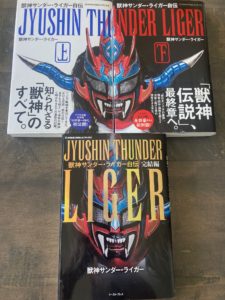
Welcome back to my coverage of Jushin Liger’s books. This next section will cover two chapters/periods: his debut under his real name of Keiichi Yamada and his foreign excursions to the United Kingdom and Canada. Throughout all of this we will also be treated to some anecdotes and backstage stories of his interactions with some very important people, including Hulk Hogan, Antonio Inoki, and Akira Maeda. He also discusses his experiences of the UWF Exodus, his duties as a gofer for the foreigners, a case in which Inoki challenged him to think critically, and a few lighthearted stories of pranks and pastimes that wrestlers engaged in when they had nothing else to do. Also for this section I will be referring to him as “Yamada” as he was still several years away from donning his famous Beast God gimmick and costume.
You can read part 1 here.
Chapter 2: Keiichi Yamada’s Debut
Yamada’s debut match takes place on March 3, 1984, in Korakuen Hall in a losing effort against Shunji Kosugi. His match is second on the card, immediately after another debut match, that of Liger’s future rival Naoki Sano. Debuting at the hallowed Korakuen Hall was an anomaly but Yamada credits Antonio Inoki with making that decision. Later on, Shinya Hashimoto would joke that his own debut match took place in a vacant lot that has since been converted into an apartment complex. Yamada wasn’t all that nervous because he credits the match’s success to his opponent, who was being called a second generation version of Kotetsu Yamamoto. Yamada is also proud that foreign wrestlers like Adrian Adonis and Dick Murdoch wished him luck and watched his match. He also thinks part of this stems from his duties at the time as he was a gofer for several of the top foreign stars touring NJPW at the time. Yamada also shares a brief anecdote of being forced to chug a bottle of Andre the Giant’s wine. Though Yamada recalls being treated well by the touring foreigners he still had the unenviable task of washing their wrestling costumes. And since many of them didn’t wash that often – citing King Kong Bundy’s cape as an example, he often found himself almost fainting over the smell.
Yamada compares the current day locker room to the one of his debut and notes the latter were much more “chaotic” and prone to pranks. Andre would sometimes refuse to get up for his match until the very last minute to tease people and Marc “Rollerball” Rocco would call Yamada “Frankie” (i.e. Frankenstein) due to his receding hairline. Yamada also shares stories about other famous foreigners like Dynamite Kid and Hulk Hogan. Yamada admired Kid and used the diving head-butt as his first finisher. For some unknown reason Kid would wink at Liger when Liger was a ringside attendant. Regarding Hogan, Yamada recalls him getting busted open from a ringpost attack during a match and Yamada approached him and asked if he wanted to fetch the medicine box. Hogan responded by slapping Yamada so hard he almost collapsed and had to be carried backstage. Yamada suspects Hogan thought of him as annoying or distracting during his match. Yamada also has a short Bruiser Brody story: he was initially star struck by Brody but at some point Brody said something insulting towards Japanese people which caused Yamada to glare at him and needing to be held back by a bunch of other wrestlers. He tells one final quick story about how, after becoming Liger, Tiger Jeet Singh and Abdullah The Butcher would give him advice on proper costume maintenance so that he wouldn’t look like his attire was getting old or disheveled.
From here Yamada pivots to talking of his famous peers from the same training class: Hashimoto, Masahiro Chono, and Keiji Muto, The Three Musketeers of Fighting Spirit. His initial thoughts on each of them is that Muto was very mature for his age and was universally respected; Chono was a lightweight when it came to drinking despite allegedly being the leader of a biker gang; and Hashimoto was the wildest but also the most cheerful and friendly. Yamada recalls many warm memories drinking with Hashimoto and Nobuhiko Takada. Marui, the interviewer, pivots to a quote from Muto in which he claims that he’d have quit if he was Yamada’s actual underclassman (as in, not in the same training class and debuting a few months after him). This stems from rumors of harsh treatments and brutal hazing in the dojo, including one instance of a rookie being held underwater in a bathtub or something like that. Yamada admits that the actual perpetrator was Masakatsu Funaki but Yamada was the one to whom it was attributed. When it comes to these young rookies getting into arguments or fights, Yamada explains the ring was the perfect outlet and sometimes they’d blow off steam in there, as seen in one instance in which Yamada and Chono had a scuffle during a match only to get scolded by Kosugi.
Shortly after Yamada’s debut, the original UWF launches centred on Akira Maeda and it includes both Fujiwara and Takada, two seniors with whom Yamada was very close. But this wasn’t that much of a secret: before they left those two seniors announced to anyone willing to follow them they should meet in Takada’s room. Yamada didn’t go because he was on chanko duty and would learn of what transpired from Funaki who, according to Yamada, cried his heart out when they left. Being a recent debutant, this sudden departure shakes Yamada’s confidence and he briefly contemplates quitting if things don’t work out.
Afterwards, there’s a brief period during which Don Arakawa oversees young wrestlers’ training but both Yamada and Funaki rebel because they find his training and ideas too comedic. Instead, Yamada finds his way into special lessons provided by Karl Gotch, who teaches them about specialized body movements and joint locks. Soon afterwards Yamada is assigned to the role of Antonio Inoki’s attendant, replacing Takada who couldn’t to do due to either injury or illness. Yamada also recalls that Takada didn’t want to go to Pakistan so Yamada goes with Inoki instead. Yamada doesn’t have much positive to say about being in Pakistan, especially since both he and Inoki got sick from the drinking water and couldn’t part ways with the toilet paper.
As Inoki’s attendant, Yamada didn’t have to do much because Inoki was so self-reliant. He was also very generous towards his attendants and never yelled or blamed them for anything. Yamada’s most important lesson came from having critical conversations with Inoki while touring the provinces. When faced with an unenthusiastic crowd, Inoki would turn to his attendant and ask “what would you do?” or when an intense fight between veterans was going on but the crowd wasn’t into it Inoki would ask Yamada, “How would you change this atmosphere?” Yamada would say he doesn’t know and Inoki would give his opinion. The most significant of these various lessons was when Inoki told Yamada to “put the audience in the palm of his hand”. Yamada goes on to say that Inoki’s thinking was 20 years ahead of its time, both in terms of his business ventures and wrestling. That said, he believes that Inoki would’ve become a billionaire “if the timing had been a bit different and he had more capable brains around him”.
Yamada skips ahead to February 2000 when Inoki appeared at Ryogoku Kokugikan dressed like a homeless person. Shortly afterwards, Inoki holds a meeting and basically says that if anyone has problems with me, speak up now. In response, only he and ring announcer Hidekazu Tanaka raise their hands. Yamada/Liger conveys his concerns but Inoki swiftly dismisses them saying “you don’t know anything.” In hindsight, Yamada notes that in the moment he didn’t understand Inoki’s intentions but now he understands that Inoki was creating topics that reach the public and his critics weren’t doing anything that could surpass the Antonio Inoki brand. Yamada tells another story of accompanying Inoki to Palau, and with such a loose schedule Liger got a bit carried away and ended up mooning some people. Liger doesn’t get punished but he does think he might not be worthy of being Inoki’s disciple. Yamada concludes this chapter suggesting people re-evaluate Inoki and watch his matches to understand why he was so great.
Chapter 3: Training Abroad as a Warrior
In the wake of the UWF Exodus, NJPW holds a five-day training camp in Hakone to rekindle team spirit and unity. Shortly thereafter, Yamada participates in the inaugural Young Lion Cup and finishes as runner-up, losing to Kosugi. Despite that UWF Exodus, the wall between UWF and NJPW doesn’t stay up for long and by the end of the year Yamada visits UWF’s dojo to train with Fujiwara in the hopes of becoming a wrestler who could handle all styles of wrestling. In terms of what was shown to the audience, Yamada notes that sometimes UWF’s shows would take place in front of silent crowds akin to attending a wake yet the clashes between UWF and NJPW would be intense and dramatic. He also recalls interacting and drinking with Akira Maeda a lot and they seemed to get along, until Maeda pins him down during a sparring session and tells him to not get to full of himself. This allegedly stems from Yamada getting lots of media attention despite being a rookie and Maeda didn’t want him getting a big head. Yamada appreciates Maeda’s actions: despite them being from rival promotions, Maeda was looking out for him so that he wouldn’t step on the wrong set of toes down the line.
As the rookie years continue Yamada is bestowed with Tokyo Sports’ Rookie of the Year Award which makes him happy. Soon afterwards there’s a serialized manga called “Suplex Yamada-kun” that comes out around 1987. Yamada’s happy about this too but is a bit embarrassed over certain soap opera-like elements of the writing. Then after teaming alongside Inoki himself, Yamada is invited on foreign excursion to the UK at the request of Mark Rocco. There had also been talk of Yamada going to the US instead but Kendo Nagasaki tells him that because he’s so short he isn’t likely to get over in the US at the time. Yamada’s initial response to this is to return to Mexico but then accepts Rocco’s offer to train in the UK when he learns it’s the home of catch wrestling and both Satoru Sayama and Akira Maeda had trained there.
The United Kingdom
While in the UK he wrestled as “Flying” Fuji Yamada and stay at Rocco’s house in his kid’s room. Rocco’s house was in Liverpool and most All Star Wrestling shows were in London so it would take Yamada and the other wrestlers he traveled with three hours to and from the venue. Yamada boasts about being able to eat a record six servings of locally-made fish and chips while the nearest record by any other NJPW wrestler is Satoshi Kojima with three. While wrestling ASW Yamada wins his first title, the European World Middleweight Championship from Rocco himself and goes above & beyond crediting Rocco with helping him polish his wrestling skill. Aside from Rocco, Yamada also credits watching Johnny Saint and being amazed by Saint’s “puzzle-like” wrestling and cites Zack Sabre, Jr. as a modern equivalent. He also shares fond memories of wrestling both Fit Finlay and his son Dave Finlay, and then concludes with a quick story of the ring breaking apart during in parts during a match, leading to a no-contest.
Calgary
After wrestling in the UK, Yamada spends three months wrestling in Calgary after Stampede Wrestling had reached out to NJPW. With several other Japanese wrestlers there – Mr. Hito (with whom he stays), Hiroshi Hase, Shinji Sasazaki, and a wrestler named Morimura – Liger sees this as more of a training camp than a foreign excursion. Much of Yamada’s memory of this period is filled with pranks and blunders during travel, like when he peed into a cup that had a hole in the bottom so he tried throwing it out the window only for it to splash Morimura in the face. Behind the scenes the foreigner Yamada bonded with the most around this time was Jerry Morrow since he spoke Japanese had had experience with IWE. In the ring Yamada spent most his time teaming with Bruce, Keith, and Owen Hart, with Brian Pillman thrown in for good measure. Yamada also recalls hearing a rumor that the Harts were billionaires but he was never invited to their home (APOD: This doesn’t sound right since he did say elsewhere that he trained in the Hart Dungeon…which was located in the basement of Hart House).
During this period Yamada suffers a neck injury following what is described as a combination Tombstone Piledriver. Gama Singh is the one holding him in the Tombstone position but for some reason he doesn’t mention the other person. Yamada concludes that, more important than any lessons on physical strength or wrestling technique is the amount of mental toughness he developed during this period. In Japan the company protects you but in these other environments he was basically on his own. These excursions toughen you up no matter who you are and whether you like it or not. He concludes by saying that going overseas is, in essence, a rite of passage for anyone looking to become a wrestler.
APOD: This was an interesting collection of memories and anecdotes. Liger telling stories about his interactions with legends like Hogan and Andre was fun and gave us a small glimpse of what young boys on the New Japan side had to deal with. The quick story about the hazing was wild but not surprising: of course there’d be some abusive, borderline criminal activities done behind closed doors to gatekeep their business and make sure people had the right mental fortitude to deal with the inevitable waterfall of mental anguish that would accompany the physical. Liger’s Inoki stories were really cool because we got to get a glimpse of what made that famous man tick. Unfortunately he didn’t say all that much about his excursions beyond some generalities and his respect for Johnny Saint. He was fairly neutral about his time in Stampede, which is unfortunate because it would’ve been nice to hear another Japanese perspective about it, especially since thus far our only other such perspective is Kawada’s and he was anything but complementary.
As always, thanks for reading.